[click image to enlarge]
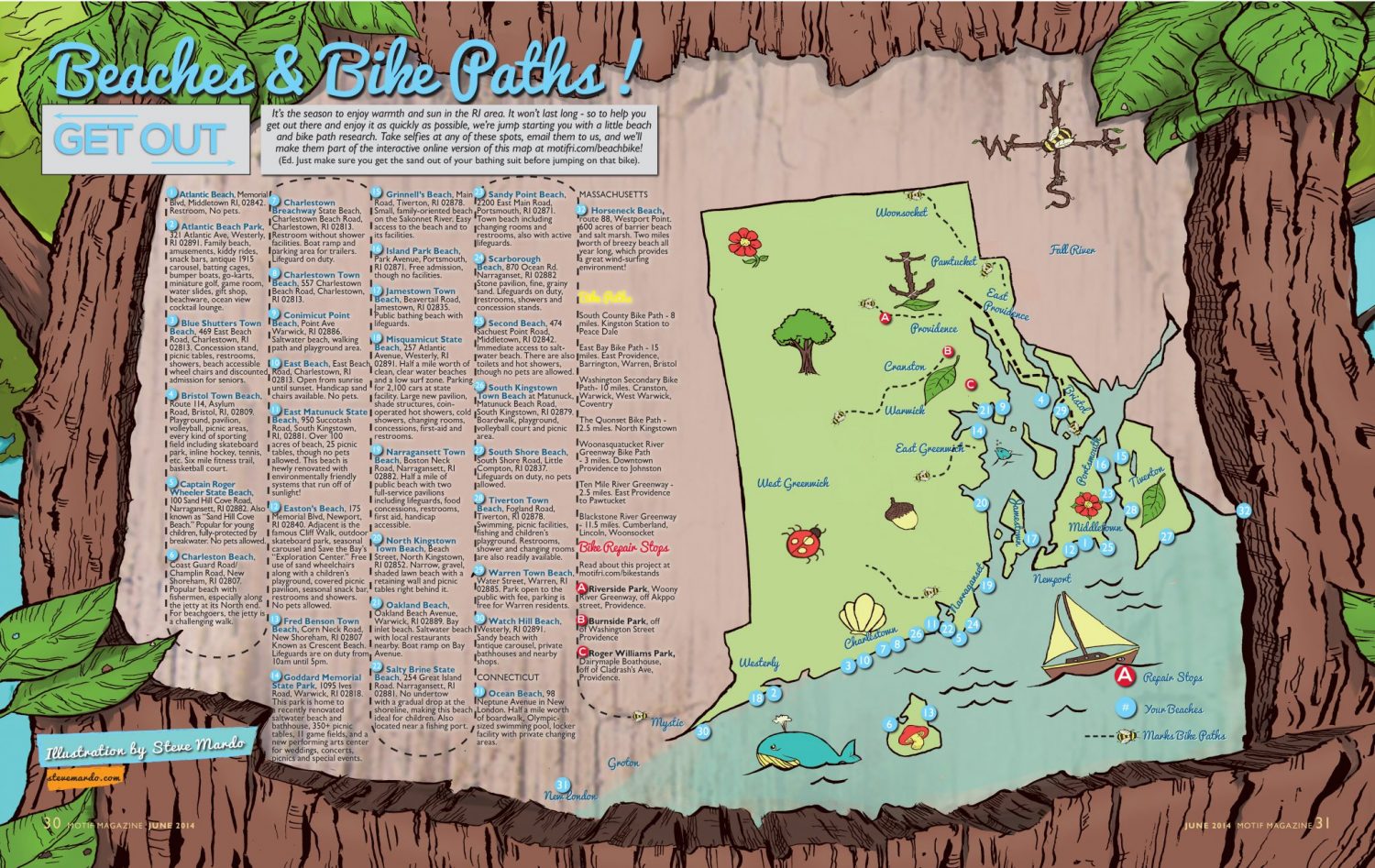
Check our map of beaches and bike paths
or view the interactive version below!

[click image to enlarge]
Check our map of beaches and bike paths
or view the interactive version below!

 Wherever you go in Providence, they are hard to miss: freshly paved streets. A welcomed relief for beleaguered motorists who for years have had to navigate through streets besieged by potholes. The city is more than halfway through a $40 million paving project approved by voters in 2012 and expects to finish ahead of schedule by the end of the year.
“I think the paving has actually been great. Because we’re out here on Manton Avenue, it was pretty much hellacious. It was all chopped up, ’’ says Jim Damico, who lives in Providence near the Johnston line and rides his bicycle every day the weather allows him to. So he notices things about the roads many motorists don’t.
We first met Damico two years ago after the city repaved and installed a bicycle lane on Broadway — his preferred riding route to work on the East Side. He was concerned then that within months of the paving, utility markings appeared on the street. And some other streets were dug up shortly after the paving work.
Now, Damico says, it’s happening again. “They repaved it and I’ve been noticing more and more utility companies are coming in and cutting up the roads, which seems to be antithetical to the $40 million the taxpayers have invested in,’’ he said.
Providence Director of Public Works Bill Bombard said most of the work is being done as emergencies. He said the utility companies signed an agreement in 2008 not to work on newly paved streets for five years unless it was an emergency. And if they had to, the street had to be restored to its newly paved condition.
We went back to Bombard last month to talk about markings and cuts The Hummel Report has seen on newly paved road throughout the city.
“Utility cuts can accelerate the decay of a road exponentially,’’ Bombard acknowledged. “Once you break that mat, you create a seam, the seam allows for water to penetrate the road. Saturate the base and it makes it decay more quickly.’’
Bombard says he meets with the utility companies monthly and has made it clear to them the city needs to protect its investment.
“We’ve spent taxpayer money to fix these roads. We don’t want you digging them up just because you want to put a new water main, new gas main, new electrical line,’’ he’s told the companies. “It’s not that it totally prevents (work), just make sure that they do extra work to restore it back to the condition it was — curb-to-curb paving, for example.’’
But Damico questions whether the city is putting any bite behind its bark, saying he’s seen little change since we first spoke with him in the summer of 2012.
“Right up on Manton Avenue they just finished paving in December and it’s already marked up with Providence Water and National Grid.’’
Damico also took pictures of a section of Chalkstone Avenue that was paved last year. A cut was made within weeks and hasn’t been restored almost nine months later. One day last month we found a National Grid crew working on a section of Chalkstone Avenue just east of Mount Pleasant. Bombard produced permits the utility pulled for of the work, indicating it was an emergency.
“When we receive a permit application, we compare that against a list we maintain for recently paved roads,’’ he said. “We call these protected streets. So if they absolutely have to disturb the road, then they recognize they have this additional cost as opposed to simply patching a trench.’’
Translation: They need to make the cuts they’ve made disappear and look like the original paving job as outlined in the protected street agreement between the city and utility.
We found another section on Canal Street that was cut up in March. “If it is an emergency, fine, but you still shouldn’t let the cut not be repaired properly for more than 30 days,’’ Damico said.
Bombard said the road needs to settle — usually for about three months — before it can be repaved. That doesn’t answer why the Chalkstone cut has not been repaved more than six months later.
Damico questions whether the city is going back to make sure the work is done according to spec. “I mean it’s great that we have newly paved roads, but when you go back and cut ‘em back up, it defeats the purpose. If the idea is to repair it to what it was, a brand new road, it’s not happening.’’
And he a has simple message for the city: “Please, please protect the investment. Because $40 million is a lot of cash. Please hold the utility companies responsible and accountable.’’
The Hummel Report is a 501 3C non-profit organization that relies, in part, on your donations. If you have a story idea or want to make a donation go to www.hummelreport.org, where you can also see the video version of this story. You can mail Jim directly at jim@hummelreport.org.
On a Saturday morning in April, a committee of half a dozen people gathered to decide how more than $100,000 will be spread to three dozen agencies in the Providence area. They are today’s stewards for one of Rhode Island’s oldest independent charities: The Providence Shelter for Colored Children (yes, you read that correctly), which has withstood periodic efforts to change its name since the organization was founded in 1838.
“The name actually struck me as really odd, but I was intrigued,’’ said Linda Cline, the group’s current president. Not only did the name pique her curiosity, but so did the fact that there is no shelter building. That was closed in 1940 and the assets were converted into a foundation. The name, though, and the group’s goals remain steadfast 70 years after the doors closed: financial support for children of color.
“There are so many organizations that need financial assistance in order to thrive, in order to be viable,’’ Cline said. “We’re still servicing African-American children in the Greater Providence area and we have not strayed from that mission.”
Mary Lima has been on the board for more than three decades and knew children who lived at the shelter before it closed in 1940. “It’s quite an interesting history in terms of the role they played because there was no other facility, state or otherwise, that provided a shelter for the colored — black — children at that time. Families needed this kind of assistance, particularly because the women were single parents and worked as domestic workers or maids in homes throughout Providence, particularly on the East Side.’’
The shelter was founded by a group of middle-class white women living on the East Side in 1938 that included the granddaughter of leading anti-slavery activist Moses Brown.
It was housed at 403 North Main Street the first decade, before moving over to the lower end of Wickenden Street. For nearly a century, though, the shelter was located in a building on Olive Street, in what is now the heart of the Brown University campus.
Connie Worthington is a past shelter president and knows much of the organization’s rich history. “The shelter was a place where parents who were working at the houses on College Hill could board their children because the kids weren’t welcome.’’
Elayne Walker-Cabral’s mother, Betty Walker, at the age of 10 lived in the shelter with her siblings after Betty’s mother fled from an abusive husband. Betty Walker later served on the board and died four years ago at the age of 74.
“My mom was insistent as the oldest of six children — she was about 10 at the time — that the siblings stay together,’’ said Walker-Cabral. “So somehow the shelter was responsible for them being placed with a minster and his wife who cared for them until my mother got married.”
Changes in child welfare policies in the 20th century meant a dwindling number of children in the shelter, which ultimately closed its doors.
Since then the organization has transitioned into a charitable foundation. In the 1950s and ‘60s it gave relatively large sums to a handful of organizations, including the Urban League of Rhode Island, The Mount Hope Day Care Center on the East Side and the John Hope Settlement House.
In 1970, the focus shifted and now the shelter annually funds a variety of organizations and schools, including Community Music Works, Crossroads Rhode Island, Sophia Academy and the San Miguel School.
This year a total of $112,000 went to 36 agencies in amounts ranging from $500 to $6,500.
Mary Lima says the organization has had periodic discussions about keeping, or changing, its name. “As we bring new board members on who don’t have the full history of the board, that’s generally when those discussions will come up. A new board member may wonder why we are the shelter for colored children.”
Worthington said, “We refer to children of color in this day and age, so it’s not so impossible. But I think the main thing is that its historic. It’s 175 years old. It’s been the name that long and I think anytime an organization changes its name, it’s tough.”
Walker-Cabral at one point confronted her mother about it. “I remember saying to my mom when she first went on the board, ‘I think you should make some kind of proclamation that they should change the name from colored children to African-American or black children.’ Having gone to college in the South, I was very militant. And she said, ‘They would never do that because that is who they served: colored children.’ And they didn’t make a distinction between black and African-American and Cape Verdean and other immigrant people.”
If you want to see the video version of this story go to www.hummelspotlight.org. If you know of a person or organization who you think deserves the Spotlight, send an email to info@hummelspotlight.org
Becky Kelsey is in a great mood this Monday afternoon, laughing and smiling for her mother Jodi. It is a lighter moment in what can often be challenging days.
Becky, who is 33 and lives at home, has a severe form of cerebral palsy. She can’t speak or walk, and she has pulmonary issues and a seizure disorder. For the past 20 years, she has been on a feeding tube. Jodi Kelsey says for years Absolute Respiratory out of Johnston had the contract for Becky’s formula and other supplies, all paid for by taxpayer-funded Medicare and delivered directly to their door. That all changed last summer.
“I’m thinking that Medicare requested bids to save money and the company we were using did not win the Medicare bid, so we were given a list of different places,’’ Kelsey said.
She chose Lincare, a large national company with a local office in East Providence.
“They own a company called Enteral Central, which is where their enteral care comes from. I believe it is in Arkansas,’’ Kelsey said. “When we started a year ago they really didn’t know much about enteral care. I had to speak with somebody in Florida, then they switched me over to somebody in Alabama, and then the food comes out of Arkansas.’’
But the biggest problem was that the cans of formula were arriving damaged. And not just a few.
“We’ve gotten orders of 150 cans where there’s probably between 25 and 50 cans dented,” Kelsey said. “The first few months we got it, cans were crushed and dented. The other supplies were also in those boxes, and they were loose all over the place.”
Of the 150 cans she most recently received, Kelsey counted 68 that were damaged.
Even though there has been no money out of pocket for her, Kelsey has spent countless hours on the phone to get replacement cans after the manufacturer of the formula told her to throw the dented cans away because their sterility could be compromised. She has kept extensive notes of her conversations.
“It’s a waste, number one. And my first question was, ‘Are you charging Medicare twice for cans that I’m throwing away?’ They said, ‘No.’’’
Kelsey filed a complaint with Medicare in January, but heard nothing back. “And I know I’m one person. I can’t fight Medicare by myself. I can’t fight Lincare by myself.”
Now it appears she doesn’t have to. Last month, The Hummel Report contacted Senator Jack Reed’s office, which assigned a staffer to look into her case. The office contacted the Centers for Medicare and Medicaid Services and has been in touch with Kelsey daily, sometimes several times a day. We’ve also learned a Medicare fraud and abuse unit opened an investigation into Kelsey’s complaint. We asked her if she thought she was an isolated case. “No, because when I call (Lincare) I speak to the same girl and she’s doing everything within her power. She said to me, ‘I get a lot of phone calls about this same kind of thing.’”
Kelsey called Lincare so many times that the company did its own investigation — of her.
Kelsey: There was a time when the order was being sent to the local Lincare so they could make sure I wasn’t just saying that these cans are dented.
Hummel: Like you’re going to scam them and get extra cans?
Kelsey: Exactly. Why would I bother?
Hummel: When it’s being paid for anyway.
Kelsey: Right. And they were getting dented cans.
Hummel: So they know.
Kelsey: They absolutely know. I’m not going to let this go because I want to see a resolution. I want to see them do something right. When it comes to my daughter, because I’ve been fighting for her for 33 years, I want it right. I want to make life a little easier for her. I don’t want her to get a bad formula and get sick, so I just keep going. And hope that those efforts eventually pay off.
The Hummel Report is a 501 3C non-profit organization that relies, in part, on your donations. If you have a story idea or want make a donation go to www.hummelreport.org, where you can also see the video version of this story. You can mail Jim directly at jim@hummelreport.org
The Providence pop-up scene can be hard to track down – the very nature of a pop-up is that is temporary, almost ephemeral. Pop-up galleries in Providence can be like unexpected springs discovered on a backwoods hike – something you come across when you part some foliage, without realizing what you’ll be stumbling upon.
One such recent pop-up is the exhibition by local artist, Steel Yard patron and co-founder Nick Bauta. The show, occupying otherwise vacant space on Westminster St. in downtown Providence, includes some beautifully crafted furniture and an action-packed tapestry diorama that might have belonged in Joss Whedon’s version of Game of Thrones (if such a thing existed). But the focus of the show is Dragons.
Particularly, a set of interactive dragons of various sizes that are constructed from an interesting combination of materials, including metal, plastic, rubber, feathers and bone.
The creatures are meant to be played with – larger ones, almost person-sized, greet visitors at the door and respond to people stepping on foot pedals by rising to full height, feinting an attack or opening their mouths. Further into the exhibit, poseable dragons around two feet in length remind the visitor of really cool action figures that didn’t (and still don’t ) quite exist in the toy store. But maybe could, in an alternate reality.
“You can’t make art that’s about rejuvenation – about taking action to overcome the destruction of our eco system, and not expect people to interact with it. That’s the litmus test – participation,” says Bauta, encouraging visitors to touch and move the dragons.
The skulls used for many of the creatures were obtained by mail-order, while the metal sculpting happened at the Steel Yard.
The creatures are representations from a larger fantasy-adventure fabric, a cautionary tale about taking care of the environment – before extraterrestrial dragons descend to feast on an ecologically damaged Earth. (The dragons, of course, are metaphorical. But they also have names and a conversation with the artist hints at complex, hidden backstories which promise more work to come).
By the time you read this, it’s likely this gallery (called “Beheaded”) will have popped back down – its half-life was limited, and this visitor found it in our downtown jungle too far into its run. But keep an eye out – there were definitely dragons in this heart of the city; and if we’re lucky, perhaps they’ll come back.
 Nearly 2,000 bills have been filed since the beginning of this year’s general assembly session. Only a fraction have made it to the governor’s desk so far and the majority of those are bills that would allow certain individuals to perform marriage ceremonies. So The Hummel Report decided to take its annual look at some proposed bills that may have you asking the question: Really?
OMG: The cell phone police are back with a bill that would make it illegal for students to use cell phones on a school bus unless it is an emergency. Not the driver, the kids. Apparently the sponsors don’t have teenagers. If they did, it would be obvious the kids don’t actually talk on the phone; they text. If lawmakers are really worried about public safety, why don’t they ban loud talking and spitballs?
Speed it Up: Another bill would require local building officials to either approve – or reject – permit applications within 30 days of the time they receive them, just like they do in Massachusetts. Now this is a common sense bill that we actually like. But that sound you just heard is building officials across the state of Rhode Island collectively throwing up.
Double Dip: Then there’s the proposal to increase the days retired state employees can come back and work while continuing to collect their pensions. The increase is from 90 to 180 days. You might call it The Double Double Dip.
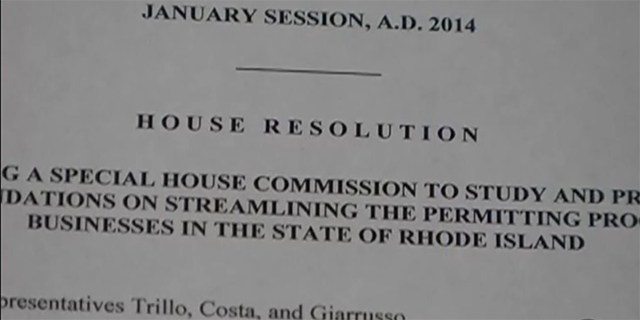
Back to the Future: How about one lawmaker’s proposal to create a commission to streamline business permitting and report back in January 2015? Great idea, but we shouldn’t we have been doing that in 1915?
It’s Electric: Okay all of you owners of electric vehicles, we know how proud you are of saving money and saving the environment all at the same time. Well, apparently those I’m electric decals on the rear window aren’t enough. A pending bill would create a special category of license plate just for you — right up there with the chief emeritus plate, war veteran and Red Sox lover plates.
Where’s the Love?: A bill filed last year, and again this year, would allow the town of Smithfield to take over maintenance of grounds and fields like the one from the Smithfield School Department. We need a law to get this done?
Get the Lead Out: Attention all hunters: a house bill would mandate that you use non-toxic ammunition whenever it’s available. Maybe not so good for Bambi in the long run, but the rest of us can all feel good about the environment.
Full Disclosure: Next time you go out for a meal, think about this bill that would make all restaurants list the total number of calories and ingredients for each item on the menu. Well that takes all of the fun out of going out, doesn’t it?
The good news that this is an election year, so most of the people up at the state house want to pack up early and get going on their campaigns. That and an unprecedented mid-term change in the leadership means the vast majority of these bills will never make it out of committee. Who said there’s no good news coming out of the general assembly these days?
The Hummel Report is a 501 3C non-profit organization that relies, in part, on your donations. If you have a story idea or want make a donation go to www.hummelreport.org, where you can also see the video version of this story. You can email Jim directly at jim@hummelreport.org.
Every Thursday they converge, seemingly out of nowhere: a core group of volunteers who will unload two pallets of food in about 20 minutes. It is an efficient operation and this group has it down to a science.
They are some of the nearly 100 people pitching in at Tap In, an all-volunteer outreach organization that provides resources and services to residents of Rhode Island’s East Bay. Headquartered in the basement of the old Peck School in the heart of Barrington, Tap In is synonymous with meeting a need for dozens of families from Bristol, Warren, East Providence and Barrington who come through the doors for help every week.
“We did our homework. We knew what wasn’t out there and we started small, but we’re big now,’’ said Pam Faulkner, one of five founding members who started Tap In 30 years ago. The original mission in 1983 was informational — to help match people with other service agencies.
“There seemed to be so many needy people in town who needed information on where to go for things like healthcare, Meals on Wheels and hospice. Those organizations were all just starting about the same time we did,’’ she said.
So the goal was to Tap In to those services, hence the name. Someone later expanded the acronym to Touch a Person In Need. “Then a whole lot of other things came up and out, and like flowers sprouting, we could see there were many other needs,’’ Faulkner said.
First the so-called food closet, which helps stretch working families’ budgets or helps those on food stamps by allowing them to get a generous bag full of supplemental food items once a month. There are children’s clothes, household goods, beds, the occasional bike and children’s books and toys.
“The supply followed the need. It was interesting that we were asked several times why we were locating in Barrington,’’ Faulkner said. “People assumed Barrington doesn’t have needy people. Well, wrong. There are many needy people in Barrington who need transportation to medical appointments, who don’t know where to turn and who don’t have many family members.’’
The town provides the space rent-free, but Tap In has to cover the cost of utilities, computers and phones, so Faulkner says the organization appreciates monetary donations to help with the overhead.
Tap In is open 9 am to noon Monday through Friday and a different group of about 10 volunteers comes each day. The organization relies on donations of all sorts of items and many in the area think of Tap In first when they’re clearing out a house.
Ann Wood began volunteering for Tap In eight years ago and now serves as one of its co-presidents. She spends most of her time on the phone and computer to find matches for a wide variety of items. “If somebody in Bristol has a bed that they want to donate, they keep the bed there, we call the person who told us that they need a bed and we say, ‘We have a bed available for you. Just call this person,’’’ Wood said. “And they’re responsible for picking up the bed.’’
One of the original missions — and a constant the past 30 years — has been providing rides. George and Rose Marie Bolton have been drivers; she for 25 years, he for the past 17 since he retired. “A lot of people are former drivers who can no longer drive,’’ George Bolton said. “Once in a while you get a younger person who’s handicapped who needs the service, but they’re mostly older people.’’
And while Tap In buys food at a reduced rate from the Rhode Island Community Food Bank it also relies on donations. “We have people who have come in with donations, who said, ‘You helped me in a tough time and I’d like to give back,’’’ Faulkner said. “And they may come in with a small financial donation or they may come in with some furniture or children’s clothes or whatever. But they want to give back.’’
Hummel: Do you think about what would happen if you guys weren’t here?
Faulkner: I think it would leave a big hole. I think it would be hard for people who have depended upon us and looked to us for help.
Hummel: Did you ever think, in 1983, you’d be here 30 years later?
Faulkner: No, I never thought in my wildest dreams we’d be this large and serving this many people with so many volunteers. It’s very heartening.
See the video version of this story at www.hummelspotlight.org. Know a person or organization who you think deserves the Spotlight? Email info@hummelspotlight.org

 Sick Pills — Sickening
Earlier today I was blasting the new CD Sickening from the New Bedford-based band Sick Pills. With all that ground thumping new wave goodness pouring from my open window, my normally bucolic, suburban street was transformed into what the Bowery must have sounded like some 40 years ago when Television or Blondie were booked at CBGBs. Led by Chris Guaraldi (former of Blood Moons and Chris Evil & The Taints), these guys have used that late ’70s / early ’80s punk sound as merely the foundation for a vibrant, relevant and thoroughly modern sound. Standout examples include “Wormfood,” a classic middle finger to the religious establishment, inevitably proclaiming: “I don’t pray for what I want, or the loved ones that are gone….Because we all become wormfood in the end.”
DirtyDurdie — Group Therapy
Dirty Ice and Durdie Furby, aka DirtyDurdie, bring a cohesive, masterfully mixed compilation to the table with their latest album release, Group Therapy. Their fourth project gives life to the duo’s laid-back style and no-shits-given attitude, self-described as, “controversial, conscience and comical.” They take this lyrical style into the “group therapy” theme of the album, bringing issues like Oxycodone addictions and evil yet addictive women to the table. What is most striking about the flow of the tracks is that it keeps a strong cohesion while presenting an array of stylized beats, undoubtedly a result of working with nine different producers in their 16 tracks. They do this through a thematic use of classic and oriental instrumentals paired with vocal samples reminiscent of Gang Starr, MF Doom, Dr. Octagon and Wu-Tang Clan. Halfway through, the album mellows out with an easy-riding beat, in “Running,” and picks back up with “Han Jamboree,” skillfully looping a cut time flute riff under the beat. They again alter the pace a few tracks later with “Zero Gravity,” easing into a ¾ waltz-style time signature.
Hope Anchor — Never Gonna Let You Go
Hope Anchor has released arguably one of the finest albums to come from the biggest little state in 2013, the highly eclectic Never Gonna Let You Go. Each of the disc’s nine tracks illustrate the band’s diverse sources of inspiration, ranging in styles from ’80s pop-tinged melodic rock, to the post-punk / new-wave sounds of the Psychedelic Furs, with even some Beach Boys-influenced harmonies thrown in the mix. To underscore this diversity, the disc opens with “Get Away Blues,” a heavy-driving, blues rock number that immediately declares these guys are loaded for bear. Throughout, Pip plays some relentless electric harmonica, with a confidence usually reserved for lead guitar slingers. In fact, if I didn’t know better, I would have thought I’d slipped in a Young Neal & The Vipers disc by mistake! Read the full review here: QRCODE
Torn Shorts — Through the Mill

With November’s statewide election drawing closer, Rhode Island is beginning to enter its bi-annual political frenzy of candidates and policies. In the four years since the last mayoral race, the nation has seen a dozen gun-related mass murders and hundreds of shootings in Providence alone, putting firearm policy atop the list of hot topics.
In one new approach to this complex issue, Providence mayoral candidate Brett Smiley (D) proposed a 10% supplemental sales tax on all guns and ammunition sales statewide with proceeds benefiting anti-violence efforts by nonprofits and underfunded community outreach programs.
Providence has not seen a proactive step toward the reduction of gun violence since Mayor Cicilline’s implementation of community policing in 2006. But is the proposed law fair to those who purchase firearms legally while the majority of shootings are carried out with illegally obtained weapons? Would financially backing selected community outreach programs have an effect on the rising number of shootings annually? Motif invited Brett Smiley and GOP Chair, Mark Smiley (no relation, as far as they can tell) into the studio to debate just that.
Brett (D): [The proposed law] is inspired by cigarette taxes. Just like we ask the tobacco companies and smokers to pay for public health initiatives, I think it’s fair to ask the firearms industry and those who prop it up to pay for anti-violence efforts.
Mark (R): On the surface, [the law] has merit. Of course gun violence is a terrible thing in the state; we don’t want to see it happening. But to tax gun owners when just a tiny percentage of the actual violence in the state is perpetrated by people who legally own guns … it’s not exactly related.
Mark links the state’s violence epidemic with its poor economy. “We have to improve that and the gun violence will relieve itself,” he explained. Brett agreed that there is a correlation between violence and poverty, but went on to explain that guns legally obtained do end up in the wrong hands.
While “Blue Cards,” received after passing a firearm safety evaluation, are required for purchasing firearms, there is no permit required to purchase ammunition. Both party representatives agreed that requiring a Blue Card to purchase ammo is a step in the right direction.
Mark: [But to] randomly tax people who are doing something perfectly legal that is also part of their Second Amendment rights … cigarettes are not part of the constitution.
Brett: Paying an extra 10% on either a box of shells or a new firearm isn’t infringing on anyone’s constitutional right, but [it’s] providing a way to protect the whole community.
Mark: It’s penalizing people who haven’t done anything wrong. There was recently a Harvard study put out that can’t find a correlation between stricter gun control laws and a reduction in gun violence. Guns don’t create any violence, it’s the people behind them. We have to fix that part.
Brett: I don’t think this is actually going to be an infringement on gun owners, but rather a fair and justified place to find additional funding to keep our streets and cities safer.
Mark: We need to figure out how to reduce the amount of revenue that we’re taking from the people that will allow them to create the economic prosperity that would solve the poverty issues.
Brett: We have students not receiving the proper education, an economy that is either not growing or growing too slow, and we have real serious public safety challenges. These three things are interconnected.
He went on to speculate that students don’t walk to school out of safety concerns, and that once a pupil’s fear of violence is resolved they may gain the proper education to become Providence’s entrepreneurs of tomorrow, in turn, improving the economy and reducing the crime rate.
“We need to find ways to provide additional support to the people doing anti-violence work in our neighborhoods.” Brett’s proposed law would strengthen community policing, implemented post-Mayor Cianci, to forge partnerships between the police force and crime-ridden neighborhoods. Statistically, crime dropped exponentially in the years that followed that earlier focus on community policing. The proposed law is a tool to re-form those community programs without drawing more, debatably needed, funds into the Providence police force.
The new tax would bring in an estimated $2 million each year.
Mark: It sounds to me like you’re trying to take a disproportionate amount of money from all around the state to correct problems in Providence. Telling someone in Narragansett that they need to pay for that — that’s not fair to anyone involved.
Brett: The capital city is an asset to this entire state. Just like you go to shows in Providence and have a meal on Federal Hill. You want to feel safe at that meal. The assets that we have in Providence are statewide assets.
Mark: I haven’t seen [violence] keep anyone away yet.
Brett’s proposed law has the backing of 10 sponsors and has been introduced into the house and senate where it is currently awaiting its hearing. It will find its way from there to house and senate finance and from there, to the floor.