Category: Breaking News

Rapidly breaking news, usually short takes.
  • News Analysis – Iran War Update: The world faces deadlines only weeks away

    News Analysis – Iran War Update: The world faces deadlines only weeks away

    [See prior update: motifri.com/iran-war-update-01]

    The Iran war cannot continue as it is for much longer, and this is a result of simple math.

    Time is running out for energy and food supply

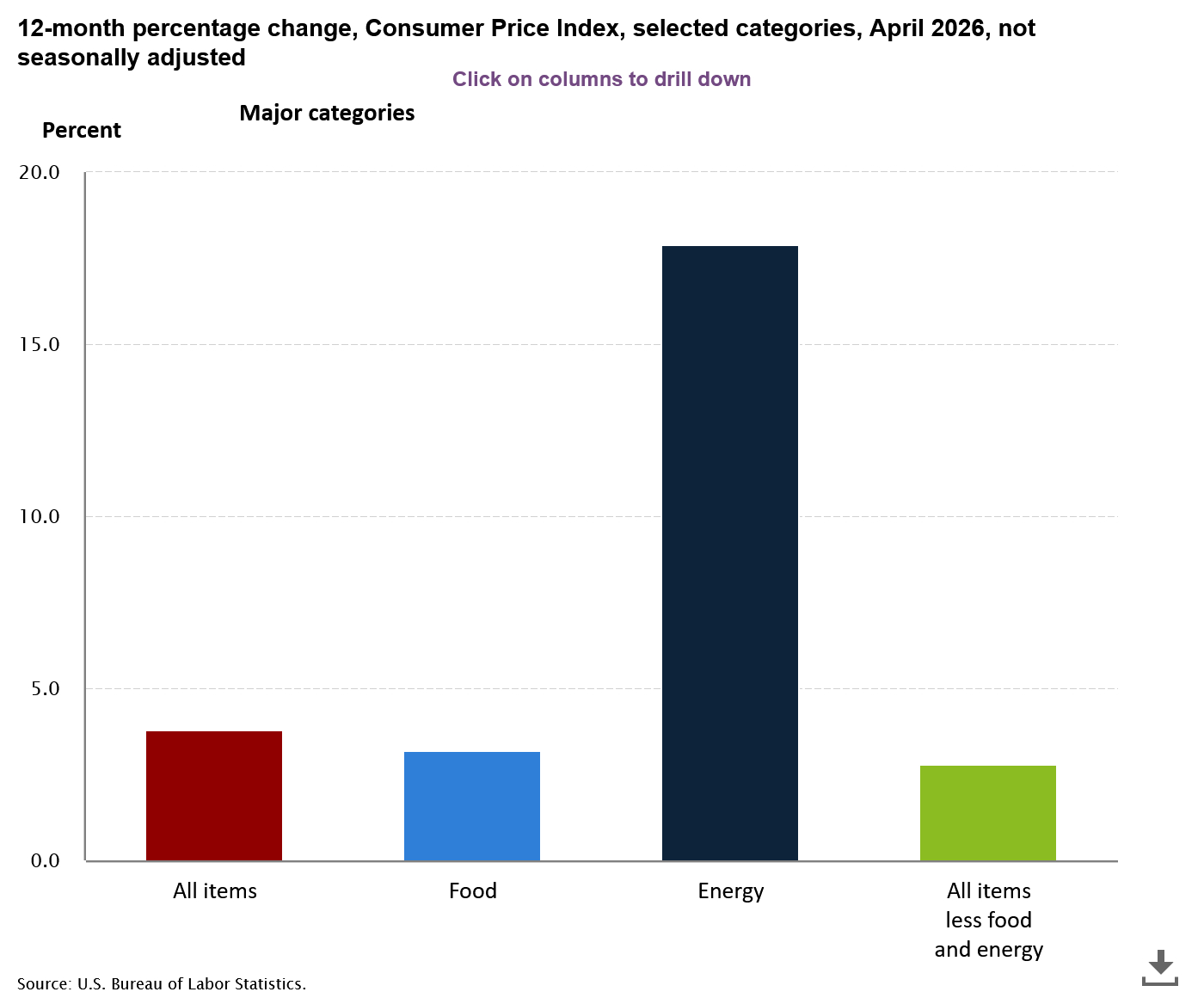
    The commonly cited US Consumer Price Index for All Urban Consumers (CPI-U), the primary measure of the rate of inflation, reached 3.8% year-on-year in Apr 2026, nearly double the Federal Reserve target of 2.0%, jolted by a 17.9% rate for energy and a 3.2% rate for food. Wage gains of 3.6% did not keep pace with prices. The Producer Price Index (PPI), a leading indicator suggestive of future supply chain disruptions, reached 6.0% year-on-year in Apr 2026, the highest rate since Dec 2022 during pandemic recovery. Although closure of the Strait of Hormuz is causing damaging economic effects in the US, with the price of diesel fuel reaching (as of May 11) $5.639/gal, up $2.163/gal from one year ago, the rest of the world is experiencing physical shortages.

    As the spring planting season begins in much of Asia, farmers are leaving land fallow because limited supply and rising prices of fertilizer make it uneconomical to plant for this season. About one-half of the world supply of urea, a nitrogen-based agricultural fertilizer that is a by-product of natural gas processing, has been interrupted. “The disruption of the Strait of Hormuz can push 45 million more people into hunger and starvation,” according to Jorge Moreira da Silva, Executive Director of the UN Office for Project Services (UNOPS), citing data from the World Food Programme (WFP). Most of those driven past the tipping point are far from the Middle East, the WFP explains: “Nearly two‑thirds live in Africa and Asia – the two regions hardest hit by the spillover. That would bring the global total to 363 million people facing acute food insecurity, the highest level on record.” Although farmers in wealthy countries can outbid those in poorer countries for available fertilizer, they must then recover the increased costs from consumers, raising the price of food.

    The world economy has only a few more weeks until supply shocks become severe and possibly irreversible. JPMorgan Commodities Research, as reported by Bloomberg, combined data from several reliable sources (Kpler, IEA, EIA, OilChem, PAJ, Singapore, JODI) to estimate that worldwide oil inventories, would fall below the “operational stress level” by June and below the “operational floor level” by September. Oil infrastructure depends on bare minimum amounts for pipelines, storage tanks, and export terminals to function properly, and equipment may be permanently damaged if this level cannot be maintained. Smaller national economies, particularly Indonesia, Vietnam, Pakistan, and the Philippines, will suffer effects earliest, with larger national economies, such as India and China, relatively less vulnerable. At first.

    The US is now forced into a war that it must fight to the end

    While Donald Trump may have picked a fight it was incredibly stupid to have started, he is now committed to finishing it with two axiomatic and non-negotiable constraints; Iran cannot be permitted to:

    • Have or develop nuclear weapons
    • Control the Strait of Hormuz

    Almost anything else is negotiable from the point of view of the US, but neither of these are – and they are precisely the points on which Iran refuses to negotiate. Trump, a devotee of professional wrestling, has signed up the US for a cage match.

    Control of the Strait of Hormuz, and the consequent power to asphyxiate the entire world economy, is a more dangerous tool than a nuclear weapon because it has more practical use: Iran could conceivably threaten to explode a nuclear bomb knowing that the inevitable retaliation would totally destroy the country, but closing the strait is something they can do, and are actually doing, without much immediate response.

    For the first time since the conclusion of World War II in 1945, the US faces an existential conflict it cannot afford to walk away from, something not widely understood by the public or reported by the press. When the US withdrew from Korea in 1953 with a stalemate, from Vietnam in 1973 with a defeat, and from Afghanistan-Iraq in 2014 with an arguable defeat, it could afford to do so. If the US withdraws now from Iran, by contrast, it would leave the Strait of Hormuz in enemy hands and make the entire world economy their hostage. American allies in the Middle East, ranging from Israel to the Arab Gulf Cooperation Council (Bahrain, Kuwait, Oman, Qatar, Saudi Arabia, and the United Arab Emirates), cannot tolerate an empowered Iran able to choke off world commerce. American allies in Europe and Asia likewise cannot have their national economy and industry be placed at the mercy of Iran.

    The most effective strategy currently pursued by the US is a naval blockade of Iranian commerce, which eventually could starve the economy enough to produce unrest against the Islamist clerical government. About 80% of the population would prefer to see the Islamists removed, but unfortunately they have no organization and no weapons, so the clerics get away with massacring tens of thousands of peaceful protesters. Although the blockade has already cost Iran about one million unemployed and caused underemployment on a scale ten times that, the CIA estimated that the blockade would take at least three or four months to have significant effect, as reported May 7 by the Washington Post. This was blindingly obvious: despite lacking the resources of the CIA, I estimated four to six months right after the blockade began on Apr 13.

    Classified intelligence assessments publicly reported by the New York Times suggest that Trump and the Pentagon have been knowingly lying by claiming that the military capability of Iran is substantially destroyed: 30 of the 33 Iranian missile sites along the Strait of Hormuz have been restored to operation, and about 70% of mobile launchers and 70% of inventory remain available to Iran including both long-range ballistic missiles and short-range cruise missiles. Iran has apparently taken advantage of the cease-fire to repair and restore its offensive missile capability, while US defensive inventory remains depleted. Because sophisticated and expensive US weapons systems require lengthy timelines to resupply, there is concern that materiel purchases already paid for by European nations to help Ukraine will be diverted by the US to the Iran war. Over the past few weeks, the US already used half of its long-range stealth missiles, ten years worth of orders for Tomahawk missiles, and two years of orders for Patriot interceptor missiles. While production can be increased and sped up, that itself will take years and huge sums of money, and there are limits on how badly the most highly complicated components, such as rocket motors, will serve as bottlenecks, slowing the process to a crawl.

    There are only two ways out of this that I can see: (1) the naval blockade works and Iran descends into economic and political chaos, possibly even civil war, that results in regime change where the Islamist clerics are overthrown and some sort of popular government comes into power; (2) a massive land invasion of Iran, involving a half-million to one-million troops, is carried out to remove the regime, comparable to the Allied victories in Germany and Japan in World War II. Other possible exit strategies seem implausible to me: the Islamic clerics would lead their nation into martyrdom rather than any kind of substantive surrender, and Trump could never settle for a deal that would be rightly perceived as a defeat. Although Trump probably believes he could spin a military defeat into a political win with the American public, and he may be correct about that, he could never get away with leaving national allies hanging out to dry, vulnerable to kinetic attack from drones and missiles in addition to economic strangulation.

    If Trump sits on his hands while maintaining the naval blockade, the economy of the world (including the US) will teeter on the precipice of disaster in a game of chicken to see who can endure more economic pain longer. If Trump grows impatient with the blockade, he will have to undertake enormous military escalation. Trump has to choose one of these options.

    Time is running out for Donald Trump

    Trump, about to turn 80 years old in June, is in evident mental and physical decline, rapidly accelerating since long before the Iran war. Trump regularly falls asleep in public; on May 11 he was observed to close his eyes for 18 seconds during a meeting in the Oval Office, which his staff described as merely “blinking.” Later that night into the next morning, he apparently went without sleep, posting on Truth Social dozens of strange comments averaging every three minutes, including paranoid false claims that Barack Obama plotted a coup against him and personally profited over $100 million from the Affordable Care Act, and expressing displeasure that the New York Times accurately reported their discovery that his no-bid contract to repaint the reflecting pool on the National Mall would cost nearly ten times what he claimed it would.

    As Trump’s job approval is cratering in polls, and Republicans seem resigned to losing control of the House of Representatives in the Nov election, his freedom of action in conducting the war would be imminently restricted. Aside from the economic fallout from the war, including inflation generally and energy cost specifically, this creates enormous time pressure on Trump to bring the war to some kind of conclusion, any kind of conclusion, rather than let it drag on indefinitely past an election that is expected to render him disempowered.

    So far, Trump has not made a coherent case to Congress or to the American people for why he started this war, what he hoped to achieve with it, or how he plans to end it. Instead, he consistently makes ridiculous assertions in defiance of reality. The American people are therefore unprepared to give him another $200 billion to fund the war in the current fiscal year, eventually costing at least $1 trillion. That works out to about $7,700 per household (across 130 million households).

    The question now seems to be whether Trump will be able to continue to function as president long enough to dig himself out of the terrible problem he created with no goal, no understanding of the implications, and no plan. What can he do now, and what will the American people let him do?

  • Feds to Regard Cannabis as Medicine: Recreational use expected to follow within months

    Feds to Regard Cannabis as Medicine: Recreational use expected to follow within months

    In the face of decades of evidence that cannabis has safe and effective medical uses, the federal government moved it on Apr 23 from Schedule I, which is for drugs such as heroin and LSD that have a high risk of abuse and no legitimate medical purpose, to Schedule III, which is for drugs that have lower risk of abuse and accepted medical purpose, such as ketamine, codeine, and morphine. (Fentanyl and hydrocodone, because they have both high risk of abuse and accepted medical purpose, are on Schedule II.)

    In a detailed 34-page order, the US Department of Justice (DOJ) cited international treaty authority and findings of fact in support of the rescheduling, notably, “That marijuana has a potential for abuse less than the drugs or other substances in schedules I and II” and citing widespread non-medical use without serious adverse consequences as evidence of safety.

    At this time, only medical – not recreational – cannabis will be rescheduled. The order states: “Placing only FDA-approved products containing marijuana and state-licensed marijuana in schedule III also is consistent with” legal constraints. “By maintaining in schedule I all unlicensed marijuana crops, bulk marijuana, and any marijuana or marijuana extract that has not yet been incorporated into a FDA-approved drug product, and by requiring that state-licensed marijuana satisfy the requirements relating to the purchase and sale of marijuana by DEA, the United States will continue to meet these obligations without disruption or delay.”

    DOJ states that this action carries out an executive order issued by President Donald J. Trump on Dec 18, 2025, which said the FDA found evidence for “medical use of marijuana and found scientific support for its use to treat anorexia related to a medical condition, nausea and vomiting, and pain.” This furthers a process begun by the FDA in Aug 2022 and endorsed by then-President Joseph R. Biden in Oct 2022.

    The immediate practical benefit of this rescheduling is that medical cannabis will be regarded like any other legal-but-restricted drug: it can be prescribed, consistent with FDA regulations (to be adopted), and those handling it by growing, processing, or distributing it will become legitimate businesses able to use the banking system and incur tax-deductible expenses, including marketing and advertising, without undue restriction. Patients may be able to consider their costs as medical expenses, eligible for consideration under Health Savings Accounts (HSAs), or even reimbursable by insurance like other prescription drugs. Scientific research on cannabis, which was severely encumbered by bureaucracy, will become enormously easier.

    The spate of orders clearly regards the very different treatment of medical and non-medical as a temporary situation. A separate 7-page order directs that a review will begin Jun 29 to consider moving non-medical cannabis to Schedule III as well. Because both medical and non-medical cannabis are effectively identical in the entire supply and delivery stream, and the vast majority of state-authorized non-medical cannabis suppliers also handle medical cannabis, keeping the products differentiated by intended end-use would be unsustainable.

  • Fake RI DMV Text Message Scam: Tries to entice following a risky web link

    Fake RI DMV Text Message Scam: Tries to entice following a risky web link

    RI DMV scam alert notice about fake texts
    (Source: dmv.ri.gov )

    Readers made Motif aware they received text messages trying to entice them into following a web link that presumably would lead to a scam, collecting financial information or infecting the user with malware. The messages threaten dire legal consequences due to unpaid violations at the RI Department of Motor Vehicle (DMV), citing general laws references and other window dressing to seem believable. The messages are entirely fake.

    Two major and relatively obvious defects are apparent on closer inspection: (1) the web link ends in “.CAM” rather than the ordinary “.COM” and (2) the sending telephone number is not in area code “401” (Rhode Island) but, in our example, “443” (Maryland). The normal web link for the RI DMV is actually at DMV.RI.GOV, where the following was posted:


    Fraudulent Text Alert — The Rhode Island Division of Motor Vehicles (DMV) is alerting the public following a recent surge in fraudulent text messages falsely claiming to be from the DMV. These scams are designed to deceive recipients into clicking malicious links and submitting personal and/or financial information under false threats of license suspension, fines, and credit score or legal penalties. These messages are NOT from the RI DMV.

    In response to an inquiry from Motif, Paul Grimaldi, press spokesman for the RI Department of Revenue who handles matters for the DMV, said, “We are aware of the latest phishing wave. We posted a warning on the DMV website… alerting people that these are fraudulent messages that do not originate from the DMV.”

    Recipients of such fake text messages can safely ignore their instructions and delete them.

  • No Kings Rallies Mar 28: Find one near you

    No Kings Rallies Mar 28: Find one near you

    No Kings 3, Mar 28, 2026

    No Kings – nokings.org – is a non-violent protest movement responding to the monarchy-like concentration of power in the hands of the president, to the exclusion of Congress and the judiciary. The 50501 movement (“50 protests. 50 states. 1 movement.”) named its protest events “No Kings” as an explicit evocation of history, drawing five million participants in June and seven million in October.

    The No Kings Coalition announced on its web site on Feb 17 it “continues its nationwide digital organizing effort to push back against the growing authoritarian actions of the Trump administration” and would next hold mass rallies on Mar 28, “including a flagship gathering in the Twin Cities [Minneapolis and St. Paul, Minnesota], with thousands more anticipated across the country leading up to the day of action… The March 28 mobilization is expected to be even larger than October’s, as more and more Americans rise up against President Trump’s increasing authoritarianism and federal abuses.” The web site continues, “The Trump Administration has escalated their brutality and authoritarianism on families and immigrants in Minnesota and across the country, killing multiple people including Keith Porter Jr., Renée Good, Alex Pretti, and at least six people in ICE custody so far in 2026. Last year, 32 people died in ICE custody, making it ICE’s deadliest year in more than two decades.”

    A web site – mobilize.us/nokings – allows searching for events near any location. We searched around PVD and (as of Mar 17) found these, sorted by start time on Mar 28:

    Middletown, RI 02842Pottsy Field10:00am – 11:30am
    Somerset, MA 02725U.S. 6 & Brayton Point Road10:00am – 11:30am
    East Greenwich, RI 02818671 Main St10:00am – 12:00pm
    Little Compton, RI 02837The Commons Little Compton11:30am – 1:00pm
    Seekonk, MA 02771Intersection of Rt 44 & Arcade Ave12:00pm – 2:00pm
    Swansea, MA 02777U.S. 6 & Massachusetts 11812:00pm – 2:00pm
    Westerly, RI 02891Franklin Street12:00pm – 2:00pm
    Providence, RI 02903Rhode Island State House1:00pm – 4:00pm
    Blackstone, MA 01504Corner of St. Paul and Main Streets1:00pm – 3:00pm
    Attleboro, MA 02703Charles O. Fiske Square, S Main St3:00pm – 5:00pm
  • Minnesota, Venezuela: I come from the future

    Minnesota, Venezuela: I come from the future

    Every Venezuelan has lived this moment.

    An American asks, “Where are you from?”
    You answer, “Venezuela.”
    They reply, confidently: “Minnesota?”

    I don’t know if it’s the rhythm of the word, the way we roll the Z, or just the fact that people hear what they’re already familiar with. But it happens every time. Venezuela becomes Minnesota. A harmless misunderstanding. A joke as old as time.

    Lately, though, the joke doesn’t land.

    Because in a very unfortunate twist of history, Minnesota is starting to feel like Venezuela.

    I watch the news and my body reacts before my brain does. Armed groups in the streets. People shot during protests. Detentions justified as “law and order.” A government insisting that violence is protection, that fear is safety, that dissent is the real threat. The language is different, the accents are different — but the playbook is the same.

    In Venezuela, we had a name for these groups: colectivos. Paramilitary gangs backed — implicitly and explicitly — by the state. They weren’t official police, but they were protected. They terrorized neighborhoods, broke up protests, dragged people away, shot first and asked no questions later. All in the name of “defending the nation.”

    Tell me that doesn’t sound familiar.

    As a Venezuelan who protested, marched, protested again, and then protested some more — who ran from tear gas and rubber bullets, who watched people die in the streets — I don’t have the luxury of pretending this is abstract. I recognize the early signs because I survived the ending.

    That’s the hardest part to explain to people here. This didn’t start in Venezuela with hunger or hyperinflation or mass migration. It started with division. With rhetoric. With leaders convincing half the country that the other half was the enemy. With the idea that rights were conditional, that safety required obedience, that some lives were worth less if it meant order for others.

    And slowly, then suddenly, everything changed.

    People ask me why I’m quiet online lately. Why I’m not posting hot takes about Trump, ICE raids, Minnesota, Maduro, María Corina Machado, Nobel Prizes, Greenland, invasions — pick a headline, any headline. The truth is simpler and harder: It’s too much.

    It feels like PTSD.

    I didn’t come to this country for fun. I didn’t leave Venezuela because I wanted novelty or adventure. I ran. I ran from violence, from government-backed terror, from the constant fear that today might be the day someone doesn’t come home. Seeing those patterns reappear here — at your doorstep — does something to you. It freezes you. It exhausts you. It makes you careful in ways you wish you didn’t have to be.

    That doesn’t mean I believe in silence. It means I believe in survival.

    Protesting matters. I will never say it doesn’t. Protests saved lives in Venezuela, even if they didn’t save the country. But if you don’t feel safe protesting — if your immigration status, your skin color, your gender, or your past make the streets dangerous — there are other ways to resist that are just as powerful.

    Help your neighbors. Check in on the people living next door. Call your local representatives. Help someone register to vote — literally sit with them and do it. Build a community where cohesion, not division, is the goal.

    Authoritarianism thrives on isolation. On convincing us that we are alone, that everyone else is the enemy, that there is no point in trying. The most radical thing you can do sometimes is simply show up for one another.

    Because division is the real weapon.

    They want MAGA versus liberals, Christians versus heathens, immigrants versus citizens, chavistas versus oposición. I come from the future. I’ve seen where that road leads. It leads to political prisoners. To families torn apart. To people disappearing into systems that no longer pretend to be fair.

    Minnesota? No — I said, Venezuela.

    But yes. Those political prisoners too.

    I don’t write this to say it’s too late. I write it because it’s not. Not yet. There is still time to recognize the pattern and refuse to repeat it. There is still time to choose solidarity over fear, community over cruelty, humanity over “order.”

    So when someone asks me where I’m from and I say Venezuela, and they reply Minnesota? I don’t laugh the way I used to.

    I pause.

    And I hope, desperately, that this time the confusion stays just a misunderstanding. Not a prophecy.

    Author Irene Yibirin is the Culture Ambassador at Imperiall

  • Suspect Dead in Brown Mass Shooting and MIT Professor Murder: Authorities say crimes committed by single suspect

    Suspect Dead in Brown Mass Shooting and MIT Professor Murder: Authorities say crimes committed by single suspect

    Claudio Manuel Neves-Valente, identified by authorities as the suspect in both the Dec 13 mass shooting at Brown University in Providence that killed two and injured nine and the Dec 15 murder of MIT Professor Nuno F.G. Loureiro in Brookline, MA, was found dead of a self-inflicted gunshot wound on Dec 18 in a storage locker in Salem, NH.

    In a Thursday night press conference in Providence beginning around 9:30pm, local and federal police said that Valente, age 48, and Loureiro, age 47, had been undergraduate classmates together at the Instituto Superior Técnico in Lisbon (Portugal). Loureiro graduated with bachelor’s and master’s degrees in physics in 2000, while Neves-Valente was “terminated” according to a report in Vanity Fair. In a press conference in Boston beginning around 10:30pm, US Attorney for Massachusetts Leah Foley confirmed the same suspect committed both crimes.

    An affidavit filed by Providence Police in RI said Neves-Valente was a Portuguese national who was a PhD candidate in physics at Brown on a student visa during Fall 2000 and Spring 2001 semesters, taking a leave of absence and eventually withdrawing in Fall 2003. He then appears to have left the United States until receiving permanent resident status in 2017 through the “Green Card Lottery,” which has a 0.25% chance of success with over 20 million applications.

    The suspect took considerable effort to evade capture, Foley said, switching out European SIM cards to prevent cellular telephone tracking and covering the Florida registration plate on his Boston rental car with a Maine plate not registered to any vehicle. Col Oscar Perez, Providence Police chief, said the suspect used side streets and avoided main streets to try to evade plate reading cameras.

    There were two main breaks in the case, according to the affidavit. A Brown custodian told police he recalled meeting a suspicious person in the Barus-Holley Building, the site of the Dec 13 shooting, earlier on Nov 28 and Dec 1, and this person matched the appearance of the “person of interest” and walked with a limp. This report enabled police to find surveillance camera video from inside the building on Dec 1.

    Reddit post by “John” on Dec 15 at 9:30pm EST. Source: https://www.reddit.com/r/providence/comments/1pnkwoq/comment/nu9c70a/ )

    The second break resulted from an individual identified by police only as “John” who posted on Reddit, the social media web site, on Dec 15 at 9:30pm EST, by user “lamin_kaare” in the “r/providence” subreddit:

    I’m being dead serious. The police need to look into a grey Nissan with Florida plates, possibly a rental. That was the car he was driving. It was parked in front of the little shack behind the Rhode Island Historical Society on the Cooke St side. I know because he used his key fob to open the car, approached it and then something prompted him to back away. When he backed away he relocked the car. I found that odd so when he circled the block I approached the car and that is when I saw the Florida plates. He was parked in the section between the gate of the RIHS and the corner of Cooke and George St.

    According to the affidavit, police regarded this post as highly credible once they learned of it because a Brown faculty member reported on Dec 17 an encounter at 9:15am on Dec 11 with a suspicious gray sedan with Florida plates driving unusually slowly on Waterman Street toward Thayer Street.

    When made aware that Providence Police wanted to speak with him, “John” approached two officers near Brown Alumni Hall and agreed to be transported to headquarters for a voluntary interview. He said he noticed the suspect because he was dressed inappropriately and inadequately for the weather, wearing a “flimsy” jacket and gloves. He said he first encountered the suspect in a bathroom in the Barus-Holly Building about two hours before the shooting, was in close proximity and “locked eyes” with him. After this encounter in the bathroom, the suspect exited the building into the parking lot.

    “John” decided to follow the suspect along Manning Street and near the RI Historical Society saw him approach a gray or silver sedan which flashed its lights as if being unlocked by a key fob, but when the suspect saw “John” turned and walked away from the vehicle. “John“ looked inside and saw two “fanny pack” bags on the floor, then remained in the area, seeing the suspect return repeatedly but turn away each time he saw “John” in what was described as “a game of cat and mouse.” Finally, on George Street, the suspect began running away and “John” ran after him, “speed-walked” past him, and turned around to confront the suspect, saying “Your car is back there. Why are you circling the block?” The suspect then said, in what “John” said seemed an Hispanic accent, “I don’t know you from nobody. Why are you harassing me?” After that, the suspect walked back toward the car and “John” broke off.

    Subsequently on Dec 17 at 11:12pm EST, ‘John” posted again on Reddit

    The following is all I will say regarding the matter. This evening I spoke to Providence Police, the Rhode Island State Police and I imagine the FBI were listening in another room. They know who I am. I am not the individual posted in the recent round of photos. I wish that individual Godspeed and if they have yet to come forward I strongly encourage them to do so. All the law enforcement personnel that I interacted with today were extremely professional and worked hard to really put me at ease. Respectfully, I have said all I have to say on the matter to the right people. If any follow up is needed the right people know how to reach out to me. Though it is certainly your right to try, any news media attempting to reach out to me will not receive a response. This is a pseudo-PSA and my participation in the comments will be limited to upvoting reasonable takes. Thank you for your time and let’s hope the POI is apprehended soon so the authorities can get to the bottom of this. Hopefully you all are able to enjoy the holidays with your family and loved ones but if you are not may the following days treat you kindly.

    Once the police had the location and description of the car, a Nissan Sentra, they were able to use surveillance camera video from the RI Historical Society and city-operated Flock traffic cameras to determine the plate number, which led to the Alamo Rent-a-Car office on Boston, which had identifying data for the lessee including financial information and surveillance video of the rental transaction on Dec 1 at 11:36am. The first hit of the plate on the Flock readers was later that same day at 5:50pm, at the intersection of Camp Street and Doyle Avenue. The Flock readers detected the plate a total of 14 times.

    With this financial information, authorities determined that the suspect had rented a locker at Extra Space Storage in Salem, NH. When the FBI SWAT team arrived, the suspect was already dead from a self-inflicted gunshot wound. He had the rental car and two handguns, one found near his thigh and the other near his leg.

    As of early Friday morning, authorities said they do not know a motive for either crime and do not know why the suspect targeted Brown University or his former classmate from Portugal.

    Strong public support has been expressed on social media for giving “John” the $50,000 reward offered by the FBl.

  • Brown Mass Shooting: Police release new video, murderer still at large

    Brown Mass Shooting: Police release new video, murderer still at large

    At a press conference Mon, Dec 15 at 5:00pm, Providence Mayor Brett Smiley, RI Gov. Daniel McKee, Providence Police Chief Col. Oscar Perez, RI Attorney General Peter Neronha, and Boston FBI Special Agent in Charge Ted Docks released additional pictures and videos from area doorbell cameras. The FBI announced a $50,000 reward for information leading to the arrest and conviction of a suspect.

    Although the shooter is still at large after the incident Sat, Dec 13, Smiley said public schools would be open and he believed they would be safe, it would up to each family to decide whether to send their children.

    The new pictures appear to show a man wearing a surgical mask and dark winter clothing.

  • Two Killed, Eight Injured in Shooting at Brown University: “Person of interest” released from custody

    Two Killed, Eight Injured in Shooting at Brown University: “Person of interest” released from custody

    Two were killed and another nine were injured in a shooting shortly after 4pm Sat, Dec 13, on the first floor of the seven-story Barus and Holley Building, 184 Hope St, Providence, the engineering and physics department headquarters on the Brown University campus. As of 11pm, Providence Mayor Brett Smiley said the shooter remains at large and unidentified, and a “shelter in place” precaution remains in effect for the campus and surrounding area.

    Providence Police supplied to Motif a surveillance video taken from the exterior of the Barus and Holley Building, showing a man considered the suspect walking north on Hope Street and turning right to walk east on Waterman Street. The suspect is seen wearing dark clothing, including a hat and gloves, and is never facing the camera. No other “useful”video has yet been identified by police, although they are actively reviewing other footage.

    All of the shooting victims were students, confirmed Brown President Christina Paxson, and were being treated at RI Hospital. Of the eight surviving victims, one is reported in critical condition, six are reported in “critical but stable” condition, and one is reported in stable condition. (A ninth person took themselves to the hospital after realizing they had minor injuries; they were treated and released.)

    Smiley said the city is not at this time recommending cancellation of events, and the police will deploy a heavy protective presence. Reportedly, Trinity Rep canceled their Sat evening show and Providence Place Mall closed early on Sat. However, a concert with an estimated 12,000 attendees went ahead as scheduled at the Amica Mutual Pavilion (Civic Center) with an enhanced police presence.

    RI Gov. Daniel McKee said that he has spoken with President Donald Trump and FBI Director Kash Patel, who offered assistance. The FBI has set up a web tip line – fbi.gov/brownuniversityshooting – and Providence Police set up a telephone tip line 401-652-5767. The FBI site allows uploading photo and video files.

    UPDATE Sun Dec 14, 6:45am: Brown University has lifted the “shelter in place” order. CNN reports that dozens of police officers raided a (still unnamed) hotel and took into custody a “person of interest” who may or may not be the shooting suspect.

    UPDATE 7:25am: Smiley confirmed that a “person of interest” has been detained. Col. Oscar Perez, chief of Providence Police, said that he was limited in details he can share about the detained individual. Ted Docks, special agent in charge of the FBI Boston office, implied the detention was accomplished by local law enforcement. Perez declined when asked to identify the hotel where the detainee was located or to discuss their affiliation with the university. Perez said that street closures in Providence at this point are for the purpose of preserving and collecting evidence on and near the campus. Smiley says that enhanced police presence is intended to be “comforting and reassuring,” not because of any concrete threat, and they are still not yet ready to identify the victims.

    UPDATE Mon Dec 15, 12:30am: The “person of interest” will be released from custody, RI Attorney General Peter Neronha announced at a late night press conference. While “certainly there was some degree of evidence that pointed to the individual… that evidence needed to be corroborated and confirmed. And over the last 24 hours, leading into just very, very recently, that evidence now points in a different direction.” This means, “We have a murderer out there,” he acknowledged. Smiley said that ”the news is likely to cause fresh anxiety for our community.”

  • Opinion — Zohran Mamdani and the Pyrrhic Victory of the Democratic Party: Why he is the leftist version of Donald Trump with all of the same problems

    Opinion — Zohran Mamdani and the Pyrrhic Victory of the Democratic Party: Why he is the leftist version of Donald Trump with all of the same problems

    Zohran Mamdani protest sign (Credit: Oleg Yunakov, CC-BY-SA-4.0 via Wikimedia Commons)

    Mayor-elect of New York City Zohran Mamdani is a self-avowed “democratic socialist,” and his policy proposals include free public transit, free child care, city-run grocery stores, and free everything else, all funded by increasing taxes on corporations and wealthy city residents. Mamdani has based his suddenly rocketing popularity on telling people what they want to hear, untethered from reality. His promises are the flip-side of MAGA promising to revitalize fossil fuels, domestic manufacturing, and heavy industry, which by now should be clear to everyone were a con game that could never happen. MAGA was not even able to reduce the price of eggs.

    I really despise Donald Trump, and I pretty much called him a fascist a week before he won the 2016 presidential election. I wrote then, “In many respects, the extremes of right and left are indistinguishable, leading to serious challenges of basic definition… Presumably when Adolf Hitler called himself a ‘national socialist’ and Bernie Sanders called himself a ‘democratic socialist,’ they had two different meanings in mind for the same word – but they did, nevertheless, use the same word.”

    While one could make a plausible case for higher taxes on corporations and the wealthy on a national basis, especially as a way to limit disastrously growing inequality, it is outright absurd on a citywide basis. Firstly, trying to impose heavy taxes within a city, even New York City, will motivate the parties heavily taxed to consider simply moving elsewhere. It is a hassle for a major corporation or a wealthy individual to exit the United States, but much easier to move from New York to Texas. Secondly, imposition of such taxes is beyond the power of the New York City government, and would require action by the state legislature in distant Albany; even New York Governor Kathy Hochul, a Democrat, has explicitly opposed the Mamdani tax plan.

    As Mamdani will soon find out, telling people what they want to hear may be a strategy for short-term increased popularity and even election victory, especially when running against opponents who are seriously flawed – disgraced former Governor Andrew Cuomo and extremist talk-show host Curtis Sliwa, who came to prominence almost 50 years ago as the founder of the Guardian Angels, a roving band of vigilantes

    In the late 1970s and early 1980s, New York City was widely perceived and portrayed as a dystopian wasteland in works of fiction such as Escape from New York and in real life by bad actors such as subway shooter Bernhard Goetz. MAGA seems stuck in this false mythology of decades ago, as when Donald Trump bought a full-page ad demanding the death penalty for the Central Park Five – five Black boys, aged 14 to 16, charged with raping a jogger, who turned out to be innocent after their confessions were shown to have been coerced.

    Indeed, some of Mamdani’s proposals have merit if they could be funded. In 2015, I endorsed making bus rides free in RI by eliminating fares entirely, arguing it would lead to economic growth. I asked the then-executive director of RIPTA, Scott Avedisian, about this, and he replied, “Find me $50 million and I’ll do it.” Ironically, as the former mayor of Warwick, population 83,000, Avedisian was far more in touch with the basics of practical governance than the newly elected mayor of New York City, population 8,800,000.

    The real danger from Mamdani is not that he will prove to be a disappointing mayor unable to keep any of his key promises, which seems inevitable, but that Democrats will mistake the sources of his popularity and embrace his unworkable ideas. That is exactly what has trapped Republicans in the unreality of MAGA, where “alternative facts” and “truth isn’t truth” (Rudy Giuliani), have come to define post-truth politics.

    Since his student days, Mamdani has defined himself as anti-Zionist and sought to delegitimize the State of Israel, and more recently has defended his use of the slogan “Globalize the Intifada,” criticized by ADL Executive Director Jonathan Greenblatt as “An explicit call for violence. ‘Globalize the Intifada’ celebrates and glorifies savagery and terror…” On another occasion, Greenblatt said, “Antizionism is antisemitism. Antizionism as an ideology is rooted in rage. It is predicated on one concept: the negation of another people.” Entire articles have been devoted to documenting many conflicting and inconsistent statements, including “What Zohran Mamdani has actually said about Jews, Israel and antisemitism.” After the election the ADL announced a public tracker called a “Mamdani Monitor.”

    More than one thousand American rabbis signed an open letter, “A Rabbinic Call to Action: Defending the Jewish Future,” stating, “When public figures like New York mayoral candidate Zohran Mamdani refuse to condemn violent slogans, deny Israel’s legitimacy, and accuse the Jewish state of genocide, they… ‘Delegitimize the Jewish community and encourage and exacerbate hostility toward Judaism and Jews.’”

    It would be a mistake for Democrats to learn from this a perhaps fatally flawed lesson that normalizing anti-Zionism is a recipe for electoral success, as Republicans learned from the remark famously attributed to James Baker, secretary of state under George H.W. Bush, “Fuck the Jews, they don’t vote for us, anyway.” In the world’s city with the largest number of Jews, Cuomo, despite his liabilities as a deeply disgraced former governor, outpolled Mamdani among Jewish voters by a 2-to-1 margin, indicating the profound distrust the Jewish community has for Mamdani. Exit polls found 67% said the candidates’ positions on Israel factored into their vote, with 38% calling those positions a major factor.

    Democrats enjoyed remarkable electoral success on Nov 4, winning the governorships of New Jersey and Virginia by much greater margins than expected, and winning a few races they were not expected to win, such as attorney general in Virginia, and surprisingly increasing their majority in the Virginian House of Delegates from 51 to 64 seats. Democrats broke the Republican supermajority in the legislature of Mississippi, an overwhelmingly Republican state. California Proposition 50, allowing the state to redistrict congressional seats to offset a competing move in Texas, passed 63.9% – 36.1%, possibly deciding majority control of the US House of Representatives in the Nov 2026 election.

    Both the far-right and the far-left, by their nature, need to find scapegoats to blame when their policies fail. Each lives in a fantasy world where their utopian policies would work if not for the nefarious forces conspiring against them. Cheaper eggs? Climate change? Free child care? You’re angry that the only job you can get is gig work with no benefits? That can be fixed by sending masked thugs to abduct Latinos off the street and prevent them from competing with you. You’re angry that you’ll never be able to afford a middle-class lifestyle and buy a house? That can be fixed by punishing those foreign globalist bankers stealing your money. Trump and Mamdani will be pandering for scapegoats, but different scapegoats for different failed policies. History demonstrates that it is never just the Jews even if it starts with the Jews.

    Democratic success was in large part a reaction against MAGA insanity, including masked ICE thugs kidnapping people off public streets and boasting about shooting others; a government shutdown that puts at risk food aid for the poor, weather prediction, and safety of air traffic control; and physical demolition of the East Wing of the White House. Countering MAGA effectively is going to be helped neither by promising free stuff that cannot really be delivered nor by demonizing Jews.

  • Full SNAP Benefits Must be Paid by Fri, Nov 7, Court Orders: Judge seems incredulous that partial payments resulted in delays; government appeals

    Full SNAP Benefits Must be Paid by Fri, Nov 7, Court Orders: Judge seems incredulous that partial payments resulted in delays; government appeals

    Michael Bilow of Motif attended the 3:30pm court hearing and is reporting based on his personal observations.

    At a hearing in US District Court in Providence on the afternoon of Thu, Nov 6, Judge John J. McConnell Jr seemed incredulous that the option in his Oct 31 order to make partial instead of full Supplemental Nutrition Assistance Program (SNAP) (formerly “food stamp”) payments for November, intended to speed up the process and get those partial benefits to recipients by no later than Wed, Nov 5, actually introduced delays that the government contended could add weeks or months. Because the federal government provides money to state governments for further disbursal to recipients, and states never before needed to calculate partial payments, the practical effect was to introduce substantial procedural delay in making benefits available for use, the judge was told.

    The failure of Congress to authorize spending in the new fiscal year that began Oct 1 has resulted in a shutdown of the federal government, including monthly US Department of Agriculture (USDA) SNAP payments due Nov 1 to about 42 million recipients.

    “The administration was required under this Court’s Order to immediately make the full payment for November SNAP benefits considering the finding of irreparable harm that would occur. And just to be clear, irreparable harm means harm to families, elderly, children, and others that cannot be undone. The evidence shows that people will go hungry, food pantries will be overburdened, and needless suffering will occur. That’s what irreparable harm here means. Last weekend, SNAP benefits lapsed for the first time in our nation’s history. This is a problem that could have and should have been avoided,” the judge said from the bench.

    Kristin Bateman of the Democracy Forward Foundation, arguing for the plaintiffs, used only three of her allotted 15 minutes of argument. “This court’s order gave defendants a choice. They could fully fund November SNAP benefits, or they could come up with a plan to partially fund those benefits using the contingency funds, so long as that plan allowed for expeditious and timely payment to the beneficiaries who rely on SNAP for food, and so long as that plan was not arbitrary and capricious The defendants have not done that. By their own admission, their plan will mean that in some states, beneficiaries don’t get the money they need for food for weeks or even months, and the reasons they have given for making that choice are facially implausible. They say that they are doing that to conserve needed funding for child nutrition programs like school lunches, but tapping into those funds now to fully fund the November SNAP benefits will not take needed money away from those child nutrition programs unless the government shutdown lasts until next June. Basing a decision on such a highly unlikely set of events is not reasoned decision making, and it’s particularly unreasonable because the defendants have not explained why they would choose to let 42 million Americans, including 16 million children, go hungry now, in order to guard against the extreme outside chance that come June, there won’t be enough money to fund child nutrition programs,” Bateman argued.

    “In fact, the record shows that conserving money for child nutrition programs is not the reason; that’s a pretext. What defendants are really trying to do is to leverage people’s hunger to gain partisan political advantage in the shutdown fight. In these particular facts and circumstances, the defendants choice not to fully fund November SNAP benefits is arbitrary and capricious, and, in these particular facts and circumstances, the court should order defendants to provide that full funding immediately. It’s already six days into November. People are waiting for the assistance they need to be able to afford food, and there’s no more time to wait. So we would ask that the court enforce its existing order by requiring immediate release of the funds necessary to make full November SNAP payments,” Bateman said.

    As a result, the judge issued a new order that the federal government make full rather than partial payments for November, and that this be done within one day on Fri, Nov 7. The judge held that in addition to contingency funds already consumed to make partial payments, the necessary funds could be drawn from reserves under Section 32 of the Agricultural Adjustment Act of 1935, derived from 30% of customs receipts on imports from the prior calendar year, and therefore constitute a permanent statutory appropriation by Congress.

    “The administration erroneously and unintentionally conflates Section 32 funds and the child nutrition programs by referring to them in tandem, as though they were one and the same. In essence, they erroneously claim that Section 32 funds are to be used exclusively to fund the child nutrition program, but that is incorrect,” the judge said from the bench. “While much of this funding has been appropriated for the child nutrition program, USDA has statutory authority under 7 USC §2257 to authorize transfers of these funds interchangeably for the ‘miscellaneous expenses of the work of any bureau, division, or office of the Department of Agriculture.’”

    The judge noted that USDA had previously used Section 32 funds to keep the Women, Infants, and Children (WIC) program running, undermining any legal objection to doing it for SNAP, and drawing $4 billion from Section 32 reserves to fully fund SNAP for November would still leave more than $19 billion in the fund. While the government contends that drawing from Section 32 reserves could put 29 million children at risk of there being insufficient funds for child nutrition programs traditionally funded this way, the judge said that the evidence was that would not happen unless the government shutdown extended past May 2026, which he deemed “implausible,” and if Congress did not act to restore SNAP funding and replenish the account. “More importantly, without SNAP funding for the month of November, 16 million children are immediately at risk of going hungry. This should never happen in America. In fact, it’s likely that SNAP recipients are hungry as we sit here,” the judge said from the bench.

    Truth social post by Donald Trump stating intent to defy court orders on SNAP funding, Nov 4, 2025. (Source: https://truthsocial.com/@realDonaldTrump/posts/115492285081397189 )

    Judge McConnell repeatedly referenced a Truth Social post by President Donald Trump, “The president stated his intent to defy the Court Order when he said, quote, SNAP payments will be given only when the government opens, unquote.” (What Trump actually wrote was, “SNAP BENEFITS… will be given only when the Radical Left Democrats open up government, which they can easily do, and not before!”) The judge at the end of the hearing, which lasted less than a half-hour, returned to this point, “The defendant’s stated desire to conserve funding for the child nutrition program is entirely pretextual given the numerous statements made in recent weeks by the President and his administration officials who admit to withholding full SNAP benefits for political reasons.”

    Despite outright finding that the government claims were “pretextual,” a blunt way of accusing the government of lying, the judge was careful to acknowledge the difficult if not impossible position the attorney representing USDA, Tyler Becker, found himself in: “I’m not accusing you, and I don’t think the plaintiffs are either, of bad faith in it, or of acting inappropriate. I think what the plaintiffs are saying – I mean, they’ve not, and I think rightly so, haven’t asked for contempt – what they’re merely saying is: enforce the order that is plain and straightforward, and clearly the government didn’t read the order in its plain language in that regard…”

    Indeed, the judge noted that, as federal employees, Becker and the Court staff needed to hold the hearing were all working without pay.

    Judge McConnell in Providence appeared so angry that, without any actual request from the government, he preempted such a request and said from the bench, “The request for a stay of this decision, either a stay or an administrative stay, is denied. People have gone without for too long. Not making payments to them for even another day is simply unacceptable.” Such a stay, which would delay the effect of his order, is relatively ordinary if the case is appealed, as he clearly expected.

    After the close of the hearing, the court issued a 27-page written opinion detailing the terms of its order. Almost immediately, the government filed a notice of appeal to the First Circuit in Boston.

    The case in Providence at the US District Court for the District of Rhode Island is Rhode Island State Council of Churches et al. v. Rollins et al. (1:25-cv-00569). The case in Boston at the US Court of Appeal for the First Circuit is Rhode Island State Council of Churches et al. v. Rollins et al. (25-2089).

    UPDATE: The First Circuit in the early evening of Fri, Nov 7, denied the government request for an administrative stay of the lower court order, effectively allowing the payment of full SNAP benefits by the end of the day. The government then asked the US Supreme Court for an emergency stay, which was granted by Justice Ketanji Brown Jackson in her capacity as the duty justice assigned to handle emergencies from the First Circuit, which she granted late that night, providing that full SNAP benefits need not be paid until 48 hours after the First Circuit makes its decision, allowing time for a further appeal by either side to the Supreme Court.

    UPDATE: The First Circuit at 11:49pm, Nov 9, issued a 29-page opinion in favor of the lower court order that full SNAP benefits be paid.

    See our coverage of the SNAP crisis:

    “SNAP Benefits Must Be Paid, PVD Federal Court Rules: Contingency funds must be used despite government objections”, by Michael Bilow, Oct 31, 2025.

    “SNAP (Food Stamps) Emergency: RI announces support during federal shutdown”, by Michael Bilow, Oct 29, 2025.