It was the constant tiredness I had been feeling for months, the fear I felt for anyone who looked like me, and the hunger for hope that brought me to the Subway across the street from Kennedy Plaza.
It certainly wasn’t the bland, cold, sandwich-like product I gnawed through while I waited for the parade to start on Washington Street. I had half an hour, an empty stomach, and apparently the willingness to overpay for fast food in this economy.
La economia esta mala, I thought. And it’s going to get worse.
All things were getting worse for people like me, the targeted. And this time around, the perpetrators didn’t need to look for yellow badges, they could just look at our skin color, our hair, listen to the accent in our voices. This time they could hide their shame behind masks, assuming they had any. If the sportsbook in RI took bets, I’d bet those masks hid smiles.
I pulled back the bread of my purchase, and it looked plastic to me. It had an oily complexion I didn’t remember ordering.
I wondered, if I had ordered it heated, would it taste different? That wasn’t going to happen, though. The owner of this establishment thought he could save a couple of bucks by only having one person work the counter during PVDFest. You’d think they would make back their investment in salary on a Saturday that Downtown Providence was bursting with people. The young Hispanic sandwich artist was doing his best, although customers in the long line were throwing him curve balls.
“Can I get six meatballs?” asked a woman.
“You want a meatball sandwich?” He replied.
“No, six meatballs,” she said.
His face contorted into a smile, but I could see his wheels turning. He had never been asked this, he wasn’t trained for this ask. He was frozen with indecision.
I worked retail for years in another life; there are plenty of interactions that aren’t in the training video. You just have to learn to improv to get the line moving. This was an easy yes-and. Charge her for the footlong sandwich and then just toss the six meatballs in a container. NEXT! Del Close would be proud.
I thought of yelling out the answer, but instead dropped my head to my phone screen.
I’m here for the cabezones.
The parade route started at the intersection of Greene Street and Washington Street. When it was my turn I gave him the easiest number to make.
“Not toasted, thanks.”
The store was like no other Subway I’ve ever been inside. Clearly it used to be something else. It was a weird L-shape, like a one-room apartment you rent because you have to and try to convince yourself it was a sane choice.
It’ll be a fun story someday.
The sandwich-making station was in the bottom half of the L, and a couple of mismatched tables made up the top. I needed napkins. I needed to get this oily film off my hands.
There was a heavy, middle-aged Hispanic ordering two sandwiches in broken English.
“Con permiso,” I told him as I slid past him and caught the sandwich artist’s eye. “Can I get some napkins man?”
Back in my seat, I tried to get the oil off, but no matter how I tried, it did not come off. I wondered if it was partly my fault: I could have spoken up and made my order clear.
“Get out of my fucking country,” I heard a voice yell. “Fucking wasting my time.”
The heavy Hispanic guy appeared in my side of the L. He brought his little sandwich bag to his chest as he walked towards the door. He looked back to the voice. His face looked like he was surprised, scared, angry all at once. He got to the door and looked.
“Learn English!” he said. “This is my fucking country. They come here and…”
I couldn’t hear the rest of what he said as it got swallowed up in the gargle of his rage.
The circus peanut. I thought. He made it okay for them to crawl out of their hiding places.
My sandwich was completely foreign to me now. Fake, in fact. Were it to be passed along as food, it would just be a lie.
“They come to this country and they don’t respect our culture,” the same voice. “Learn English!” he yelled as if the man was still there. “Get them all out.” In a different version of this country, he’d be shamed publicly.
I wrapped up my sandwich and looked for a trash can.
“These illegals hate my country,” the voice said.
I smirked at the ill-logic that a country intricately owned by the mega-rich somehow belongs to him. That stolen land can belong to anyone legally.
“You know what I mean?” he said.
It didn’t sound like anyone was talking back to him. It was silent except for him. So silent. Was it up to me? Did I have to be the one to call him a racist?
How would he like it if I said it in Spanish?
Racista Come mierda!
I’m sure that would open the racial spigot on this guy. Would he fight me? And what would that accomplish? I want to fight the system, not the idiot who rents a stolen country and doesn’t get his place in it.
I could smell the rot of my sandwich under the wrap.
“I’m here for the cabezones,” I said to no one as I got up and tossed the sandwich in the trash.
I walked into Washington Street, into the crowd of my favorite event in all of New England, one that celebrated its BIPOC neighbors.
Then I saw the sign for The Unity Project. It said, “Let’s Break The Ice,” and it made me smile instantly.
“The big heads!” I yelled out.
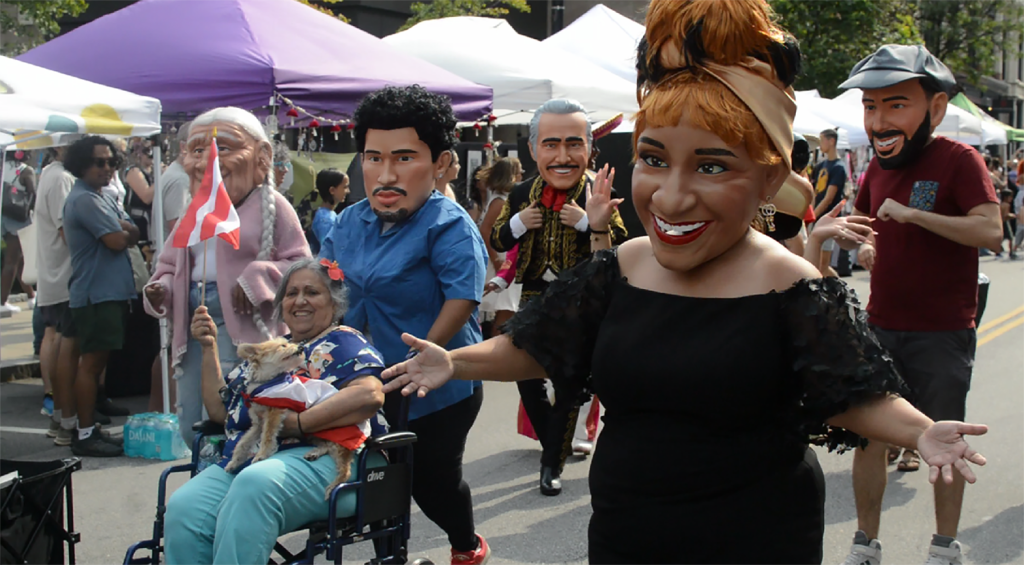
There was the oversized head of Celia Cruz on the body of a volunteer. She was bigger than life when I lived in Miami, now a saint, no doubt. There was Juan Luis Guerra, and I remembered all those times my mom had the radio on to the Bachata hour, and music in Spanish was plentiful. There was the abuelita from Coco, who looked like my viejita — probably looked like all our viejitas. There was Bad Bunny, a Brown the whites really seem to like these days. And there was El Rey, Vicente Fernandez.
The little act of parading around in cabezones brought me a genuine smile, something the outside world had failed to do for months.
I took video, I took pictures. I took a moment to reminisce. It brought me back to a time when being Brown meant being beautiful, and not a target. As I shared these digital visuals- I hoped it would do the same to someone else. That hope tasted like home.
Frank Maradiaga is a longtime community journalist. Almost a decade of that time has been in Rhode Island. He is the founder of Rhode Island In Color, an initiative to help inform the communities of color in the Ocean State.
Parade photo by Rhode Island in Color.
“It brought me back to a time where being brown meant being beauti, and not a target.”
Well said and exac what we were stri for!