Author: Alison O’Donnell

  • SHREK THE MUSICAL: That’ll Do, Donkey, That’ll Do!

    SHREK THE MUSICAL: That’ll Do, Donkey, That’ll Do!

    Photo by Bob Emerson.

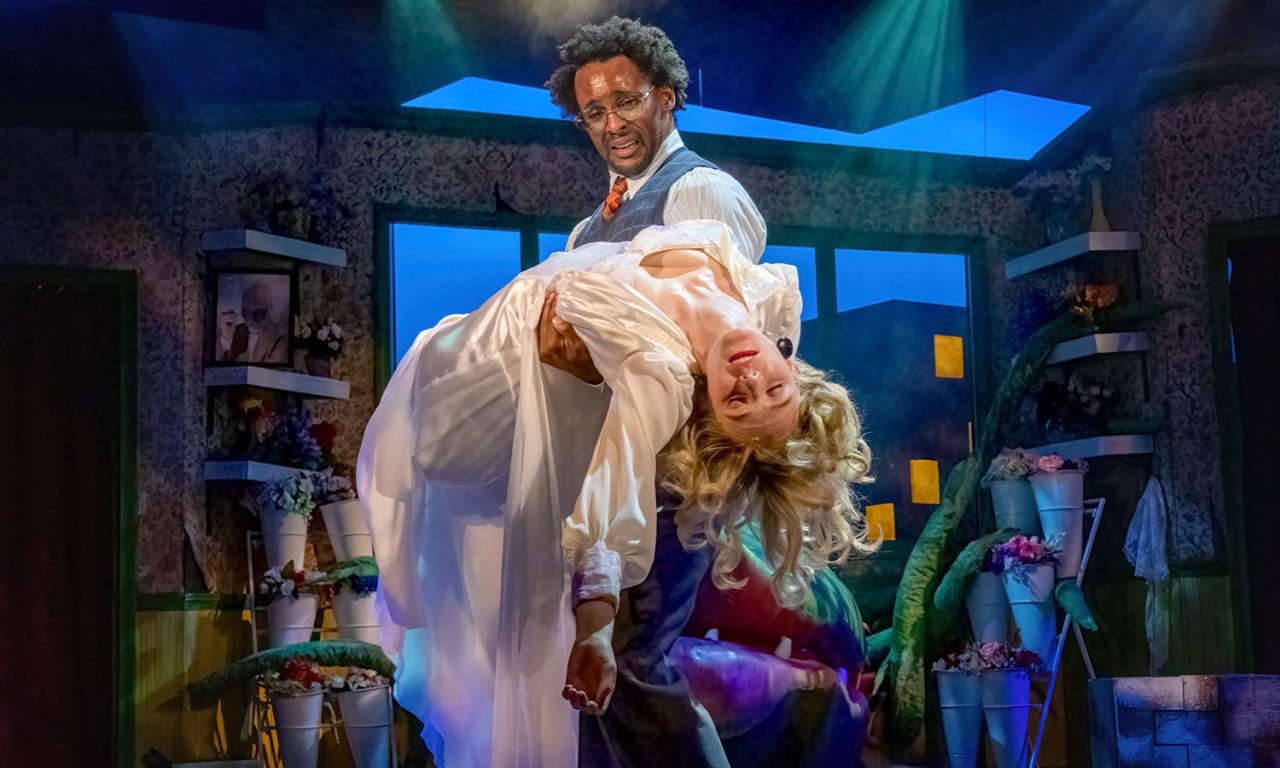
    Shrek the Musical is a hilarious and heartwarming adventure celebrating friendship, love, and the beauty of being uniquely yourself. Featuring a lively score by Jeanine Tesori, with book and lyrics by David Lindsay-Abaire, this spectacle full of heart, humor, and show-stopping musical numbers is presented by The Community Players, adeptly directed by Marianne Lonati, who also directed the choreography. In a faraway kingdom turned upside down, the unlikely hero Shrek sets off on a life-changing journey, alongside a wisecracking Donkey, to rescue a feisty princess and reclaim his swamp. Along the way, they encounter a host of familiar fairy tale characters, a vertically challenged villain, and discover that real friendship and true love can be found in the most unexpected places. Like faraway kingdoms.

    Says Lonati, “What I love most about Shrek the Musical is the happy, upbeat fairytale world. I only direct light and fluffy shows because to be immersed for months in anything darker is not good for mental health. And with the chaos we are living in these days, it is especially necessary to find a way to escape the daily bombardment of bad news. It has been wonderful playing with colorful characters who have been banned from their homes by a narcissistic wannabe king who wants everyone to look the same and forces them to praise him… Wait… Hmmmmm. The good news is, there is a happy ending, and the bad guy gets incinerated by a dragon! It is a hopeful show with a beautiful message of inclusion and love.”

    The production stars Cody O’Toole as Shrek. This green monster is utterly entertaining throughout. Likewise for Katy Lazar, who makes the perfect companion in this fun, swamp-loving couple. Christopher Margadonna, who serves as president of The Community Players, takes the stage as Donkey. Shrek’s talkative sidekick is known for his comic relief, and Margadonna gets to flex his talented singing muscles to boot.

    Chris Lovegood is hysterical as Lord Farquaad. Just wait until you see this antagonistic scene-stealer dominate the stage! Lovegood’s animated presence means words aren’t even necessary in order to elicit belly laughs! Lizzie Rider belts out Dragon’s tunes while Emily Fisher adroitly serves as puppeteer.

    Neil G. Santoro has done an amazing job as set designer/master carpenter. There’s a lot going on in this large production, and no time for too many moving parts or set distractions, so kudos given where it’s much deserved! One smartly-planned staging serves as swamp, countryside, church, and a castle or two.

    Orchestra conductor Renee Nelligan keeps the music and comical zings right on cue throughout the performance. A spirited intergenerational ensemble brings to life a colorful cast of fairy tale favorites: Kristen Allen, Misha Bennett, Mia Berube, Mitch Bertolino, Kaelyn Boss, Kylie Chartier, Paige Costigan, MK Darden, Molly Kate Donnelly, Karlie Fitzgerald, Amanda Grimaldi, Kendra Haggerty, Harper Hennings, Mac Jacob, Elaine Johnson, Jaime Kilday, Patrick Koshewa Sandra Louis, Matthew O’Brien, Alexandra Rickoff, Haley Robertson, Claudia Rufo, Harrie Salk, Neil Santoro, Dahlia Sussman, Valerie Sussman, and Daniel Thompson.

    This larger-than-life musical offers colorful costumes, strong vocals, energetic choreography plus many sweet surprises! It’s a magical theatrical experience for all ages. Come see the “freaks with teeth” take the stage, and don’t forget to grab your pitchforks!

    The Community Players present Shrek the Musical through April 26. There will be one 15-minute intermission; refreshments served in the Cafeteria. All donations will benefit TCP’s Special Project Fund. For more information, visit thecommunityplayers.org.

  • PRIMARY TRUST: A Quiet Triumph Of Tenderness And Hope

    PRIMARY TRUST: A Quiet Triumph Of Tenderness And Hope

    Photo by Mark Turek.

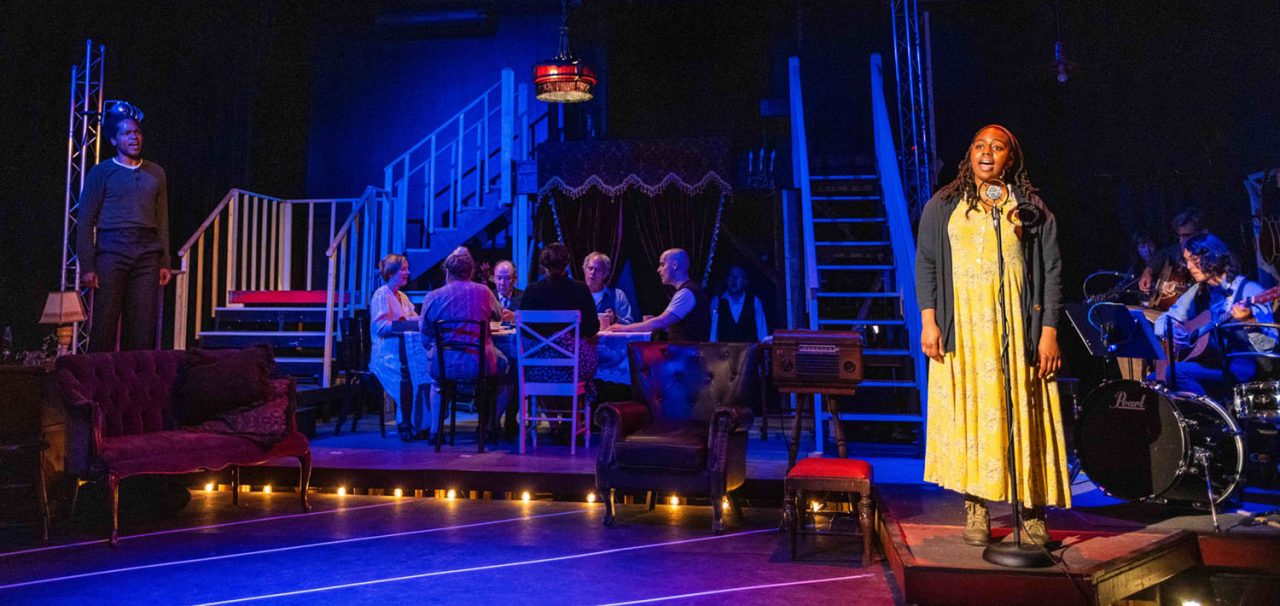
    Trinity Repertory Company’s production of Primary Trust, Eboni Booth’s 2023 Pulitzer Prize–winning play, is a comedy regarding the courage to begin again. The most widely run production today, this heartwarming story about one man’s leap of faith and the friends he makes along the way is an exquisite portrait of loneliness, connection, and revamping a life. Under the sensitive direction of Tatyana-Marie Carlo, this poignantly offbeat comedy turns the ordinary rhythms of small-town existence into something radiant and heartfelt. 

    Kenneth, a gentle, socially withdrawn bookstore clerk whose days consistently involve routine and isolation, has lived his entire life in the sleepy town of Cranberry, New York. Each day, he works his shift at a bookstore, then indulges in happy hour Mai Tais at Wally’s Tiki Bar with a close friend. When a sudden layoff catapults Kenneth out of his comfort zone, he’s forced to find the courage to face what we all dread: change! 

    In this play, the stakes are internal. Booth finds emotional breadth in simplicity, capturing the journey with tender empathy. By the final scene, when Kenneth takes his first steps into an uncertain future, the audience feels the quiet triumph of watching someone relearn trust in others as well as in himself. Carlo’s skillful direction helps keep the production’s delicate tone unscathed. The patient pacing permits Booth’s dialogue to penetrate, allowing moments of silence to be given as much weight as the discourse. 

    Taavon Gamble’s flawless interpretation of Kenneth is thoughtfully detailed and unflinchingly honest as someone capable of deep feeling and tremendous caution. Every move toward human connection can feel either perilous or miraculous. Minuscule gestures, such as the start of a nervous smile, or the way he clutches his drinks at Wally’s where much of the play unfolds, speak to his longing to be seen while unseen.

    With this dynamic cast of four, a lot of ground is covered, yet it never feels hurried. Minor roles never feel minute. A few supporting characters, including figments of Kenneth’s world, are presented with humanity and virtuosity. Daniel Shtivelberg’s portrayals of both an idiosyncratic bank manager and an ailing business owner are affecting, transparently alternating between authority and vulnerability. 

    Marina Tejada portrays Corrina, plus another server or two, or 12. She is spirit personified with a capital S! Each character she touches, however briefly, contributes to the energy and community of Cranberry, where warm familiarity meets silent haunting. Kenneth’s sensible best friend, Bert, is amicably portrayed by Rudy Cabrera. All deliver their lines with well-timed vim, or the benevolence called for in the moment.

    Patrick Lynch’s scenic design gives us a rolling set that transforms the room from tiki bar to bank office, reflecting the play’s sense of cyclical routine, and the slow-turning wheels of Kenneth’s mind. Pieces flow freely and are even incorporated into the laughs. With sound by Michael Costagliola, time jumps in brief moments after each bong of a bell. Amanda Downing Carney’s costumes and Lovanni Gomez’s lighting design help add to the realism.

    Says Carlo, “I hope that what audiences see from Kenneth is someone rising to the challenge, someone who has experienced deep trauma, and is figuring out how to live life by himself with nobody: no support system, no family; and then slowly building a support system from the ground up with the people around him, intentionally or unintentionally. I hope that provides hope! I think that we all need people, and it’s never too late to find our people.”

    Warm, humane, and impeccably acted, Trinity Rep’s Primary Trust is a roller coaster ride with wit, thrills, and enormous heart. It’s as weighted as it is uplifting. Judging from the audience’s reaction on opening night, every intended laugh lands with precision. Come see what all the belly laughs are about!

    Trinity presents Primary Trust through May 10. Show runs about 95 minutes with no intermission. For more info, visit trinityrep.com/show/primary-trust

  • PRIVATE LIVES: What Goes on Beneath The Surface

    PRIVATE LIVES: What Goes on Beneath The Surface

    Photo by Sandy Smith / Richard Griffin.


    At The Arctic Playhouse, where the proximity of actors to audience is personal, Noël Coward’s cheeky wit and havoc seemingly places you right into the conspiracy. Private Lives has been called one of the most sophisticated, entertaining plays ever written. Divorced couple Elyot and Amanda, now honeymooning with their new spouses, have a chance meeting on adjacent hotel balconies. What are the chances? When sparks reignite, they impulsively elope, only to find their relationship just as volatile as before, the passion alternating between love and anger. Truths fly when their aggrieved spouses appear, creating further chaos. Richard Griffin directs this sharply tuned, uniquely humorous play that delivers quick-fire dialogue, strained levity, and Coward’s timeless insight into what goes on beneath the surface of our “private lives.”

    Arctic’s production refuses to burnish the cruelty embedded in Coward’s comedy. During the famous balcony scene, there’s more of a sharp edge than standard charming banter. Laughter is tinged with the uneasy awareness that these indecent humans derive as much pleasure from wounding each other as from reconciliation. This gets reinforced by physicality, while moments of stillness speak as loudly as the brisk banter.

    From the moment Elyot and Amanda collide, both verbally and emotionally, the actors’ chemistry is unmistakable. Elyot is portrayed by Ryan Vigneau with an almost feline self-assurance, his intonation veiling the volatility flickering beneath the surface. Vigneau’s handsome baby face deceives during his more abusive moments. Conversely, Lydia Kapp’s Amanda demonstrates capricious shifts that are amusing one moment, cutting the next, then can suddenly become disarmingly genuine. Their pairing is effective beyond obvious attraction since they share a rhythm, requiring no dialogue to retain their bond as seasoned adversaries.

    The supporting cast provides essential counterweight. Sibyl, deftly portrayed by Stephanie Rose Witz, waltzes onstage as a beautiful, proper force. She is soon reduced to a shrill annoyance, delivering a bit of emotional clarity as her earned indignation and carefully maintained composure give way to dramatic sobbing. Victor, brilliantly portrayed by Jay Burns, refuses to be taken in by bravado. He stands steadfast despite being slightly outpaced by the emotional prowess of those around him, his authority continually outstripped by his own bewilderment.

    Leslie Racine Martin adds comedic relief as Louise, a French maid who clearly disdains the upper-class shenanigans. She brings a different energy, contrasting the intensity of the violence and dramatic arguments of the various couplings. Also adding to the brilliance of this play is set design by Lloyd Felix, offering attractive staging that literally folds into itself, transforming the hotel balconies into Amanda’s Parisian apartment. As the action moves indoors, tensions escalate, and the choking atmosphere becomes claustrophobic, as though the walls are closing in on meticulously constructed facades. 

    Hey, it was 1930, and resilient escapism was necessary. Coward’s ingenious writing expresses the pursuit of joy, community, and glamor seen during the Great Depression. Flowing fashions on the women, and dapper suits on the men by costume designer Nancy Spirito reflect this spirit.

    “I would like to take the time to thank all the people who went into making this show so special,” says Griffin. “From my endlessly hard-working and brilliant stage manager Vicki, to our tremendous costumer Nancy, our gifted set designers/construction folks, all our dedicated volunteers, the beautiful and talented cast for inspiring me to give my all every day at rehearsals. The great Noël Coward for writing this incandescently funny, yet insightful play almost 100 years ago. And much gratitude to Jim, Lloyd, and Bryan for taking a chance on me. Also, much love to Ron and Leslie Martin, and Terry Shea for planting the seed of this production in me a few years ago. To Jamey Patten, Sara Nagle, John Harley, and Warren J. Usey for showing me its potential.”

    The opening scenes may seem unnecessarily verbose, but it’s a small matter considering this production’s intelligent interpretation and cohesion. The brilliance of Coward’s stinging dialogue steadily heats up, creating more laughs as the play progresses. Come see this sophisticated comedy about love, marriage, and the riveting messiness of relationships. You’ll admire the aplomb of this fun and feisty play!

    Artic Playhouse presents Private Lives through May 3. For more information, visit thearcticplayhouse.com/.

  • THE COMEUPPANCE: Surreal Impact Of National Tragedies On A Generation

    THE COMEUPPANCE: Surreal Impact Of National Tragedies On A Generation

    Francesca Hansen-DiBello in THE COMEUPPANCE at Wilbury Theatre Group; photo by Erin X. Smithers.

    From the boundary-pushing, Tony Award-winning playwright Branden Jacobs-Jenkins comes this electrifying comedy meditation on impermanence, nostalgia, and isolation. Directed by Don Mays, The Comeuppance starts innocently enough as five former classmates from a Catholic academy gather on the eve of their 20-year high school reunion. Fueled by cocktails and weed, they reminisce at a suburban porch pre-party that hangs on a pervious border with the other side. Wilbury Theatre Group’s production is witty and unsettling, emotionally charged in ways that creep up slowly and steadily so that the tonal duality of humor and dread might coexist.

    The familiar premise is a melting pot in May’s skilled hands. Something sinister simmers underneath the laughter and familiar rituals. This so-called “Multi-Ethnic Reject Group — MERGE,” once a tight-knit gang of misfits, now faces the disquieting mirror of who they’ve become. As the porch gathering unfolds, Jacob-Jenkins’s dialogue veers from friendly roasting to confessionals and moral reckoning. Amid the quiet hum of political and personal disillusionment, the production captures how history, both national and interpersonal, presses and shapes us. In the gap between who they were and who they’ve become, they explore themes of aging, mortality, nostalgia, and the impact of national tragedies.

    Comeuppance is set on the eve of a high school reunion with a group of long-time friends who grew up, as I and so many of these cast members did, at the dawn of social media and in the long shadow of Columbine, September 11th, George W. Bush and Iraq, I graduated a year after these characters,” says Wilbury Theatre’s Artistic Director Josh Short. “Watching these actors gather on that porch and try to make sense of the last 20 years, I kept recognizing something I hadn’t quite named before: We got very good at moving through hard things. We’re less sure what to do when we stop.”

    The audience sits in ambiguity as the production resists oversharing the surreal moral elements, such as what Death is bringing to the table. He is understood to be a divine agent tasked with collecting souls upon death. It’s not about an evil force but rather marks the transition to the afterlife, minus the chaos. OK, some chaos ensues, but it’s all for the greater dramatic good. Temporal dislocation explores the misalignment between the timing of human decisions and their long-term consequences.

    Rodney Witherspoon gives a powerful performance as Emilio, and also speaks as Death. Emilio is arrogant, outspoken, negative, and judgy — but he isn’t wrong! Christine Treglia as Ursula counterbalances Emilio nicely with her comic antics, keen sense of awareness, and positively kind heart. The natural, unforced interplay makes their performances engagingly believable as the backbone of this group. Francesca Hansen-DiBello as Kristina, Marcel A. Mascaro as Paco, and Jenna Lea Scott as Caitlin complete the circle of friends as they reminisce and realize what they’ve lost over the years.

    Set Design by Scott Osborne gives us a homey feel with an attractive, tiled façade of Ursula’s house in a quiet woodsy area. Lighting Design by Andy Russ occasionally freezes time, allowing for personal reflections. As lighting suddenly becomes bright and bold in color, the characters are paralyzed, save for the one telling his/her story. A couple of these monologues feel a bit too lengthy, but the cast does their best to keep the material engaging.

    The literal figure of Death looms, inhabiting the friends to reveal deep truths. Realistic conversation becomes existential reflection, highlighted by these colorful overtones as the friends confront their past and present selves, and come to terms with the events that shaped their generation. Ultimately, The Comeuppance at Wilbury will have you reflecting on identity, the versions of yourself you’ve left behind, time immemorial, and the time you have left. It is a haunting that’s well worth your time. Wilbury presents The Comeuppance through April 12. For more information, visit thewilburygroup.org/the-comeuppance.html.

  • CLYDE’S: It’s Sandwich Heaven! Welcome to Hell.

    CLYDE’S: It’s Sandwich Heaven! Welcome to Hell.

    Burbage Theatre Co premieres Lynn Nottage’s two-time Pulitzer Prize-winning play, Clyde’s, directed by Burbage’s founding artistic director, Jeff Church. A truck stop sandwich shop offers its formerly incarcerated kitchen staff a shot at redemption. Even as the shop’s callous owner tries to keep them down, the staff members learn to reclaim their lives, find purpose, and become inspired to dream by their shared quest to create the ultimate sandwich — their ticket out of this hell and into success. 

    Clyde’s is one of my favorite plays of the last 10 years — a profoundly joyous, irreverent comedy on serious matters,” says Church. “I cannot express how lucky we are to be able to produce it on our stage. It does what the best theatre does: It reveals new perspectives and sharpens them, elicits empathy and hope, and speaks directly to the world we are living in now. It is about tiptoeing through American systems of oppression, and those missteps that carry the direst consequences. It is, unmistakably, a play about both the passionate pursuit of redemption and of the perfect sandwich. Lynn Nottage has long been a clear-eyed champion of the working class, and Clyde’s continues that theme with humor, urgency, and compassion.” 

    This production is as poignant as it is comical, and you can always count on Burbage for stellar acting to imaginatively manage the highs and lows. MJ Daly portrays Clyde, one badass businesswoman. She’s been to Hell and back, and can shred you with a look. Herself a felon, she hires other rogues to make the sandwiches, ruthlessly reminding them at every turn that their fate is in her hands. Jason Quinn as Montrellous has a gift for creating mouth-watering masterpieces, misplaced in the red diner baskets like diamonds in the rough. His vision could take the shop to new heights, if only Clyde would allow it.

    Ashley Aldarondo passionately portrays a mean Letitia — a feisty, tell-it-like-it-is, single mom with a hard shell, but a soft heart. Arturo Puentes as Rafael is a bundle of nervous energy, a joy to watch whether he’s dancing, cursing, or crashing. James Lucey is Jason, who calls himself selfish, but has a pure soul. They all just want to get by, but for now, Clyde owns them and she fully employs it. Clyde’s abuse is hard to digest, but they must survive it long enough to realize their individual dreams. The cast gels in their shared angst and amusement.

    Set design by Trevor Elliott nails the atmospheric scenography. From the audience’s perspective, you truly feel as though you’re in a diner’s kitchen observing the interaction. From the rusted walls to the bread boxes, every little detail was thought out, every necessity present (ATD/props by Brittany Costello). Dramatic lighting shifts indicate scene changes. Lighting design by technical director Andrew Iacovelli is symbiotically aligned to the sounds. A bell rings as Montrellis presents his latest concoction, and the others salivate like Pavlov’s dogs. The lighting shifts, reflecting the magical allure, and a hypnotic alien humming thumps as they stare, frozen, each time, at what just may be the most supreme sandwich. The surprise sizzling ending seals everything, wrapping that basket right up.

    “We are thrilled to bring together a cast that includes both Burbage regulars and new collaborators, alongside a production team ready to transform the Wendy Overly Theatre into the kitchen scene of sandwich heaven. I challenge anyone not to root for the formerly incarcerated employees of Clyde’s truck stop. Not to hope — fiercely — that they find their footing. Not to feel a sudden passion accompanied by a watering mouth at the sandwiches they’re slinging. Don’t miss it!” 

    Burbage Theatre Co’s production of Clyde’s closes April 12. For more information, visit burbagetheatre.org.

  • THE WINTER’S TALE: An Enchanting Shakespearean Tragicomedy

    THE WINTER’S TALE: An Enchanting Shakespearean Tragicomedy

    Mathieu Myrick at Antigonus. Photo by Mark Turek.

    BY ALISON O’DONNELL ON FEBRUARY 20, 2026

    Trinity Rep tells us their staging of William Shakespeare’s The Winter’s Tale is a freewheeling blend of comedy and tragedy, a journey through jealousy, redemption, and second chances. In a fit of unfounded jealousy, King Leontes accuses his wife, Hermione, of infidelity, leading to heart-wrenching consequences. Sixteen years later, a kismet romance blossoms, sparking reconciliation in the most magical of circumstances. The Bard’s dynamic play is directed by Ben Steinfeld, the co-artistic director of Fiasco Theater, which is the acclaimed Off-Broadway company created by Brown/Trinity Rep alumni. His direction of this production aptly handles the tragicomedy emotional extremes with heartfelt precision.

    In the bard’s day, theatre productions typically did not have intermissions. The rising and falling action ran straight through at a quick pace. As the climax happens just before intermission here, the second half can feel a bit anti-climactic. This in no way reflects on the acting of the cast though, as these veteran actors deliver stellar performances. Rachel Warren takes us on a gut-wrenching tour of pain when Hermione is accused, and again whilst she defends herself. She also portrays Time, and Mopsa, with equal gusto. 

    Stephen Thorne never disappoints in his performances, and he again commands the stage in this production as both the impulsive, rageful Leontes, and Old Shepherd. Becky Gibel, in the supporting roles of Paulina and Autolycus, is especially compelling as well as comforting. She lends vitality, strength and integrity to her characters, the perfect complement to Leontes’s jealous nature.

    Jessie March as Perdita (Latin for “the lost one”), and Abram Blau as Prince Florizel, permeate the young lovers with innocence and genuineness, their connection a refreshing contrast to the strains depicted earlier between Leontes and Hermione, Perdita’s long-lost parents. This romance serves as a compulsory bridge toward resumption, alleviating the mistakes made by the older couple. Rounding out the cast are Mathieu Myrick, Mauro Hantman, andOmar Robinson.

    Music direction and composition by Steinfeld injects interludes expertly underscored by Peter Sasha Hurowitz’s playful sound design, imbuing the production with cheerful humor. Scenic design by Edward T. Morris is visually striking in its simplicity. Locations seamlessly transform, including from a cold courtroom to a sunny meadow. These creative shifts, thanks largely to effective lighting design by Kat C. Zhou, shed light on possibility. Costume design by Toni Spadafora-Sadler offers a timeless yet contemporary feel.

    The Winter’s Tale celebrates Time itself as a character in its own right — not as something to fear, but something that allows us to grow, to soften, and to see more clearly,” says Executive Director Kate Liberman. “Time brings perspective, grace, and joy, teaching us that patience can be fruitful, and that the future may hold wonder. One of the most famous moments in The Winter’s Tale comes near its end, when a character urges those gathered together to believe in transformation: ‘It is required,’ she says, ‘You do awake your faith.’ Theater asks this of us, too: to gather in a shared space, to witness one another, and to believe that art can still move us to mutual compassion and empathy. Coming to the theater today is, in a way, an act of faith in our shared humanity.”

    Come to the theatre and see for yourself. This production certainly is much ado about something!

    Trinity presents The Winter’s Tale through March 22, running in rotating repertory with The Roommate. Production runs about 2 hours twenty minutes with one 15-minute intermission. For more information, visit trinityrep.com.

  • THE WINTER WOLF: Things Only Truly Become Perfect in Memory

    THE WINTER WOLF: Things Only Truly Become Perfect in Memory

    With the waning of winter, there’s no better way to close out the season at Attleboro Community Theatre (ACT) than with The Winter Wolf by Joseph Zettelmaier, directed by Douglas Greene. “It’s Christmas night in young Cora’s house. She’s visited by her beloved grandfather, a man of high spirits despite his failing health. As the family gathers around the fireplace, she listens to the legend of the Winter Wolf, a strange mythical creature who serves as Time’s hunter, stalking those who are in the winter of their lives. That night, as the Winter Wolf comes for Cora’s grandfather, she manages to trap it, breaking all the rules. What follows is a magical journey through the mysteries of time, as Cora learns how far one can go for the sake of someone they love,” in the words of the program.

    “I have been waiting 10 years for a show like this to come along,” says Greene. “It has so many of the elements that I love and gave me a chance to go wild with my imagination, bringing it to life. The Winter Wolf has been a true labor of love and a beautiful demonstration of the power of community when creative and talented people fix their sights on a goal.” It doesn’t hurt that the playwright gave him the leeway to stretch and adapt his script with total freedom. “He has given us a new, modern myth that I hope will gain a wide recognition and acceptance in the coming years.”

    Thanks largely to the creative team’s talents, ACT does a brilliant job emphasizing the magical elements of winter by creating a cozy atmosphere that enhances the emotional depth of the production’s narrative. Greene handles the wonder with a patient hand, perfect pacing, and tenderly imaginative set design with most impressive lighting. This is carefully enhanced by Jeanne Smith’s spectacular sound design. Together, their efforts create a dazzlingly foggy laser light show that’s not too harsh on the eyes, and fascinating to watch! The staging is split in two, with first Cora’s living room the center of the attention, then the entrance of a wolf’s den — a sensational setting of stone spires and a luminous full moon.

    Costumes by Smith and Darlene Statkiewicz bring the essence of the main characters to life, with Cora (Emma Ferrisi) in her cutesy PJs, and the Winter Wolf (Doug “Mac” MacAskill) in a most impressive fur suit that serves him as both fearsome and benign. Their interplay is all business at first, but a tender, endearing understanding with mutual respect soon develops. He then affectionately refers to her as “Pup,” as if welcoming her into this lone wolf’s pack. How’s that for acceptance?!

    Stephanie L. Geddes (Mother), Drew Bennett (Father), and Bruce Churchill (Grandfather) offer familial support. Churchill and Ferrisi share a perfect chemistry one can sense immediately. You can’t help but smile as he expertly delivers clever punchlines and she reacts with the guileless adoration of a child. The production ultimately conveys life’s fragility through folkloric mysticism, as well as the timeless power of love and memory. As the Winter Wolf exemplifies death and change, you can expect a poignant production that explores inspiring themes of hope, fate, and the fleeting time we have left on this earth. 

    The Winter Wolf is at times solemn, yet playful in the best ways. As our own seasonal thaw finally concludes, ACT welcomes you to this family-friendly fairytale production, steeped in memory and nostalgia. Come, grab a cup of hot cocoa, and howl like there’s no tomorrow!

    ACT presents The Winter Wolf through March 22. For more information, visit attleborocommunitytheatre.net.

  • THE MUSICAL COMEDY MURDERS OF 1940: (Nope, not a musical!)

    THE MUSICAL COMEDY MURDERS OF 1940: (Nope, not a musical!)

    Photo by Sandy Smith.

    In true comedic (not exactly musical) style, a cadre of eccentric Broadway devotees gather under the premise of discussing a new play. Everyone, including the producer, writers, director, financial backer, and the actors are ready to “put on a show.” It’s murder and mayhem in this whodunnit. Could it be the maid? The butler? Perhaps one of the guests? Are they even who they claim to be? Who will be next in this treacherous plot? These answers are revealed at The Arctic Playhouse as they present The Musical Comedy Murders of 1940 by John Bishop, directed by Jeffrey Massery

    The Musical Comedy Murders of 1940 is not a musical at all, but rather a fast-paced, laugh-out-loud farce that spoofs classic backstage musicals and Agatha Christie–style murder mysteries. Set in a secluded, snowbound mansion during a 1940 out-of-town musical audition, a colorful cast of eccentric characters is trapped as a killer begins picking them off one by one, leading to a chaotic, slapstick mystery full of mistaken identities, lots of secrets, and over-the-top comedy.

    Stage Manager Scott Conti and Massery believe putting on a show is a team effort. “Every cast member has been able to add to, and give input to, the show during the production process,” says Massery. And hey, no one said there are no tunes in this non-musical. “Special shout out to Emily Carter (Elsa), who did the melodies for the songs and taught them to the cast. This show would not be what it is without every cast member coming together and putting a piece of themselves into it.”

    “The cast has done an incredible job bringing this show off the page and onto the stage,” adds Massery. He’s not kidding! The cast of 10 play off each other seamlessly. You can always count on Arctic veteran Tom Lavallee (Roger) to deliver the laughs. A few mishaps on opening night only made for more laughter. The professionalism of this cast, and the brilliant comedic timing — especially from Lavallee (those ad libs!) — make it all the more worthwhile. 

    David Richards’ physical comedy, as comedian Eddie McCuen, pairs well with his self-deprecating nervous energy. There’s a sweet symbiosis among the entire cast, which also includes Rachel Bartlett (Helsa Wenzel), Daniel J. Holmes (Michael Kelly), Rob Roy (Patrick O’Reilly), David Mann (Ken), River Russell (Nikki Crandall), Cynthia Vigneau (Marjorie Baverstock), and Mackenzie Bodnaruk (Bernice Roth).  

    Arctic Vice President Lloyd Felix uses art deco period flourishes in his set design to bring a nostalgic feel to the lively, dynamic stage. The bustling action is easy to follow, and a whole lotta fun. This hilarious play will slay you! You may die laughing! Come experience a bit of Broadway’s Golden Age nostalgia, plus a chocolate chip cookie (an Arctic tradition)!

     The Arctic Playhouse presents The Musical Comedy Murders of 1940 through March 15. For More information visit: thearcticplayhouse.com.

  • GHOSTS: When the past poisons the present

    GHOSTS: When the past poisons the present

    L to R: Jeanine Kane (Mrs. Helen Alving) and Liam Roberts (Oswald Alving). Photo by Cat Laine.

    Henrik Ibsen’s haunting masterpiece of moral reckoning, Ghosts, lays bare the corrosive power of secrets and the cost of keeping up appearances. In a remote Norwegian town, widow Helen Alving prepares to dedicate an orphanage in her late husband’s memory. Things take a turn for the worse when her son Oswald returns home. Buried truths rise, and ghosts of the past refuse to stay hidden. Hypocrisy, illness, and forbidden love begin to expose the rot beneath respectability, igniting a firestorm of guilt and desire. The Gamm Theatre proudly presents this explosive new adaptation by Artistic Director Tony Estrella

    With just five incredibly talented cast members, Estrella adeptly directs this unsettling revival, remaining faithful to Ibsen’s vision and resplendent in its interpretation. Gamm veteran Jeanine Kane (who portrayed Nora in Ibsen’s A Doll’s House in 2001, and in Lucas Hnath’s A Doll’s House, Part 2 in 2019) portrays the widow Helen Alving, who is determined to conceal her late husband’s corrupt past in order to secure her son’s future. Liam Roberts portrays her son, Oswald, a painter recently returned from Paris and suffering from a sexually transmitted/inherited disease no one wants to talk about. Roberts adroitly captures Oswald’s charm as well as his fragile vulnerability. The pair skillfully play off each other’s wounds and strengths. As the mood intensifies and the emotional walls crumble, Helen’s stillness erupts, understandably, as does Oswald’s trembling confession of his love. In the end, we understand a mother’s love is at the root of it all.

    Jim O’Brien as Pastor Manders is convincingly sincere in his moral rigidity. He means well, yet his concern and old-school views are not well received. O’Brien and Kane politely spar amongst the tension. Kelby Akin as the manipulative and cunning scoundrel, Jacob Engstrand, adeptly adds that villainy we so love to see, not to mention some humor and wily playfulness.

    Regina Engstrand, portrayed by Jackie Scholl, is a cheery housemaid who understands the social order and peril within the household she serves. When she’s with Oswald, we sense her wishes, as well as her need for self-preservation. It doesn’t go unnoticed that Scholl also has a beautiful singing voice. 

    Reflecting on the uncompromising nature of Ghosts, Estrella says, “A Doll’s House, our first adaptation, told the story of the young mother who famously walks out on her husband and children in the final scene. A century and a half later, that climactic moment known as ‘the door slam heard around the world’ still has the power to shock audiences,” Estrella said. “Many considered Ibsen’s drama obscene when it was first produced. Yet, he did not apologize. Instead, he wrote Ghosts in which he considered what could happen if the unhappy mother were to stay on this side of the door, firm in her love for and debt to her son. In exploring the tragic consequences of inaction and our vain attempts to outrun the past, Ibsen has created an evergreen, electric work that remains one of the most explosive plays of the modern theater.”

    Set design by Michael McGarty is harmonious in its simple elegance. There’s a warm, homey feel that’s at times stifling. This is enhanced by the subtle shifts of light, designed by Jeff Adelberg, pulling the warmth from the space created as the characters come to light, so to speak. Costume design by David T. Howard is appropriately simple yet stylish. It’s a small stage that gives us an emotive warmth, preparing us for the coldness to come.

    Described as bold, unsettling, and decades ahead of its time, Ghosts still affects viewers chillingly with one of the most powerful climaxes in all of modern drama. There’s also a cordial lucidity, thanks to Estrella’s pensive direction. Come see what the rot’s about. 

    The Gamm presents Ghosts through March 22. For more information, visit gammtheatre.org/ghosts.

  • HAROLD & MAUDE: Love Is a Form of Acceptance

    HAROLD & MAUDE: Love Is a Form of Acceptance

    Harold, a spoiled young man, experiments with destructive ways of destroying himself in order to get the attention of his self-obsessed, affluent mother. Maude is peacefully wise, an old but youthfully vibrant, offbeat octogenarian who befriends him. What could possibly go wrong?! Colin Higgins’ screenplay has us falling in love with these opposites as they meet at a funeral, of all places. Ironically, it’s their love of memorial services, albeit for their own reasons, that unites them. As their unorthodox relationship develops, Harold learns to live life. 

    The Community Players present this classic, directed by Brad Kirton, which blends satire with love and loss to create a delightful mix of poignancy and jocularity. The relationship between Harold and Maude is as complex as it is endearingly sweet. Dysfunction attracts dysfunction here, but hey, if it results in love, and love is beautiful, then who are we to judge?!

    Kirton says, “Colin Higgins initially wrote Harold & Maude as a short, 20-page One-Act for his thesis. It soon morphed into a brilliant film with a beautiful soundtrack by Cat Stevens, which developed a cult following. Finally, it was converted into this formidable stage play, which confronts themes of life, love, death and legacy.”

    Initially introduced to Harold & Maude at age 16 by his general manager at the Blockbuster store where he worked, Kirton compares this love story to Pixar’s Inside Out. He says it is “One of the most clear and succinct descriptions of how both Joy and sadness work together to create something beautiful. It explores the existential questions of what makes life worth living and how life continues on — after. This play presents introspective challenges, while offering both humor and understanding, when dealing with living life, and living with death. Intertwining both silly antics and truthful undertones, it is the definition of dark comedy.”

    Kirton adds, “It makes us ponder what truly matters in life. It offers its audience the prospect that what is most important is human connection. Love comes in many forms, regardless of age, origin, gender, sexuality, et al. It is something we all put out into the world. It is a form of acceptance.”

    There’s an ick factor in seeing an old woman kissing a young man. The play reminds us society is much more willing to accept an older man in an intimate relationship with a young woman. Harold’s mother, portrayed by theatre veteran Karen Gail Kessler, wishes him to be married, but clearly he’s still young enough to not be. As we watch Harold celebrate Maude’s 80th birthday with her, somehow the ick factor dissipates. 

    It’s awkward enough being a young man loving someone old enough to be his great-grandmother. Imagine having the task of convincing an audience that you, so spiritless and seemingly suicidal, are in love with said woman. Enter Noah Martinez. As Harold, he effortlessly rides the pendulum from being devoid of life to being lively in love. Mission accomplished. Veteran Mary Paolino portrays his counterpart with a calming grace (and physical agility) that only she can bring. Together, they do an amazing job of portraying big-hearted souls capable of the unconditional love we come to admire.

    Izzy Labbe portrays three different potential love interests for Harold, with “Nancy” especially drawing snorts from the crowd. Molly Berard lends a deft hand as Mr. Murgatroyd, AKA “Mugsy,” a seal Maude liberated from a zoo. Rounding out the cast are Dan Curtin, W. Grant Willis, Leslie Racine Martin, Ron Martin and Katie Weeks.

    Lighting designer Graham Pelligra utilizes some cool low lighting effects. These moments are especially effective, including an amazingly beautiful candelabra scene. Set design by Dillon Bates and Kirton intertwines a trifecta of two rooms separated in the middle by a massive tree for nature scenes. Various references to trees perhaps lead us to think about life, death and renewal. More than just a fixture in the background or a convenient observation tower, this tree serves as a quiet character reminiscent of life’s cycle of growth, death and rebirth – of stability, unwavering endurance, and maybe even a sense of belonging.

    Harold and Maude challenges us to look at life and love from a different perspective. This couple connects on a soul level because it’s what’s inside that counts. That message couldn’t be more timely.

    The Community Players present Harold & Maude through February 22. Production contains flashing lights, theatrical fog, and sudden loud noises. For more information, visit thecommunityplayers.org.

    Photo Credit: Bob Emerson

    Photo Credit: Bob Emerson