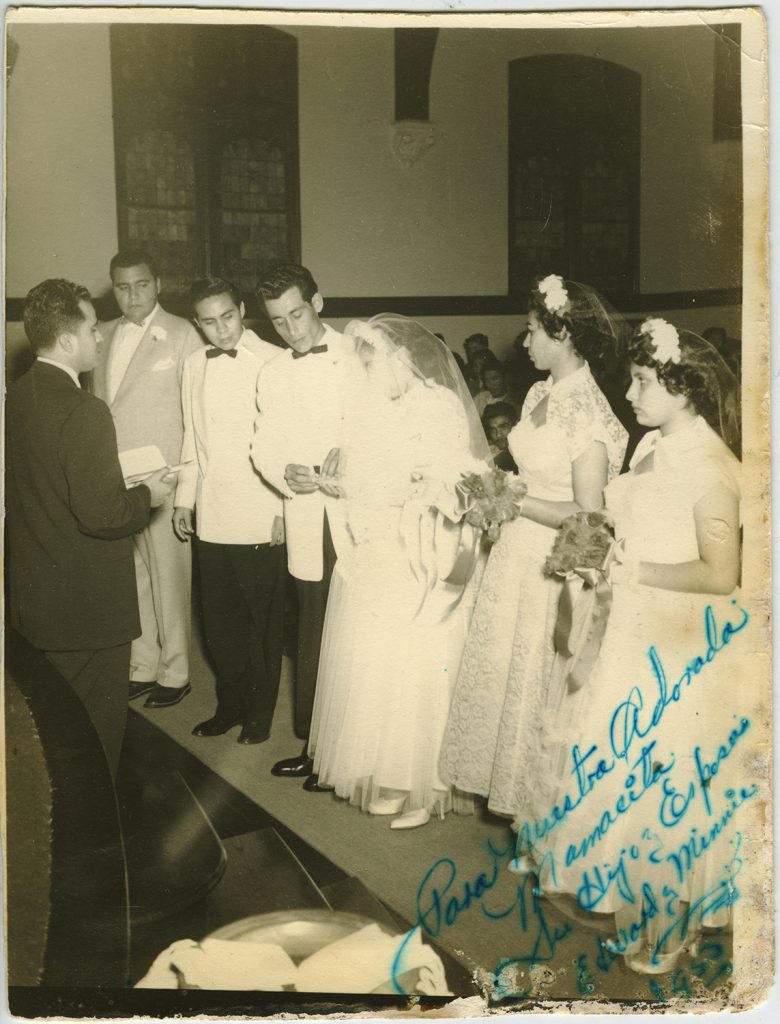
My Mexican grandfather was born in Austin, Texas, on August 19, 1929. I know this because I have his birth certificate, issued by Travis County and the Texas State Board of Health. But no, rather: I have a scan of his birth certificate, one that exists in the public records and is downloadable if you know where to look and have the flexibility of thinking to realize that a hundred years ago, your family surname was spelled differently than we spell it now. His actual birth certificate, the paper itself, is missing. Perhaps it was lost in one of the family’s many travels back and forth across the river over the last century. Perhaps it is currently sitting undiscovered in a box in my aunt’s attic in Arlington, Texas. Perhaps it is tucked forgotten in the back of a desk drawer somewhere on a crooked mountain street in Monterrey.
My Mexican grandfather was born in Texas because two identifiers are not different. For centuries, my ancestors moved back and forth across a river that has only very recently been considered a border. In 1836, following an Anglo-settler-led revolt against Mexican governance, Texas declared itself an independent nation (although Mexico never recognized the “Republic of Texas”). In 1845, Texas gave up thoughts of nationhood and joined the United States (and was recognized as the 28th state — still not recognized by Mexico). In 1848, following outright war between Mexico and the United States, Mexico relinquished a huge swath of their northern territory — including Texas — to the United States.
To be Mexican in Texas, even today, is complicated, but Texas is full of Mexicans — or perhaps Mexico is full of Texans — or perhaps all of these distinctions break down when you look at them hard enough.
When my grandfather was still a child, his family returned to their ancestral home in Monterrey, in Nuevo León. Opportunities, at the time, were better in Mexico than in Texas. He grew up there, among the slopes and basins of the Sierra Madre, but by the time he was seventeen, opportunities had reversed. He and his older brother decided to go north again. After all, they were American citizens.
My grandfather’s birth certificate lists his family’s address at the time of his birth as Sabine Street, which sits three blocks from the Texas State Capitol building. I was living in Austin when I began this research, and I drove to the approximate location. Today, a bulky chain hotel that caters to visiting politicians and tourists towers over what had once been a working-class neighborhood where my grandfather took his first steps.
I am trying to think of this birth certificate — this piece of paper — as evidence of life, as evidence of belonging, as a description of identity, but I keep stumbling over the strange elements of his existence as documented on the birth certificate. It lists his parent’s occupations (“tailor” and “housewife”), which feels like a glimpse into their daily life that I cherish. It declares the status of his birth (“legitimate”), and lists the birthplace of both parents (broadly, “Mexico”). It also lists the “color” of both parents (“Mexican”); it does not mention race or ethnicity, it states “color” — and yes, “Mexican” was apparently a color to be documented in Texas in 1929.
My grandfather’s parents, Herbert and María de la Luz, were aged 29 and 30 respectively, at the time of my grandfather’s birth. They would not have remembered a time when Texas and the sweeping lands to the west were all part of Mexico, but their parents would have remembered when the sprawl of today’s Texas, New Mexico, Arizona, Nevada, Utah, and California called themselves Mexico, as did parts of Colorado, Oklahoma, Wyoming, and Kansas. It is much more convenient these days to forget that it was only halfway through the 19th century that nearly half of what is now known as the United States spoke Spanish as their first language and answered to the capitol far to the south that lies on the shores of Lake Texcoco and the ruins of Tenochtitlan.
At the age of seventeen, my grandfather and his brother returned to the place of their birth. They hitchhiked north in what I can only imagine was a wildly dangerous venture. They carried a grocery bag filled with the only belongings that would accompany them on the journey: toothbrush, change of underwear, canteen, a Bible. Monterrey is some 230 kilometers from the US-Mexican border. Stopped at the border in Laredo, they argued their case: They had been born in Texas. They were US citizens.
But neither one of them had their birth certificate; neither one of them carried proof of their citizenship. They had grown up in Monterrey, spoke only Spanish, had spent the bulk of their young lives among their crowds of family in one of Mexico’s largest metropolitan centers. It was late in the day in dusty Laredo. The sun was going down, the US border guards were bored or tired or frustrated or all of the above. They had no reason to solve this problem immediately, so they detained my grandfather and his brother overnight. This was a humiliation my grandfather would remember for the rest of his life, the first blow the United States dealt him when all he had done was dare to tap at the door and claim his belonging. He slept that night on a concrete bench with a newspaper under his head. In the morning, the border agents called whatever office in Austin they needed to contact to confirm the details of my grandfather’s birth. He and his brother were set free into the north.
My family and I passed through this same border station in Laredo every summer when I was growing up. There was always an event that served as an excuse for these excursions, another cousin getting married, a birth to celebrate, a funeral to attend, but the truth was that we all loved going to Mexico. These long summer days were the highlight of our year. There are certain scents, certain foods, flashes of images that I can conjure even today, sitting here in a library in New England writing these words, that take me back to the Mexico of my youth. I remember a particular grind of corn, the smoke from the cabrito restaurant, a dusty football being kicked down the potholed hill by my cousins, the shout of the street vendors (“Tamaaaaales! Oaxaqueños!”), the tías’ high heels on the marble church steps and the incense swirling around them.
Right now, I am the same age as my grandfather was when he died. For a few more months, we will share this collection of years, and then I will be older than he ever was.
He died suddenly, at home, his wife in the next room. He woke up with a headache, lay down to take a nap, and never got up again. He left behind two children (my father, age seven, my aunt, an infant), a home he owned, dozens of paintbrushes, and a paint-stained ladder that still sits in my father’s garage. He left behind a widow who was not yet thirty. He left behind his business cards and paycheck stubs, a cookie tin stuffed full of coins and small bills that he called his son’s college fund.
The same day I found my grandfather’s birth certificate, I also found his death certificate. He died on February 27, 1963. Because the circumstances of his death were unusual, an autopsy was performed. This document lists his cause of death as “unknown.” The working theory was a sudden brain aneurysm, which is a word I knew how to spell by the time I was five years old because this story has possessed me since I first heard it.
At the hospital, after the death had been officially declared and the paperwork filed, they asked my grandmother if she wanted his wedding band. She said yes. Someone — a doctor? the coroner? — went to fetch it for her. He came back some time later and told her they couldn’t get the ring off his finger. It wouldn’t budge. Was she sure she wanted it?
So far, you know nothing of my grandmother, but let this one thing tell you of her sheer strength and determination. She said yes again. She said she would do it herself. She went into the room where he lay still on the table and took his hand in hers and slid the ring off his finger.
She always said, “It came right off, I barely had to pull.”
After that, she wore his ring on a chain around her neck. I used to touch it through her blouses and hope that one day I would know a love like that.
Lucía Retta is a writer and artist who grew up in Texas and currently lives and teaches in Providence. She holds an MFA from Brown University and is at work on her first novel.