“Man is born free, yet everywhere he is caged.”
Barbed wire, concrete walls, and guarded toll booths — even with friendly guards — confine people to the nation-state of their birth. But why? Borders are human inventions, arbitrary lines that separate us not only politically, but also socially and culturally.
I’ve always believed that to understand life at its fullest, you need to visit the edges — the places where definitions get stretched. Border towns are exactly that: spaces where division and connection live side by side.
Growing Up on the Border
I grew up in El Paso, Texas, a city stitched to México. For many residents, crossing the border isn’t unusual; it’s daily life. You live between two cultures without ever needing to declare it.
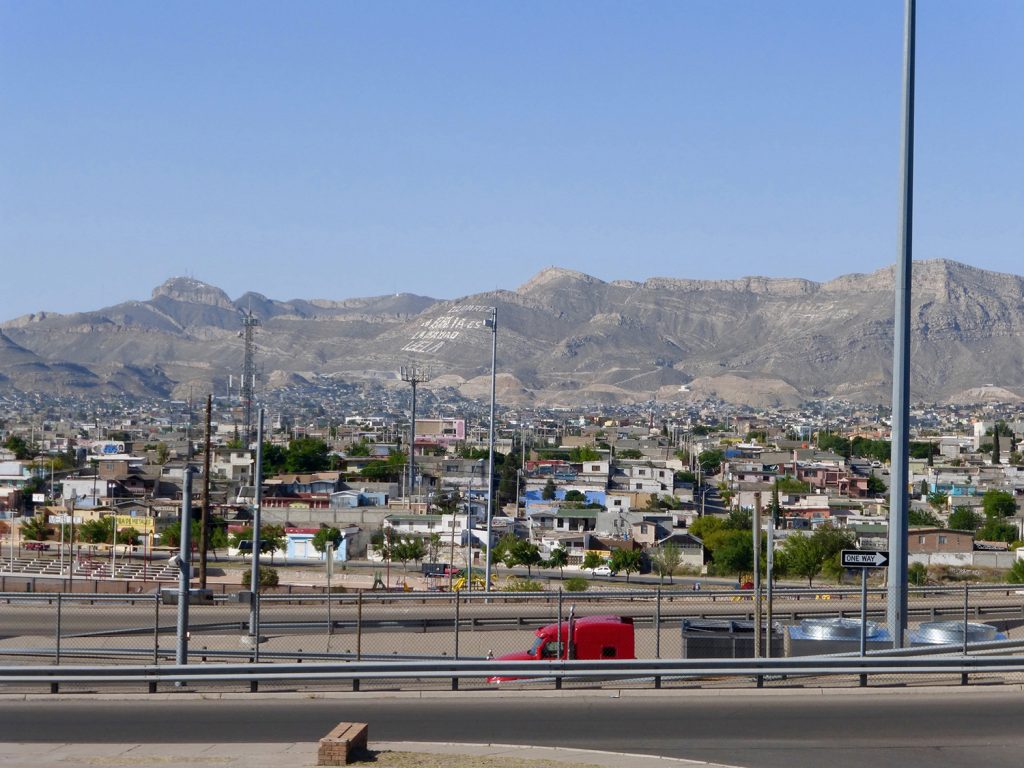
As a child, I often looked out the classroom window of my elementary school, which sat just yards from the border highway. Below that was Paisano Drive, hugging the Rio Grande, and beyond it rose the Cerro Bola Mountains, overlooking Ciudad Juárez. From that vantage point, I often wondered: were children over there sitting in classrooms like mine, or not in school at all? That question stayed with me, long after I left.
One of my favorite memories was watching the Portland Cement Company implode a building on Paisano Drive. My classmates and I crowded the second-floor windows to watch it collapse in a cloud of dust. BOOM! It stood frozen for two seconds, then fell all at once. Across the border, people in Juárez were watching too — waving and cheering. We waved and cheered back. For that moment, the border disappeared. We were neighbors sharing the same experience.
The Weight of the Wall
The border is not just a line; it is also physical — and heavy.
Between El Paso and Juárez, a chain-link fence topped with barbed wire was built in 1979. Locals called it the Tortilla Curtain. Today it’s known simply as the Border Wall.
The wall runs alongside a playground in El Paso. Children climb and slide in its shadow while families sit on benches, hoping to glimpse relatives who live on the Juárez side but cannot cross. When they spot each other, they wave through layers of wire and steel. Waving is all they can do, because Border Patrol agents stationed nearby watch closely.
It is a painful ritual: people reduced to waving at loved ones across a fence. The wall shapes not only the movement of bodies, but also the psyches of those who live in its shadow.
“The wall shapes not only the movement of bodies, but also the psyche of those who live in its shadow.”
A Journey with a Camera
In 2015, thanks to a Rhode Island Foundation Fellowship, I had 18 months to step away from my daily work and explore border towns through the lens of my camera. Photography had always been a passion, but this was my chance to treat it as more than a hobby. I also wanted to use my oral history skills to record stories and pair them with the photos.
With fellowship funds, I bought my dream camera — a Leica D-Lux 7. Equipped with two cameras, multiple lenses, and an audio recorder, I set out to capture people, landscapes, and stories in border regions.
I began in my hometown of El Paso, where my parents still lived. From their living room, the 29-foot Mt. Cristo Rey monument glows at sunset, perched high on the North Franklin Mountains, which separate Texas from New Mexico, and on the other side the mountains border Juárez and the State of Chihuahua. Mt. Cristo Rey towers above two nations and three states at once — a reminder of how arbitrary borders are, and how much hope people project onto them.
I revisited my old neighborhood, Sunset Heights. Behind our home was an alley, which separated us from my elementary school and then from the border highway. I still remember dashing across it at the sound of the morning bell to get in line with my classmates and returning home at lunchtime to find a warm bowl of sopita de fideo waiting on the kitchen table.
Beyond the Southwest
Although my focus was the U.S.-Mexico border, my travels taught me that border life exists far beyond the desert.
In Miami, the vibrancy of Cuban culture makes the city itself feel like a border zone — a place where the Caribbean and the United States meet daily, with no wall in between but plenty of cultural crossings.
In Phoenix and Tucson, I encountered stories of migration, resilience, and blending identities. The desert there carries its own weight: heat, distance, and the ever-present possibility of crossing or not making it to El Norte at all.
Farther north, I traveled to Washington State and British Columbia, where the U.S.-Canada boundary feels less harsh but just as real. In Alaska, I crossed rivers and canals to reach islands where border culture thrived in subtle ways, shaped by waterways rather than walls.
And in Maine, much to my surprise, I felt border life just as strongly as I did in El Paso. There, I met Mexican workers picking blueberries in the fields. Later, across the line in Canada, I heard the beautiful sound of Spanish being spoken at a farmer’s market where tacos were being sold. On both coasts of Canada — east and west — I heard a mix of languages, but Spanish was the one I least expected. Borders, I learned, stretch far beyond geography. They travel with people.
Lessons From Borders
Borders, I’ve come to realize, are not just lines on maps; they live inside of us, shaping who we are and how we see others. They can divide, but they also create spaces of exchange, memory, and possibility.
My travels showed me that border life is fragile, yet also deeply human. Whether in El Paso, Arizona, Miami, or Maine, people continue to create connections across lines — sometimes through trade, sometimes through culture, sometimes through nothing more than a wave.
Why Borders Matter Now
This essay is just one glimpse from my fellowship journeys. I’ve published more stories and photographs from border towns and cities — both along the U.S.-Mexico divide and beyond — on my website: www.martavmartinez.net.
But I share these stories now because they feel urgent. In 2025, immigration policies are shifting again, and border communities are carrying a heavy weight. The wall is not just standing; it is symbolically higher than ever. Families are separated, movement is restricted, and the daily exchanges that once defined border life are crumbling.
And yet, amid that reality, people still wave. They wave across the fences, across rivers, across invisible lines of culture and language. That gesture — fragile, fleeting, and deeply human — is what keeps me telling these stories.
Photo by author