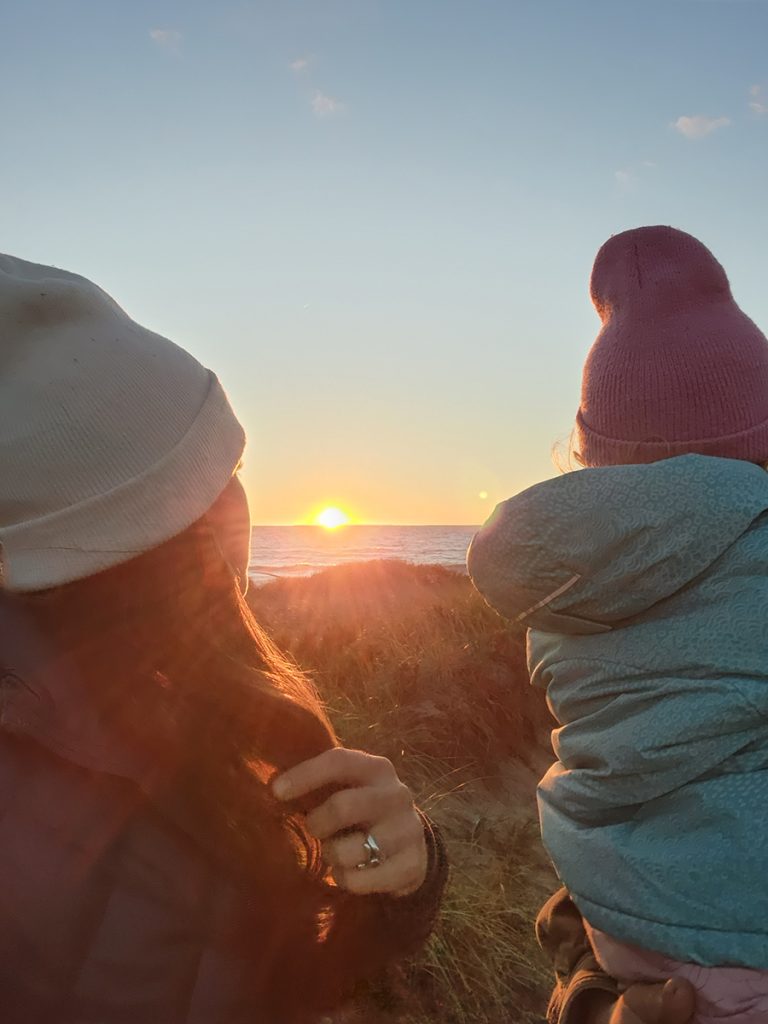
There’s a quiet stretch of winter on Block Island where time slows to a gentle crawl — the kind of quiet where you can count the cars passing by in a single afternoon on one hand. It’s in this rare, windswept stillness that Milaina Bell, one of the island’s most committed restaurant professionals, finds balance, rest, and community before the frenzy of summer returns. Since moving to Block Island full-time in June 2020, after years of summer visits and seasonal work that began in 2012, Milaina has made a life here that pulses with the rhythms of the island itself. A mother, neighbor, and seasoned restaurant worker, she navigates the island’s shifting tides with grit, warmth, and an unmistakable love for the place she calls home.
“I have been visiting my whole life. As young as three years old, there are photos of my dad and I visiting the island,” she tells me during a quiet moment squeezed in during her daughter’s nap. “But that first summer I worked here, in 2012 — that summer changed everything. The friendships, the pace, the beauty… It left its imprint on me forever.” Like many who work on Block Island, Milaina’s professional life is deeply tied to the island’s seasonal nature. She works at three different restaurants throughout the year — two during the bustling summer months and one in the winter. It’s a pattern many year-round residents understand intimately: summers are for grinding, winters are for breathing. “In the off-season, I spend my days with my daughter, a trip to the post office, the grocery store, maybe a playdate at the library,” she says. “It’s slow, and beautiful in its own way. Sometimes we just stay inside and make soup or crafts when the wind is howling outside. It’s peaceful.” That calm doesn’t last long. By mid-May, the energy begins to shift. Memorial Day weekend marks the unofficial start of summer, and the week before it is a flurry of preparation. “We scrub everything down, stock up, and get everything in its place,” she says. “Because once July hits the real madness begins.”
And madness might not be an exaggeration. As thousands of tourists pour onto the island in search of ocean breezes and lobster rolls, Block Island transforms into a buzzing hive of activity. Errands that might take Milaina 20 minutes in winter now demand patience and strategy, as locals weave around e-scooters, mopeds, traffic, and the general chaos of peak summer. There’s a deep pride in the way Milaina speaks about her work and her role on the island, but also a candor about the complexities that come with it. “Don’t get me wrong, this island needs the tourists to survive,” she says. “But there’s a difference between just visiting a place and also respecting it. I think that sometimes people forget that this is our home.” Rather than focusing solely on the frustrations, Milaina draws attention to the challenges with a kind of practical hope. Litter, traffic, disregard for local customs — these are not insurmountable problems, but they require a mutual understanding between visitors and residents. “The laws and rules still apply here. We use blinkers here. We stop at stop signs,” she says. “But summer also brings so many beautiful moments. Friends returning. Beach days with our kids. I love it here in the summer, but it’s not without its challenges.”
She especially looks forward to Sundays. “Family beach day,” she calls it. “And by family, I mean this large group of locals and all their kids. We try to get there early to stake out a spot before we can’t get one.” In her view, Block Island has undergone real transformation in recent years — economically, culturally, and socially. “It used to feel like a secret paradise. Homes were affordable,” she says. “Relaxed. Laid back. Fishing, drinking, humble. The cottages were small. Rooms were $99 a night. It wasn’t the fanciest but we didn’t care. Hotel rooms are $500 a night now and little quaint cottages are getting bought and torn down to build 3,000-square-foot houses.” But Milaina isn’t waxing nostalgic just for the sake of it. Her reflections offer a nuanced portrait of a place at a crossroads: one that is increasingly influenced by external forces but still anchored by the people who live and work here year-round. “I know that change is inevitable,” she admits. “But that doesn’t mean that I have to like it.” Despite the challenges, or perhaps because of them, she remains deeply committed to island life. Her daughter has only ever known Block Island as home, and that sense of belonging runs deep.
In the off-season, when the beaches are empty and the ferries canceled due to weather, she finds herself savoring the little things. Shore days. Dinner parties at friends’ homes. Music class at the library. “I love in the off-season that everyone waves to each other when driving,” she shares. “It might seem silly, but it makes me happy. It’s one of my favorite things here.” There’s also a comfort in the off-season work. With fewer guests, there’s more time to talk to patrons, many of whom are familiar faces. “I know almost every one of them. It’s like serving your extended family.” When asked what keeps her rooted here, year after year, Milaina doesn’t hesitate. “It’s home,” she says. “Not just the physical place, but the people, the memories, the feeling. There’s nothing like walking the beach and being the only one on it. Or hearing your kid laugh while the wind howls outside and you’re baking cookies. I love the sense of community I feel here.” In a social climate where so much attention is given to what’s new, flashy, or fleeting, Milaina and her community represent something different: the enduring heartbeat of Block Island.
As the island prepares for another summer, it’s people like her who truly keep it going — showing up to work, keeping local businesses alive, staking out beach spots, waving from their cars, and loving the island even when it tests them. And when October comes and the ferries depart, it’s people like Milaina and the community around her who finally breathe, taking in the quiet, the beauty, and each other, as the island itself exhales and remembers what it feels like to just be. •