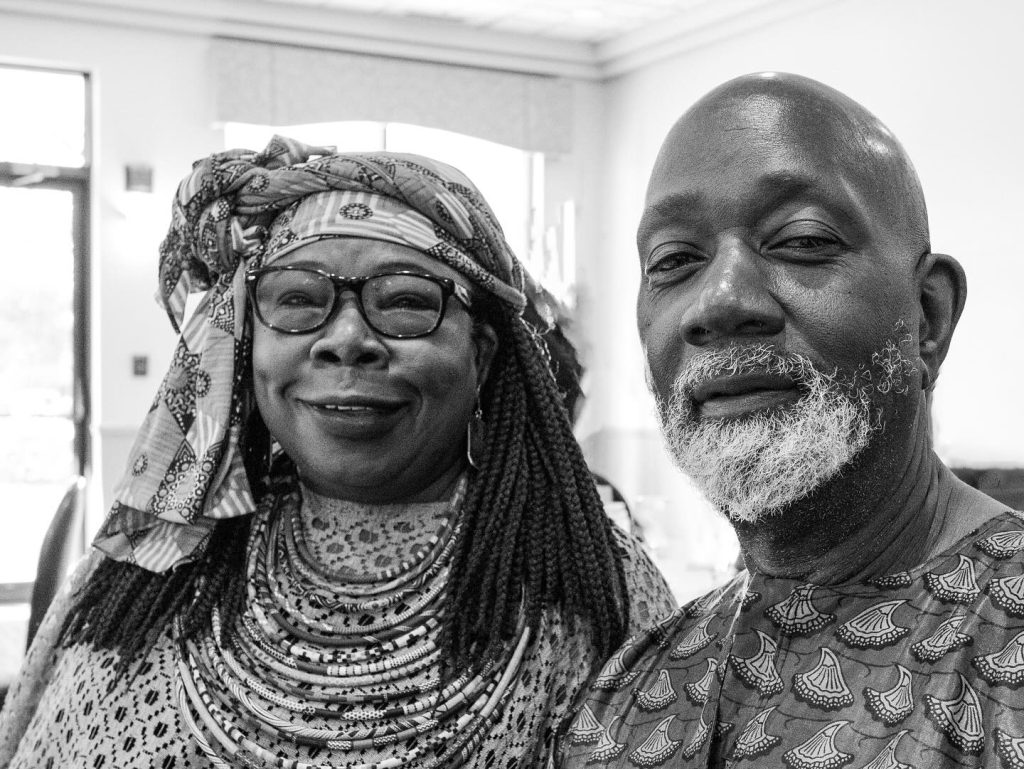
Ricardo and Bernadet Pitts-Wiley of the Mixed Magic Theatre in Pawtucket have been married for 48 years, and have been colleagues in the theatre space for 26. Over the last few years, I’ve noticed how there are so many Black trauma narratives and painful histories being told in different forms of Black art. It’s almost as if Black creatives are responsible for telling these types of stories, and works about joy and celebration are sometimes seen as vapid and without substance. The Pitts-Wileys have spent their theater careers refusing this binary.
“Our history and joy are indefinitely linked,” Ricardo says. “We have had to learn how to tell our stories where we included our joy all the time”.
The Pitts-Wileys view Black celebration and Black struggle as inherently inseparable. They have been committed to telling Black stories without centering other people’s stories, one of the foundations of Mixed Magic Theatre, the company they co-founded in 2000. Authenticity has also been one of the key foundations of their marriage, which began when they met at Brown University and has sustained five decades of creative collaboration, raising children together, and building a Black arts space from the ground up.
“We often get cast as a subcategory,” Ricardo explains. “Instead of just being an artist, I’m a Black artist. Well, I’m just an artist. My wife is just an artist. That we happen to be Black is a bonus.”
The theatre’s name is as intentional as the stories told there. “Mixed Magic theatre tells stories. We tell Black stories. We tell stories from around the world,” Bernadet shares. “It takes time dealing with Black culture itself, which is continually marginalized and dismissed, even though quite often appropriated. Our journey here at Mixed Magic Theatre is to continue to tell those stories, to refuse to be erased by those naysayers.”
On Black love in America, Ricardo shared enlightening thoughts about how joy itself becomes resistance: “I have become, in my life, more enamored with the beauty of Black people. They get more beautiful as I get older. And also, I’m constantly amazed by the strength and power of Black people, their resistance, their resilience, their creative survival instincts. And also, the depth of their love. Black people, when they love, they love deep.”
But that loving and nurturing spirit has to be guarded and exercised with awareness, because unfortunately, that’s just the nature of the cutthroat and individualistic society we live in. “Our gentleness, our kindness, can also be perceived as a weakness, when it really isn’t. It’s our strength,” Ricardo explains. “We have held onto our humanity in spite of incredible, tragic events being imposed on us.”
Bernadet frames it through the lens of sacrifice, faith, and radical hope. “You’re sacrificing quite a bit. But that sacrifice comes with your belief that the future is always going to be better. If you just hold on, if you just keep sharing, if you just keep bringing compassion to the table, things are going to get better.”
This forward orientation is precisely what is meant by the word sankofa, a concept originating from Ghana, meaning to learn from the past and carry that wisdom with you while also moving toward a better future. It’s often represented with a symbol of a bird looking backward to retrieve an egg. This mindset has defined both their marriage and their creative work. “The key thing about the Sankofa bird is it is moving into the future,” Ricardo explains. “Even though it’s looking back, it draws its strength from what it sees behind it. The winds of support, the forces that lift us off the ground, the forces that allow us to fly.”
The secret to their 48-year marriage? “Don’t be afraid to fight. Just don’t let it end with a fight. End with a connection,” Ricardo says. Bernadet adds another layer: “Start off with respect. If you’re able to respect the person, then you can disagree and carry on.”
Beyond romantic love, the Pitts-Wileys cherish the value of Black love, joy, and celebration as a generative creative force. “Black love is manifested when we allow ourselves to be creative with other Black people and the world,” Ricardo says. “When we sing, when we dance, when we smile, when we paint, when we poet, when we storytell, and something new gets born out of the creative energy. That’s a lovely thing.”
Despite what has felt like backward movement in American progress on race relations, Ricardo imparted this optimistic message: “No matter how many times the boot attempts to be put on our throats, we will rise up anyway. We cannot be held down. Forces have been trying to do that for so long and they failed every time. And they will fail again.”
How exactly do a people keep fighting when these forces have gone to lengths to suppress them, make them feel lesser, break them down until they’ve given up and lose all hope? That resilience comes from collective memory that informs how they carry themselves in modernity.
“We sustain ourselves from knowing that the sacrifices that have been made for us weren’t made in vain,” Bernadet explains. “Quite often, growing up, we would hear the old ones say ‘my soul looks back and wonders how I got over.’ And they know that they got over because we were standing on their shoulders. And that foundation is as strong as it ever was.”
“We heard something from an author that we as Black people are from the blood of kings,” Bernadet says. “And from that blood you are forever. There is a future and you believe that and you pass it on.”
The Pitts-Wileys have been going strong in passing on those stories and timeless wisdom for 26 years, building Black love into every production. One thing I learned from talking to them is that there is no Black love and celebration without struggle. But I’m reassured in knowing that there is no struggle and oppression that Black people go through where Black love and celebration are not enduring throughout, in spite of the forces that try to extinguish it.
Visit mmtri.org to purchase tickets and learn more about their upcoming productions.