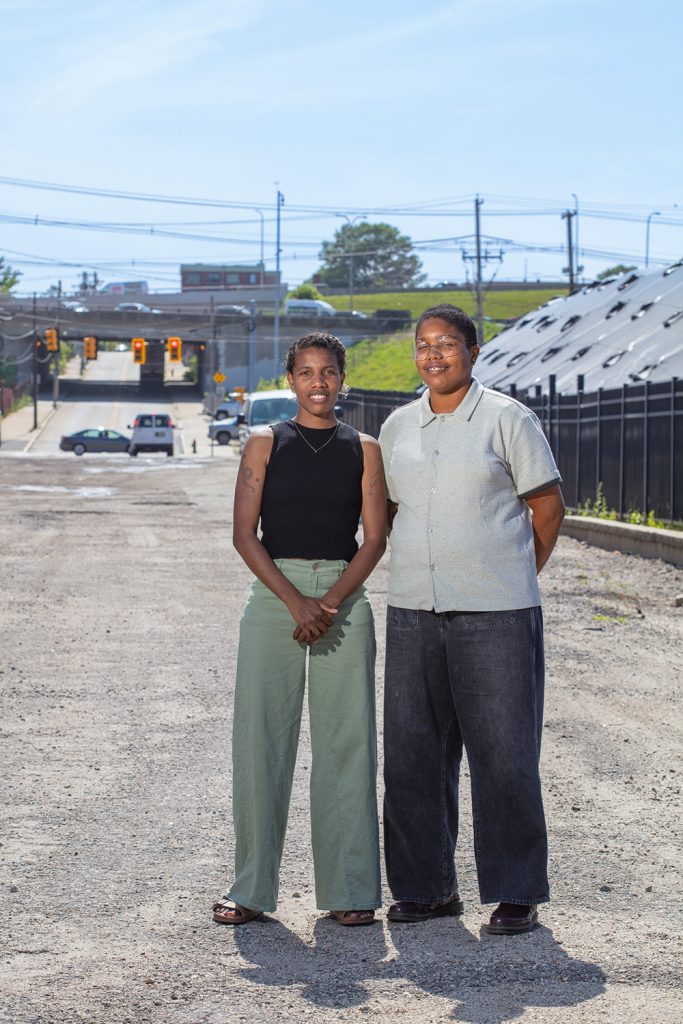
The South Providence People’s Archive (SPPA) is a collaborative project between Providence-based artists k. funmilayo aileru and Edwige Charlot. Commissioned through the Providence Commemoration Lab, the SPPA seeks to “contribute intimate accounts of Black and Native American life to the public record” by collecting, recording, and preserving ephemera, objects, and memories “that document the people, places, and ways of life that animate the neighborhoods surrounding Public Street.” Both funmi and Edwige are former AS220 staff members and colleagues of mine who played vital roles in the AS220 Youth and Community Studios (then known as the Industries). They both cultivated culturally responsive spaces through their policies and practices, prioritizing accessibility. You can learn more about their work and the SPPA at edwigecharlot.com/South-Providence-People-s-Archive
What motivated you to embark on this project?
Edwige: The South Side is an area that is presently experiencing high levels of gentrification. It’s being labeled as revitalization, but we understand that to be the new term for the urban redevelopment that happened in the same area from the ‘50s through the ‘80s. In the research that we’ve done, what we’ve often found is that the folks who lived in the neighborhood were often not the ones telling their own stories, and do not get to represent themselves in the public record. There are lots of photographs of buildings, topographical views, and maps highlighting different challenges or issues. What we found was that it was devoid of people. We were thinking about how can we, as artists, do this work meaningfully and what it looks like for a community to have autonomy and agency in telling their own stories. The South Providence People’s Archive really sprung from that. k. funmilayo: We’re seeking deeper reflections of intimate life. Oftentimes, when Black and Indigenous life is reflected in the public record, it’s in contrast to whiteness or white supremacy being enacted upon the neighborhood and the communities there. We are really concerned with what those intimate accounts look like when people are telling their own story.
What is your process for engaging with the community?
Edwige: We go to events where people are already gathered to let people know that we exist. We do events and pop-ups where people can come, see the research that we’ve done, what we’ve collected, the equipment that we use, and demystify the process. We’ve purchased equipment, scanners, printers, and provide those services free of charge. The caveat is that you have the agency to give us permission to include your materials in the archive, or you can just utilize the services. We’re trying to minimize the extractive nature of this process. We also do one-to-one appointments and give folks the opportunity to tell us where they want to meet, where they’re at. We’ve met folks at their homes and their offices.
k. funmilayo: It’s made me hyper-aware of collective consciousness on a neighborhood level that I haven’t engaged with before. It has been good to hear about different events from different perspectives. So when I think about my mother, a boomer, talking about the riots that happened on the South Side after the MLK assassination, and hearing stories about the OIC (Opportunities Industrialization Center), Buddy George, and members of the Fact Finding Committee… Now I’m hearing it from other Elders that I did not know personally before, and it’s just been interesting to hear how those events have impacted the trajectory of many lives on the South side.
It’s also given me an invaluable opportunity to have generational conversations with other Black millennials from the South Side. Conversations about national events that were happening. 9/11 really impacted my generation. No Child Left Behind really impacted my generation. The Patriot Act. These national conversations, but with a Providence and Southside-specific context. Events, particularly around death and dying, have come up. It’s the first time I’m having these kinds of conversations with folks beyond my own family or friend group, and seeing how these events have impacted a generation of folks from a specific place.
Have there been any standout moments for you in the project so far?
Edwige: Part of our research led us to find a collection at the Library of Congress, which includes images by a photographer by the name of Henry Horenstein. There is a set of images of Ebenezer Baptist Church congregants. They were taken in 1979, in the fall, during an outdoor service. We found it troubling that the people photographed were not named. Unfortunately, this is an example of Black erasure from public record, a common practice. So we’ve spent the last three months working with members of the Ebenezer Baptist Church community to identify people in the photographs. It’s been both an effort to correct the record and also to rectify what we’ve identified as a challenge of these archives that are held by the system – that often Black and Brown and Indigenous people are nameless. It’s great that these images exist, and why do we continue to remain nameless? We’re going to go meet with an elder of that community to do the last round to identify some of the folks that we haven’t been able to identify. That feels like a big win, because we’re actually in contact with the Library of Congress. Our hope is to submit the names of the people in the photographs, and I don’t know how long the process will take, but it will list the folks, the Black folks in those photographs, along with the photographer. It feels like a real, tangible shift in what we’re hoping to do with this project.
What does the future of the archive look like?
Edwige: Our hope is to create a digital platform for people to engage with the things that we have, and to start educating folks that are taking part in efforts, and initiatives, and movements within the neighborhood to think about how we want to remember the work that we’re doing? Unless we, as the people on the frontlines, on the ground, doing this grassroots level work, are documenting what we’re doing, our stories won’t be documented. Whoever writes the record is the person who gets to shape the narrative.
k. funmilayo: Because of various forces at play – relocation, redevelopment, revitalization… Whatever we want to call it today – a lot of folks, who are Black American and from the South Side specifically, are now dispersed throughout the city and throughout the country. In a conversation I was having with someone recently, they reflected on, “We did the ‘American Dream’ thing of excelling in school, going to college. We wanted to return to the South Side and we couldn’t afford it. We got priced out.” So, this is also a call to folks and an opportunity to return home and do some work even if you cannot physically live there anymore. •
Photo: Artists Edwige Charlot and k. funmilayo on Public Street in South Providence, 2025. Sindaiganza Photography.