When a whale dies, sometimes the ocean delivers it back to us. Whether it drifts ashore in a quiet cove or crashes onto a crowded beach, its body becomes a stage upon which humans project meaning: grief, gratitude, and even opportunity.
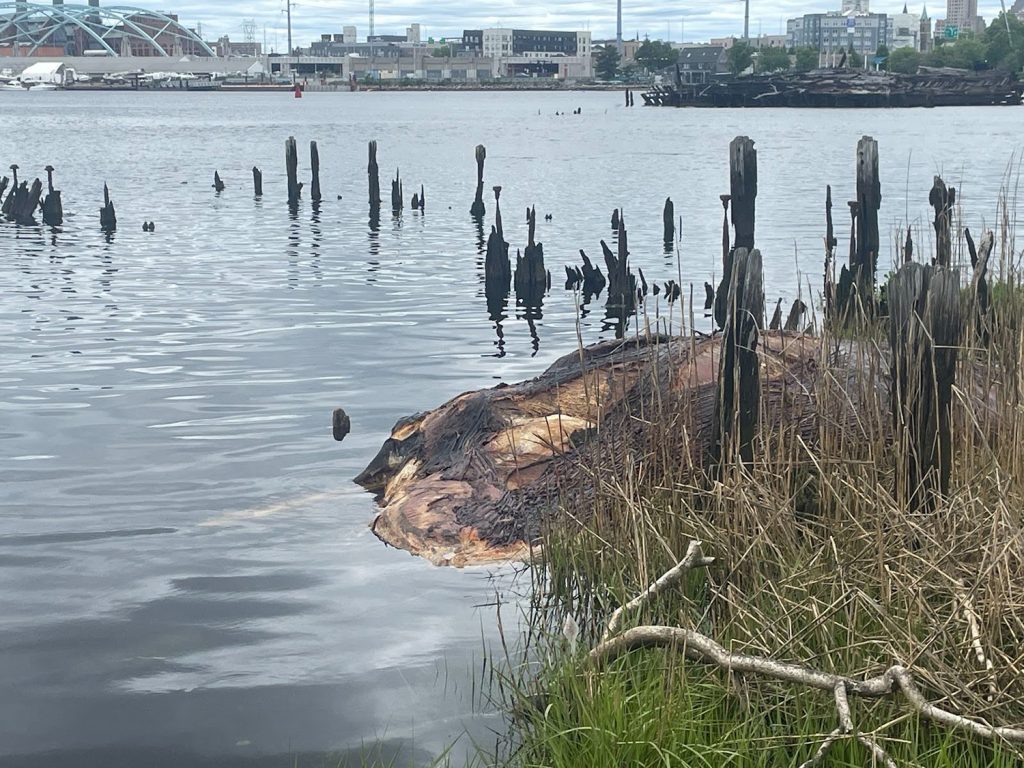
This past spring, a minke whale carcass washed up against the shoreline at Bold Point Park in East Providence. By the time it arrived ashore it was four months dead, and too far along in decomposition for necropsy or removal. Following expert recommendations, the state announced the corpse would be left to naturally decompose.
Like many curious Rhode Islanders, on a cold spring morning passing through the city, I stopped (at a distance) to see the body for myself. The smell of petrification, sweet and miasmic, hung heavy in the air. I took a photograph, and then immediately felt ashamed of my curiosity, yet my eyes stayed fixed. Phone half-raised, I was caught between the morbid urge to document, and reverence. Witnessing such a massive mammal, undone by death, decay, and bloat, revealed a scale of life and death I had never before encountered.
Among Indigenous people of southern New England, the death of a whale has long been an occasion for reverence. Whales fed villages, their bodies yielding food, tools, and shelter. But they also inspired songs, prayers, and rituals. “Our people were sea-going people and still are,” says Loren Spears, councilwoman of the Narragansett Tribe and director of the Tomaquag Museum. “Whaling was dangerous, going out in dugout canoes. You had to respect the greatness of the whale, the waters, and the balance of life itself… There were ceremonies before, during, and after. If a whale was stranded or harvested it fed whole villages… Gratitude and grief were both a part of it.” In this worldview, a beached whale was never just carrion. It was a gift, a sacrifice, and a reminder of the ocean’s generosity and its peril, an event threaded with gratitude and grief.
When European settlers arrived, that understanding shifted. The whale was no longer a gift from the seas, but also a commodity. Where the Narragansetts carried out ceremonies of balance, colonists reveled in the opportunity to play god, decimating the New England whale population. They saw barrels of oil, stacks of baleen, cargo to be sold across the Atlantic, and beyond, raw capital. By the early 1700s, Rhode Island was paying bounties for whale products, and Warren became a thriving port; the whaling fortunes built the houses that still stand today. A whale washed ashore became a harvest stripped in haste, blubber boiled, bones cut off, meat tossed aside. The reverence was gone. Colonists conscripted Indigenous men into the whaling trade, exploiting their skills at sea while severing it from its cultural roots. The slaughter nearly erased whales from the Atlantic and left Indigenous people caught between two worlds. By the nineteenth century they had been hunted to the edge of absence, until petroleum replaced whale oil and the industry collapsed.
Today, the sight of a dead whale carries a different meaning. Chris Dodge, a volunteer with Mystic Aquarium’s Animal Rescue Program, has responded to marine mammal strandings and emergencies along RI’s coast for the last eight years, rushing to beaches and coves when the hotline rings. Since 2017, minke whales have been dying in unusual numbers along the Atlantic coast, an “Unusual Mortality Event” (UME) that remains unresolved. “Even if the whale is already dead, it’s important to get there quickly,” Dodge explains. “We need samples before they’re lost.” From samples of parasites, to fishing entanglement scars and blunt trauma from ship strikes, clues help provide critical data for marine research. Other samples, such as that from whale ear bones, can help scientists test for damage from underwater noise, a controversial question amid the offshore wind farming debate. Each dead whale becomes a data point in a larger story about human impact on the oceans.
The work is technical, measuring sampling, documenting. But it is also human. “Honestly, every one of them has had an effect on me,” he said. “It can be really discouraging, seeing how vulnerable they are to what we do.”
Across centuries, the death of a whale has reflected the values of the humans who find it. For Indigenous peoples, a stranded whale was a moment of ceremony, of gratitude and grief. For the whalers of Warren, their bodies were the source of fuel, fashion, and fortune. For today’s scientists and rescue workers, it is evidence in a forensic investigation of an ocean in crisis.
A stranded whale unsettles us because it feels like a signal, a sign that something is wrong in waters we have destroyed with our ships, our noise, our extractive appetites. That life is fragile. The vestige of a whale’s body requires reckoning. As Spears says, “When whales beach themselves, you know something is unbalanced in the ecosystem. We live in a place that needs balance. When there is no balance, we die.”
Visit mysticaquarium.org to consider volunteering or donating to Mystic’s Animal Rescue Program (MARP).