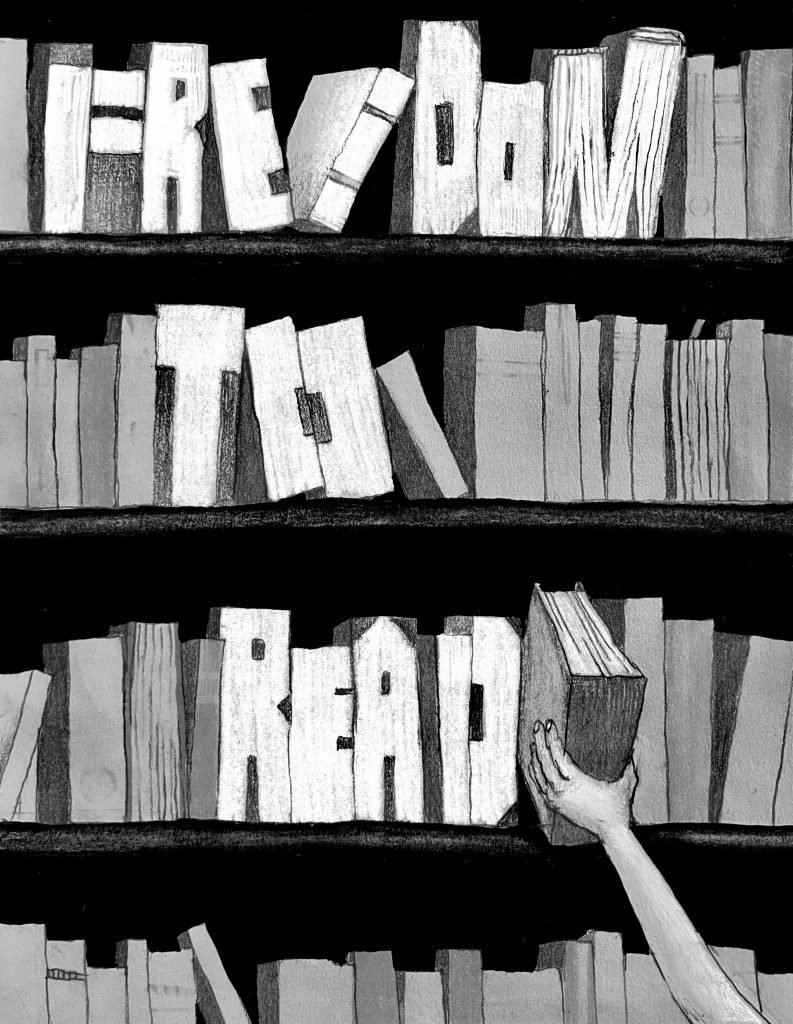
There are books I’m sure everyone is familiar with — horror, fantasy, thriller, etc. However, a new genre has emerged this year for discussion among the library community: “Banned Books.” Books whose content is considered inappropriate, offensive, or graphic, thus why they’re being removed from libraries. I was surprised to discover some examples of banned books were ones I read in school, including To Kill a Mockingbird, The Kite Runner, and 1984. This issue took the book media by storm, and the calm is passing the “Freedom to Read Act” to prevent censorship, with support from organizations like AABB RI (Association Against Book Banning Rhode Island).
RI Governor Dan McKee passed the “Freedom to Read Act” in 2025, giving locals the right to read books in the state’s public or school libraries. The bill gives people protection to choose books by preventing censorship or politically-motivated bans. Association Against Book Banning RI is one group involved with the act passing the RI legislature.
I had the opportunity to communicate with authors and organization co-leaders Jeanette Bradley and Padma Venkatraman. I communicated with Padma first, then Jeanette, who responded with her own thoughts about the Freedom to Read Act. She reached out to Motif Magazine to spread awareness and stopped by the office with her daughter to create zines. They shared the challenges of passing the bill and what’s next for AABB RI.
Sabrina Ruiz (Motif): What were some of the challenges faced when trying to pass the bill? And what has the outcome been like?
Padma Venkatraman: Several organizations came together to pass our bill —and my co-leader at AABB-RI, Jeanette Bradley, and I, worked very hard, along with many others, to build and support a grassroots coalition. According to studies, the American public overwhelmingly opposes censorship and supports freedom of expression; but despite this, we did see pushback — mostly, I think, because there are very well-funded and well-organized groups (across the nation and with chapters in RI) that spread misinformation and disinformation about the current state of book challenges. They seek to distract from what appears to be the real reason we’ve seen an exponential growth in calls for book bans, which is the silencing of those with certain identities or points of view. It is difficult to fight groups like this, especially if they are billionaire-funded. But we were lucky in our state to see an incredible groundswell of support for the bill — from Rabbis, Atheists, and Church personnel; youth from organizations like ARISE and the not-quite-as youthful people like us; and just the whole swath of Rhode Islanders.
Jeanette Bradley: Some of the challenges we faced were: Attempts from the conservative Democrats in the General Assembly to weaken the Act and remove protections for authors and illustrators. In the beginning, there was a lack of urgency on the bill due to legislators not seeing censorship as a problem in our blue state. AABB-RI spent a lot of time educating the public and legislators about the impact of censorship on RI creators, and the rise of censorship attempts in our state over the last five years.
SR: What media sources did you contact in RI (for example, Mike mentioned you came to Motif to fold ‘zines)?
JB: Motif not only folded the ‘zines, they created them! I have a spreadsheet of places we sent out media alerts to. We had great articles in ProJo, Globe RI, Motif, Steve Ahlquist’s substack, RI Current, and news spots on PBS & Channel 10.
SR:Now that the bill has been passed, what is next for the organization?
PV: Passing the Freedom to Read bill was a great first step to ensure that book creators (authors, illustrators, translators, editors) and book curators (librarians, teachers, university personnel) in our ocean state are protected; but it’s only a first step. We need to continue educating the public about the importance of our freedom of expression (to read, write and create literature), and the challenges that we continue to face (from people who either do not fully understand what is happening or those actively seeking to erase the stories of BIPOC, LGBTQ+, and non-majority religious communities, and to rewrite parts of our history).
The act has been signed, but the battle against book bans isn’t over. AABB RI (like other groups) continues to fight, preventing fearmongers from silencing the voices of authors, and ensuring books aren’t removed from the shelves of your local libraries.