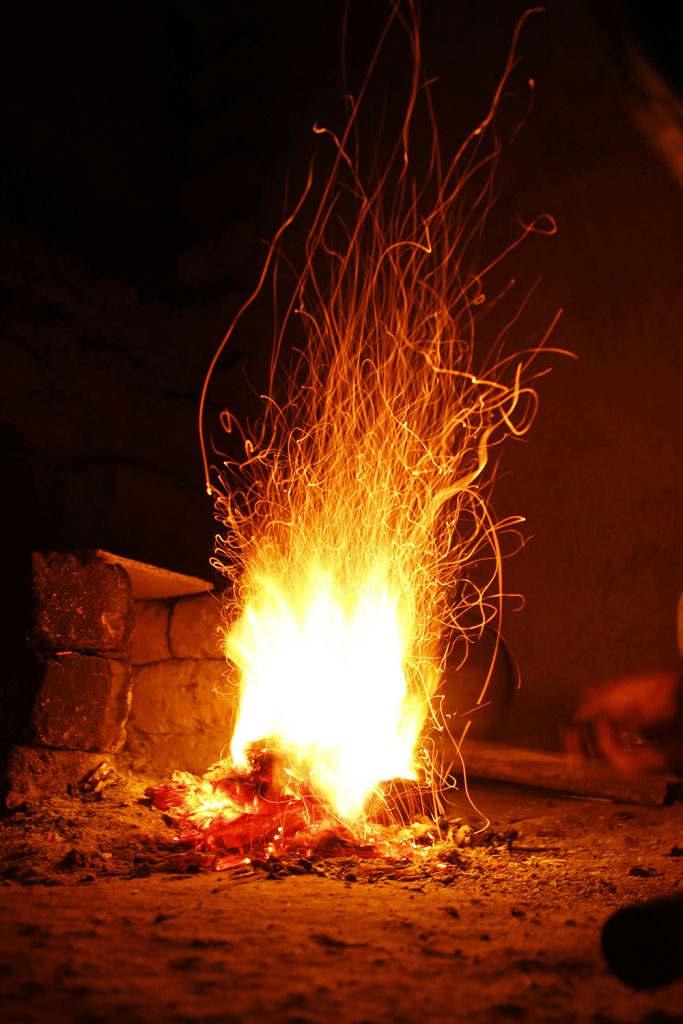
Eric’s mother called them fire dogs: light-sparks outside vision, phantom fires set in the corners of reality.
His childhood home had real firedogs, and irons in the fireplace shaped like twin dachshunds that guarded flames throughout cold New England winters. One night when he was ten, on his mother’s birthday, the flames escaped their captors. In the morning nothing was left of the house but one daschund, charred brown and friendless.
They kept that morbid souvenir on the mantle of their new home, and years later after his father died, Eric gave it to his son Jacob, who always wanted a dog. In perfect child logic, he named it Toasty.
Eric’s mother said the other dachshund was a lie, its iron a shell for a true fire dog, fire that gleams on the borderline.
But she had set their house on fire so she wasn’t too reliable.
Even as an adult, Eric figured that if he ever did track down light at the outskirts of sight it would look exactly like a red hot smiling weiner dog, melting fur on fire.
He went to law school, joined a firm, met his wife, had a son, had a condo, made partner.
Through life his fire dogs loomed, embers that trailed him. They kept him moving, not looking back. He didn’t visit his mom or go to her funeral when she finally hung herself. He always found himself busy when his father called, busy when Jacob wanted to see his papa. He didn’t tell his wife about the lump he felt in her breast, and he knew if he stopped and thought about any of this, fire dogs would catch up to him.
After they’d been married for a while, he’d tried explaining fire dogs to Sharon, but she just took him literally and told him to see an eye doctor. He skipped that and went to a shrink.
Eric told the shrink he knew fire dogs weren’t real, just metaphors of anxiety, like black dogs of depression.
Scapedogs, the shrink said, probably thinking he was funny.
Look, the shrink added, the world is meaningless chaos. Things happen for no reason, bad things to good people. Like some Job you’ve interpreted fire dogs as proof of God’s ill towards you, but what if there is no God?
Eric searched the wall for the shrink’s license.
Anyway, the shrink said, it’s obvious you avoid things. Why don’t you take a good hard look at the dogs?
Eric knew if he ever looked at fire dogs one of two things would happen: His problems would melt away or he’d go crazy. He wasn’t sure they weren’t the same thing.
Then one rainy night driving home he saw something in his rearview mirror. Instead of looking away, he chose to be a dog catcher.
It might’ve been just a headlamp, but then light floated through his blindspot, smelling of smoke, crackling like fire.
A year later Sharon will divorce him, sick of fire dogs, sick of everything. He will chase fire dogs as they snake like Chinese dragons through his eyes, floaters bouncing through his darkness like balls over gibberish words in a yammering singalong. They will outshine his sun.
But that night his headlights flashed on the dog tag of a golden retriever in the middle of the road, and he hit the brakes and twisted the wheel.
He awoke in the hospital with broken ribs. The doctor said he was lucky: if he hadn’t swerved when he did he would have hit the drunk driver head on.
Eric felt relief, then disappointment. His whole life he’d been avoiding looking back, and when he finally did it almost killed him. It just seemed so random.
But it did move him to finally pursue his passion and open a brewery. He named it Firedog, of course, and its flagship offering was Toasty, a malty IPA with nutty undertones.
To celebrate the opening Eric hosted a bonfire. Everyone was there, all the law partners. He saw Jacob wander off with the namesake Toasty as he tapped the first keg. He still argued with Sharon over whether a hunk of iron was a suitable pet for a six-year old.
The night grew long and drunk. Eric toasted to Sharon’s good health, to family curses, to fire dogs, to Toasty.
Everyone wanted to know about the name of the brewery so Eric told them all about fire dogs. It was the first time he’d told anyone but his shrink or his wife and it felt good. Nobody thought he was crazy, and if they did it was a fun kind of crazy.
More kegs were tapped, more wood thrown on the fire. It lit up the night, lit their faces, left nowhere for fire dogs to hide. Eric had faced his past and now could face anything.
And he talked and talked and drank and drank, and turned just in time to see his son walk with Toasty into the fire.