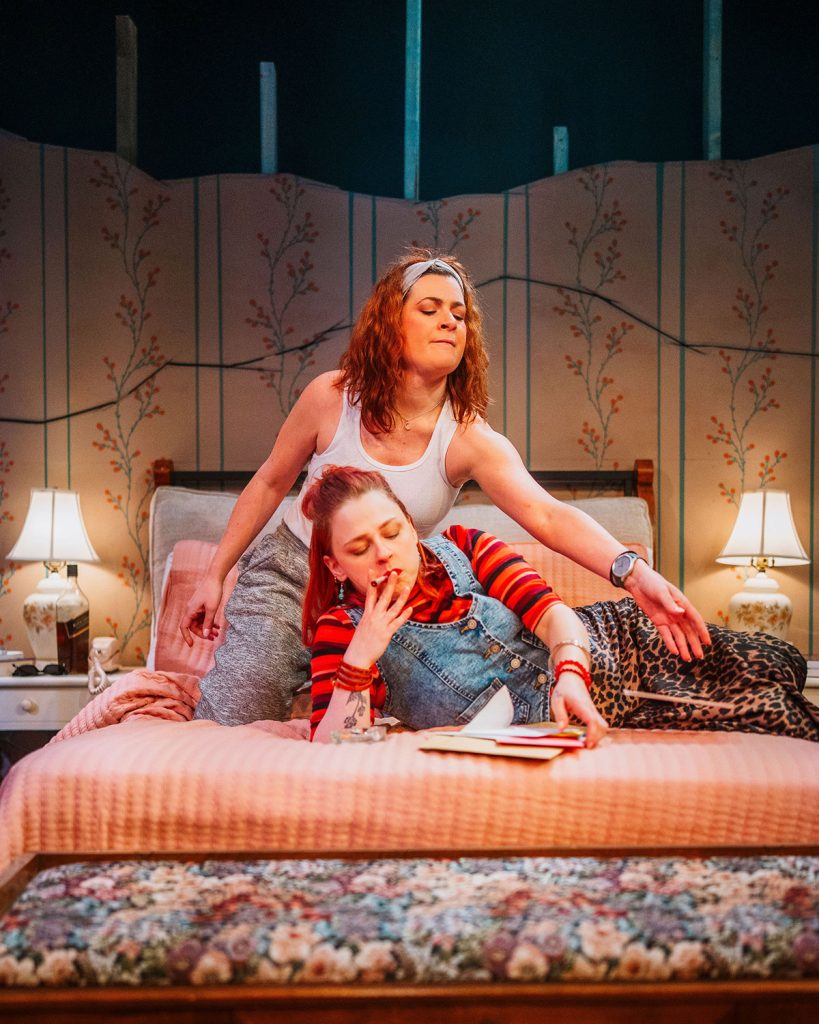
Picture this: grief and laughter, absurdity and tenderness coexisting cohesively. Not easy to do, yet Burbage Theatre Company’s production of The Memory of Water adeptly captures this ephemeral equilibrium. Under the expert direction of Lynne Collinson, this revival of Shelagh Stephenson’s reflective comedy lands with a bittersweet bang — funny, fractured, and full of feeling. Starring Burbage artists Rae Mancini, Allison Crews, and Valerie Westgate, the production explores themes of sisterly love, anger, and conflicting memories.
The play’s premise is deceptively simple. Three sisters — Teresa, Mary, and Catherine — gather before their mother’s funeral at her seaside home after years of separation. Each is haunted by her own demons, dealing with the death and how it directly affects her. Their different memories of the same events cause constant bickering about whose memories are the right ones.
The production opens with Mary, played with luminous precision by Crews. Her composed exterior masks an undercurrent of longing and confusion, especially as she begins to “see” her briskly acerbic mother, Vi (portrayed on opening night by Collinson; Carol Schlink casted) in moments that walk a perfect line between the real and imagined. Their scenes together pulse with quiet electricity — the daughter desperate for validation, the mother clinging to a version of herself softened by death. Mary ponders the question, “Can you feel nostalgia for something that never existed?”
Teresa, the self-righteous eldest (Mancini), leans into her wounded authority, offering some of the best laughs, as well as the most painful truths. Meanwhile, Westgate brings an effervescent energy to Catherine, the youngest, whose fashion choices and late-night confessions veer brilliantly between hysterical and heartbreaking. Together, they paint a portrait of sisterhood that feels elevated but true — the shared laughs, the looping arguments, the sudden tenderness that shocks even them. These ladies, while unable to agree on even one experience, are unified by their familial bond. As Vi comments, “Some things stay in your bones.”
The metaphor of water runs throughout the play, symbolizing the fluidity of memory and the impact of loss. Hidden lies and self-betrayals claw their way to the surface. Among the siblings’ tension and conveniently unearthed secrets, Burbage finds the stillness and unease that make Stephenson’s writing sing with a rhythm honoring the ache of loss and the absurdity of family memory, and how grief circles back on itself. The cast rides those waves beautifully, shining during moments of grief, anger, and sadness.
The ladies bring along their partners, their grievances, and their ghosts. The men in the women’s lives (Brien Lang as Frank and Aaron Morris as Mike) have their place for grounding as well as upending, but it’s the sisters who deliver the laughs, finding humor in their solemnity. Even when the chuckles come, there’s a constant ache behind them, each joke a form of self-defense. The humor can feel a bit forced at times, as we’re reflecting on pain then jolted by a joke, but the most deliberate laughs land as calculated.
“The Memory of Water is dark comedy at its best. It is at once a bittersweet examination of grief — its functions and social manifestations, its direct and rippling impact on family left behind — and a sharp comedy rife with wit and irreverence,” says Artistic Director Jeff Church. “Much in keeping with our previous partnerships with Women’sWork, Shelagh Stephenson’s play is a unique balance of gravity and levity. It understands something universal: When faced with grief, we don’t become eloquent — we become human. We laugh at the wrong moments, argue over trivial details, misremember the past, and cling to the stories that help us survive. The play speaks directly to anyone who has ever lost someone and discovered that mourning is messy, funny, uncomfortable, and deeply revealing. It invites an audience to recognize themselves — unflatteringly and honestly — in the ways that families love each other, fail each other, and endure. This is a play that makes you laugh because it tells the truth, and then quietly asks you to consider which of your own memories you’re still protecting.”
Burbage’s design team complements the play’s contemplation of memory and identity. Designer Grey Rung’s set — a bedroom strewn with old furniture and the detritus of memory — feels right for the family’s intimacy. Mom’s bedroom is where they all argue, reminisce, cry, smooch, hide, yell, drink, dress, and undress. The walls look like they’re crumbling, letting us know there are cracks in the family foundation, and one day the sea will claim this structure. Production design by Trevor Elliott gives us both subtle and blaring lighting shifts, marking transitions between recollection and acceptance, letting the audience drift in the spaces between the waking world and memory.
Because the play is often interspersed with painful recollections of tragic events, some might argue it’s a tragi-comedy. It’s tender, funny, full of spirit, and finds truth in those in-between spaces. By the time the play closes, not with resolution but with a quiet release, Burbage’s The Memory of Water has earned its tears and laughter. It leaves us musing on how we misremember, reinvent, and forgive — and how memory, like water, slips through our hands no matter how hard we try to hold it.Burbage presents The Memory of Water through Feb 8. For more information, visit burbagetheatre.org.