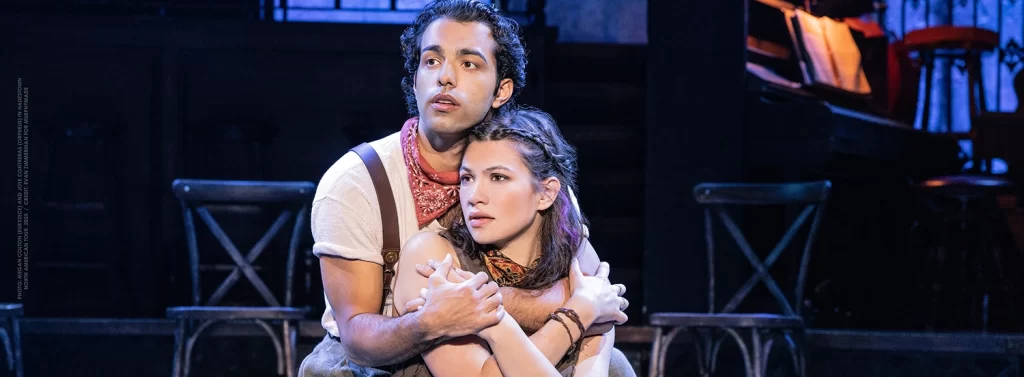
The energy ignites the moment the Hadestown crew takes the historic Providence Performing Arts Center’s stage, as the musicians begin with the promise of myth re-imagined. As told by PPAC, Hadestown — the Tony-winning musical from Anaïs Mitchell and Director Rachel Chavkin — is the ancient tale of Orpheus and Eurydice, a Greek myth woven together with the story of Hades and Persephone, told with a modern folk-jazz sensibility that adds a pulse of current times.
Eurydice (Megan Colton), a starving young girl, goes to work in a hellish industrial version of the Greek underworld to escape poverty and the cold. Her journey into the underworld is heartrending, carrying both resignation and rebellion in her tone. Colton uses her powerfully sultry voice as the catalyst for the amazing sound behind the songs telling the story. Her poor, singer-songwriter lover, Orpheus, valiantly comes to rescue her. Orpheus (Jose Contreras) has a beautiful falsetto voice, a nice complement to Hades’ (Nickolaus Colon) beguilingly commanding baritone. You feel the heat delicately tinged with suffering when Contreras sings of cold deals and turning coal into currency.
Rudy Foster’s grand entrance as Hermes, complete with zealously sly movements, mark him as the omniscient narrator. He guides us in and out of darkness with musical swagger reminiscent of The Big Easy, bridging worlds while reminding us that storytelling is how we make sense of the dark.
You’re now in a world where the rails of industry click beneath the canopy of dreamers, where underworld contracts can hinge on a single song. The set, where a speakeasy warmly meets an industrial shaft, announces Persephone’s arrival with a lively, horn-driven “Livin’ It Up On Top.” The jazz-infused style makes you feel like you’re partying with players in N’Orleans. Namisa Mdlalose Bizana’s Persephone has a luscious tone, dazzling us with an alluring presence that glows under the minimal lighting.
Persephone, typically described as fun-loving and spirited, becomes jaded after years in the underworld. “She drinks for a reason,” says Bizana. “She is complicated, flawed, but when she sweeps in, she makes you feel special. Everyone wants to be around her. She feels deeply. She has a sense of justice,” especially regarding Hades’ treatment of his workers.
The ensemble, consisting of the Workers Chorus and the Fates, provide gritty voices with robotic moves reflecting the show’s industrial heart. As the rhythms deepen into the clank and grind of labor, the Workers Chorus becomes a formidable presence, their robust voices rising like steam from furnaces, reminding us this production isn’t just about romantic love but rather power, contract and survival. Lighting by Brad Sievers brilliantly shifts the ambience into cold steel grays, cobalt, and copper. The set could use a bit more light above ground to lift the shadows, and perhaps more flora to contrast the underworld.
As the Fates, the Workers, and the lovers huddle in shared urgency, the minimal set sometimes feels congested. We initially see Hades seated at a bistro table on a Parisian-styled balcony, watching the happenings in his dimension. Musicians are seated stage left and right, ever-present throughout the production. While it’s a refreshing change to see the orchestra above ground, it leaves us wishing for a less-congested setting change for Act II. Still, this production retains the heart and soul of Broadway as the above-ground world is transformed into the subterranean factory of Hadestown.
What gives Hadestown its power is the resonance of its themes: the contract we make for love, the deal we strike for security, the cost of forgetting our songs. In these current times, when labor, environment issues, and inequality often rear their ugly heads, the show’s symbolism can feel desperate. The Workers Chorus’ memorable dance sequences strike a spike into the heart. The cyclical journey from spring’s new birth to underworld labor echoes a desire for badly needed resumption.
There were occasions when notes dropped off, and plot clarity was lacking. If unfamiliar with the myth, you might find yourself listening to the beautifully powerful voices, watching the brilliant choreography intently, yet finding the storyline hard to follow. There’s wondrous meaning to the magic, we just don’t sense it otherwise.
With its compelling cast, immersive world, and strong angelic vocals, Hadestown is a meaningful, action-packed show. True, there are some compromises, but you can sense its heavenly heart if you allow yourself to be pulled into the hellish industrial world.
PPAC presents Hadestown through November 9. For more information, visit ppacri.org.