Also written by Noah Emanuel Morrison.
In celebration of the reopening of AS220’s Paul Krot Community Darkroom, we asked a few community members from the darkroom’s past, present, and future questions about their experiences with and hopes for the space:
PAST (PAM MURRAY AND SCOTT LAPHAM):
Scott Lapham and Pam Murray: We built it!
PM: Yeah, it wasn’t really an introduction.
SL: We were part of the first wave of people living at AS220 on the third floor, and it made sense to have a public darkroom. It made sense for me because I didn’t have a place to print. Previously, I had a darkroom wherever I lived, I just made one in a bathroom or whatever.
PM: I got out of school and I took a CCRI summer photo class just to get access to a darkroom because I didn’t have one. SL: There was unclaimed space in AS220’s basement, so we made a darkroom. The green room for the stage was in the basement, so it was like stale beer, bands in states of consciousness that they probably didn’t want you to see them in.
What was the need for the space like in the past?
SL: It was a mix of amateur and professional people. Back in the day, the Providence Journal had a full photo staff. They were coming in to do their own private work. We had people that were doing wedding photography that would come in and use it to do their jobs.
PM: Modeling portfolios.
SL: You’d have a person from Brown who was studying neuroscience who also wanted to work in the darkroom. There was one woman who would take a bus from Woonsocket ’cause she couldn’t drive. She’d get on a bus and come here to print because she didn’t have a place to do it. Just a real range of people.
How did you see the space change over the years you spent there?
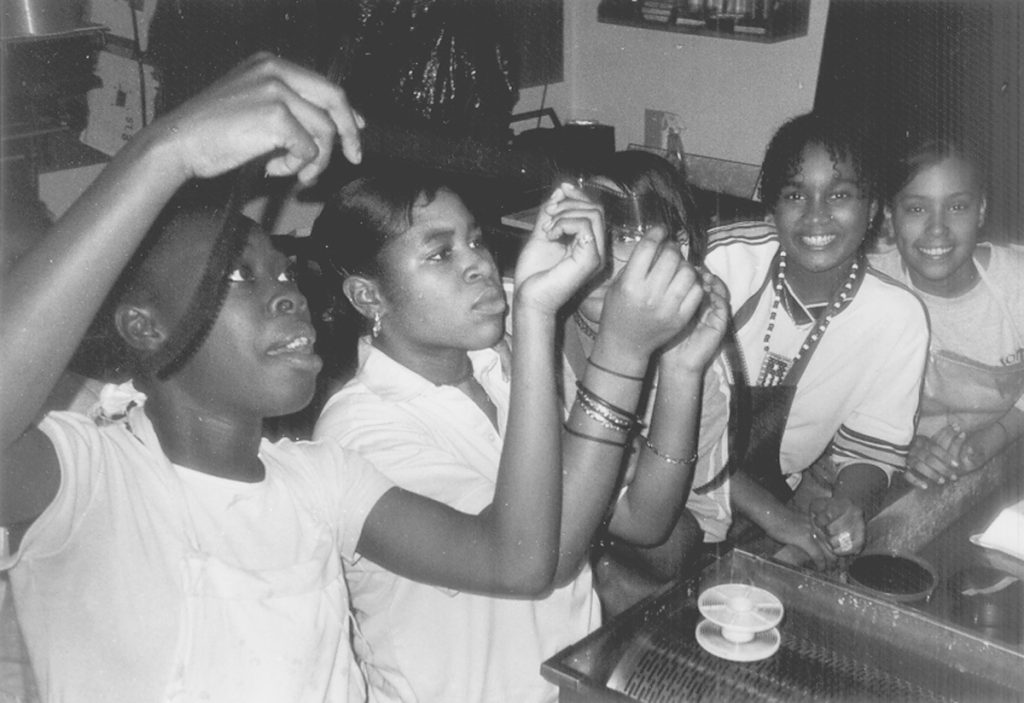
SL: I think when the AS220 youth program came in, that had a real sense of community. To have that in-house population with access to the facility on a regular basis allowed people to really get into it. They’re teenagers and they start to form these relationships with each other, and the space, and some of the adults, so that really did feel communal.
What do you enjoy about working in the AS220 darkroom?
SL: It is very meditative and it can be a real, nice place to be. It’s usually cool in there, temperature-wise. It’s just kind of a meditative process that felt refreshing if you didn’t have pressure. If you were in there on your own terms it’s a wonderful, relaxing process.
PM: I think I was always a little impatient for the darkroom. Shooting things was more of the obsession for me.
PRESENT (NOAH EMANUEL MORRISON):
Why does the space continue to be relevant?
The darkroom can produce magic. The look on someone’s face who’s making a print for the first time as they see the image appearing out of the developer is a source of neverending joy and inspiration. Community darkrooms in the US and around the world are becoming rare, and thus hold incredible value as places where amateur and professional photographers, young and old, can come together, learn from one another, share skills, and build their practices. For $40/month, someone who comes to AS220’s darkroom could make prints for a fine art gallery, a wall in a friend or family members’ house, a book, an edition, or themself. Within AS220, I’ve already seen the darkroom connect youth members who have experience with digital photography but want to get deeper, adult members who want to develop and print their old negatives that have been stored away for decades, and residents and staff who are interested in alternative processes like cyanotype and Van Dyke printing. It is a space where people can create new visual narratives about themselves and those around them: where, with a little patience, they can take photography completely into their own hands.
What are your goals for the space as it opens back up?
I am looking to build the space up to be a creative incubator across AS220 programs and age ranges. With my colleagues in AS220 Youth and Community Studios, I hope to build out a curriculum that represents what people want to learn and integrate darkroom programming into the larger creative landscape in the region. I am looking for potential instructors at all levels and across disciplines – people who work with alternative processes like anthotype, cyanotype, and Van Dyke, people who want to propose creative lighting workshops with darkroom involvement, printmakers and painters who use photography in their practices, large format shooters, and anyone else who wants to use the space creatively. The darkroom is outfitted for all formats, from 35mm to 8×10, as well as black and white and color developing. I also aim to eventually set the darkroom up for RA4 color printing.
What do you enjoy about working in the AS220 darkroom?
The slowness, the smell of the chemistry, chatting with people to the rhythm of the paper moving through the trays, teaching and instructing people about how to make the best prints they can, the potential for connection because people are forced to share space, having to see how other people see, helping other people see how I see, the red lights, the total darkness. It’s a vibe.
FUTURE (KINCAID MCLAREN):
What excites you the most about the AS220 darkroom being open again?
In a way, I feel like my inner child has found their playground again. Not saying the darkroom is an area for fun and games, but it is an area for film photographers like myself who can use their hands and fingers to develop and create something. The process from start to finish is a continuous process of “what’s next?” or “I wonder what this is going to look like?” each step of the way. The AS220 darkroom is a direct response to what artists and photographers are looking for again. I feel lucky and honored to be surrounded by knowledgeable colleagues like Noah who can aid the process of getting refamiliarized with the space to then pass down that knowledge to the younger generations I work with. I hope they can feel like the darkroom is another playground they can explore this year.
How do you see the AS220 darkroom growing as a space for teaching and learning, particularly for AS220 Youth?
Everybody should learn film photography before digital photography. Learning the exposure triangle, composition, and angles is way easier when there’s only a few mechanisms to worry about on a camera. Obviously, not everyone has the privilege and access, because film photography before digital is a privilege. But I look forward to carrying on that same practice with my youth to empower them through taking every single photo and learning all the mechanics it takes to make just one exposure. The darkroom allows me to teach another skill to the youth I come in contact with downtown, at our partner schools, and even at the Rhode Island Training School.
How do you see the darkroom evolving as AS220 and Providence grows?
From what I know, AS220 is the only place in Providence where anyone can develop their film by simply becoming a member of the space at an affordable fee. The darkroom opening at AS220 again couldn’t have come at a better time. Everyone is using analog as a form of photography now. Having our darkroom workshops and hours accessible to the community will generate more interest as time progresses. I wholeheartedly believe there will be a big influx of people desiring to develop both black and white and color 35mm and 120mm film here, or even taking their previous negatives and creating prints.
What do you enjoy about working in the AS220 darkroom?
It feels like a secluded oasis. Everything is organized and labeled to ensure ease of access, and there’s enough space for multiple people to work at a time. I simply enjoy that we have a darkroom; it was the missing piece from AS220 and now I feel like we have all the art mediums and spaces anyone would need. •