This month Nayyab Naveed, a current MFA Student at RISD, has partnered with Dr. Jane to tell a story about her eco-spiritual encounters with ants while growing up in Pakistan.
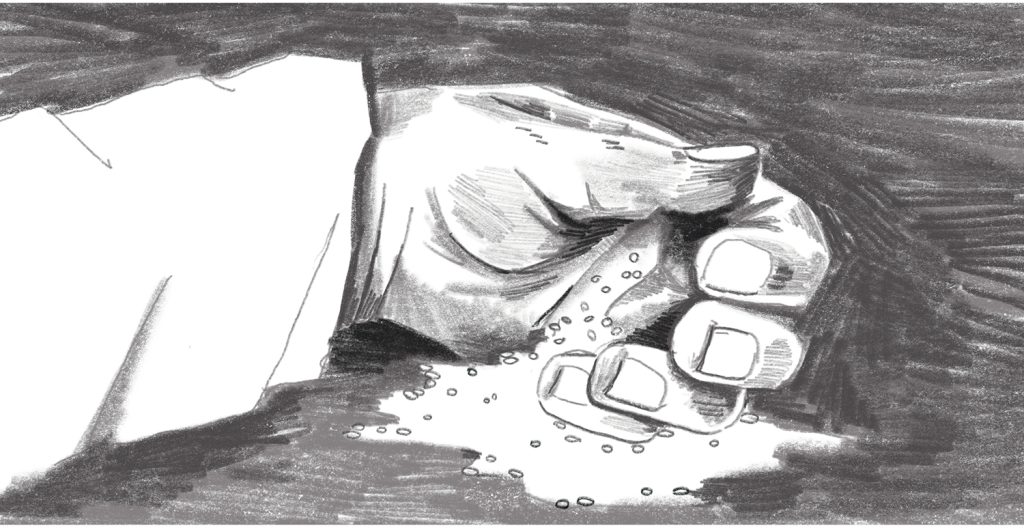
My Nana Abu was a friend to the ants. Mama told me he left out granules of sugar for them near their doorways, and you could see the shiny black dots congregate feverishly near the offering. Nana Abu didn’t explain why he did this; just did it. That was usual for him; leaving things unexplained only for them to make sense later. When he passed away, he remained a mystery to me. The most I could associate with him were the toffees he slipped out of his pocket when I would go see him, and the ants that scurried in the periphery, carrying crystalline boulders that disappeared inside the walls. It was a feeling of being enshrouded in gentleness. The kind you feel when you know you’re in the presence of someone who treads the earth lightly.
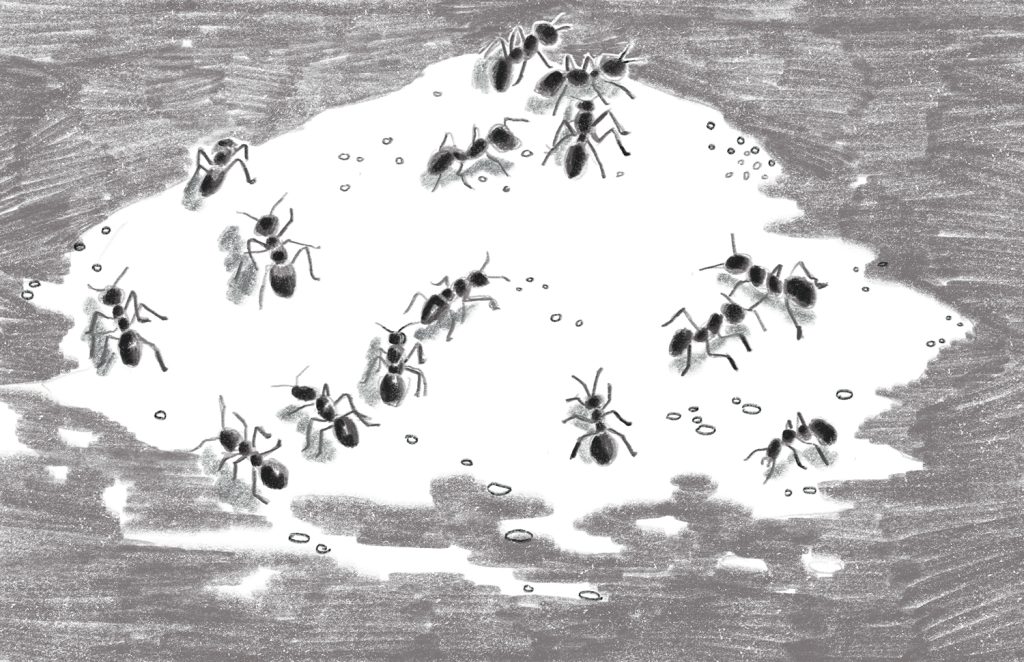
It was only years later, when I was old enough to understand and revere my Nana’s Sufi practice, that I could place his love for ants in a wider religious and cultural context. Visiting Sufi shrines during my travels in the south of Pakistan, I saw that devotees of Sufi saints had a peculiar relationship with the shrine’s ecology. Cats, eagles, bats – all were fed. The trees were considered sacred, the soil holy. But what especially fascinated me were the sweets left out for the ants, just the way Nana Abu did. Red, pink, blue mithāī left for the ants, sometimes on silver plates, sometimes with incense burning next to them. I immediately understood that it was not just the saint buried at the shrine that the devotees were appealing to. The small, nonhuman entities were to be seduced as well, the same way a lover seduces their beloved.
In Sufi tradition, devotees visit a shrine to ask a saint to pray to God on their behalf. The belief is that since the saint is closer to God than ordinary people, God is more likely to listen to the Saint’s prayers. The Saint is then seen as a mediator. Hence, if ants are being offered food and reverence, don’t they also become part of the sacred prayer? Doesn’t the gentleness with which they are handled and the respect with which they are treated prop them amongst the team of representatives praying for you and on behalf of you? Is it possible to then say that the ants become saints as well?
The story of Prophet Solomon in Quranic and Jewish texts narrates how Solomon could hear the speech of ants, and rerouted his army’s path in order to avoid destroying a colony that was in the way. An eco-spiritual reading of the story suggests that the Divine invites us to listen more deeply to the voices of the creatures often overlooked; in this case the ants. The practices of Nana Abu and the devotees at the Sufi shrines demonstrate how the nonhuman is sacred. And how a relationship of reverence is also a relationship of respect. It takes a certain kind of strength to humble yourself before a creature only a fraction of your size; it takes a certain kind of sensitivity to show devotion to an ant.
Illustrations by Manuela Guzmán. Follow Dr. Jane and her research lab on Instagram @antlabpvd or on the web lovetheants.org.