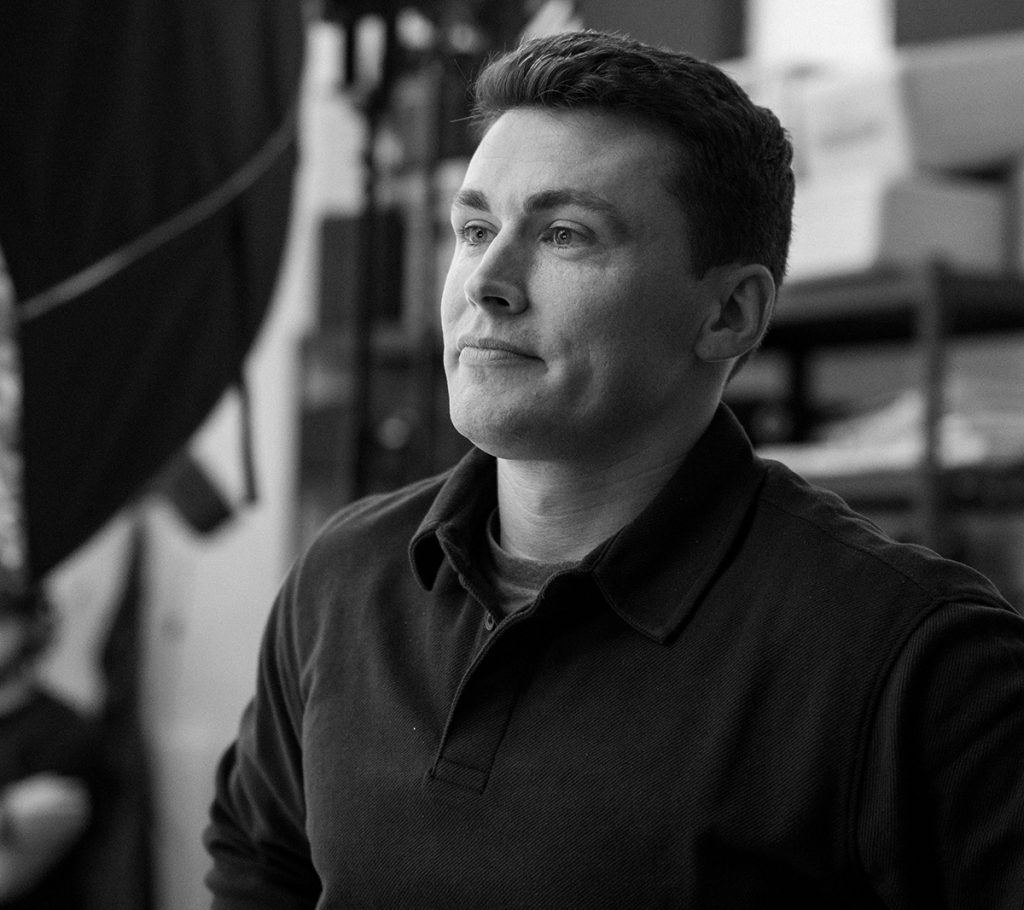
Last year, I had a blast and a half working on a fun commercial shoot. I landed the gig because the fella producing, Josh Kirk, asked around to find an actor to portray the client’s mother, and that is how I landed the role as Lawyer Twillie’s mom. Yes, that is the attorney’s real name. If you follow me on Instagram, you can check out the outtakes to see just how much fun it was.
Josh is an award-winning commercial and narrative writer-director and the founder of HIP CAT, a creative production agency based in Rhode Island. He is the recipient of the New England Director’s Award at the RI International Film Festival and the Lighthouse Award at the Block Island Film Festival. His work includes commercials, short films, a television pilot, and music videos that have screened at film festivals around the world. He is now working on his first feature film, White Coat, a dark comedy that satirizes greed, capitalism, and the American healthcare system.
I caught up with Josh on a video chat to find out more about his start in this wild and wacky world of showbiz and to find out a bit more about his newest project.
DMK (Motif): Josh, you have spent more than 15 years working in advertising, commercial production, and narrative film – and full disclosure – I have worked on a few projects with you. What would you say were moments or turning points in those experiences that most shaped you into the filmmaker you are today?
Josh Kirk: First and foremost, I think the idea of utilizing comedy was huge for me. I did narratives before I did commercials, short films, stuff like that. And since comedy elicits an immediate reaction, which is laughter, it was very easy to tell if I was doing something right or wrong. People who don’t know you aren’t going to fake laugh for your benefit — they’re going to either laugh or not laugh. I started leaning into that and learning that comedy is a great tool. I also remember distinctly, very early in my career, being on a panel at a film festival in New York and thinking, “I didn’t do anything new.” I was just paying homage to films or things I liked, and I really wasn’t breaking any new ground. That was also a huge turning point, the idea of trying to progress the medium instead of existing in it, pushing the envelope a little more creatively.
DMK: Which is more common in filmmaking, to be innovative or be more in line with the trends that are happening?
JK: I would say it’s probably more common to go with the trend because it’s safer, because a trend has been proven. That happens all the time in commercials and advertising, with so many people sticking with what works. I find more often than not, the commercials or the films or even the books that stick with you are the ones that are different or new. That was a huge kind of explosion in my brain when I realized that you don’t have to walk that kind of path.
DMK: You’ve been recognized with awards. How would you say those honors have influenced your confidence as a filmmaker and as a creative person in general?
JK: I think it’s extremely validating for a lot of reasons. I mean, off the bat, it validates a creative vision. So the choices you made that you maybe think were risky or different were worth it. It boosts your confidence. It helps establish your credibility. And it’s not just credibility with clients. It’s huge for credibility with crew, cast, and other artists, because they know that you’re going up to bat and you’re actually hitting a ball, as opposed to just practicing swings.
DMK: How important is brand – professional or artistic – to your work as a filmmaker?
JK: Having a brand is huge because a brand is your signature. It’s a style. It’s something that makes you different and sets you apart. Being different and having something that can be easily identifiable is important.
DMK: Your production company, HIP CAT, isn’t just a production company making commercials. It also includes a philosophy about how you approach production. What gap are you trying to fill by creating this agency, and how does that actually show up when people work with you?
JK: We don’t follow trends; we try to create them. We’re not here to do what’s already been done. So we always try to push for being fresh and original, and definitely fun. The big thing we do is try to push boundaries and try to offer unexpected, exciting work. We want to be able to go on our instincts and our creative vision. And if something happens, we want to be able to chase it. You can’t really chase it if it’s a giant production.
DMK: And I can speak to that personally. In one project I did with you, it was so much fun with all the outtakes. Everyone was laughing. A core part of HIP CAT’s work is keeping creative production here in RI. Why is that important to you?
JK: About 90% of the productions we do are based in RI. Keeping it local is extremely important. Our state is full of creative talent, whether it be crew, actors, artists, painters, or musicians. We live in an extremely creative state. And also it’s full of a bunch of go-getters, too. They’re not afraid; most of them aren’t afraid of anything, which is great. RI is becoming more of a film hub, as you know. The way the technology is going, too, the idea of going to California to make a movie may very well be in the past. For us, investing in local talent and local businesses helps the local community. I think the culture of RI is very authentic, and it’s very artistic. To not use that and to not want to harness that power is crazy. It is a lost opportunity.
DMK: You’ve worked with Del’s Lemonade and Brhodies, a local clothing company, alongside national and international clients. How do you approach telling a true blue, authentic Ocean State story while operating at a global commercial level?
JK: I’d say in a general sense, there is no difference between doing a local spot and an international spot, just because we’re going to be passionate about it. If I believe in the company or believe in the product, I’m going to give it everything I can to make it impactful and successful. I think the difference with RI is in the nuances that make it unique. For the Del’s commercial in particular, that was a very personal project for me because I’ve lived those moments that were showcased in it, as I’m sure a lot of Rhode Islanders have lived those moments. Experiences like having a lemonade with my mom when I was a kid, or playing with my friends in the streets – even on a date on the beach. I think we’ve all lived those moments, and connecting to that was necessary because we can all relate to that. Nostalgia and memory are immensely powerful tools in advertising. If you can connect an audience with a product like that, you’ve done the hard work.
DMK: Now, let’s talk a little bit about mentorship. How is that embedded in your approach to business, and what would a real-world experience actually look like for folks who are new to the industry, working with you for the first time?
JK: I think it comes down to risks. Taking risks on people is very important. I didn’t go to any kind of film school. I didn’t go to college. I am a trial-by-fire kind of guy, which is probably my favorite type of education. I didn’t have anybody when I started; I didn’t have a mentor or guide. I wish I had, it would have maybe saved me some time. I can relate to an underdog in that sense. It drives my commitment to mentorship and mentoring crew. But as you grow, I think people need to take risks on you. That’s the whole gamble that we take in this business, right? Taking a risk on emerging talent is very important because if we don’t, we’re going to miss the next great artist. I’ve always felt that if someone has the gumption and the drive, why would you not give them a chance? So you have to pay it forward if someone has taken a chance on you.
DMK: RI has become quite a popular place to make movies. From your perspective, what do you think the local film and ecosystem for commercial-making gets right, and where is there still room to grow?
JK: RI is immensely supportive of creatives. Nurturing up-and-coming talent and giving them a voice, giving them a stage to be on to do the work. I think we’re doing a good job fostering talent, but we need to amplify that. The more we spotlight underdogs and up-and-comers, it helps new talent get noticed. We have a creative community, and I think if people know it’s here, maybe they can find it sooner.
DMK: Let’s talk about your film, White Coat. It’s going to be your debut feature film. It tackles greed, capitalism, and the American healthcare system as a dark comedy. What drew you to this particular story and to tell it in this way?
JK: I remember reading an article about the organ trade and just how strange it was. It’s a very odd life path that people take. When I started to read more about it and understood just how insane the healthcare system is, and the wait times people need for transplants, it blew my mind. You can see why a lot of people have resorted to the criminal path of obtaining organs, which is wild. It should be talked about. I often say that a vulture capitalist is someone who takes a company and then starts selling it for profits, piece by piece. That’s what an organ thief does: takes a body and sells the parts. I wanted to explore these kinds of issues of greed and capitalism and the healthcare system through dark comedy. I think comedy helps us see the absurdity of our own problems.
DMK: You’re going to be basing the film and also shooting it entirely in RI, primarily in East Greenwich. How does place influence the tone and the texture, and how you’re trying to tell this story through White Coat?
JK: I think location setting is crucial. In filmmaking and in advertising. Also in satire. Location is a whole other character. And it can say a lot about a topic. The location was chosen to contrast a wealthy vibe with the underbelly of corruption. I thought it was also very funny for an organ thief to be stuck in an East Greenwich mansion.
DMK: As you move into these key areas of bringing a film to life – casting, funding, all kinds of partnerships – how can RI creatives, businesses, community members, neighbors get involved in making this truly a local production?
JK: I want the flavor and the stamp of it to be authentic. The idea of having a Rhode Island-centric kind of production is paramount to us. It’s necessary to tell this story. We also want to bring attention to RI and RI talent. We already have Dark Star Pictures with an intent to distribute, so they’re already lined up to distribute the film before it’s made, because they loved the script. I believe that having more RI creatives involved will make all the difference.To learn more about Josh and his work, visit HIPCAT.co. Follow Dennise on IG @TheAdventurebroad.