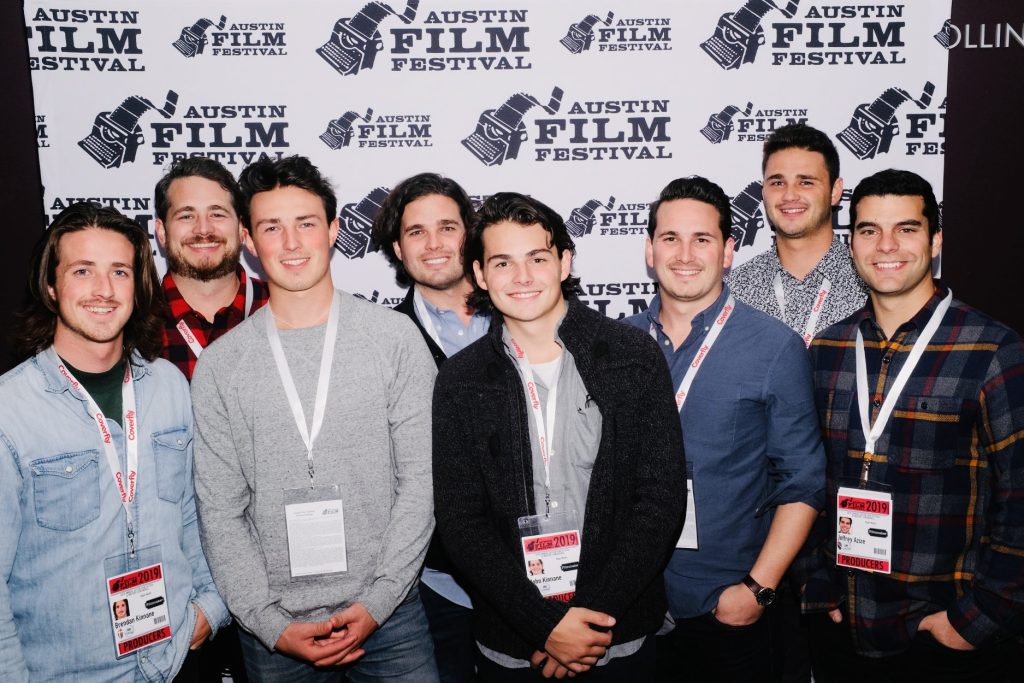
I am a hopeful romantic and a huge fan of romcoms. The films often have a woman in the lead navigating adventures in love, love lost, and love reclaimed. There’s always a happy ending. I sure was surprised to learn about a twist in that formula in a recently released film, Solo Mio, starring Kevin James. It is a story of a wedding fiasco that leaves the groom stranded at the altar, in one of the world’s happiest cities: Rome.
The film came to life with the help of eight Ocean Staters: The Kinnane Brothers. Based in Little Compton, these fellows have worked on several projects that include a YouTube channel created with Kevin James during the pandemic called The Sound Guy. It is a hoot and a half. Their first movie, Home Team, produced by Adam Sandler, also stars Kevin James and was the #1 movie on Netflix for two weeks in a row and Top 10 in 90 countries worldwide.
I hopped on a video call to talk with John Kinnane, a brother who is one of the writers, and Jeff Azize, a brother-in-law who served as executive producer of Solo Mio, to learn more about the filmmaking family based here in Rhode Island and how their bromance with Kevin James began.
DMK (Motif): Eight brothers, one film. How did you divide up responsibilities, and what did collaboration look like day-to-day when everyone has a clearly defined creative lane?
Jeff Azize: About ten years ago, I start off the day asking, “What are you excited to do first on this project?” Each person shares what they are excited to help out with and then we look at how to plug them into that role for the project. You’re more creative when you’re excited about something, right? Each of us would naturally find our spot in the collaboration. All of us are storytellers and writers. When we all get in a room, we call it ‘the brain trust’, each of us will pitch ideas, and the best idea wins.
DMK: This is the first project where all eight of you are officially credited, correct?
John Kinnane: Yes. We divided up the roles a bit more than we have done in the past and each one was credited for that particular role. On previous projects, like the Water Brother documentary we did, everyone pretty much pitched in anyway they could. It was a similar situation with the film Home Team. In Solo Mio, there were more designated responsibilities.
DMK: It’s more fun when more people are at the table, but it also has its challenges too, but you all have been figuring it out. You clearly like spending time and making movies together. I want to talk a little bit about The Sound Guy series, which went a little viral during the pandemic. What lessons did you learn from that internet project that you could transfer over to doing a full length feature?
JA: I’ll let John chime in because it was actually him and our brother, Pat, who came up with the idea of the series. John did most of the visual effects.
JK: We learned a lot using After Effects, and this was before AI was around where you can just put in a prompt and say, do this, and it did it, so we spent hours and hours and hours learning how to insert Kevin James into all those movie scenes.
JA: It was the lighting techniques we used that were inspired by some of the greatest filmmakers of all time that helped us recreate the lighting for those scenes. Trying to just recreate the visual effects and matching the lighting — that was done by two of our brothers, Dan and Pat — which was the most challenging part. We had to make it feel real, to really sell it that Kevin James was actually there in the film.
DMK: I’m sure in post-production, when you’re trying to put a scene together, when the lighting’s different, you need to do those special effects to match, even the sound.
JA: Yes, and I would even add to the fact that, one of the brothers, Chuck, and I come from the documentary world and because we have worked together for many years, one of the things that we’ve learned is we can make anything work. We can improvise, and it’s something all the guys also picked up on immediately. They’ve done their short skits for years before everyone started working together, and I think that’s one of the things when you have a shoestring budget and you don’t have the fancy camera work is, what can we do to make it work? You’re constantly adjusting on the day. When you’re doing a feature, there’s a little bit of a buffer, because you have time to actually think about what you want to do during filming. That’s very helpful. It definitely is a strength of ours, to constantly adjust.
JK: From a sound and editing standpoint, we learned a lot making those YouTube skits. Just by making subtle changes to the sound you realize how important sound design is, how you edit and how you can get creative. If something’s not working, how to come up with a solution to it. There’s a lot of trial and error. I feel like we learned so much in doing all those skits.
JA: You’re flexing those creative muscles in your mind. If you’re always using it, then it allows you to adjust very quickly when something is not working story-wise. Then we bounce it off each other and the best idea wins. Collectively, all eight of us just kind of figuring it out is very helpful to kind of just come up with a solution.
DMK: Ah! I love “MacGyvering” things in life and creatively as well. And having that kind of brain to problem solve is a really powerful tool when it comes to making movies, I have no doubt.
Your newest film, Solo Mio, was released to over 3,000 theatres nationwide in February. That’s a big jump, right? That’s a different experience. That is a different kind of storytelling as well. As a writer, how did you make that leap, John, from YouTube skits to the full-length feature film approach to storytelling?
JK: I would say the approach didn’t change, but the way we were allowed to put ideas in the script did change because Kevin was a producer on it. He also wrote the film with us, and he was the main lead. The producers really gave us the freedom to do anything we wanted. And that is not normal. There’s a cameo in the movie that we wrote into the script and had the freedom to just throw in crazy ideas and write what you want to write. We could be a little bit more nuanced and just have more weird ideas that we thought were funny and we hoped that everyone else thought were funny. Life experiences kind of meshed into this film and I think that’s the reason why a lot of different people can relate to it and it’s not just for an older audience or younger, it’s for everyone.
JA: Yeah, to add to that, it’s like a joke, you know, some jokes take five minutes to tell and some can take an hour and a half to tell. I think for the shorts, you’re telling a very quick story in a short amount of time and with a feature film, you just throw more obstacles in front of your character to hurdle over and if it’s interesting enough, people are going to watch till the end. It’s all about how we can stretch it or how naturally the story just unfolds in that timeframe.
DMK: Let’s talk about the film, Solo Mio. I watched it and it was super fun. I consider myself a hopeful romantic and romcom is my favorite genre. It’s funny. It’s dramatic. It’s bittersweet. What drew you to tell this story about a guy going through this experience?
JA: John and Pat were working on another movie with Kevin in Vancouver and we crashed the dinner with the producers. One of them asked Kevin about where he wanted to make his next movie. He said, “I’d love to shoot something in Rome.” And it turned out to be one of those classic back-of-the-napkin ideas. Chuck asked, “What if it was a destination wedding and you were left at the altar?” Then John came up with the idea of the character going on the honeymoon alone. And that was the film. They loved it and we got to work on it. That was March 2024 and we were in Rome about four months later prepping for the film, all the while John and Pat would write pages to send to us.
JK: We got to give credit to Mark and Jeffrey, the producers, for doing it so quickly and getting us everything that we wanted as far as these crazy cameos, and ideas, and songs.
JA: They essentially sold the idea in Cannes in May and there was still no script. I commend those guys for trusting Kevin and us with it and knowing that this was going to be a great movie. You’re given these little pieces, but then you start to think wow, a male lead role in a romcom – that’s pretty interesting.
JK: I learned so much. I don’t think I would have been able to work on the project if I wasn’t for my girlfriend! There’s a lot of us in the movie, a lot of each of our relationships in the story. The women in our life read it and they gave us notes. We got some great feedback on the initial cut that we implemented into the final version of the film. And so, you know, there’s eight boys, but there’s also, eight girlfriends/fiancés/wives by our side, working with us, helping make the project.
DMK: I love Rome. I had a chance to live in Italy for a month a few years ago and that was one of the cities I stayed in. It’s not necessarily known as an easy bureaucracy to navigate. Was it tough to make a movie there?
JK: I was just working on the script and I didn’t have to worry about the actual issues or the technical stuff. I did hear that it wasn’t easy but on the flip side, it was amazing working, filming and living in Rome — such an insane experience. We’re from a small town in Rhode Island, and then all of a sudden we’re in Rome, and we’re commuting to this movie set every single day.
JA: Being able to have access to certain situations that you normally wouldn’t if you were a tourist was amazing, but there were a lot of logistics and hurdles, even a shakedown at one point, but that was settled after a couple of hours and filming resumed. The biggest hurdle was probably the Palio, the horse race in Siena. It was a bit challenging negotiating with the condrade, the neighborhoods, that compete in it. They had a bad experience with another production and stopped allowing it. We worked with them to make sure we honored the tradition in a respectful way.
DMK: That’s a great story. When you face challenges, and you can’t predict them you can only prepare so much. When you’re on the set, whether it’s weather, people, a dog, whatever the case may be, you have to be really flexible to be able to shift.
You’ve worked with Kevin James on a bunch of different projects. You co-wrote this film with him. Why do you work so much with him? I mean, I don’t know him personally. He seems like a nice guy. So what about that relationship clicked that led to you doing all these creative projects together? What was your cute-meet moment?
JA: It all started when Kevin saw a short video I did documenting my wife and I’s NICU journey when my son, Francis William, was born prematurely. It’s called Just Keep Swimming, a nod to a message in Finding Nemo. It wasn’t something I planned to do, but after my brother left his camera behind, I decided to capture it to share with my son when he was older. It came out at about the same time Finding Dory was released and it went viral. Kevin saw it and loved it. Kevin also saw a miniseries we worked on with a mutual friend and wanted to meet us. We started hanging out, which was surreal. We started that YouTube channel with him during the pandemic and then we’re like, let’s make a feature. We did Home Team, which was on Netflix.
DMK: I love that. You know, because you just never know where one conversation will take you. It’s very magical.
JA: That’s literally how Solo Mio happened. It’s like, you go to dinner, and then someone poses a question, and then a movie idea comes out of it. You don’t know. It’s the whole networking thing.
DMK: What’s something that you’ve learned while running your own shop that you want to share with other filmmakers? You’ve been around the proverbial filmmaking block a little bit. You’ve done a few projects, you even have a place with a traditional Irish pub in the basement. What is something from this experience of having your own independent production company that you could share with other filmmakers?
JA: You’re mopping the ocean. It’s always in motion. There’s always going to be something. You’re always constantly working on something. It never stops and you have got to have a true love and a passion for it, because it’s a challenging industry. I couldn’t do it alone. That’s why we’re all working together. I don’t think any of us could really single-handedly last as long as we have because we’re not made for Hollywood. We have our own ecosystem and lean on each other for everything.
JK: We try to have as many projects going as we can because you never know which one is going to land, or which one’s going to go. Right now, we probably have like six or seven different projects working right now. You never know which one’s going to go next.
JA: I know so many people just wait for something to be perfect, it’s never going to be perfect. To John’s earlier point, just create it. We got some wisdom from our composer John Williams, who writes a minute of music every day. It doesn’t have to be perfect. It just has to be done. As long as you are flexing that creative muscle it can help you fine tune your craft.
DMK: There’s so much that goes on before those 90 minutes on the big screen. It’s thousands and thousands of hours of experience even before that story was an idea. What a celebration to see it together on the big screen.
JK: We all went to Picture Show Cinema in Fall River for the release of Solo Mio and the entire theatre was filled with all of our family and friends. There may have been a few strangers there, too. It was kind of like our hometown premiere. A longtime friend of the family who used to take us to the movies when we were growing up was there. It was an emotional moment for me when I saw her.
JA: Like you said, thousands of hours, years, months. We’re a 10-year overnight success of working together.
Learn more at KinnaneBrothers.com. Follow Dennise on IG @TheAdventureBroad.