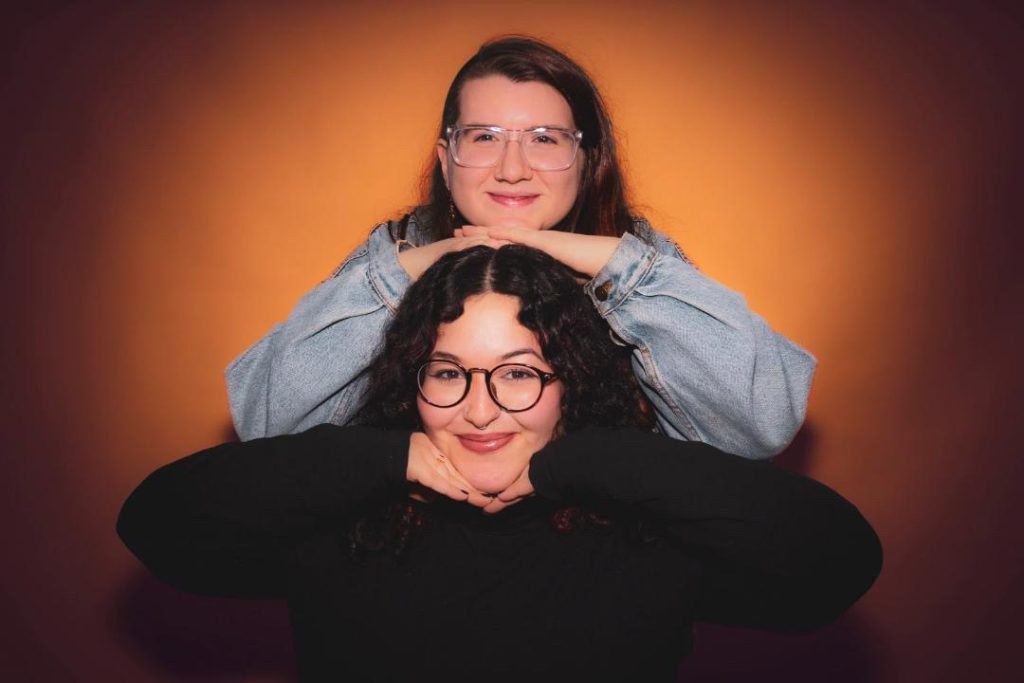
It’s often said (well, I definitely say this), that some of the deepest conversations and connected moments can happen while one is sitting in a car. This is certainly true for the duo, band, sisterhood — Ferns and Fiddleheads. Not only did Isa Arango-Tobon and Tess McGowan get to know each other in one, they also realized they needed to get serious about starting something — when they couldn’t stop singing harmonies in cars. Nominated for the 2026 Motif Music Awards for Breakthrough Artist of the Year, Isa and Tess are songwriters who use relatable wordsmithing, beautiful imagery, and everyday sounds to create their songs. With the support of recording studio the Proving Ground and producer Dylan Titus (both also nominated in this year’s Music Awards). Titled “Scenic Route” and “Long Midnight Drive” respectively, their two EPs tell coming-of-age stories of ever-evolving growth, learning, and friendship; making them the perfect soundtrack for your next road trip.
Mayté (Motif): Please share the following: Name, hometown, favorite karaoke song.
Ferns & Fiddleheads in unison: Oh, God!
I: Sure. My name is Isa, I’m from Pawtucket, and my favorite karaoke song to sing is “Suddenly Seymour.”
T: Oh that’s a good one, and we sing it together… I’m her Seymour!
My name’s Tess. I’m from Pawtucket, and my favorite karaoke song is “Saving All My Love for You” by Whitney Houston. It’s a banger.
M: I would love to know how you met and decided to start this duo / band.
T: We met in 2022, when Isa was in a relationship with a friend of mine. Then we went to an Elton John concert together — his farewell tour. We sat in the car until 1am after. We really bonded, talked, and got to know each other. And from then on I feel like we just have not separated, ever! And she and that friend of mine are no longer in a relationship, so I feel like she got me in the divorce, or vice-versa.
I: Haha! I would say there were two distinct moments. One where we realized, “Hey, we should form a project together.” They were both in the car, actually. There was one time when we sang “Chiquitita” by ABBA. I think we did it both in Spanish and English, because I had grown up on that. We did that, and it was a clicking moment. We were like, “Woah, we sound great when we harmonize.” And the other moment was outside of our friend’s house, we were listening to “Dream Boat Annie” (a song by iconic band, Heart).
T: I said, “I’m so enthralled with this two-part harmony. There’s something about it. It’s so gorgeous.” Then she fell in love with it, and we could not stop singing it in the car together. And we were like, “Damn, we need to do something.”
I: We started talking about wanting to commit, but we never got around to it. And then last year we were like, “Let’s do this!”
T: We had our first show as Ferns and Fiddleheads in September of 2024, as a folk-inspired cover band. Then it was winter of 2024 when I said, “Hey, I have a song, and I need help because I don’t believe in myself enough, and you believe in me, and I would like to run this by you.” And I showed her a song that I wrote in 2021, “Smile.” And in January of 2025 I started writing “Colorado in Spring,” and we then started writing together. As we sit here doing this interview, it has been over one year of original songs for Ferns and Fiddleheads, recorded at the Proving Ground. Dylan Titus is our producer. He’s a writer on the albums too, and has done most of the heavy lifting. We wrote the songs, brought them to him, and he gave them the life that they have now.
M: Amazing, talk to me about choosing the name Ferns and Fiddleheads.
T: There’s actually a story, should I tell it?
M: Chapter one!
T: We performed at Ward’s Berry Farm in Sharon, Massachusetts, where I’m a manager. We’d been trying to come up with a name for two months; we had a lot of interesting choices, all leaning towards nature, something you can see and touch. We also had female-themed ideas — Mother Nature, Mama Gaia, Mother Terra — something that showed that we were two strong women making music, but they also had this delicate side. So our first show is coming up, and we’re panicking because we don’t have a name. Then I’m lying in bed one night, and I have a vaulted ceiling in my bedroom. And across the top there’s trim, where I have antique-style postcard posters that are nature themed: bulbs, flowers, plants, tarot cards. And the one that is directly above the center of my bed is an open fern, and a closed fiddlehead.
M: Together.
T: Together. I was staring, and thinking, “Ferns, oh I love that word.” And then there’s a fiddlehead. And I love the alliteration of that, ferns and fiddleheads. A fern starts as a fiddlehead, and they are small and edible, which you could equate to weak.
M: Vulnerable.
T: Vulnerable, yes! And then as they grow, they open themselves up to this beautiful fern that everybody wants around their house.
M: Hold up! I had no idea a fiddlehead was a baby fern!
T: Yes! Fiddleheads are harvested when they are fiddleheads. But if you let them grow, they turn into ferns and become inedible. I loved that theme of a fiddlehead being small, vulnerable, but something that people still love. And then the fiddlehead opens itself up to be this beautiful fern and becomes inedible, stronger. I pitched it to Isa. She loved that idea, and that is how our name came about.
M: Can you expand on the relationship between your two EPs?
I: We can start off by saying that one is more you and two is more me.
T: They’re purposefully night and day. Initially, this was going to be one 12-track album. Splitting it into two EP’s was our producer Dylan’s idea. Scenic Route is the drive to the adventure, and Long Midnight Drive is the drive back home. EP number one is the feeling of packing all your friends in the car. You’re driving up to the mountains, going to some destination to make a memory. EP number two is all your friends packed back in the car. You’re driving back home, you gotta drop them off, everyone is asleep in the backseat. You, as the driver, are awake. It’s the middle of the night. You’ve had just an amazing core memory type of day. What are you listening to? On both of those occasions? “Scenic Route” is about something I’ve always personally struggled with — slowing down, prioritizing myself, taking care of me. And that’s literally a lyric in the song. In my life, I would like to metaphorically take the scenic route. The songs have this brighter, sun-shinier type of vibe. Another song on the first EP, “Colorado in Spring,” (where Kevin Koehler plays the violin) is about a trip we were supposed to take. It’s all about [having experiences] and carrying all of that with you. Then Isa pitched the song “Long Midnight Drive,” and we got the inspiration for the second EP.
I: I started “Long Midnight Drive” in 2021. That was actually my Harmony Two final project at Berklee College of Music. I had just made this small demo on logic and I had never forgotten about it. So we were thinking about what other song we should put on this album, and I decided to pitch it to Tess and Dylan. It set a [new] tone for the next [collection of songs] because it had more synthy sounds. I always think of this specific album as having orange and purple tones, it just feels so warm to me.
T: I love that we associate colors with the albums. The first one is yellow and green. I’m also very proud of the album covers themselves, having the night/day matching.
M: In the song “Scenic Route,” you sing, “I don’t want to listen to you anymore. I’m done hearing. Your point is moot.” I love that line!
T: Yes, Thank you! I feel like I’ve heard that from multiple people. Specifically that line, because…
M: A lot of people don’t know what it means (“having little or no practical relevance”).
T: Yeah, and people have asked me, “Why did you put moot in a song?” And I said, because it rhymes with root! But also, it made sense for what I was saying. I was writing- “I’m done with hearing you” speaking metaphorically about other people, but also my own brain. I’m telling myself, “Your point is moot, just keep doing your thing. Stop and smell the flowers for once in your frickin’ life.”
I: I love the idea of taking the scenic route. It means I’m going to see something cool. It reminds me of our first EP cover. The year before we had the total solar eclipse, and coming back home from that, we passed by this random road in New Hampshire, and I was like, “Look at the mountains, that open space.” I told Tess, “We have to go do anything there.” I needed to go back, I just felt it. And so we did, that’s where we ended up doing the EP cover.
T: We chose that photo literally 30 minutes after taking it. We hung out in the meadow for a long time, frolicked, and then on the way back, we were starving and we found this random diner. We’re sitting at our table, looking through our pictures, [meanwhile] the table right next to us has two couples sitting, probably in their 70s, maybe 80s. They’re talking about their son coming to visit, and we’re looking at our phones when one of the guys straight up says out loud for the whole restaurant to hear, “Guess who took the scenic route?” And we looked up at each other…
I: At the same time!
T: And looked over at him, and he’s still just having his own conversation. And he has no idea he has just changed our lives. So thank you, man. Whoever you are!
M: You mentioned “Colorado in Spring.” The song is about the two of you?
T: Yes, so John Denver is a huge inspiration for my writing style, the way that he views nature, people, and how he writes. I introduced Isa to his deep cut songs and we both fell in love with him. We were going to be a John Denver female cover duo (that didn’t happen). I’ve always wanted to go out to Colorado, so I talked to Isa about it, and we decided to go in the springtime. Then I had some medical issues, needed to save up for a potential surgery. With the world’s politics at the time, travel was in question — what we could afford — what was safe, and we decided not to go. The fact that I had to choose pissed me off. So I started writing a poem about what I was feeling, and it became, “I don’t know what the future will bring, but I hope we’ll have Colorado in spring.”
I: I came up with the instrumentation, the melodies. I was reading what she wrote, and I thought, this feels like it should be in six-eight (time signature), and it became a waltz. And I think I came up with the “fields of marigold and lavender” line…
M: I love that line! The other day, I was coming home from work, listening to your song, and during that line the sunlight came up behind me and just flooded my car. I thought, “Okay marigold!” I get chills just telling you that.
I: That’s how I felt when I came up with it, actually! I thought, “Wait, we’re cooking with this. With the rhythm, especially.” I have the early recordings, our demos. And it’s just us literally figuring out the rhythm and realizing we had a song. Both of us have expressed that we’ve felt super insecure in the past about our own songwriting. And it was just so beautiful to me. This was a moment that I will always cherish, where we looked at each other and knew, we both believe in each other. We know we got this, in terms of our writing, our musicianship, and how well we worked together; just creating that first song, and from there the ball got rolling.
T: It exploded.
M: Ha! Talk to me about the song “Smile,” where I heard you speaking as a little kid, Tess.
T: Yes! I am speaking as a little lass in “Smile.” It’s a love letter to my younger self, where I’m thinking, “I need to feel good about myself, because I know that little Tess would think I’m cool.” The hook is, “What would she think of me? Would she see the faults that I see now as an adult?” So I wrote that as a question — what would I do differently? I would tell her: be happier, be more free, don’t be afraid. Run, frolic, do all the things that would make you happy. There’s a very silly line in the song, it’s me just saying, “Jump the fences,” because I’ve never jumped a fence. I was always too scared as a kid, I would always go around. It was the safer option. And now, as an adult, I’m like, “Damn, I wish I jumped that fence.” I wish I did something because I wasn’t afraid.
M: Outside of the norm.
T: Outside of the norm! So I wrote that song, and I brought it to Isa. Then I kept getting this image in my head of a home movie of me, Dylan, and our brother John. My mom is behind the camera, it’s us in the pool, and it’s the first time ever that I’m swimming with no floaties. It’s a perfect compliment to the song because, in that video, I’m a little girl doing something scary for the first time, but I’m so happy. So I asked, “Hey, can we put this in the song somewhere? Because you did that in ‘The Norm,’ and it’s so inspiring.” I love hearing little Dylan in the song, and there are sound bites of our grandfather in it too. It’s so special. So, for “Smile,” we put the pool clips in. My mom says, “Go ahead and swim; let go of the ladder.” And then I say, “Hold on, ready?!” as I dive in. Then you hear a very crackly, “Woo!” — that’s Dylan as a teenager, supporting me. And I feel like that was a great metaphor. Here we are, 20 years later, cutting this record, and he’s still always standing behind me, cheering me on.
M: Thank you for sharing that story.
T: Of course, thank you for asking. Nobody ever asks about “Smile.”
M: Out of curiosity, have you jumped a fence as an adult?
T: Listen, I’m an anxious adult. I was an anxious child. I still have never jumped a fence. But I’m okay with that. I summited half a mountain in Wyoming. I held a sloth in Honduras. I swam with manatees in Mexico. I have filled the gaps. I didn’t jump the fence. I just knocked it down and ran as fast as I could.
M: Turning to you, Isa, and the song “Figure me Out,” from your newest EP.
T: Yes! I love that song so much! It’s so good!
M: The lyrics in Spanish are:
“Soy muy llevada de mi parecer, siento que no voy a crecer, y ya no quiero más.
Me encuentro en un atardecer, quisiera volver a nacer, y ya no quiero más.”
(I stand steadfast in my opinions, I feel like I’m not going to grow, and I don’t want any of that anymore. I find myself in a sunset, I want to be born once more, and I don’t want any of that anymore).
Could you walk me through what they mean to you?
I: Being Colombian-American, I wanted this first record to have Spanish in it. Something that means a lot to me, something that is Isa. I grew up speaking Spanish in the house. That was my first language. Both of my parents are from Medellín, Colombia, and I’ve been there a lot. I would love to take Tess there one day too!
T: I wanna go so bad! And then we can release an album in Spanish?
I: Oh my God. Woah.
T: Our next era.
I: So, I had to talk to Tess about this song because I had written it, and then I realized there was actually a specific meaning there (post-breakup) that I hadn’t seen.
T: This is going to sound mean, but I mean it in a loving way. She was oblivious to her own writing. She shared some of her deepest feelings and thoughts, but didn’t even realize it. And then I said, “Isa, you know what this is about, right?” And she was like, “Oooooh!”
I: During that relationship, a lot of people knew me, but they didn’t. That’s kind of how it’s been most of my life, anyway. I feel like sometimes I put up a bit of a wall, I’m quite introverted in social settings, and I thought, “Not a lot of people know the true Isa.” Since that breakup, I’ve learned and grown, and I was basically saying to myself, “I want to grow more!” I don’t want to keep just putting up that wall. I want to be more free and be able to let my guard down, and allow the real Isa to come out and let more people see that, because I have a lot more to bring to the table than just staying in a corner, not speaking. So that ended up being way more personal. It’s definitely my most vulnerable piece so far.
T: I think that’s why I love it.
I: Funny thing, when we recorded the vocals for that song, the majority of it was one take. I know it was a late night in the studio, and I was a bit exhausted. I was in my feels and I just let that all go. Afterward, mixing, I asked, “Can we re-record certain spots?” And Dylan was always adamant, he said, “No, this is your rawest take yet, you can feel the emotion in it.” It’s one of my favorites, honestly. The lyrics hint at the idea that how I’m perceived is not what is true. I also talk about a sunset. In hindsight, I just wanted it to sound pretty. Then I mention wanting to be reborn. I had a family member reach out and ask, “Why would you say that?” I explained that it’s more about me wanting to make different choices. I don’t regret anything, but I think it’s just about being more mindful.
M: Maybe being more yourself.
I: Yes. Absolutely, being more myself, I just want to figure myself out and just go for it!
M: Another lyric that spoke to me was, “I’ll react how I want to; it ain’t your space, or your time, or your mind.”
I: Ooooh!
T: I’m going to tell you right now, I scream that line in my car. I love that, every time you sing it!
I: There were certain things that I reflected on that maybe shouldn’t have happened. I felt like I should have spoken my mind more and held my ground. I just couldn’t stand for something like this anymore.
M: You took a stand and walked away.
I: Yeah, exactly!
M: Okay, and what about “Photosynthesis Soul”.
T: I had just gone through a breakup as well. Isa and I both had just lost a mutual loved one- and so we were going through it — a lot of grief in different ways. And I was at my friend’s house because they said, “Come over, we’ll take care of you.” So, we’re making breakfast and my friend Molly goes, “Oh, the sun is so nice right now.” She drops what she’s doing and says, “Guys, photosynthesis time!” And all the people that live there were like, she’s right, and they all walked outside. And I thought, what is happening right now? We walked out in our pajamas, bare feet, and we sat in the grass together and just soaked up the sun. So apparently it was this tradition that they had started doing every morning with each other: 15 minutes, go sit in the sun, don’t do anything. I was listening to music because I’m never not, and I was listening to the Flamingos, a group from the ’50s and ’60s, similar to the Platters — classic four-part jazz, very dreamy. So I have one earbud in, listening to it, and we’re all sitting in the grass, and I start to get very emotional. I’m a person who cries every day. I cry over everything. That’s just my body’s response. So I started crying. And Molly and my friend Delta were like, “What’s happening right now?” And I looked at them and went, “I’m having a moment.” I felt so grateful to have those moments, those people around me: Isa, my brother, Molly, Delta, Lance. My best friend Megan and her boyfriend. And I was thinking, oh my God, I’m so grateful for my friends and for my family. And we’re all lying there, and I’m picking up clovers and I start stuffing them in my friend Delta’s hair. Then we go into my friend’s room and all pile onto her bed, watching a movie. I’m on my phone because I started writing this, “Saturday morning, clovers in my hair, barefoot on the moss, jazz playing softly, we almost forget about our loss.” It was just a retelling of how I felt sitting in the sun, breathing in and out with my friends, and how conducive to my healing that was. It felt like my soul was photosynthesizing. I brought what I wrote home, and my three good friends, Ryan Cimon, Matthew Beatty, and Garrett Macrina helped finish the song.
M: We also talked about “Meant to Be” a bit. Is that where you say something about your favorite mistakes?
T: That song is Isa’s baby, and the line you’re referencing is the bridge that I wrote when she got stuck.
I: It references one of the first times that we clicked. It happened on a long midnight drive, where we got lost, going nowhere. It’s me literally talking about June 2022, when we solidified our friendship, our partnership.
T: I had written “Colorado in Spring” about the two of us, and then she was like, “I’m writing a song about us,” for the second EP.
M: The “who” you’re singing about is not necessarily obvious in your songs.
T: I feel like that’s the beauty of it, the listener can relate it to anyone. We’re talking about each other, in the sense that we feel meant-to-be artistically, and in our friendship, and how we weren’t comfortable in what we were creating until we collaborated. And at the same time, anybody can listen to it and say, oh, this is about my partner, my mom, my best friend. It’s also so much about us not being sure of ourselves. The line you mentioned is me saying “I can’t wait to see what we’re going to do,” and along the way, we are going to “pen our favorite mistakes.” It’s a lyric that I fought to keep because our producer wanted to make it something more positive.
M: Is that the song where y’all burst out laughing, and there are crickets too?
T: Every time you hear a nature sound or a car driving away or whatever, it is methodical. “Scenic Route” ends with us laughing. “Meant to Be” too. “Smile” starts with the sound of a morning dove, which is my favorite bird. It reminds me of childhood — the sun rising. In the beginning of “Meant to Be,” you hear crickets.It’s sunset. It’s the end of the day. Also, I love the laughter at the end of it even more because there’s a scream and then more laughter. When we laugh we emote a lot, we clap, slap, and Isa backed up too far and fell over a chair, so the scream you hear is her going thud! And then she says, “Well, that should be the end of the song,” and then Dylan cut that with the sounds of us driving away.
I: I think it was maybe recording Wyoming, where that laughter happened, because we were in the booth together.
M: Anything you want to share about the song “Wyoming (for Greg)”?
T: That song is dedicated to my great uncle, Greg, because he’s from there, he grew up on a huge ranch, and he talks about it with such fondness. He’s almost 80 years old, and he still has a little bit of a Wyoming accent. My great aunt and my great uncle are like grandparents to me — we are extremely close. In July of 2025, I went on a national parks road trip with a good friend. We did 2,300 miles in seven days, and our first stop was Wyoming. Every day I would call him and say, “Guess where I am now.” And I was sending him photos and he was sending me childhood photos, and saying, “I was there when I was 12.” We were just swapping stories, and it was so beautiful to share that experience with him, with an elder in my family.
While I was out there, I thought, “Oh, I’m going to write a song about this. It’s inevitable.” And I started writing the song. During the entire trip, I kept hearing in my head, “It’s because Wyoming is where you are,” who the “you” is, depends. The “you” that I’m talking about is two different people. It’s me. I’m saying that a part of me is out there now. I found her out there, and I brought her back with me; and it’s my uncle, because everywhere I went, I thought of him. I’d pick up a rock and put it in my pocket and be like, “He can tell me what that is later.” I brought the song to Dylan and we created the tune in one night. Then we went up to New Hampshire together and surprised him. I printed out the lyrics on paper, aged it, framed it and wrote “Wyoming (For Greg)” at the top. I gave him the gift and said, “The song is for you.” And he sobbed. I said, “You can’t go back home, but let me bring a little bit of home back to you.” I framed plants that I picked on my walks, I vacuumed-sealed them so they couldn’t age. And when you open it, it smells like a field (she stuffed hay in the frame). My uncle said, “It smells like my backyard.”
M: Clearly your other talent is gift-giving.
T: Yeah, a little bit. My uncle said he listens to it twice a day, once when he wakes up and once before he goes to bed. And my aunt says he still can’t listen to it without crying. I love that I’ve opened up that side of him. Because he’s the kind of guy that says, “I’m emotional but I can’t let anyone see it.”
M: “Streetlights and Moonlights”, tell me about that song to wrap up.
I: I’m basically challenging myself, who I’ve been up to this point, and who I plan to become. Facing my fears, insecurities, and accepting them. I think it’s so fun how it just explodes in the middle of the second verse, it’s very doo-wop-y. It’s also one of the songs where I wanted to bring out the belting side of me, because I love to belt as a singer. And that bridge is just me going wild. I had one of my friends, (Tommy), help me figure out the chord progression. I also had some inspiration from a Colombian song, “Esa” by the band Binomio de Oro. I liked the way it sounded, so I tweaked it, changed the key. I wanted to figure out a way that I could make it my own. I love when songs have a nod to something, or make me have a specific reaction. That’s what I look for in music. That’s what I want my music to basically express.
Dive deeper into this duo’s music, storytelling, and charm. Follow them on instagram: @ferns.and.fiddleheads and go to their bandcamp: fernsandfiddleheads.bandcamp.com