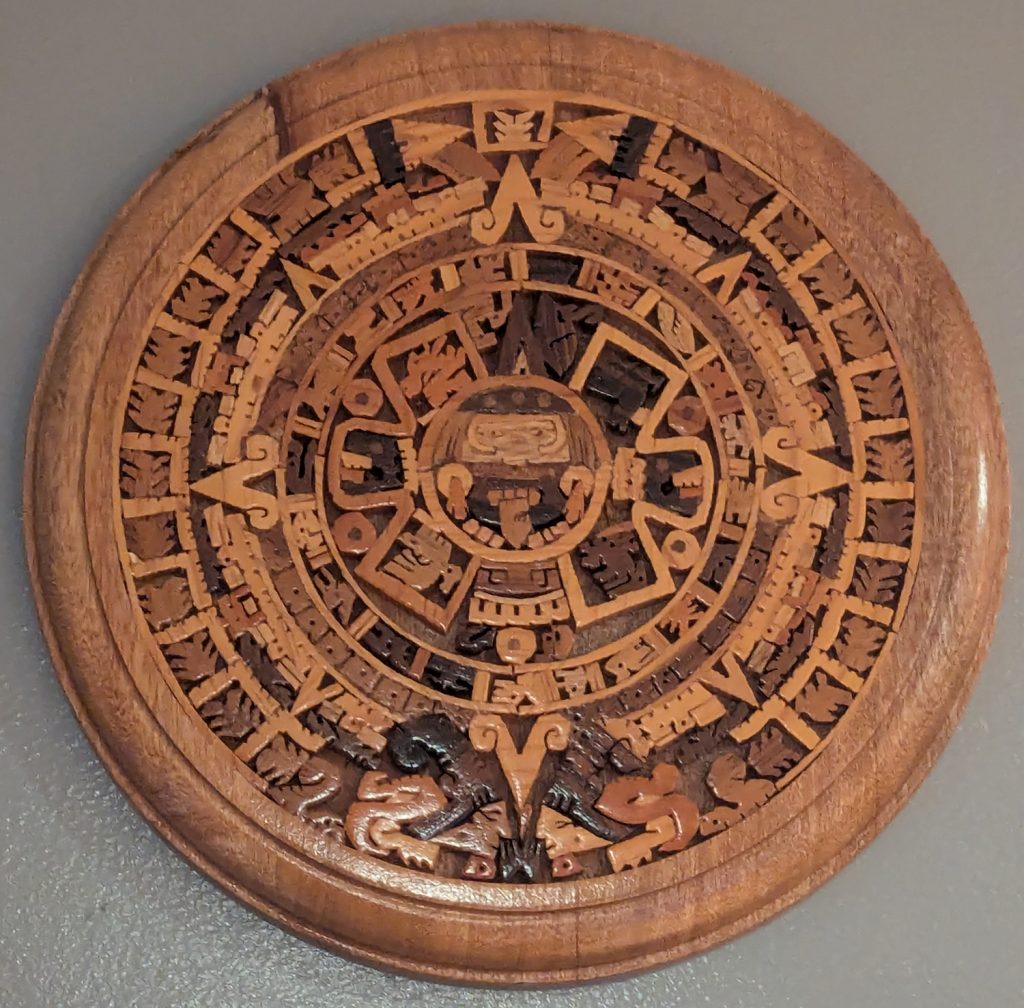
Strolling through The Find on 6 in Johnston, I came across a beautifully, intricately carved, circular, wooden plaque. It stared at me as I was staring at it, intrigued by its detail, and I picked it up for only $10! I was surprised; the price was a bargain and I just had to have it. As we all do, I Googled it and found out it was not a pre-Hispanic original, but a copy of the Aztec (Mexica) Sunstone- or Calender Stone..
Upon more research I found out it is of Mesoamerican heritage. Mesoamerica is a historical cultural region which extends from Mexico to Central America. Over the course of several millenia, various cultures emerged in different parts of this area including the Maya (who flourished from roughly 250-900 CE in today’s Guatemala, Honduras, Belize, and southern Mexico) and the Aztec (1325-1521 CE), among many others. These cultures were distinct, but they had certain shared traits such as the ballgame, certain deities, and of course, the calendar.
I found one of these complex calendars, or so I thought, and I watched some videos and read up on the history of the Calendar Round. The calendar uses a vigesimal base number system of 20, compared to our base system of 10. It has 2 calendars: the Sacred calendar and the Solar calendar. Mesoamerican cultures notated days in these calendars with the help of numerals: for instance, for the Maya dots were used to indicate ones, and bars for five, shells are zero or base number; but these were not just numbers, to the Maya, they represent heads of different deities.
I reached out to Paul Tamburro, a graduate student in Anthropological archaeology at Brown University to find more details on this artifact and how the calendar works.
Kelly Marino (KM): How did you become interested in the Mesoamerican calendrical system of astrology?
Paul Tamburro (PT):I first became interested in Mesoamerica during college. I’d always been interested in the ancient past, but I was amazed to discover how little I knew about this part of the world, as many of my earlier studies had focused on civilizations such as Greece, Rome, and Egypt (these are often better taught in the US school system, at the expense of other civilizations). I remember being stunned as I learned about the complexity of the Mesoamerican calendar, art, and writing in my first class on the topic, and I wanted to learn more.
KM: What do you know about the details in the Aztec Sunstone?
PT: So the piece you found is a copy of the Aztec Sunstone, which is in Mexico City. It is sometimes called the “calendar stone” and it certainly has calendrical elements. There is actually a large-scale copy in the Boston Museum of Science, and it’s a huge symbol of Mexican identity today; in fact it’s probably one of the most famous pre-Hispanic images around. In Mexico, you’ll see it everywhere, including on sports jerseys and on the 10 peso coin.
It was rediscovered in the late 1700’s near the main cathedral in Mexico City. (The Spanish had probably seen it in the 1500s and buried it, since they would have considered it “idolatrous.”) Eventually it was moved to Mexico’s National Museum of Anthropology, and it is one of the most iconic pieces in the collection there today.
The original was made of volcanic stone, which is characteristic of Aztec art. So this piece has elements of the calendar round, but it’s not meant to be used like how we would use a calendar today – instead it’s a schematic rendering of how time and space are intertwined. For a very quick breakdown, the face in the center with the tongue sticking out is the current “sun” or creation, called Tonatiuh. Aztecs believed that there had been four prior suns before the one in which they were living. Each of those prior Suns were successively destroyed in succession by different forces. The squares coming off the face diagonally represent those prior creations and how each was destroyed uniquely by a cataclysmic event. The circle that runs around the center has the day names from the ritual calendar. It’s important to note that time and space are also combined here; notice how the different points move outwards towards the different cardinal directions.
KM: Can you explain how the Sacred calendar works?
PT: The ritual calendar consists of 20 named days and 13 numbers. Each day, both the name and number of the day change. So to simplify a bit with English names, if today is 1 house, tomorrow would be 2 lizard, the next 3 snake, and onwards until you get to 13, then you’d start from 1 again and eventually get to 8 house, 9 lizard, and so forth).
This cycle repeats in full every 260 days. This calendar has a deep history in Mesoamerica and days were often used as personal names with specific associations (for instance, we know that for the Aztecs, people born on the day “monkey” were often destined to be artisans.)
KM: Can you explain how the Solar calendar works?
PT: The solar calendar is made up of 18 months, each with 20 days, for a total of 360 days. An additional 5 days were added on to the end of the year to approximate the length of a true solar year (the Maya considered these very unlucky and dangerous days; they called them the wayeb – literally the “hole of the year”). Originally the months in the 360 day calendar may have corresponded to seasons; however, since Mesoamerican timekeepers didn’t account for the extra quarter of a day or so that we now make up for with leap years, the months slowly shifted over time.
KM: Can you explain the “year bearer” system?
PT: Year-bearers are derived from the way that the ritual and solar cycles intersect. Just by a convenient trick of mathematics, it works out that the 365-day cycle will always restart on one of the same four days in the 260-day cycle. Those days become the name of the year, along with their corresponding number, (for instance “2 house”), and since the year names only repeat every 52 years, they give you some degree of temporal specificity.
Both calendars create a set that resets every 52 years, which is known as the Calendar Round- the end being a time of great anxiety for certain cultures like the Aztec. They would engage in a ritual called the “new fire” ceremony in which all the fires in the realm were put out and then relit when one of these cycles turned over. This system was used by the Maya and Aztec, as well as various other Mesoamerican cultures.
KM: Can you describe some of the challenges or breakthroughs in the decipherment of Mesoamerican calendrical texts?
PT: The calendars are really well documented: we have thousands of texts from the Maya Classic Period (250-900 CE), as well as plenty of Aztec monuments and a number of Mesoamerican books. We also have written accounts from the time of the Spanish conquest as well. Spanish friars were particularly interested in understanding the Mesoamerican cultures they encountered. They documented the different calendars and calendrical rituals that they observed, partly out of a desire to eradicate these and replace them with Christian beliefs. (Ironically, at the same time that they documented these practices, many also burned thousands of Mesoamerican books, destroying these key records).
There was a resurgence of interest in Mesoamerican calendars in the 19th century when several pre-Hispanic books resurfaced in Europe. Over the course of a couple centuries, scholars began to work out the basics of the calendar and ultimately, the Maya writing system too (this is something that we’ve come to really understand well in the last four decades or so!) Ethnographic research has also added to our understanding since there are various indigenous communities in Mesoamerica that still use versions of the calendar today.
The calendar round is a 52 year cycle then resets. However, since the same dates would repeat every 52 years, it was tough to record distant past dates, like records of ancestors of kings. The long count, a system used primarily by the Maya, did provide greater temporal specificity though.
KM: Can you explain the long count?
PT: The Mayan long count is something that will let you fix the date in absolute time, and it is made of a bunch of interlocking cycles, which scholars have invented names for. The first one is the cycle of a day (a “k’in”), then 20 days (a “winal”), 360 days (a “tun”), 20 years (a “k’atun”), and 400 years (a “bakt’un”). That gives you a degree of precision and when you look at an ancient Maya monument, the most typical format would be for it to open with the date of the long count, so they’re very concerned with telling you exactly when something happened, and we can correlate those dates with dates in our modern calendar. Maya monuments often include other calendrical information too: in addition to the long count, the calendar round date is usually included as well, and information about the lunar cycle may be there as well. Basically, time was notated within several interrelated systems simultaneously. However, the long count was not universal, so the Aztec didn’t use it.
The Maya also kept track of eclipses and other astrological phenomena with startling accuracy. In fact, there’s so much calendrical information in Maya writing that for a long time, scholars were hesitant to believe the Maya wrote about anything else – it was thought that they were just peaceful “calendar priests” who constantly crunched the numbers. We now know that was misguided. As we’ve deciphered more and more of the Maya script though it’s become clear that they were very much concerned with a range of issues, some of which might seem a bit familiar today: the lives of individual rulers, warfare, political alliances, and much, much more.
KM: How did you find that different Mesoamerican cultures adapt or interpret the core elements of the calendar round?
PT: They all use the calendar round, even though they speak different languages and use different terms for the days, and sometimes the days have slightly different associations. For instance, the Aztec have animal names for the days, and they are also rendered differently. The Maya have very distinctive cartouches: they always put the day names within a sort of circular shape with droplets coming off the bottom. (This possibly represents mythological blood from a supernatural creature.) Meanwhile, Aztec art and writing is more angular than Maya art and writing, so the days are often with squares. There are regional variations like that, but the use of the calendar is fairly consistent across Mesoamerica.
Mesoamerican cultures had calendar priests, whose job was to read the prophecies of the days, especially the day you’re born on. Some of the documents that were made in the colonial period basically tell us every day has a different association, some days are good days and some days are bad days. There’s even some indication that if you’re born on a bad day, you might wait for a good day to get brought to the calendar priests, and your destiny will be better… It’s also really common to see calendrical names in Mesoamerican art – for example, you might see someone named “seven deer”, after the day they were born.
Further Reading:
mayadecipherment.com
David Stuart, The Order of the Days
Michael Coe, Breaking the Maya Code
Michael Coe & Stephen Houston, The Maya
Paul Tamburro is a graduate student in Anthropology at Brown University. He studies the archaeology of ancient Mesoamerica, with a focus on the art and writing of the ancient Maya. His research interests also include ancient sound, the role of reading and vocal performance in Mesoamerica, and ancient musical notation.
Photo by author