In the corner of the media tent, a thin man sits between two reporters. He holds a mic in his hand and speaks into it with ardent gestures. “Jazz is something alive, something moving. Think about Thelonious Monk, Coltrane, Davis, all those giants, and we’re here moving with them, always moving, always improvising,” he says, leaning into the left reporter while the other one nods along. I’m standing on the make-shift back porch, waiting in line for the bathroom, drinking a seltzer water and watching the shadows collect the few others sitting at sparse chairs and picnic benches. A weary man has his hand in a bag of chips collected from the free-food table. Two big-bearded photographers take their gigantic lenses off their cameras and begin packing up. The notes of a saxophone drift through the air, the sound of hands clapping, the roar of another song begins. For me, and many others, the 71st annual Newport Jazz Festival is just about over.
Jazz, as a music born from people in a society that inherently rejected and persecuted them, exists as a reaction to that subjugation. As Ralph Ellison wrote in Invisible Man in 1952, being Black in a racist-white world is akin to being invisible, or “I am invisible, understand, simply because people refuse to see me. Like the bodiless heads you see sometimes in circus sideshows, it is as though I have been surrounded by mirrors of hard, distorting glass. When they approach me they see only my surroundings, themselves or figments of their imagination, indeed, everything and anything except me.” Blues and jazz have roots in slave music, and as a result of asserting visibility in a world that denies them, have evolved into a cultural celebration of heritage and identity through their free-form and improvisation.
It’s interesting how Newport, once a prominent slave trading hub, now hosts one of the biggest and most influential jazz festivals in the world. It’s even more interesting how the festival grounds themselves – Fort Adams – were a major port for the slave trade. As young white women sipped lattes and their boyfriends, with their affinity for Bud Lite, marched them towards the beer tent, I wonder now how many people thought about jazz and its history. The thing is, I am one of those young white women, and I can’t pretend to assume that I have or can have a deeper understanding of anything other than that I love listening to Holiday and Coltrane, and have a strong affinity for a crazy, whitenailed, sax solo. But what can the music teach us that history can’t?
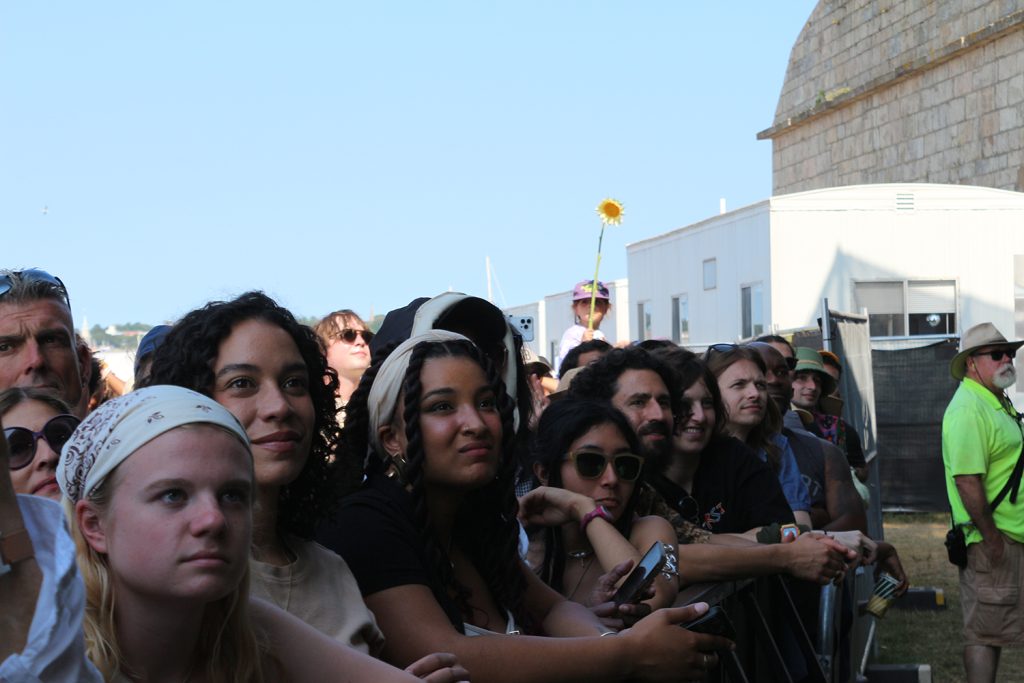
On reflection, it’s interesting to think about these things, but for me the biggest takeaway from a festival like the Newport Jazz is its similarity to the music itself; the beauty and joy and sorrow it inspires in those who engage with it. As we walked across a grassy cliff overlooking the classic view of the Narragansett Bay and the Newport Bridge, the grounds seemed to swell with invitation, as though a carnal heat was rising from the creation of a united crowd in a shared experience: Jazz.
At the fest’s Quad Stage, Cymade began to tune up for their afternoon set. Cymade is a popular British funk band of about 9 people from the 1970s, and their music had a throng of people from all age ranges bobbing along. A small group of young people in the back cheered to a bass solo, an older man with leathered skin in a wheelchair, who was missing a leg, listened intently in the middle of the aisle with his eyes closed, and some people stood to the side, out of the tent’s shade and in the sun, squinting in the brightness of summer, kicking their feet in the dry heat. Suddenly the crowd began to disband, people moving like languid cockroaches to the main event stage, the Fort Stage. De La Soul was about to start their set, and after a few technical difficulties, Kelvin Mercer jumped on stage while Vincent Mason sat behind the DJ set and spun the familiar beats. It was hard to not feel the absence of David Jolicoeur, the third member, who passed away in 2023. A surprise guest appearance from Talib Kweli and Pharoahe Monch didn’t hurt, and when they started up the 2002 hit “Get By,” it provoked a buzzing communal response; one that brings awareness to everyone, and yourself, in this inescapable orchestra of human experience.
One of the final sets of the night, at the Quad Stage, was Esperanza Spalding. As we lounged on a blanket, the sun began to set, people around us ate nachos and sipped sodas, and the gulls flew closer and closer overhead. Lying on the ground, watching the trees, listening to the famous bassist take the stage with her practicing plucks, was a disembodied experience. I’ve recently rediscovered her early album, Esperanza, so I was looking forward to her set when I saw her on the bill. Spalding’s essence was warm, and she had a humble way of communicating with the audience, but also one of much power. She introduced her most famous song, “I Know You Know,” with a nod to youth and hindsight, saying, “I wrote this song when I was 22, and I thought that when people said things in love they meant them.” To this song, people danced alone and in each other’s arms, lovers smiling and laughing, old women and men watching or swaying. Spalding, behind her bass, began introducing her next song “Thang (hips)” in a dreamy voice, “In life, sometimes we’re called to do things, but get distracted. You got this thing, called stride grease, in your hips, that will always guide you back to the thing you’re meant to do in this life. Listen to your stride grease.” This notion, as it floated through the air behind her bass cords, resonated. As though it was that simple, that everyone had this internal light force inside of them that, when things got too tough or off-track, would guide them back to where they needed to be.
Hand-in-hand with my love, I left with the stride grease; I would argue everyone did. In times like these, with our President cancelling National Public Radio, disbanding DEI services, and basically praising and supporting a dogma reflective of all the worst aspects of our country, it felt like the Newport Jazz Festival was a sensitive, important reminder of our national history, and the throughline of music as a vessel of human expression; that life, when we let it do its thing, is all about improvisation. •