While you may read alone, on the train, or in your bed, is there a conversation involved in the process of reading? Reading is considered a solitary act, but what happens before picking up a book and feasting your eyes on the page? Most readers have a favorite bookstore, and so they frequent it. One may like the ambiance, or the location, but largely it is their favorite because they appreciate the selection. Curation is the unspoken work of the independent bookstore: They don’t only hold marketable books, they promote the uncirculated, the less read but equally as good. They create the draw that pulls you back through their doors. Recently I found myself thinking about this relationship: The conversation that implicitly happens between a bookstore and a reader. And so, I decided to sit down, reverse the roles, and ask these curators about what guides their process.
Riffraff Bookstore and Bar, is exactly what it seems to be: a bookstore and a bar (both coffee and alcohol). Owned and run by Ottavia De Luca and Lucas Mann, Riffraff seeks to offer both big and small titles, the found and unfound, and urges people to step, in the words of De Luca, “Off the beaten path.” Their poetry selection is vast, and their staff favorites board can’t be missed. With fresh and unexpected picks like The Autobiography of Gucci Mane, Riffraff seeks to have something for everyone. De Luca and Mann took over the store in 2023. “We were customers first, before taking over… we feel like there is stuff here that we couldn’t find anywhere else in Providence, as well as a lot of big literary books, big popular titles that I also wanted to read,” De Luca shares. But as time has passed and ownership has shifted, De Luca says that she “wanted to keep that vibe going, and just expand on it” by buying from small, independent presses, buying works in translation, continuing to buy poetry books, and also continuing to widen the scope of the classic titles they hold. Mann and De Luca read front-list catalogs from publishers and shop a season in advance – the titles they buy aren’t the books that have just come out, but are ones that will be coming out right as the store begins carrying them.
Owning Riffraff has enabled them to develop relationships with publishers and representatives. Mann offers “Publishers and reps get to know you. They’re not even talking to us about books that they’d be talking to other places about because they know us. On the publishers’ end of things, on the sales rep end of things. It’s like, ‘This could be a Riffraff book. This is a book that might get buried somewhere else, but could be special here.’” De Luca and Mann recognize that the books they’re offered are more obscure and typically less known, but that is what they appreciate as something special Riffraff has to offer. Riffraff may not carry the next Dan Brown book, but that’s fine with them. To Mann and De Luca, Riffraff is not just a storefront but a place with a larger purpose. “The store has a political point of view, and that’s something that is important to us too; we want to be a reflection of our beliefs, our staff’s beliefs, and the self-selected community of folks that come through here… There’s a shelf of books that are highlighted that are all about Palestine or often from Palestinian pieces, and that’s something that is really important to us,” Mann shares. “Hopefully, folks who are politically engaged in progressive spaces feel safe here, and not only safe, but feel like it’s a place to have a conversation that people want to have.”
While Riffraff can be a place one can go to grab a book, Mann and De Luca seek to offer more: a space in which one’s interaction with literature can feel more fulfilling. Mann adds “I think hanging out is great and important.”Riffraff breaks the rules of the solitary library, it’s boisterous and energetic. It wants you to linger and chat, and if you stay long enough, you, like me, may even hear Bob Dylan wailing out “Like a Rolling Stone” over the radio while you browse. In recent years there has been an undeniable shift towards supporting local businesses. Perhaps this stems from people’s longing to support systems outside the capital machine that is Barnes and Noble, but Mann argues that there is an even larger cultural shift taking place; that people are more interested in exploration than consumption. Mainstream media reviews were supplanted by online reviews which are now being replaced by word of mouth for book marketing, according to Mann. “It feels like what’s really important is local, and it feels like sometimes the best way to be excited about a book or find out about a book is to find it yourself. It’s almost like a band – it’s better to have an experience with it.” De Luca adds that this charming shift also stems from the support of the local community. “Providence is seemingly a very unique town where people go to things, creative things, creative events, plays, book readings, art gallery openings… We really show up, and it’s amazing.” Now back to Gucci Mane, because follow up is necessary. Riffraff encourages everyone to gravitate towards their staff favorites board. “It’s always a great place to start because it’s very varied, and it’s always books we love.” De Luca shares, with Mann adding, “And it is true to the point of view of the staff.” Riffraff’s staff picks area is an easily organic way to begin exploring both genre and subject, “giving air and space to really cool things that aren’t algorithmically fed to people,” adds Mann. Riffraff leans contemporary, but still values the classics, with 7,000 books in their repertoire. The balancing of the contemporary and the classic comes in the layout of their store, with their newest books resting on centralized tables perfect for browsing, and their more established and curated books residing on their room-framing shelves, suitable for direct searching.
Mann concludes, “We can only be what we are, like what you see is what you get,” while you can still place specially requested orders. For Riffraff staff there’s a lot of thinking on their feet. “Often people will say, ‘Do you have this?’ and I find myself saying, ‘No we don’t have that one,’ but what is really cool is to steer them in a different but similar direction,” says De Luca. It’s this conversation that makes Riff Raff so special. “It feels like people finding new books is gonna be the heart and soul of it no matter what,” Mann shares. In recent years, readers are gravitating towards more contemporary books as the canon continues to shift and expand. “There are way more books that come out now than during the time of the canon. And so, it’s just way more saturated,” De Luca says. But with this newfound surge in production, the most important part of a book’s victory in an oversaturated market is giving it the shelf-time to succeed. Riffraff is a special place, and if this place were to cease to exist, the community would suffer. “I want to live in a place where there’s bookstores and record stores and at least one independent movie theater. Part of the reason you live in a place is because you feel like you can go somewhere that gives you access to something really cool that you might not have access to somewhere else. Something you can’t just order off Amazon.”
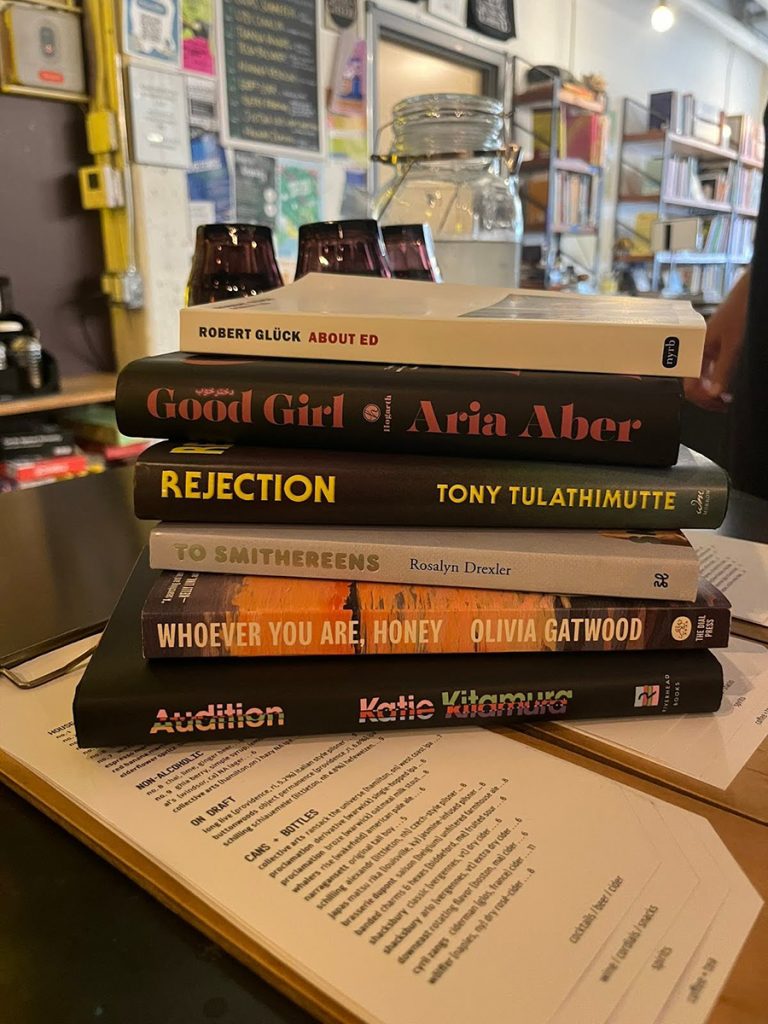
As conversation slowed, and our time came to an end, giddy as ever, I couldn’t help but ask the unspoken question of the hour, “What do you recommend?” In response Mann began mentally cataloging and De Luca sought some clarification, asking, “Just one?” Swiftly, with little-to-no effort, the list grew. De Luca excused herself quickly, seeking to present me with the the physical copies, and I must say, De Luca and Mann’s Riffraff recommendations to non-regulars stand strong, with recent visitor Melissa Febos’ The Dry Season, Katie Kitamura’s divisive Audition, Olivia Gatwood’s summer read Whoever You Are, Honey, Rosalyn Drexler’s reissued To Smithereens, Tony Tulathimutte’s wild Rejection, Aria Aber’s debut novel Good Girl, and Robert Glück’s quasi-memoir, quasi-fiction About Ed. Fundamentally, visiting a bookstore is like signing a social contract to be in the shared company of those with common interests, and this is something that Mann and De Luca recognize. “Books are really social, they’re conversation starters. And they’re an excuse to find shared interest,” Mann says, going so far as to say that visiting a bookstore is akin to joining a run club. So get out there folks, jog to that reading, fuel up with that cocktail, beer, or coffee, and relish the fact that you are lucky enough to live in the golden era of independent bookstores like Riffraff Bookstore and Bar. •