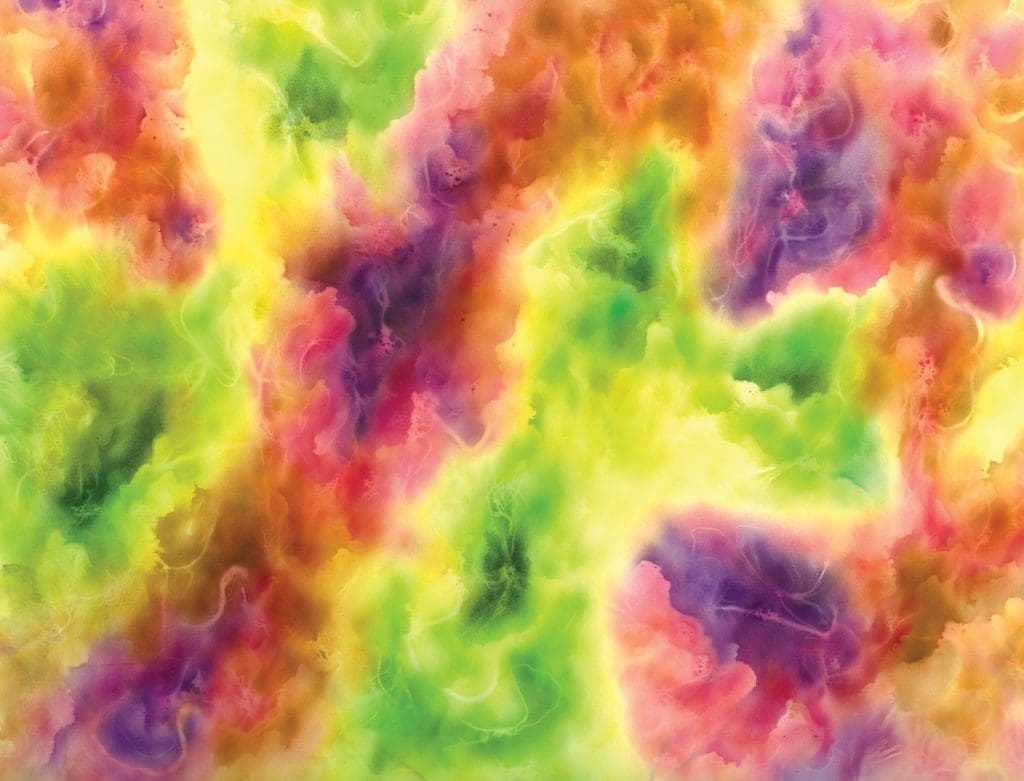
Quite some time ago, I read a quip that the art of diplomacy is how to tell a man to go to hell and have him enjoy the trip. If true, then the abstract expressionism of Sheila Isham offers an inverse corollary, as the diplomacy within her art suggests an inquiry toward the heavenly.
Born Sheila Burton Eaton in New York in 1927, Isham’s marriage to Heyward Isham, a US foreign service officer, set the artist on a spiritual and aesthetic trajectory around the orbit of the American diplomatic corps. During postings to West Germany and the Soviet Union in the 1950s, Hong Kong in the ’60s, and Haiti in the ’70s, with domestic assignments in Washington, DC, residence in New York, and travels in between, Isham explored color and light, and experimented with style and form, allowing for regular reinvention over incremental evolution.
On the occasion of Isham’s 80th birthday in 2007, RI senator Sheldon Whitehouse took to the Senate floor to recognize her “extraordinary contribution to American art,” crediting her work itself as an ambassador, both for her creative vision and for her country.
As Sheila Isham: Between Worlds opens at the Newport Art Museum (76 Bellevue Ave), the solo exhibition traces Isham’s life and artistic practice across continents with more than 40 works that span five decades, including previously unexhibited paintings and works on paper.
“Rather than organizing the exhibition as a conventional timeline, we focused on several defining moments and environments that shaped her artistic vision,” said Danielle Ogden, artistic director at the Newport Art Museum. “Geography becomes important because place was never simply a backdrop for Isham; it was often a catalyst for transformation.”
Growing up during the Great Depression, Isham lived in a residential neighborhood in the southwestern corner of Long Island, alongside marshland and the Lawrence Country Club. Throughout her childhood, according to US Census records, she and her two older sisters were supported by live-in domestic servants from Canada, England, Ireland, and Scotland. Above their home, sightseeing biplanes circled the skies, coming and going from Jamaica Bay Airport’s dirt runways a couple of miles away, on territory that would later be redeveloped as JFK International Airport. In interviews, Isham often reminisced over summer travels spent in nature on a family-owned island in the St. Lawrence River, and in 2005 she told the East Hampton Star newspaper that her father, Walter Eaton, had been her first art teacher.
During Isham’s senior year at Bryn Mawr College, the New York Times announced her engagement to Heyward Isham, a graduate student at Columbia University’s nascent Russian Institute, destined to enter into a career as a civil servant with the US Foreign Service. The married couple served their first international posting in the post-war ruins of West Berlin. As military personnel patrolled the borderless cityscape alongside Soviet East Germany, and her husband assumed his role at the US High Commission, Isham sought her own career. She became the first US citizen after the war to attend the Academy of Fine Arts (Berlin), learning from Max Pechstein and Karl Schmidt-Rottluff, exile expressionists from the Die Brücke collective.
With the Cold War intensifying, the New York Times reported in 1954 on “an atmosphere of general skepticism, tinged with only faint hope of progress” in Berlin as the US convened England, France, and the Soviet Union with an aspiration of moving from “words of peace” toward “deeds of peace.” While her husband navigated the era’s political maneuverings, Isham debuted her own work in a spring show at Rudolph Springer’s feted Galerie Springer.
When the Ishams relocated to Moscow the following year, with their first child and a second on the horizon, Isham continued her own artistic practice. In his Congressional remarks, Sen. Whitehouse noted the difficulty Isham faced there as the KGB observed and followed her movements, leaving her “unable to meet with other artists or to draw freely.” Still, in a catalogue essay introducing a 2023 solo show at the Hollis Taggart gallery in New York’s Chelsea neighborhood, Patricia L Lewy, director of the Sheila Isham Archives and organizer of the Between Worlds exhibition, described Isham as persisting in her sketches and prints of “abstract figuration,” completing new work “en plein air” even as these explorations resulted in her own arrest.
Isham undertook a series inspired by Orthodox churches, and traveled to Soviet cities including Sochi, Leningrad (St. Petersburg), and Tbilisi. Upon receiving an invitation to view the art collector George Costakis’s private collection, Isham dwelled with appreciation on the spiritual expression she saw in the avant-garde and abstract works of Kazimir Malevich and Wassily Kandinsky.
Her return to the US with her husband’s domestic assignment in Washington, D.C. led to a prolific creative period for Isham, aided by the availability of dedicated studio space. Apocalypse (1958) bared the anguished architecture of post-war Berlin in fractured black strokes. A grayscale Moscow Street Scene (1958) rendered a patchworked cityscape of building blocks dotted with cupolas. The National Museum, Smithsonian Institution (now: Smithsonian American Art Museum) hosted Isham’s first solo museum show, and some early works found homes in the collections of the Yale University Art Gallery and the Philadelphia Museum of Art.
Having established the foundation of an artistic reputation, Isham next found herself on a diplomatic rotation in Hong Kong, with her husband posted at the US Consulate from 1962 to 1965. She immersed herself in Taoist teachings as well as the representation and abstraction of written Chinese by learning classical calligraphy with contemporary artist Feng Kanghou. The experiences, along with other travels in Asia, lent a deeper, exploratory spiritualism to her work, as she channeled ancient poetry and experimented with local materials like rice paper. With echoes of Trappist monk Thomas Merton, Isham’s new work married religious elements of Christianity with spiritual meditations on interconnectedness.
A fire at her Washington, DC studio in 1972 destroyed much of her artwork and contributed to what Lewy described as a further movement toward the spiritual: “Despair over material loss was transformed into self-willed detachment from external contingencies,” releasing a greater sense of internal feeling throughout her future work. A subsequent posting in Port-au-Prince, where her husband assumed the US Ambassadorship to Haiti, followed by less than a year as Director of the Bureau of Counterterrorism in Washington, DC, led to retirement from diplomatic life back on Long Island. Living in the Hamptons village of Sagaponack, Isham scoured the seaside environs for inspiration and returned from the beach to spraypaint her canvas using found seaweed and sponges to create textures.
“She spent her life moving across cultures, ideas, and artistic traditions, always asking questions rather than offering fixed answers,” said Ogden at the Newport Art Museum.
During a recent visit to the Hollis Taggart gallery, I find myself sitting before Isham’s Shêng – Pushing Upward (c. 1969) transfixed by the ascension present on the canvas, as if a sunrise over the hills of Hong Kong’s Lantau Island. An off-center jade “bi” circle with a hole at its center symbolizes the vast cosmos and has a similar effect to a lens flare in photography, sometimes interpreted as a spirit orb, suggesting an interplay of physics and supernatural alike. The result creates a feeling of fog or haze, with swaths of khaki green cut by orange bursts hinting at oxidization or sunset or fire. I realize the horizon I see doesn’t exist but is insinuated by the assumptions I make from Isham’s placement of light.
At either side of Shêng hangs an Untitled, paintings on paper from 1972 and 1973, following Isham’s studio fire. Their depth calls to mind the nature of orchids, the stroma of an iris, and the aurora borealis, dimensions swirling in white space on single sheets of paper. Teth (1972) bursts with an energy akin to the plasma of nuclear fusion. The spherical Pierce Blue – Place Blue (1978) offers floral touches like the slow diffusion of watercolors in a glass of water. Until the gallery viewing, I had only seen Isham’s artwork in images in print or online, but it’s the physical artwork of Isham’s that releases the metaphysical, a spirituality possible in the tangible.
Afterwards, I admire her antecedents and contemporaries at the Museum of Modern Art (MoMA), where Isham’s illustrated book I Ching (1969) is held, and then dwell on the sense of place in the paintings of Isham’s influences Malevich and Kandinsky, in Modern European Currents at the Guggenheim Museum. Later, reading a 1963 issue of Foreign Service Journal, I note undated visual dispatches from Isham: Only the masts were thick as flies and Moscow, her brush strokes representing maritime Hong Kong’s fishing vessels and Russia’s onion domes.
The expanse of Isham’s artworks, and the geographies through which they were shaped, surface the possibilities found in blurring boundaries, setting aside preconceptions, accepting the risks and uncertainties involved with change, and getting lost and found along the way.
As the Newport Art Museum makes room for Isham’s Mythic Scroll (1981), which is 60 feet long, large-scale engagements with the past and the future in her Cosmic Myth Series, Phoenix Rising’s meditation on hope after loss, and dozens of works spanning her artistic journeys between 1956 to 2011, the exhibition celebrates inquiry and experimentation.
“I think her work brings you to a place of transcendence and peaceful introspection,” said Hollis Taggart in an interview at his gallery. “In a world of turmoil, it’s nice to have a sanctuary.”
# # #
Sheila Isham: Between Worlds, organized by Patricia L Lewy, will be on display at the Newport Art Museum (76 Bellevue Ave.) from July 10, 2026 to February 28, 2027. Reporting for this article was supported by a travel grant from the Dorothea and Leo Rabkin Foundation.