The FIFA World Cup tournament was full of thrills, drama, chaos, unity, and live television shots of devastated children in tears after their team lost a heartbreaking match. The final whistle brought a rush of excitement as Spain celebrated their 1 – 0 victory over Argentina. I had a revolving rooting interest throughout the tournament that changed based on match outcomes, but I knew I didn’t want Argentina to win (they won last time). That rush only lasted seconds until I had the feeling of, “What happens now?” Lucky for me, there is still plenty of local soccer to follow and root for.
The “Summer of Soccer” invigorated the state. It was hard to go out in public without seeing multiple people sporting a jersey. Most establishments had the games on their television, evolving from a background white noise to eyes glued to the screen. Conversations were struck between strangers
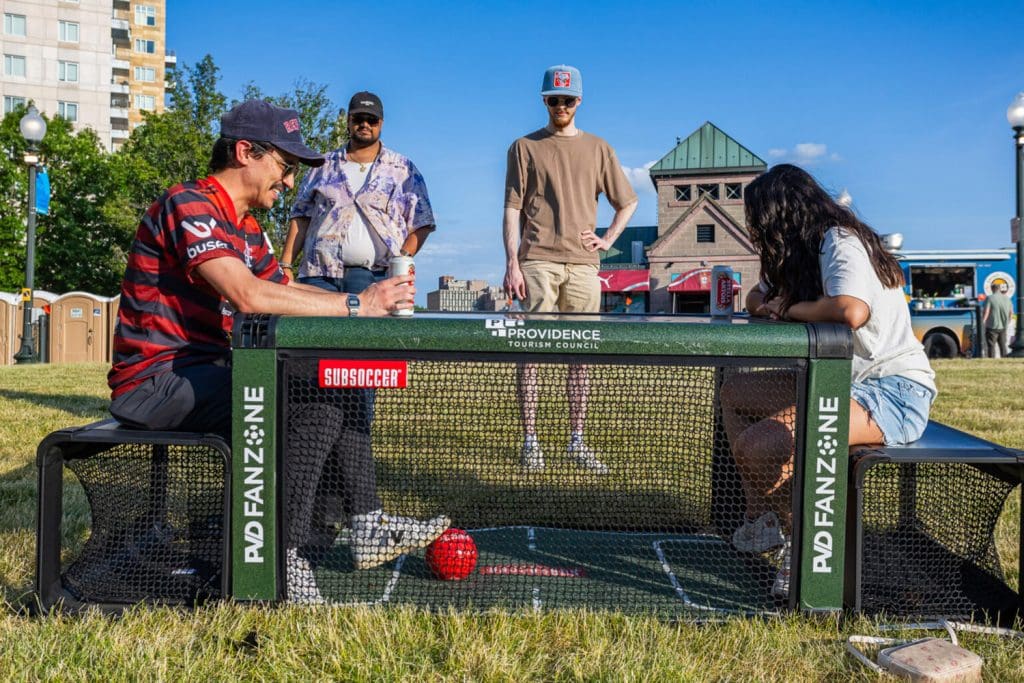
Bars and restaurants aside, watch parties were held throughout the state. Providence’s FanZone, a setup at Station Park with a giant screen, food trucks, beer gardens, huge lines for said beer garden, and plenty of fun activities for kids, was by far the biggest. An estimated 125,000 mostly law-abiding people graced the area to cheer on their team or check it out for the sake of curiosity.
“So much work went into these experiences we all were able to enjoy,” says James Toomey, executive director of the Blackstone Valley Tourism Council. While not as large as PVD FanZone, they hosted many events throughout their community. “We helped with the block party in East Providence and DaSilva/Diossa friendly match at Pierce Stadium. We also helped with the ‘Taste the World’ passport promotion in Central Falls and helped connect folks for the Levitt AMP soccer celebration in Woonsocket and helped to unlock the space in Pawtucket for Project GOAL to do mini-pitches. We also had monthly meetings with local partners leading up to the tournament called ‘Blackstone Valley 2026,’ to keep folks informed the best we could. Other than that it was promoting the watch party events in the cities, bars, breweries and restaurants.”
RI gained international exposure due to matches being held at Gillette Stadium (or Boston Stadium if you go by FIFA’s silly rules), a relatively quick ride up 95. The state offered more reasonably priced accommodations than Boston, allowing travelers to soak in all the local flavor in between games. Scotland’s Tartan Army embraced RI (and the New England region as a whole), holding a parade, donating $10,000 to Hasbro Children’s Hospital and getting everyone to fall in love with their easy-going ways and antics.
“Having the biggest tournament in the world come to our region of the country had a lot of benefits,” Toomey says. “It brought attention and tourism to the area, and was able to raise our profile on somewhat of a global scale.”
TOURISM TO RI/WORKING TOGETHER
I love seeing so many soccer-related entities work together and support each other. Bigger clubs such as Rhode Island FC and Boston Legacy FC sponsored youth tournaments. While non-profits such as Mundialito work to create the next players and teach leadership with the young players in the area, one of the most worthwhile achievements was the creation of two new mini-pitch soccer courts in Pawtucket and Woonsocket. This was a perfect example of people on all levels, including Project G.O.A.L., Rhode Island FC, Centreville Bank, and municipal leaders and school directors coming together to build something for the future and having a legacy from this incredible time period.
That takes us to the present. The World Cup was a positive experience that generated considerable goodwill and interest in the sport. This should prove to be a benefit to RIFC (Rhode Island Football Club) and Boston Legacy FC, who both play home games at Centreville Bank Stadium in Pawtucket. The home attendance has increased since the start of the World Cup, despite having rainstorms every home game this season. Boston Legacy FC hosted a World Cup Finals watch party at the stadium before their match vs Washington Spirit, which became their first sell-out there.
“Our local teams already did a fantastic job getting out to the community and having a presence at many public events and watch parties,” Toomey says. “Beyond that, they can continue to welcome in as many people as possible through targeted giveaways and special promotions… and of course, by putting the best team they can on the field. If they understand that it can still be a ‘new’ game to some fans, they can help explain the game and its culture in the most accessible way. In the end, people want to be part of something. Reducing any barriers towards people becoming a supporter will go a long way in the end.”
“So much work went into these experiences we all were able to enjoy. I’m most proud of Blackstone Valley and our beloved communities getting to shine with a larger audience simply because of who they are. Blackstone Valley was able to welcome new people to the area. Nothing was manufactured. The energy around soccer is part of who we are. I know we shared what we’re capable of and I hope we use that as a springboard for similar endeavors that engage our residents and visitors in such a positive way.”
Full Interview with James Toomey
1. How did the World Cup benefit the RI community?
Having the biggest tournament in the world come to our region of the country had a lot of benefits. It brought attention and tourism to the area, and was able to raise our profile on somewhat of a global scale. There are probably a lot of citizens in Ghana that did not know Rhode Island was a place… and now they do, since it was their national club’s basecamp during the tournament.
Beyond all that though, the main benefit for Blackstone Valley was that our communities were able to showcase their incredible cultures with incredibly attended watch parties and cultural celebrations. It was also the perfect time for us to share Blackstone Valley’s important role in the development of soccer in our country via a “How Immigrants Became Icons: The History of Soccer in Rhode Island” special exhibit at the Museum of Work & Culture, which has received wonderful reviews. Sharing the stories of the first African American soccer players, some of the early clubs in America, and the caliber of players that all came from this area was a key benefit.
2. What impact do you think the World Cup will have on soccer going forward?
It’s definitely raised the profile of the game in our country. I heard several stories where people who had no interest in soccer prior to the tournament end up getting hooked with all the excitement and shared opportunities to watch the matches.
3. What can local teams do to keep that momentum going?
Our local teams already did a fantastic job getting out to the community and having a presence at many public events and watch parties. Beyond that, they can continue to welcome in as many people as possible through targeted giveaways and special promotions… and of course put the best team they can on the field. If they understand that it can still be a “new” game to some fans, they can help explain the game and its culture in the most accessible way. In the end, people want to be part of something. Reducing any barriers towards people becoming a supporter will go a long way in the end.
4. How are communities and teams working together to build an interest in soccer?
I love seeing so many soccer-related entities work together and support each other. Bigger clubs such as Rhode Island FC and Boston Legacy FC sponsored youth tournaments. While non-profits such as Mundialito work to create the next players and teach leadership with the young players in the area. One of the most worthwhile achievements was the creation of two new mini-pitch soccer courts in Pawtucket and Woonsocket. This was a perfect example of people on all levels including Project G.O.A.L., Rhode Island FC, Centreville Bank, and municipal leaders and school directors coming together for the purpose of building something for the future and having a legacy from this incredible time period.
5. Do you expect there to be an uptick in youth soccer?
I’m definitely not an expert on youth soccer and don’t have any hard numbers to back this up. From my view, yes, but I feel like Rhode Island FC has been leading that uptick for the past couple of years. Everything RIFC does to engage the youth has been impactful and more kids want to play soccer or reach higher levels with their own game, because they have the unique opportunities to interact with professional soccer players on a regular basis.
6. Please add anything else you think would be important!
So much work went into these experiences we all were able to enjoy. I’m most proud of Blackstone Valley and our beloved communities getting to shine within a larger audience simply because of who they are. Blackstone Valley was able to welcome new people to the area. Nothing was manufactured. The energy around soccer is part of who we are. I know we shared what we’re capable of and I hope we use that as a springboard for similar endeavors that engage our residents and visitors in such a positive way.
7. What events/watch parties did Blackstone Valley put on?
We helped with the block party in East Providence and DaSilva/Diossa friendly match at Pierce Stadium. We also helped with the “Taste the World” passport promotion in Central Falls and helped connect folks for the Levitt AMP soccer celebration in Woonsocket and helped to unlock the space in Pawtucket for Project GOAL to do the mini-pitches. We also had monthly meetings with local partners leading up to the tournament called “Blackstone Valley 2026,” to keep folks informed as best we could. Other than that it was promoting the watch party events in the cities, bars, breweries and restaurants.