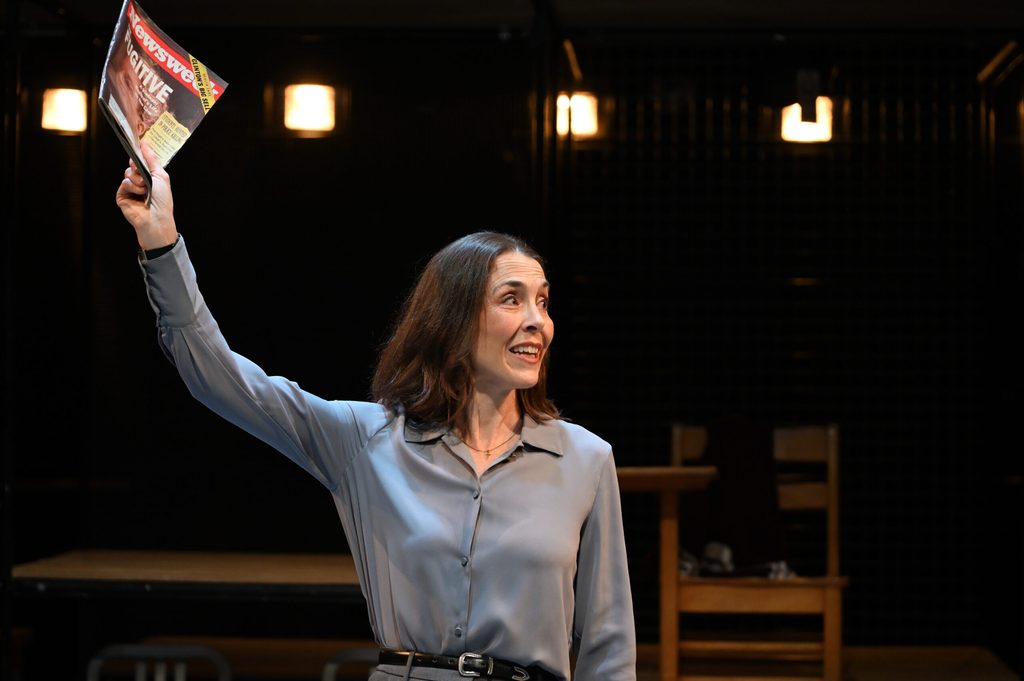
If there is such a thing as too much of a good thing, The Getaway Driver at Trinity Repertory Company is it.
The world premiere of the two-person play by Deborah Salem Smith and Charlie Thurston that opens Trinity’s 2026-27 season runs one hour and 40 minutes with no intermission, approximately 20 minutes longer than it needs to.
The show is a powerfully important inspection of the layers of emotion, grief, remorse and indifference that cloak a single act of violence and the perspectives of two women involved. It is a fabulous topic in this season of conflicting viewpoints, antagonistic outbursts, and sore feelings.
It is just a little too long and frustratingly repetitive. Had the playwrights or company shaved a few scenes or dialogues, it might just be perfect.
“The Getaway Driver” relays the 1970 murder of a Boston cop responding to a bank robbery, who was gunned down by a member of a group of college students enraged at the government’s handling of the Vietnam War and the assassinations of Martin Luther King Jr. and Robert Kennedy.
“We were swept up in the rage,” reasons Katherine, who sat blocks away from the bank in the getaway car.
Through the scenes — set against ceiling-high scaffolding holding a riot of props, costumes and television sets that serve to enhance moments – the audience follows Katherine’s journey. After fleeing the crime scene, she spends 23 years on the FBI’s most wanted list, carving out a life for herself on the other side of the country. Eventually the conscience that had propelled her into college protests in the first place, leads her to turn herself in.
The Boston courtroom is where she crosses paths with Clare, whose father died at the bank. She is the oldest of his nine children and one of four in law enforcement. Her reaction to Katherine’s self-absorbed explanation of the crime – and plea for early release from prison four years later – is initially anger. Slowly, it fades to a brusque compassion.
Played beautifully by Rebecca Gibel and Rachael Warren, Katherine and Clare are tragic characters in tumultuous times, both trading feelings of helplessness and anger for chunks of their lives. The commonalities are subtle but impactful, their differences fading like memories and angry outbursts.
With a solid working-class Boston accent, Warren never raises her voice but the emotion packed into her lines is palpable and riveting. Gibel proves chameleon-like, her persona drifting from do-gooder to calculating radical with a subtle tilt of her head or jut of the jaw.
Outgoing Artistic Director Curt Columbus – he calls “Getaway Driver” his swan song at Trinity – pulls out all the tricks to cement the show’s impact. Key scenes where both actors react in their unique ways to the same thing are powerful, as is the finale, with lights and sounds filling the auditorium as a huge exclamation point.
The Getaway Driver is a great start to the company’s season. The need to be as long as it is, again, is debatable, but the message is perhaps more important than any since the Vietnam War era itself. The show plays through Oct. 4. Go to trinityrep.com for tickets..