Fill your belly and your heart, while slowing down, appreciating the natural world, and building community.
Have you noticed how everything feels a little too fast these days? The internet age has brought a number of genuinely remarkable things to humanity; I love being able to listen to any song I like, whenever I like, having such broad access to movies and TV shows from every decade, and look up any topic I am curious about with speed and ease. However, there are many ways in which I think the immediacy of our modern era has fostered huge anxiety in both me personally and our society at large.
The never-ending emphasis put on progress and productivity, the expectation of total self-sufficiency, and the pervasive message that to rely on others is to become a burden on them, even the constant feeling of being ‘On’, as though every moment is recorded or might be. Even in personal circles, the ability to text people, while wonderful sometimes, can lead to a feeling of social pressure to be perpetually available. Add the rise of AI into the mix (my beloathed to be perfectly frank), and there is an acute sensation of drowning in a high speed technological landscape, a feeling of being swallowed by a too fast world, and the sense that one must either drive themselves beyond the bounds of their own humanity, or give up and be pulled under entirely.
I feel exhausted. I bet a lot of you do too.
My friend Hal is one of the most interesting people I know: a fantastic artist, talented cook, and accomplished forager. Every time I have the opportunity to spend time with them, I feel enriched in both intellect and soul. The most delightful thing about Hal is that they are so passionate about what they do. Foraging is more than a fleeting hobby to them, it is a craft.
Thinking about Thanksgiving and the approach of winter, I asked Hal what sort of foraging they are able to do in late autumn. This time of year, the expectation is that pretty much the entirety of the natural world is either dead or asleep. Hal runs food pop-ups, a way to cook professionally while maintaining creative control, designing seasonal menus that often heavily feature foraged ingredients. I wanted to know how the cold weather affects the materials available to them. November is mushroom central. Mushrooms are, I think, one of the biggest hurdles for new foragers to get over. Mushrooms are frightening. Mushrooms are unsettling. The average person does not trust mushrooms. (Statistical evidence not needed; do you trust mushrooms? I didn’t think so.) Mushrooms are poisonous and also alien. Not a plant, not an animal, not touching it. But mushrooms are also some of the most substantial, nourishing, and healthy organisms that can be harvested directly from the forest. They are delicious, nutritious, and once you learn to see them, they are everywhere!
Hal says that they think the reason why people are so intimidated by foraging mushrooms, is because people do not trust themselves. But Hal argues, it isn’t all on you. You also have to trust the knowledge of your community. There are people out there who have already figured all this stuff out, you just need to go slowly and pay attention to the information others have already gathered for you. “I think fear exists in the absence of curiosity,” Hal muses.
Curiosity seems to be a big part of what drives Hal. In this, foraging toes the line between spiritual practice and scientific method. Hal references the book Braiding Sweetgrass by Robin Wall Kimmerer, the concept of being able to say hello to things and know them by name. Walking in the woods with Hal, they do just that. Every few steps they take, they see something they recognize and crouch over it with palpable excitement, telling me what it is and what it’s used for. The science, the history: how it works, and why it matters. Learning as much as they have has amplified their experience of the natural world tenfold. It is a practice of exploration, taking the time to really see their surroundings.
This is not the sort of thing you can do with AI. First of all, because it will kill you – on this walk alone, we found a mushroom that looks very similar to a toxic mushroom, which AI would absolutely, confidently misidentify as safe to consume – but also, because to use AI would defeat the whole purpose of foraging in the first place. Watching Hal in the woodland environment, I am so struck by how building this skill has grounded them as a person, taught them patience, observational skills, and appreciation. The joy is in the knowledge itself, the process of learning, almost the development of a new sense, an entirely new form of sight.
The first year, Hal says, is really hard for newbie foragers, because you are physically training your brain to see something it didn’t before. I am shocked when they spot (midstep!) a clump of completely camouflaged brown mushrooms on a rotten log that was invisible to me. Laughing, they explain how, as you practice foraging more often, you develop the skill of scanning, where you can spot a mushroom in your periphery as easily as you would be able to recognize the familiar pattern of a human face.
Squatting down next to the mushrooms, Hal whips a Peterson field guide out of their backpack and shows me how to identify a mushroom you are unfamiliar with. These mushrooms are brown and gilled. Hal explains that gilled mushrooms are in the agaric family, which means they are more likely to be dangerous. However, Hal has observed that often the mushrooms which grow out of rotten wood tend to be ok. The forager rule of thumb is only if you are 100% sure (or 90% sure if there are no poisonous lookalikes), so Hal flips through their guidebook to a page on the agaric family. On the page there is a nifty little wheel which has readers first identify the color, then the shape of the gills, the smell, and so on. Having never actually looked through a book like this myself, I am delighted by the easy use. I suppose I always imagined books of this nature to be dense and filled with facts that need to be memorized. In actuality, the book is full of comprehensive charts that guide the eye, getting the reader to notice details they otherwise wouldn’t think to.
For this particular mushroom, the description is inconclusive however, because there is always some variation to nature which cannot be briefly recorded, and in this case the chance of poison is still too high. Our options are either a harmless edible mushroom, or a mushroom known as deadly gallerina, the deadly skullcap alternatively. So, Hal pulls a Tupperware container out of their bag and pops the mushrooms inside. You are usually good to touch mushrooms, they explain, around here they are mostly only toxic if ingested. What Hal is saving these fellas for is a process known as “spore printing.” By placing the mushrooms on sheets of white and black paper to sit overnight, spores gradually release from the mushrooms’ undersides, creating a print akin to a cyanotype. Examining this print, the color and shape of the spores, is a great final step to help foragers identify tricky cases.
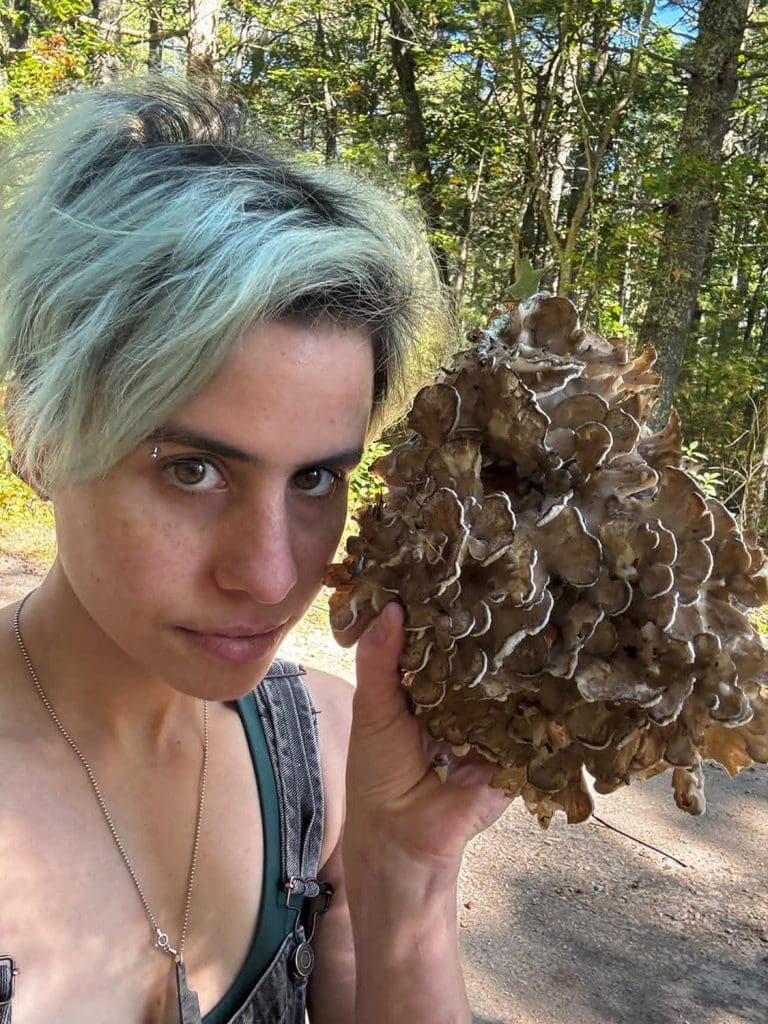
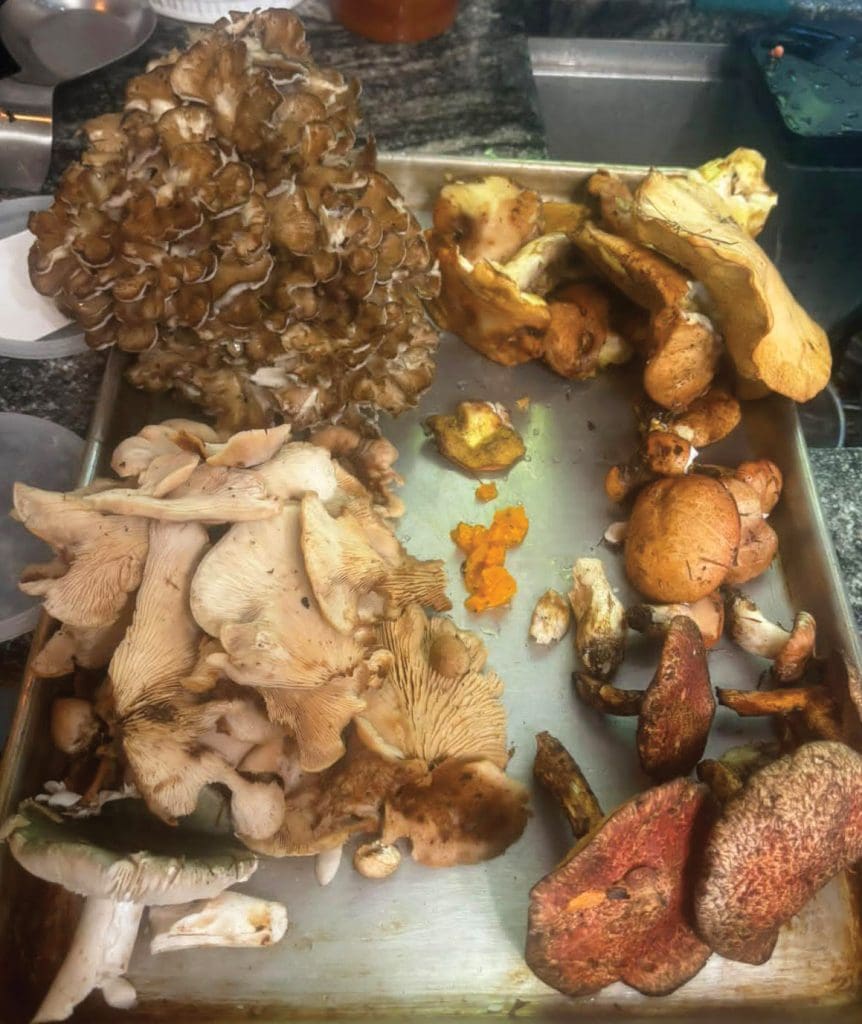
A list of edible mushrooms Hal was able to identify on site, honestly surprising me in terms of plentifulness, goes as follows: turkeytails (not much of a taste, but good for you and apparently extremely abundant), witch’s butter (a pretty, yellow mushroom which had a fun, chewy texture when I was given a bit to nibble on), and a saffron milkcap, which Hal described as having a curry-like flavor, a little sweet when uncooked. On a different recent walk, Hal found a massive maitake mushroom easily the size of their head, and spent much of our stroll extolling the deliciousness of maitake, saying that it is their favorite mushroom to work with and their biggest recommendation for anyone who would like to add a foraged food to their Thanksgiving festivities. Maitake grown in the woods, Hal says, tastes better than maitake grown anywhere else, because flavor is absorbed from the soil in much the same way oysters absorb flavor from the water they live in.
Speaking of which (sort of), Oyster mushrooms are also common this time of year, though we did not find any on this particular walk. We did, however, find a mushroom called “artist’s conk,” which looks and feels very much like wood, with a soft white underside that can be drawn on easily. This mushroom is closely related to the tinderhoof, a mushroom that was found on the Five-thousand-year-old body of Otzi the Iceman! These woody mushrooms were fire starters in prehistoric times and work just as well today!
This is another thing that struck me as Hal talked. Foraging is not strictly a matter of finding food, although Hal is extremely good at that side of it. I asked Hal how much of a meal they would be able to make purely with foraged ingredients, and they said 100% of it if they so chose and depending on what they found that day. Oystering, they say, is not technically foraging, but they would certainly count it. The maitake can practically be a meal all on its own. Greens for salads are readily available. In short, foraging is not limited to herbs and berries, there is enough to be found that can genuinely satiate an appetite. On top of that though, there are plants with other practical uses all around us.
Pausing by some dried milkweed in a field, Hal pulls apart the seed pod to show me the feathery fluff within and tells me about how in WWII wool imports were affected by blockades, which meant there was not enough wool to properly supply the Navy with lifejackets. Boy scouts were encouraged to gather milkweed seeds, which were sewn into the lifejackets instead, and it was discovered that the fibers were even lighter and more buoyant than the woolen counterparts.
Speed round: More edible plants available in November, if you are not ready for mushrooms just yet: Queen Anne’s Lace, the frilly white flower you see every day in the field, forest, and even along the road, is a member of the carrot family, with edible roots. If you pull up these flowers, you will be amazed just how similar to carrots the roots smell. Crabapples are excellent for jellies, in spite of their reputation as sour fruits. If you see white dust on your apples when you pick them, that is actually yeast! So feel free to skip washing them if you are making a cider, as this can be used for the fermentation process. Wood sorrel is a lemony herb that looks similar to clover, except with heart-shaped leaves and no variation in color. It is one of my favorites to pluck and snack on while walking, tasting surprisingly citrusy for such a small and unassuming plant. Black walnuts are encased in green shells, which smell sweet, almost like strawberries, when rubbed, and can be cracked open and eaten like regular walnuts, or boiled to make dyes with the tannins. Wintergreen is a dark green plant with a single, edible red berry, which tastes minty like toothpaste. Autumn olive is a tart, cranberry-like invasive, which you should eat as much of as you desire. It can be cooked for a mellower or sweeter flavor. Once you have finished enjoying the peaches of September, you can strip the leaves to make tea.
Isn’t it incredible just how much food and plant life exist this late in the season? I never would have expected such abundance right on the cusp of winter.
This practice of exploration and observation appeals to me massively. It seems so clear how many benefits can be reaped in terms of slowing down, engaging in appreciation, community, joy. Foraging strengthens the muscles of patience, noticing, and most importantly, being curious. In our high speed modern age of want and gratification, these skills seem to be more important to develop than ever before. They will not develop entirely on their own, without effort. Passion and perseverance are required. But as I said, Hal is one of the most interesting and grounded people I have ever met, one of the most enjoyable to be around, and I can see how the practice of foraging has helped mold them into that.
In Hal’s own words, “I go into the woods and I am able to say hello to everything and call it by its name, and then I can bring that into my own creative practice and potentially use it to feed people… if I lose that part of myself, if I lose that skill, like I couldn’t do it again, I would feel like I was losing a part of myself. And why is that? That’s another question I’ve thought very long and hard about – what foraging means to me as a practice; it’s very thoughtful, very meditative. I think foraging – and cooking, and food, but foraging as well – is a way that I understand the world… For me, it wouldn’t feel like losing a small ability; I think if I forgot how to forage anything at all, it would feel a bit like losing an arm. Or even an eye. It’s just like another sense.”
I feel as though Hal has given me the gift of spending a couple of hours looking through that eye, that sense. It filled me with awe, peace, joy, contentment, and yes, thankfulness. Hal talked a lot about the foraging community, and how full of cool people excited to share their knowledge with you it is. So for those of you like me, who are feeling the speed and drain of modern life, I cannot recommend enough taking some time with a nerd in the woods.