Author: David Sano

  • Washington

    Washington

    i. Shear
    Eighteen spans, massive
    Trembling softly
    Soothing and rocking, murmuring
    Forgetfulness, abnegating the air
    The space beneath
    The commuters hung aloft
    Steel and concrete, manmade
    Piles driven deep, riverbed anchors
    Towering to brace
    His vertebrae
    Cooling drops condensing
    Salt air drifting in
    From estuary, cove and inlet
    Soothe his pebbled skin
    His task is far from easy
    A minor Atlas bearing
    Stress and strain—incalculable!
    No complaints from him
    Unless one considers those
    Transitory groans and
    Pops of weary joints
    Easily drowned in the
    Steady roar of inertia
    A gate from East to West he keeps
    From stately past to present
    Bearing us up, holding us aloft!
    Trembling softly
    Uncomplaining
    Shear, not sheer
    (Like a woman’s negligee
    Har har har)
    Because if the bridge was sheer
    (And not sheared)
    We wouldn’t have been caught with
    Our pants around our ankles!
    But no one jokes like this
    At RIDOT this late winter
    Not aloud, not after dispatches from
    Young engineers, burrowing
    Into pigeon-fouled catacombs
    With cameras and flashlights
    Drawings held tight like
    Ancient scrolls, trembling as they witness
    Tie-down rods in twain
    Sheared!
    Shit, they murmur
    This is way worse than we thought
    Revelations drowned in
    The steady roar of inertia

    ii. The Buck
    Arising, a manmade storm
    A shitstorm, a scandal brewing
    The whitehaired men, weathering
    Neckties flapping, hard hats held
    Fast against the winds
    Texting, always texting, as if thumbing
    The rosary invoking
    Sublime catechisms
    Of sobriety and thanks—
    It is hard for me to express
    to you in words the depth
    of appreciation I have
    for the support and leadership
    you provide to me and my team

    The whitehairs link their arms, knees
    Bent, tired backs tensed, forming
    A power structure, engineered
    And constructed against
    the landing of the buck
    The men tremble in knowledge of
    Its terrible weight
    Smiling at fundraisers, shaking
    Hands massaging their temples in
    Emergency meetings they tremble
    The buck's terrible weight!
    The shitstorm, foul clods and their
    Indelible stains, hurled heedless
    ProJo and BoGlo, Turn to 10
    Human trusses deflect
    Shift, even sag beneath
    The buck pressing heavy
    Ponderous and gross, sniffing
    At their napes and ears
    But they do not break!
    The buck heaves slowly
    Its terrible weight!
    And rolls on
    And on, anon!
    To other bridges in other states
    Other painful failures of our
    Crumbling infrastructure
    As if precipitating out
    From some foreordained progression
    An emissary arrives
    To advance the scenario further
    Lo! America’s Mayor
    (For the title’s former bearer
    Has become woefully unfit—
    An addled buffoon colluding
    With dye run down his cheeks)
    Like some imperial bishop
    In vestments of fluorescent
    Orange and silver stripe
    He dispenses the benediction
    Tacit indemnification
    Precious royal pardon—
    If that repair project were not
    undertaken, the inspections that caught
    this potentially deadly flaw
    would not have happened
    There’s a very real risk that residents
    would have found out through
    a collapse

    iii. Washington
    This vital behemoth,
    Of broad back and infinite patience
    Has borne a billion
    Dour commutes, countless ventures and
    Homecomings, spring vacations
    Fall returns, beach days and
    getaways
    In his history also—
    Carnage, twisted metal, blood and
    Broken glass, fires that
    Scorched his skin, men and women alike
    Careless, drunk and swerving, mocking
    His very purpose
    Washington, he was called
    The westbound Washington Bridge
    Abides, trembling
    Once burden-bearer, now burden
    Used up, deficient, defunct, condemned
    Awaiting the foreman's machines
    To tear his concrete flesh

    iv. Reclamation
    What's going on here she said
    As astride their bikes they stood
    Behind them Van Leesten, sun-bathed
    Gawping and uncertain, wondering
    Wherefore this chaos approaching
    A parade or some such gewgaw
    Her companion rejoined, squinting
    Studying the vanguard for meaning
    Recalling dimly the Festa, where
    Young Corleone made his bones

    All at once, the facsimile loomed
    Towering, a white Suburban built
    Larger than life, festooned
    With little trees and rosaries
    Wiseass bumper stickers, borne
    Up on twenty-twos, borne up
    On the shoulders of commuters
    City, state and federal
    Administrators, politicians clutching
    Ribbon-cutting scissors,
    Engineers with laptops,
    Dealership financiers, auto
    And home insurers, union
    Men and women, every single one in total
    Solidarity with the mission

    The car gods bay for blood
    Her companion murmured, man
    Shall pay obeisance
    And lesser gods shall perish
    Her reply, aborted as
    A bollard flew overhead
    Hurled with vehement rage
    Years of unearthly spite
    And in the procession smiling
    The folk reverently approaching
    The ark, to stuff dollars in the
    door-gaps
    Hoisting children aloft, for
    Little hands to learn the motions
    Anointing the while the icon
    Beer transubstantiating
    To turtle wax, to full synthetic
    To regular unleaded
    A few were jostled harshly
    Or in a careless stumble, caught
    Before the bogus coach
    Grille-struck and mowed under
    Pedestrians in the last
    As inertia roared about them
    Bollard after bollard flew and
    In the taillight glow
    Figures danced and whirled,
    With cone-shaped hats and brushes
    Agents of revanche,
    Awake in joyful trembling
    Ecstatically restriping
    Inch by careful inch
    The stolen holy pavement

    What fresh car hell is this?
    She entreated, and
    Hearing no word in answer the two
    Mounted and rode in fear
    Trembling
    As previously was their custom
    Before the fleeting respite of
    The South Water Street urban trail,
    Fleeing, before the marchers
    Singing
    In gleeful, boisterous shouts

    HERE IN MY CAR
    I FEEL SAFEST OF ALL
    I CAN LOCK ALL MY DOORS
    IT'S THE ONLY WAY TO LIVE—


    Final lines of poem are lyrics from Gary Numan’s song “Cars”

  • Two John Browns: A work of horror fiction or historical fiction

    Two John Browns: A work of horror fiction or historical fiction

    Ed note: Stay tuned to the end for an interview with the author.

    i.
    The manacles: heavy irons coursed through with rust, ghostly webs tracing the blood, sweat and tears of Africans, ripped from their lands and torn from their relations, herded across the vast Atlantic in squalid, creaking dungeons, sold at market and beaten into servitude until their exhausted bodies and spirits gave them over to death’s embrace.


    “Caesar’s things to Caesar,” said John Brown, draping the chains over the headstone. “Strange flowers, those.”


    Brown started and turned. He faced a slender man in oddly cut clothing, hair parted and expertly combed. His face was long, with prominent ears and a protruding lower mouth that thrust together his thin and bloodless lips.


    “A fitting bouquet, for the one buried here,” Brown answered.


    The stranger peered at the headstone. “You denigrate the legacy of the John Brown?” “I AM JOHN BROWN,” thundered Brown. “The other is a kidnapper and a brute! These shackles are his legacy!”


    The stranger was amused. “You journeyed to Providence to accomplish this?” Brown composed himself. “I speak before the Anti-Slavery Society tonight, at the behest of Elizabeth Buffum Chace.”


    The stranger sniffed. “Ah, the blacks. I can tell you that ending their bondage will not improve their station. I truly cannot understand all this frenzied fixation over the disposition of mere n…”


    “Mind your tongue!’


    The stranger covered his face. “Oh how meaningless these battles! If man only knew the things he did not know—his madness and destruction would follow from a glimpse of their silhouettes. The universe is far more terrific and eldritch than man’s self-satisfied rubric of God—Hell—the Devil.”


    A cold wind rose, carrying traces of some sickly miasma over the hills. The surrounding birdcalls shrieked like tuneless flutes.


    “Oh!” the stranger exclaimed, as if hearing a remark. “Nyarlathotep requests a bit of sport. Quickly then: Brown, you prize human equality above all else?”


    “I do.”


    “And you feel toward this other man Brown a mortal hatred?”


    “I do.”


    The stranger began to speak a wretched garble, gibberish sounds utterly alien and deeply hideous, as if the most corrupted parts of every human language were combined and distilled into an ur-tongue of malignancy.


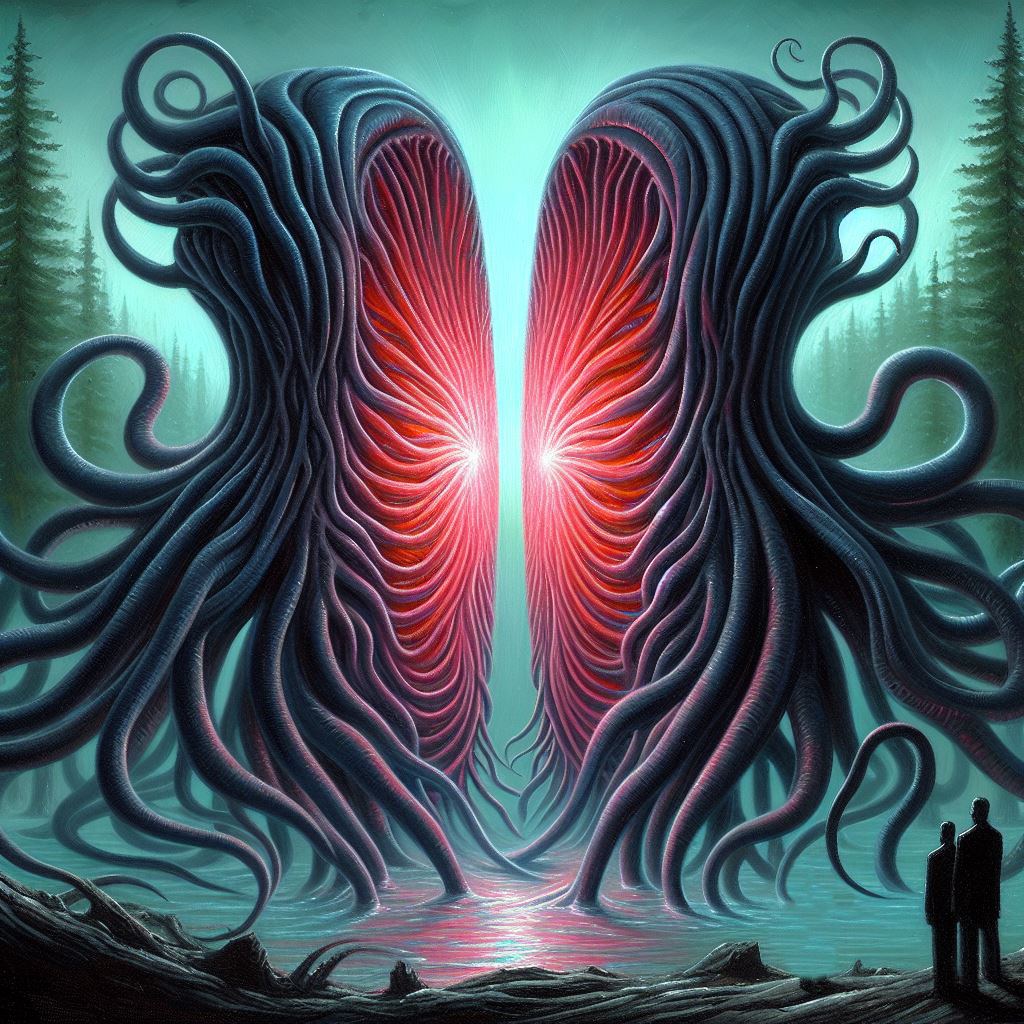
    Up from the Moshassuck flowed a torrent, breaking off and congealing into a ragged sphere tall as three men. As this noisome shape loomed over Brown, a rustle from a stand of trees to the east heralded the emergence of two vertical darknesses, tall as oaks, their outlines writhing like swarms of flies. These ignominious columns ran in Brown’s direction on stunted children’s legs.


    The dark columns stood apart and reached tentacles into the viscous blob, each pulling the plasm toward itself until between them stood a shimmering film of bloodred iridescent, beyond whose surface wavered the incomprehensible.


    The stranger grasped Brown.


    “In we go.”


    ii.
    Sunset bathed the hilltop mansion in stately amber tones. The representative-elect’s address was imminent, and assembling on the lawn were many distinguished ladies and gentlemen, thrilled to cheer with lusty hurrahs their John Brown—and his counterpart, Champlin—on to Philadelphia.


    Alienated from his natural reality and time, John Brown shivered despite the warm summer night. He had lost the stranger, and he longed for the steadying presence of his sons. He regarded the dais where Brown would speak, then, overcome with nausea, he stumbled desperately away and vomited on the grass.


    “Travel by shoggoth can be difficult.”


    Brown looked up. The stranger offered a handkerchief. Brown accepted. “How…” “No matter,” the stranger replied. “And you will need this.”


    He presented like a duelist’s pistol what appeared to be an infested turkey leg, gristle trembling at the joint. Brown reached then flinched back from the clustered eyes and seething tentacles.


    “Take the clynakth and finish the job.” The stranger said sternly. “Your precious negro race depends on you.”


    Despite whatever foul phantoms Brown owed his presence at this juncture, there remained spirits of a different class entirely, howling constantly in his ears. Now the enslaved carried him before the dais and gave him voice.


    “What of the Sally?” shouted Brown.


    From the lectern, Brown glowered. “That matter was settled decades ago. Now be silent, fool—or leave this place.”


    A murmur went up. Several men moved toward Brown.


    “Scoundrel! Your acts are against humanity, the Declaration, and God! By committing them in my name, you leave me no choice.”


    Brown raised his arm and pinched the trigger gland. The clynakth coughed. Brown ducked and behind him a dark spawn wriggled through solid brick. Brown scurried into his mansion with Brown on his heels.
    Crashing through a kitchen, Brown fired again. Wounded, Brown collapsed into the second floor study, where his brother conversed with his daughters. “Moses, stop him,” Brown gasped, holding his hip where a green effluence bubbled. Moses only stood to observe, while Alice screamed and Abigail ran to her father’s aid.


    “Madman!” Abigail shouted at Brown. He leveled the clynakth, but timorously. Sensing this, the organism writhed and transformed, elongating whiplike. An orifice issued an acrid slime, driving off Abigail.
    Brown had Brown dead to rights.


    Brown raised his arm as so many “masters” had in all that unforgivable era of despotism and brought the living lash down on his namesake with the fury of millions denied their earthly recourse. Moses and the stranger stood like sentinels and Brown swung and swung until green bile and blood splattered the books and furniture. Finally Brown’s guests crowded in and apprehended Brown.


    They carried him out struggling, heaved him atop the coffin lying in his chariot and spurred the horses. Chill December air crept in from the void and the seacoast was swallowed up in forests and hills. Between long lines of soldiers he rode, suddenly grey and brittle. The scaffold lay in a field, dreamlike, and he mounted. The rope was placed around his neck and no intermediary stood between him and God. Of regrets he had few, and regarding his efforts on behalf of the enslaved, John Brown had none whatsoever.

    ************************************************
    Interview with the Author, David Sano
    “When I first moved here and saw all this stuff named after John Brown I was like, ‘Whoa, that’s bold. I can’t believe they named all this stuff after a guy whose last act was an insurrection.’” It was only a matter of time before Michigan-native David Sano learned it wasn’t that John Brown.


    “It’s a funny, historical thing that one of the most fervent abolitionists in America shares a name with a slave trader. It’s a common name, but nonetheless it’s a funny cosmic joke, and I thought it would be fun to have them meet or have them confront each other, so that’s kind of where [Two John Browns] came from.”


    Sano submitted Two John Browns to Motif’s Flash Fiction contest held earlier this year. The story features both John Browns and HP Lovecraft, although Sano admits due to the contest’s word count restrictions, all of the historical figures have been flattened.


    “It’s a complicated legacy… I think people should read the history of the Browns and follow the trail. John Brown wasn’t just a one dimensional villain, he had a long and interesting life. He took part in the raid on the Gaspee, and then he was in the House of Representatives. I feel like a lot of stuff gets flattened but it’s interesting to trace the whole thing and try to understand the Brown family. If I were a Brown student, I would be interested to know that it was a lot of brothers with a lot going on. I wonder what that was like, especially the Moses / John Brown dynamic, what was it actually like between them?”


    Sano cites Cormac McCarthy and Thomas Pynchon as two literary influences. Noting Blood Meridian as the paragon of what literature can be, and the slack-jawed brilliance of Gravity’s Rainbow as his inspiration to start writing.


    “I just couldn’t believe one person could come up with all of that and research all of that and put it together and make it snappy. That was kind of it for me.”
    In Two John Browns, Sano’s lyrical writing takes readers back in time to a Providence of fantasy when two John Browns – one abolitionist, one slave trader – come face-to-face.

    – Meg Coss

  • Set Your Own Path: Reports from the rambling Rhode Island roads

    Set Your Own Path: Reports from the rambling Rhode Island roads

    One day, some years ago, I suffered a car-induced bike crash on North Main Street in Providence, right in front of the Walgreens. I wandered bleeding into the pharmacy as the bewildered manager offered me first aid products. A little later, at the urgent care across the street, a young woman scrubbed road grit out of the open wound in the palm of my hand. Two of my finger joints were permanently damaged. I was riding North Main because it functions as a direct and efficient artery between a certain part of Pawtucket and downtown Providence. After the crash, I avoided riding on North Main unless absolutely necessary. I had learned an important lesson; as a cyclist, the direct route is often the most likely to result in injury or death. The most elegant route that you can imagine, or that Google can optimize, is often beset by hazards both structural and behavioral. It feels silly and anti-modern to forsake convenience, but being a few minutes late to work, or to that coffee date, is certainly preferable to arriving early to your own grave. 

    I was quite upset at the driver who cut in front of me and caused my crash, but in reality I was undone by much larger forces. Upon reflection I understand that North Main is chock full of hazards, two of which are endemic to mobility of any kind in the state of Rhode Island – Rhodius Caesar and the Unethical Intersection.

    Rhodius Caesar

    The spirit of this ancient Emperor possesses motorists across Rhode Island at intersections great and small. The motorist will slow their car to a near stop, lower their window, and extend their hand in a gesture of magnanimous clemency. The Emperor has renounced His own right of way! The chosen car may turn left before Him, or emerge from that side street, or supermarket, or parking space. While Rhodius Caesar’s spirit is noble, His benedictions often manifest as curses for others at the juncture – for Caesar is merciful, but not all-seeing, and by directing traffic ad hoc, He is liable to direct His subjects into the person or path of other motorists, pedestrians and cyclists – none of whom were party to the royal agreement to suspend the prevailing traffic laws.

    The Unethical Intersection

    In my observation, certain Providence intersections lend themselves to dangerous, unethical driving at all times of day, no matter who is driving through them. For example, the right turn from southbound North Main onto Smithfield has its own lane. Cars using it should, in theory, observe a red light by stopping before turning right. This does not happen. Instead, there is a sort of continuous stream of slightly hesitating cars who only stop at the point of collision with the northbound left-turners (who have a green arrow) or any poor child-of-a-gun unfortunate enough to be crossing Smithfield in accordance with the walk signal. There are many intersections like this around town, and once you know the patterns, you learn how to predict, how to defend yourself, but that doesn’t quite settle the issue, because watching motorist after motorist (and maybe even yourself) fall into a structural impatience trap that skirts reasonable rules and endangers everyone is a rather sad observation on human nature, is it not?

    Getting back to the day of my crash – I was on my way to Riverside Park in Providence when I bit the pavement. Imagine my starting point as Antonio’s Pizza on East Ave. What route would I take today? What route would you take? Would you trust what Google has to say?

    East Ave. to Hope Street is not so bad. East Side motorists are generally considerate, and you should be pragmatic and take advantage of this. Will you shoot up Hope most of the way downtown? For one week in October 2022 this would have made perfect sense, but not anymore. The shopping-street section of Hope is mostly pacified and traffic is slow, but the roadway is hemmed in by parked cars and pedestrian pinch points, and as a cyclist you have to accommodate those crossing pedestrians, too. You do not enjoy stopping for pedestrians on your bicycle; momentum gained by muscle and sweat feels more precious than that gained by on-demand combustion. So avoid misunderstandings by taking a different route.

    You will turn right from Hope onto Chace – a perfectly quiet, narrow side street. Hill climb through some speed humps then bang a left onto Top. Rarely see a car here. Zigzag onto Summit and you are approaching Miriam Hospital. Vigilance required. There are two-way stops here, which are a dicey proposition in this state, especially as motorists encounter them for the first time. They may think that because they have a stop, you must also have a stop. A certain balanced assertiveness is required, enough to demonstrate your right of way, but cautious in case the perpendicular driver should act the fool. Wiggle through this stretch and veer left to stay on Summit and you’ve got a sweet little runway ahead. Brilliant speed hump placement on Rochambeau westbound means cars will slow approaching the intersection, giving you extra time to dart in and quickly turn left onto Ivy.

    During the Hope Street Temporary Trail fiasco of Fall 2022 (alluded to above), you were one of the people saying, “Well what about Ivy Street?” If its asphalt were not in tatters, Ivy would be a bike superhighway. Ivy parallels Hope, but with a gentler grade. The road is wide and sparsely trafficked and visibility at four-way stops is good. Why wage war with the NIMBY shopowners when this gem is hiding in plain sight?

    When you reach Cypress, turn right, but be wary – visibility is very poor to the left. The four-way stop is a little hairy – cars charge up the hill, down the hill, others across. Assert your lane, signal your left, and you’ll be fine. The downhill on Camp is fun, but beware of Camp & Doyle – a low-level Unethical Intersection, perhaps due to the subconscious fear of rolling back down the hill, and the subconscious fun of zooming down it. Watch the one-way and the school children on your way to Olney. Take a right here and meditate on the fact that bike lanes are but paint on the roadway, flimsy suggestions that will never truly nudge anyone who is not already willing to share the road.

    From Olney there is no peaceful way to get to the center of downtown. Taking North Main to Canal is a terrifying thrill ride, but is it worth all the fear? The alternatives are so tangled that in this case, yes, you must fly downhill while dodging strange burial mounds on the right, then cross a bizarre angled intersection so that you can merge weirdly from the left onto Canal.

    Once on Canal, you have to get over quickly to make a right onto Smith. Then you have to get over quickly to make a left – while charging uphill. Gaspee is a little chaotic, but a slight downgrade and sweeping curve ‘round the train station give it a dramatic flair. However, the intersection with Francis between the Rhode Island State House and Providence Place Mall is an eldritch nightmare. Even going straight on green feels wrong somehow, as if the cars also have a green light to plow through you. Grit your teeth and pedal. Once on Hayes, watch out for parking garage confusion, then turn left onto the joyous descent that is Park Street.

    At the bottom of the hill one could be seduced into riding on Promenade, which does indeed boast some bike infrastructure. This siren song is false. Promenade and Dean is a high-level UI, and because of a surprise left-only lane, the shabby ethics often extend to Promenade and Acorn. Harris is the one that you want, even if you have to cross like a pedestrian and ride (carefully) on the sidewalk across the car-swallowing maw of the parking garage entrance.

    Even before the speed humps were installed, Harris was a breath of fresh air. Sure, the asphalt is not great, there are transverse train tracks, and the surroundings are somewhat bleak. However, the road is so wide and relatively under-trafficked that a sense of freedom pervades. Fast cars can simply swing wide around you. You have not ridden Harris much in the Farm Fresh-era, but you can’t imagine that the influx of roof rack’d urban renewalists and the addition of a bicycle collective on Sims have made the cycling any worse.

    The massive intersection at Eagle, Harris and Atwells is not as horrible as it looks – the ethics here are surprisingly reasonable. There is a bit of a hairy passage from Atwells to Valley, but then there is Donigian Park. A very brief bike path winds through some truly sublime river views. Ejected into a weird alley, you turn right onto Delaine and head onto Manton. You have missed the San Souci bike path, which is short but sweet. Next time. Recent infrastructure has made Manton less of an abject deathtrap for cyclists and pedestrians, and thankfully, your exposure will be short, as the safety of Aleppo Street is a stone’s throw away.

    The journey ends at Riverside Park, a majestic swath along the Woonasquatucket River that houses the Red Shed Bike Shop, community gardens, and most importantly, the start of the Woonasquatucket River Greenway Bike Path.

    Does the smooth, scenic, contiguous, and car-free course of the Woony Path bear any relation to the disjointed and inefficient route you took to reach it?

    Urban cycling is not a jaunt down the East Bay Bike Path. Every stretch of road is a calculation with multiple variables. I would rather zig-zag zanily between the harsh and the peaceful than endure a prolonged but straightforward compaction between parked and passing cars. Those are my tradeoffs, and Summit, Ivy, Harris and Donigian are my treasures. All the sly, little maneuvers needed to connect these dislocated causeways – these become your special glue, giving your path cohesion. There is agency in the creation of these routes – exploring all this harsh terrain and judging according to your experience whether to use the bike lane on the big road or take the side streets, whether to climb the steep hill to avoid the Unethical Intersection. And verily, Unethical Intersections will always coo sweet temptation to our demons, just as Rhodius Caesar’s reign is unending. Despite the devoted and tireless efforts of mobility advocates, a safe point-to-point ride for every rider and every destination is simply not possible.

    You will have to set your own path, again and again, for every destination, and in time all of these paths will become one great weave with handsome fibers and threadbare spots and one day you will end up at a city planning meeting and discover that you have been weaving together parts of the same tapestry with many others, and some of them work at City Hall, and you will tell them, a touch shyly, about the paths you have set and they will perk up and tell you that a protected lane is coming to one of your most grueling stretches and you will wonder at your luck that several of your paths are upgraded at once, and afterward you will ride past Burnside Park downtown and see a horde of cyclists gathering in neon to take the streets and you will join them, amazed to see Caesar baffled and the UI corked, and you will crisscross your many paths, seeing each of them in new light and appreciating the care with which you have set them, recognizing that though they belong to you they also belong to everyone, and on this night at least they are wide and safe and full of cyclists, a river of human power delivering you to your destination in perfect, fluid ease.

  • Rest in Peace, Cormac McCarthy: Reflections on The Evening Redness in the West

    Rest in Peace, Cormac McCarthy: Reflections on The Evening Redness in the West

    I was shopping at my neighborhood supermarket when I first heard the news. It was the afternoon of June 13th. My friend phoned me and when I answered he blurted out an urgent jumble of words. For a moment I was terrified, thinking something terrible had happened. As it turned out, something terrible had, but not in the close-to-home way I initially thought. What my friend was saying was that Cormac McCarthy had died. 

    It is a matter of great fortune to have a friend with whom you can engage fully in matters of literature. Reading is very personal, writing perhaps even more so. My friend and I read and discuss and write and collaborate constantly. We love literature, and since we love literature we have no choice but to love Cormac McCarthy. That he was born in Providence is happily serendipitous as well. Neither of us are completists in regards to his oeuvre, but one does not have to be to understand the man’s genius. We love No Country for Old Men in both forms and regularly quote Anton Chigurh’s best lines to each other (knowing that “just call it, friendo” is a false artifact of trailer editing). We thoroughly enjoyed The Road, which replaced zombies and gimmicks with restraint and grimness, and we liked that film as well.

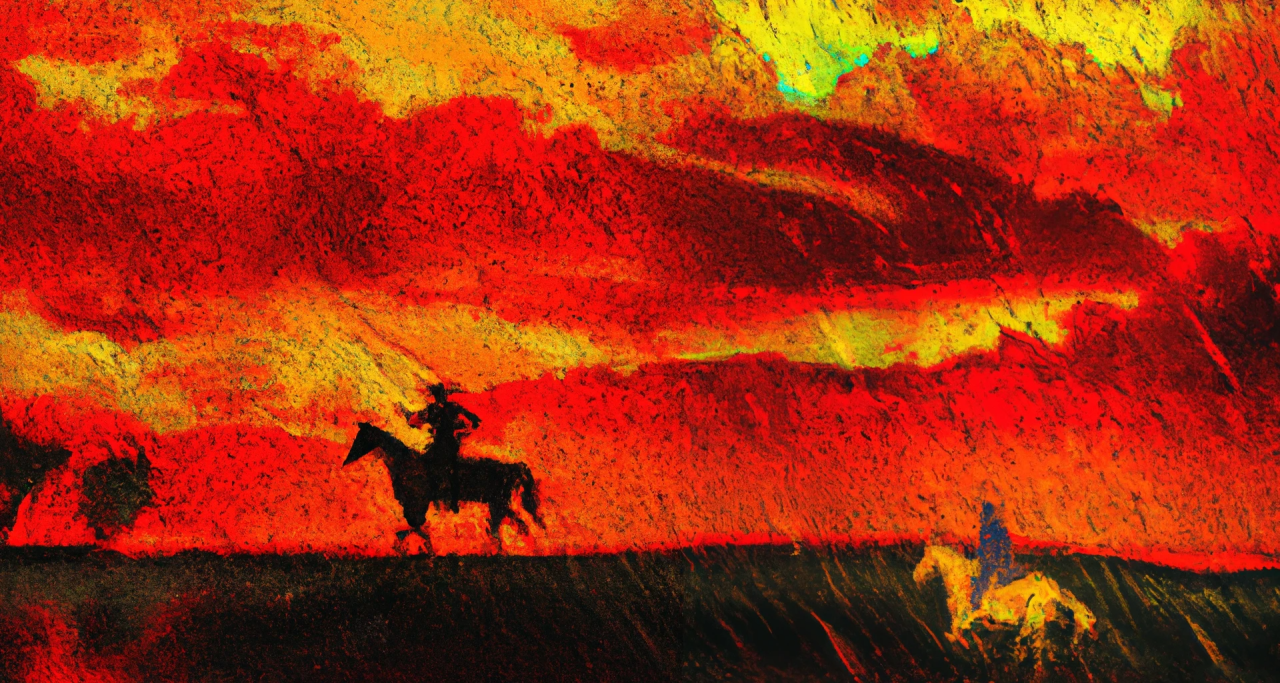
    But for us, Blood Meridian, or The Evening Redness in the West is clearly McCarthy’s greatest gift. What a singular novel! Unfortunately the shorthand used to frame it does as much to repel as it does to invite. Yes, Blood Meridian is quite violent, and yes, it is concerned thematically with human brutality writ large. However, Blood Meridian also contains some of the most artful and intoxicating nature writing ever committed to paper. The American Southwest (and northern Mexico) as captured by McCarthy is primordial and awesome, volatile and vital and possessed of an alien force that seems borrowed from the realms of fantasy. Yet McCarthy has invented little, instead relying on indelible visual metaphor (“crumpled butcherpaper mountains”) and obscure geological phenomena (“coral shapes of fulgurite”) to set his brilliant scenes. Channeled through McCarthy’s “biblical” prose, Blood Meridian feels like a visceral, contested genesis, where man’s place in the world is more unsettled than he knows—at stake in a game few understand as being underway.

    Blood Meridian is also marked by its great clarity and intention. The novel is very much entwined with history—John Joel Glanton was a real person, who led real scalp-hunting expeditions at the behest of Mexican city governments—and yet McCarthy’s heady blend of earthily grandiloquent prose, deeply laconic dialogue, litany of obscure details, and pervasive metaphysical atmosphere does not have analogues in the writings of the time—or any time, for that matter. Given the success of previous adaptations much has been made of the “unfilmable” quality of Blood Meridian (just before his passing, McCarthy had teamed up with director John Hillcoat to adapt the novel). This can be understood as an understandable reluctance to reproduce the sheer violence contained in the book—gory encounters delivered dispassionately without the usual cues or lessons, often genocidal in nature. But the structure of the novel may be the deeper challenge—Blood Meridian is essentially a serial chronicle of strange and brutal events, interspersed with quiet passages through spectacular landscapes. The overarching movements of the Glanton Gang often subsume the kid, our protagonist, to the point of his vanishing completely. The rising action is mostly a record of the otherworldly Judge Holden guiding the gang into escalating depravity, justifying their marauding all the while with his bleak, arcane philosophy. The end of the book offers a conclusion of sorts, but does little to clarify the novel’s arc. There is simply far less coherence here than the public expects from most works of film. 

    Perhaps this is why Blood Meridian has a special power as literature, where language and image and meaning are absorbed differently. After my first time finishing the novel (many eons ago) I had an afterglow of mental engagement that I had not experienced with any book before. There was so much horror in this novel, such amorality without consequence… so why was it so beautiful to read? I felt as though I had just wandered about in a profound place, witnessing things I could partly sense but not fully understand. Who could tell a story of such dreadful human predators as this, and somehow turn their remote and blood-soaked vistas into the fulcrum point of man’s balancing act in the universe?

    So for me, my friend, and countless others, Cormac McCarthy’s death is a great loss. We hardly knew him, for McCarthy steadily refused to become a public figure. But this may in fact be better for us all; any examinations of the man must necessarily travel through the dark heart of his work. Could a writer ask for anything more? I hope many new readers will take this moment to dive into McCarthy and see for themselves what all the hubbub is about. For those of us already in the know, many of whom have been changed somehow by one work or another, we should simply be thankful, and hope that Cormac McCarthy will rest in peace. 

  • Show Near Me, Weather Tomorrow

    Show Near Me, Weather Tomorrow

    Baby, Baby Explores (Photo: David Sano)

    Providence’s music scene can be described as a series of overlapping and interlocking domains: a dynamic Venn diagram in which no circle holds its shape for long, and the areas of overlap often yield subtle, unexpected shades. This culture of cross-pollination and permeability allows for the free mingling of genre, sensibility and fanbase. Every so often a musician or group embodies a novel sound with qualities drawn from a critical mass of diverse tastes. When we — the denizens of this scene — see these performers come around, we can feel the consensus emerging, sense the tingle in the air, and recognize the part we must play. So we nominate, by means unofficial and organic, yet tangible and binding. We go to their shows, we buy their tapes, shirts and vinyl, we tell our friends, we follow their tours like proud parents and in time we announce to the world, “These musicians, they are us, and we are them, for they are the sound of Providence.”

    The March 9 show at Pawtucket’s Machines with Magnets possessed just this sort of energy. As if the three piece art-pop band Baby, Baby (full name: BABY; BABY: EXPLORES THE REASONS WHY THAT GUM IS STILL ON THE SIDEWALK) were being confirmed in their ambassador status, sanctioned to carry the light of PVD’s bizarro sensibility to broad vistas and a new generation. Baby, Baby were enjoying some momentum coming into the show. They had played all over the country in the past year, including tour dates with Lightning Bolt, and were in the midst of yet another swing through the US. Their new LP, Food Near Me, Weather Tomorrow, was less than a week old, and had been reviewed favorably by Pitchfork, among others.

    Opening for Baby, Baby at the sold-out event were Silver Dagger and Black Pus. Silver Dagger kicked off the festivities with a hot slab of rock & roll. The Dagger’s sound was driving and up-tempo, accented with surf and blues touches, and tempered with a certain gothic brooding. Frontwoman Laura was a charismatic force, crooning and cavorting, shouting, yelping and whipping her hair in wild arcs. In the absence of a raised stage, she prowled the front row of the audience, initiating the sort of immediate and reciprocal communion that is the universal language of underground music, spoken and understood in basements and bars and back lots all over the globe.

    Silver Dagger (Photo: David Sano)

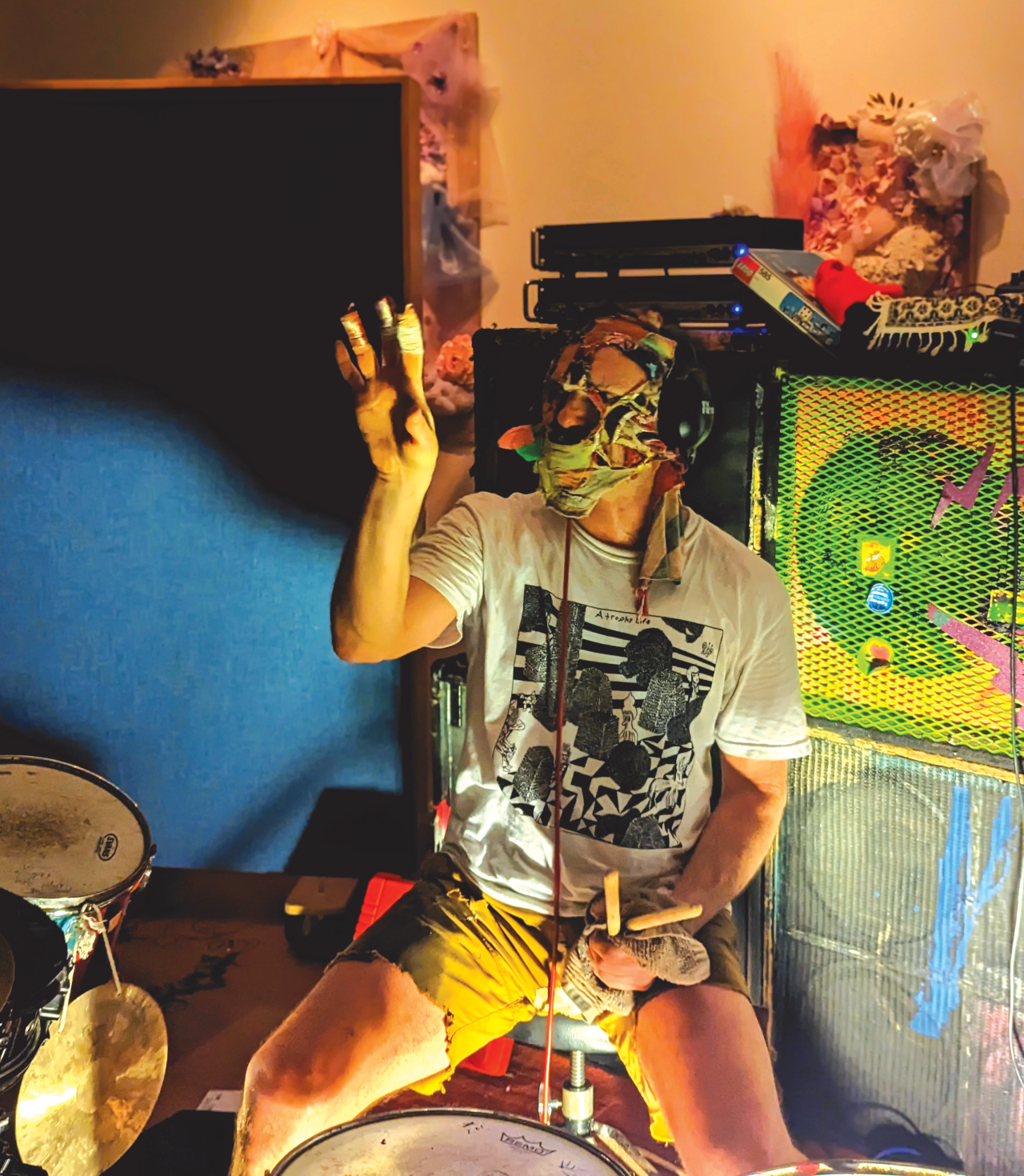
    The second set of the night began with a sort of venue change – the crowd lured, Pied Piper style, into an adjoining room, proceeding in a polite but urgent procession to ascertain the source of the emergent sounds. Waiting in the art gallery, at the center of a disorienting jumble of drums, amplifiers, pedals and speaker cabinets, was Brian Chippendale — otherwise known as Black Pus. Chippendale is legendary in PVD — and well-regarded in underground music at large — for his role as one half of Lightning Bolt. Chippendale’s work as Black Pus is also prolific, stretching back to the mid-2000s and covering more than 10 official releases.

    The mood of the set was casual. Chippendale bantered freely with the audience, effects pedals garbling the output of his mask-embedded microphone. He revealed that he had sliced his fingertips open while grasping a lamp earlier that night, and showed off fresh white bandages — delicate puffs of gauze that would be soaked in blood by the set’s end. 

    That night, it seemed, fidelity to any recorded version was a false god. The true and enduring tenets of Black Pus are that the entirety of the earth-shaking Sturm und Drang blowing your hair back in the moment is coming from one industrious man and his crazy, broken-looking gear, with no overdubs and often no script to speak of.

    Audience reaction was split between rapt attention and wild moshing, some of which knocked the very art off the gallery walls (sorry Hallie Driscoll!). By the end of the set Chippendale was quite literally bleeding for his art, and thanking us for the privilege of doing so.

    Black Pus (Photo: David Sano)

    One gets the sense that critics have trouble gauging the level of seriousness in which Baby, Baby’s music was made, and the level appropriate for engaging with it. Is this goofy art rock made for goofing’s sake, or is there some deeper statement lurking in the silly? What does the irony meter say? How do I evaluate and write about this thing without looking like I missed the joke, or that I laughed when I shouldn’t have?

    For any critics in the house, and for over-thinking fans, these internal debates melted away as Baby, Baby began their performance. Live, the band’s craft and effort are clear. The songs are not overly technical in the musical sense, but do involve some appreciable feats of signal processing. Each musician was outfitted with roughly a half-dozen audio processing devices, including drum machines, effects pedals, samplers, and even a telegraph key. 

    What comes through live, and not necessarily on the record, is the construction of these songs – every aural building block follows some well-worn path from electronic storage, instrument, or microphone, through the requisite effects and out into the mix in real time.

    What makes Baby, Baby worth seeing and listening to is not just their means of production, but rather the musicality and catchiness of their compositions. During the performance, sam m-h spent much of the show crouched over pedals, turning knobs, but their guitar was always impeccably applied. Gabe C-D’s clever hands banged out clear, bright melodies on tiny rubber sampler buttons, and often introduced chord changes or harmonic interplays that were almost too affecting for this sort of cartoon art-pop. Lids B-day held the audience’s focus as frontperson, delivering their odd, sometimes relatable lyrics with a kind of art-school James Brown energy. 

    These strengths were not lost on the audience, who refused to take no for an answer when the set was complete. Fresh out of prepared songs, Baby, Baby bravely improvised a short piece to close out the night. One has to believe that more than a few fans drifting out to their cars or finishing up their drinks in the afterglow had the sense that they caught a band at a turning point, art-punks on the come up.