I’ve never known much about growing flowers. The few gardens I’ve started in my life ended all too unceremoniously, in death. And I’ve never known much about 3-D printing, either. In fact, probably attributed to my lack of knowledge and skill in both realms, I never really cared much about either subject. But when my cousin, Adrienne Allard, asked me at Thanksgiving if I’d be interested in joining her “3-D printing garden” project, I told her there were no two subjects I was more knowledgeable or passionate about. The fib got me a spot secured on her team.
At the time, what I knew was this: Adrienne worked in marketing for Landworks Studio, a landscape architecture firm based in Salem, Massachusetts. Though we’re both Rhode Islanders — she grew up in Wakefield, I in Burrillville — her career had pulled her into the design world and across state lines. After working there for six years, she and several colleagues branched off and started their own company, Atelio.
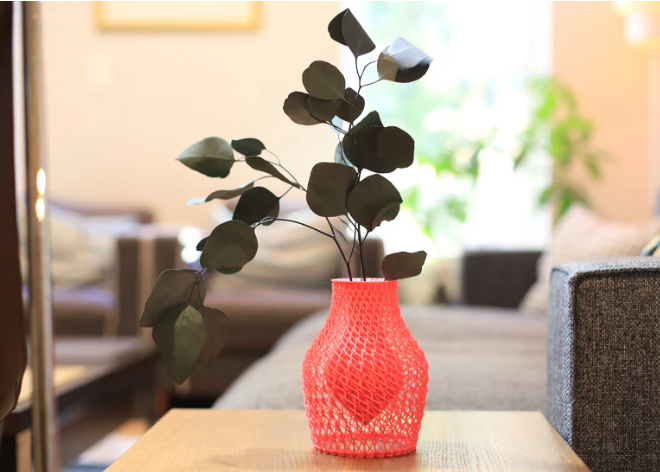
At first, the Atelio team made smaller items like vases (pictured below), but soon they invested in a massive (and heavy, trust me) robot arm capable of printing full-size structures—things as big as a house. With this new technology, they were able to collaborate with Lily Kwong, a landscape designer, artist, and entrepreneur. She works with plant life as a creative medium, creating immersive installations and gardens. Her work has appeared in high-profile public spaces like The High Line, Grand Central Terminal’s Vanderbilt Hall, the New York Botanical Garden, and Madison Square Park.
As someone with an artistic and entrepreneurial mind myself, I loved this middle ground of art, technology, gardening, and business. I jumped at the chance to be involved.
I flew out to San Francisco to lend a helping hand, though I didn’t realize just how much work would be involved at the start. We were working on “EARTHSEED DOME,” (pictured below) a large dome with an outer shell printed from recycled marble dust, limestone, and sand, and an inner layer composed of earthen blocks that we printed ourselves. The blocks were seed-infused; eventually, flowers would grow directly from the structure.
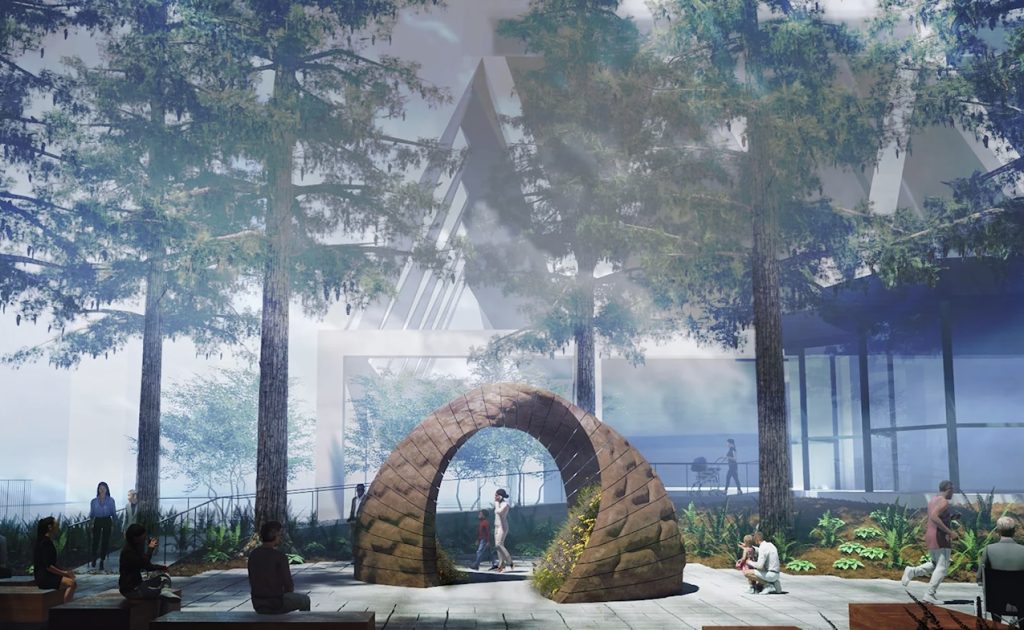
Per Atelio’s website, “EARTHSEED DOME is a 3D-printed living soil installation at Transamerica Redwood Park.” Fabrication was underway at the Transamerica Pyramid, where visitors were invited to look behind the scenes as the site-responsive work took shape in full public view. Merging ancestral building practices with emerging technology, the installation functions as both a public artwork and a seed-dispersal hub, designed to support the restoration of urban ecology.
The tagline we came up with — while working inside a building with massive glass windows where everyone could watch us sweat — was: “Public art being made in public.”
At first, I saw the project as adjacent to the current discourse around AI and its intersection with art. To me, 3-D printing felt like technology encroaching on craftsmanship, on human input, on the romantic ideal of the artist with dirt under their fingernails. But I quickly learned that the human element was not at all lost — at least not yet — as I discovered while doing much of the manual labor.
We unloaded pallet after pallet of 50-pound bags of geomix, the marble, limestone, and sand mixture, and concrete alternative. We hand-mixed a very specific blend of soil, sand, clay, starch, water, and seeds — tweaking ratios until the consistency was just right, able to travel through the extruder without clogging, but sturdy enough to hold its form. The mixture fed into an auger that spun the material and pushed it through the nozzle, printing it layer by layer onto trays.
I’m summarizing here, sparing you the tedium. But rest assured: the human element was alive and well. The dirt was very much under all of our nails.
I was in San Francisco for a week. Adrienne and her team — made up of David Shimmel, Andrea Varutti, Rita Lopez Shimmel, and Colleen Beckett — had been at it much longer, nearly a month, and there are still several weeks left of assembling the now-printed blocks in Redwood Park, stacking them piece by piece.
The future of 3-D printing and its intersection with art and architecture is only going to grow. As Adrienne tells me, there are many more Atelio printing projects on the way, several of which may take place in Rhode Island. Private clients have already requested large-scale statues of insects. There’s talk of potentially collaborating with WaterFire Providence — where Adrienne previously worked with Laura Duclos, who actually met us out in San Francisco — for America’s 250th anniversary. There are also early discussions about a possible 3-D printed installation for Salem’s 400-year anniversary.
And the ambitions extend beyond art installations. Atelio is interested not just in sculptural pieces, but in architectural applications — custom large-scale planters, retaining walls, furniture, and other functional structures that blur the line between infrastructure and artwork.
Though I may have started out knowing little about either gardening or 3-D printing, I can say I have a far better grasp of both than I ever expected. And, if they’ll have me, I look forward to collaborating with — and hopefully reporting on — Atelio’s next ambitious experiment.