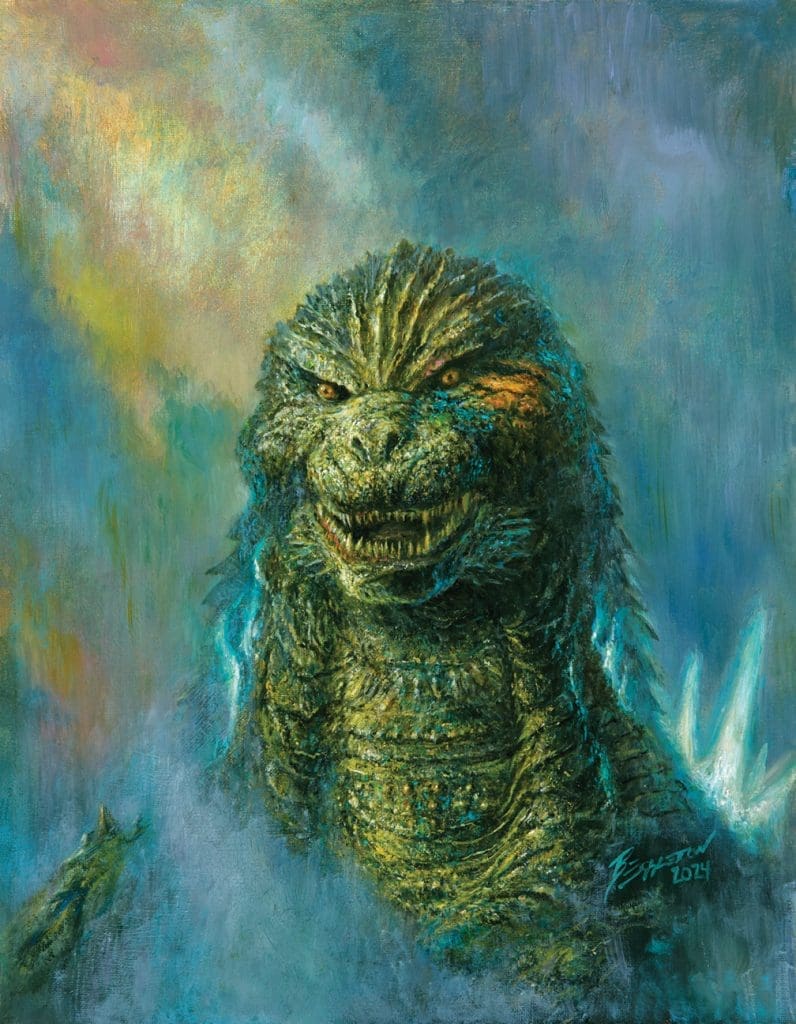
Godzilla has been a cinematic icon for over 70 years. However, there are important themes around the monster that have gotten lost with international audiences.
There is no gigantic monster that has had a greater influence on pop culture than Godzilla. With many projects on the horizon, the character is at a level of popularity that rivals established American franchises. Godzilla is still finding new and exciting ways to captivate audiences. However, even in today’s world, where a lot of original Godzilla material is now widely available in the United States, there still seems to be a difference in how he is seen here vs. in his original Japanese versions. While Godzilla’s perception here has garnered more respect recently, the majority of international audiences see Godzilla as a powerful anti-hero. Japan’s perception is more complex.
Inspired by the success of the recent films, I decided to re-watch all 38 of the Godzilla movies and partake in extensive background research to learn something new about them. Many of these themes are nuclear in nature. Godzilla is an allegory for the nuclear bomb, as portrayed in films such as the original 1954 classic, 1984’s The Return of Godzilla, and Godzilla: Minus One. Other themes portrayed in various films are about corporate greed, pollution, the ineffectiveness of the Japanese government, and the dangers of forgotten history.
According to each film, Godzilla’s body of work is more reflective of Japanese culture. To understand more, I spoke with two of the most prominent American-based artists in the Godzilla community (Bob Eggleton and Matt Frank) and asked both about the different perceptions of Godzilla.
One of the most interesting facets of these interviews was listening to how each originally connected with Godzilla media. In the 1970s, Eggleton had a tough time trying to track the movies down. As Bob said, “I was pretty much hunting down Godzilla media at a time when these things were hard to come by. Nowadays, he is merchandised everywhere.” For Matt, growing up in the 1990s, Godzilla had a bit more exposure. Even with the niche nature of Godzilla back then, he was still “ingrained into pop culture.” While there was more of an effort to sell Godzilla-related merchandise in the States, it was still difficult. “The only real way to see Godzilla movies was for it to either be playing on television, or you had to luck out and find one at a video rental shop.”
These different ventures showcase an interesting reason for Godzilla’s western perception: lack of exposure. Audiences make their own analyses of the films based on the inaccurate English dub, which leads to misconceptions. Thankfully, with more releases of the Japanese originals, we have a deeper understanding of how these films work in relation to Japanese philosophies.
Eggleton goes on to discuss the difference in the portrayal of radiation. He mentions that, because of Japan’s negative history with radiation, Godzilla helps the people of Japan cope with their trauma because of their “collective memory of the WWII bombings.” Meanwhile, here in the US, according to Eggleton, “Radiation was your friend.” Since the US has never experienced a nuclear disaster on the scale of Japan, we don’t have that collective trauma. We see radiation as a “power boost.” Like Spider-Man or the Hulk, Godzilla with his nuclear radiation is seen as more heroic, or an anti-hero. As Eggleton says, Godzilla is “Not on our side, but not against us.”
Frank describes Japan’s different culture regarding natural disasters. “They have this very unique relationship with impermanence and with accepting that there are forces that don’t care about you and will just wipe you out.” For the states, despite facing smaller-scale disasters, according to Frank, “…we are really good at pushing that down.” The US feels like they are the “masters of their own destiny”. Godzilla has a rationale for his actions in America, whereas Japan’s take is more existential. Godzilla just exists and it’s up to the humans to figure out how to deal with his presence. Eggleton also states, “Nature is bigger than us. In Japan, they have a tremendous amount of respect for nature. So even though Godzilla destroys a ton, when he dies in the Japanese films, no one ever celebrates. They mourn him and understand the tragedy in his creation”.
What both Japan and the US have in common, with respect to Godzilla, is his popularity. Everyone loves Godzilla! Especially in the States, why has he endured for so long? Frank makes a point to mention that modern audiences are understanding of the monster’s nuclear origins and are willing to watch with a “suspension of disbelief.” Older American audiences would consider the whole movie a mistake if just one bit of special effects wasn’t convincing. Modern audiences appreciate the practical effects used in older movies a lot more because of the modern overuse of CGI. Eggleton also points out that American audiences are drawn to “big and tough” action heroes. Movie stars like John Wayne and Sylvester Stallone were always huge draws because of the tough persona each exudes. Godzilla is no different, showcasing a near-invincible power-level and an “I don’t care” type of attitude that appeals to Western audiences. Frank talks about Godzilla being Japan’s first successful global export. People were drawn to Godzilla because of his large presence and are still going to see his movies because of how “maleable” the character is. Drop him into any scenario, and the film would still work because of how differently everyone reacts to Godzilla. You can make him a hero or villain, and the story would still work because the core traits of Godzilla never change. Frank believes that Toho Studios, the company behind Godzilla, has been really smart in their handling of Godzilla. “They know when to apply pressure and when not to. They knew when to put Godzilla away because you can’t keep running him into the ground.” Eggleton thinks there is one simple reason Godzilla has stuck around for so many years: “Because of his name. He has such an iconic name, that everyone instantly recognizes who he is. He has stood out and outlasted the other monsters of his time.”
Thanks to these insightful answers, I believe that Godzilla’s difference in perception boils down to two factors: different cultures and accessibility. Japan and the United States have different ways of seeing things, with the biggest difference being Japan’s unique relationships with nature, death, and impending doom. They bring those aspects into Godzilla movies; they have some respect for Godzilla because of nature, and the destructive path he leaves behind is reminiscent of natural disasters and nuclear fallout. All of which is something that Japan has dealt with in real life. We don’t have that understanding in America because we don’t have the experience of total destruction that Japan has. Accessibility is also a big factor, given how little Japan did to promote a lot of Godzilla movies internationally for 70 years. No one could get a hold of them in their original Japanese form, leading to misconceptions about Godzilla despite his global appeal.
It is this global recognition that has made Godzilla such a huge (both figuratively and literally) a cinematic icon. He represents our innate fears about nuclear apocalypses and natural disasters. But he can also be a superhero, saving the planet from existential threats. I believe it is this versatility that is the secret to his success. All of these iterations still work because it’s Godzilla. Seventy years later, and Godzilla is still going strong. I hope I can make it 70 years and be as strong as Godzilla.