In his final year at college, cover artist William Schaff truly learned what it was like to work in a studio. “I developed a course of study in general fine arts with one of my professors, who would come see my work a few times a week, and the experience taught me how to work in my studio for twelve hours at a stretch,” he explains.
He graduated with a BFA from Maryland Institute College of Art (MICA) in Baltimore in 1994. His artwork runs the gamut from drawing to album covers to mixed media to paper cutting to hand embroidery.
The visual artist also did what he called The Whale Guitar Project, for which he designed the body of a guitar in the shape of Moby-Dick, from the novel of the same name, with a peg-legged Captain Ahab strapped to the sperm whale by harpoon lines. The guitar, part of Jen Long’s Whale Guitar Project, has since been played by thousands of musicians from RI and beyond as a gesture of support for conservancy. Currently, he’s working on a six-foot-tall embroidered rendition of Chewbacca from Star Wars.
Born and raised in Boston, Schaff became interested in art at an early age. “I’d always done artistic things as a little child,” he recalls. “I drew on the walls. And I’d cut pictures out of books to use them as landscapes in collages.” His parents encouraged him to draw.
“As I got older, I found the ability to express ideas, although it was not as articulate as I would have liked it to be,” he says. But such articulation did come with time and experience.
Upon graduation from MICA, Schaff lived and worked in Baltimore for a few years, doing mostly commercial illustrations. He moved to RI in 1997 and lives in Warren in a house he shares with his wife and a few fellow artists.
He’s nicknamed the place Fort Foreclosure. That’s because as an underfunded artist, as he puts it, he’d fall behind in mortgage payments. His home, which houses his studio, has been in and out of foreclosure over the years, he explains. Schaff is currently working part-time on a farm to help make ends meet.
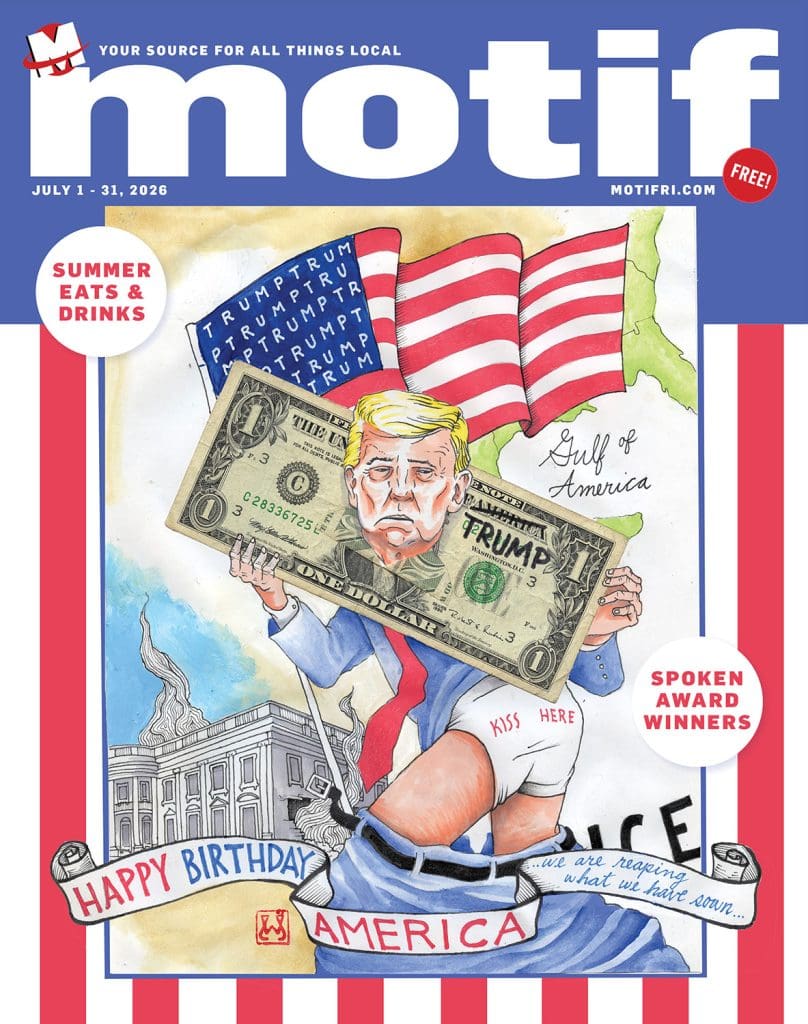
For the cover of the July issue, the artist put President Donald Trump front and center, above a banner that reads “Happy Birthday America…we are reaping what we have sown…”
Trump is wearing his typical too-long red tie, and his pants are pulled down to show his tighty-whities with “kiss here” written on the backside. His head is poking through the one dollar bill, where George Washington’s should be, and he’s standing in front of a US flag which has letters spelling out TRUMP replacing the stars in the blue canton.
“I wanted to poke fun at how absurd this man is, who sticks his thumb in everything, and ends up mocking himself without knowing it,” Schaff comments, adding, “So sad.”
The artist says he’s inspired by the work of the early 20th century surrealist René Magritte of Belgium, who was known for putting familiar objects in unexpected contexts. “His landscapes looked like something I could recognize. And he always showed the actual essence of the object he painted.”
Surrealism features in Schaff’s own pieces. And some of his pen-and-ink drawings look like what you might get from Edward Gorey on LSD.
But it’s the creation of album covers that is one of Schaff’s great loves. He’s done the covers for Okkervil River’s first ten albums, Godspeed You! Black Emperor’s Lift Your Skinny Fists, and the intertwined indie groups Songs: Ohia and Magnolia Electric Co.
Schaff recalls that when Jason Molina, who founded Songs: Ohia, commissioned him for an album cover, “He said: ‘Owls, magnolias, pyramids, run with it.’” Molina, who died in 2013, was an amazing artist himself, Schaff comments.
“The first album client to let me do whatever I wanted was Alec K. Redfearn and the Eyesores,” the artist says. He did the covers for their first three albums. In fact, Schaff relates that he joined the Eyesores as a musician. “I started on drums with them, because their regular drummer was hiking the Appalachian Trail. When he returned to the group, I switched to guitar for the gypsy punk band, and the guitarists showed me what chords and scales to play.”
There were a number of tours. One that sticks in his mind is a horn festival in Serbia.
When it comes to his work, Schaff says he strives “to make art to be viewed, and hopefully inspire thought. And it doesn’t always have to be adversarial to get its point across.”
He adds, “I just happen to put on paper what I know. I have a visual vocabulary that I can pull from. My art looks mysterious. But if you spend time with it, it doesn’t look all that mysterious.”
In the same vein, Schaff notes that Molina was notorious for making stuff up about himself in his songs. To this day, a lot of people aren’t sure what was true and what was fictional, which makes Molina’s music something of a delicious mystery.
Mystery must run in his roots: Schaff is also a literal magician, just like his Dad.
—John Picinich
His website, titled “The impossible beautiful world of visual artist William Schaff”, can be viewed at williamschaff.com.