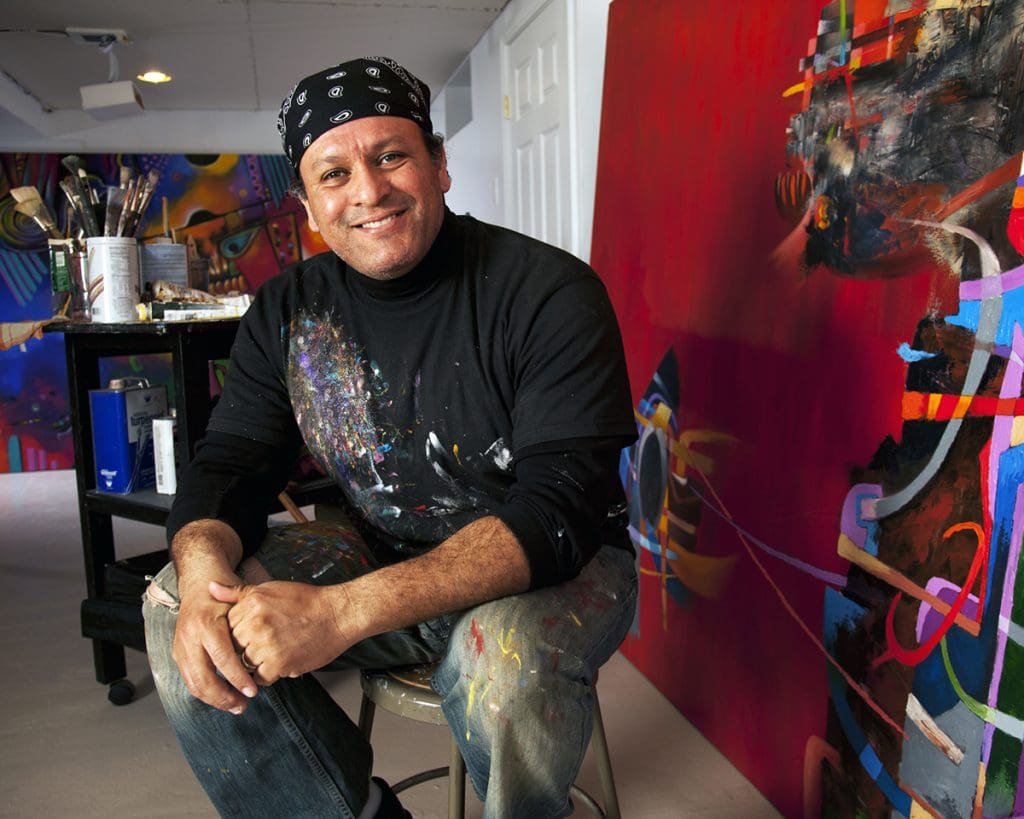
For the Rhode Island artist, educator and muralist, creativity has become a way to open doors, strengthen community and help others discover possibilities within themselves.
For Nilton Cárdenas, giving back does not begin with charity. It begins with creativity.
It can happen while painting a mural, organizing an exhibition, teaching someone who has never considered themselves an artist, or helping another artist find an audience for their work. Increasingly, Cárdenas has come to see these experiences not as something separate from being an artist, but as essential to what being an artist means to him.
His philosophy is simple: Art should not belong only to galleries, museums or those who already consider themselves part of the creative world. Art should be accessible. It should invite people in.
“I believe everyone has the ability to create,” Cárdenas says.
That belief is at the center of an artistic journey that encompasses his work as a visual artist, educator, muralist, curator and community leader. But it also reflects something deeper: an understanding of service that began long before Cárdenas developed his own artistic voice.
Growing up as a Peruvian immigrant, he remembers being surrounded by values of solidarity, respect, hard work and responsibility toward others. His father, the late Jorge F. Cárdenas, was an especially important influence. (Read more about Jorge’s legacy here.)
For more than two decades, Nilton had the opportunity to work alongside his father and witness how education and community service could create meaningful opportunities for individuals and families.
The experience left its mark.
But Cárdenas is careful about an important distinction. His father’s example helped establish the values by which he would live. It did not determine how the son would express them.
“I am not trying to reproduce someone else’s path. I am building my own path through art.”
And that may be the most important way to understand Nilton Cárdenas.
Finding His Own Language
Like many artists, Cárdenas began his career focused primarily on the work itself, developing his skills, finding his artistic voice, creating a body of work, exhibiting and establishing himself professionally.
Those ambitions have not disappeared. But his definition of success has expanded.
Over time, he began to recognize that everything he was accumulating as an artist — knowledge, experience, relationships, and skills, could be used to create opportunities for other people.
Today, he measures accomplishments not only by what he creates, but by what his work makes possible.
An exhibition can expose someone to a different perspective. A mural can change how people experience a public space. An educational program can awaken a creative ability someone did not realize they possessed. An artist given an opportunity to exhibit can find a new audience.
“Art is not only about the finished artwork,” he explains. “It is also about the conversation it creates, the stories it preserves, the emotions it awakens, and the connections it builds.”
That philosophy is visible in projects such as The Artist In You, a community-based arts initiative Cárdenas has developed to bring visual art into schools, community organizations, healthcare facilities, and senior centers.
Its premise is contained in its name: helping people discover the artist within themselves.
Participants are encouraged to explore their imaginations, express themselves, develop skills, and connect with others. For Cárdenas, an important moment occurs when someone who has never thought of themselves as an artist suddenly realizes they have something worth expressing.
His commitment also extends to RI’s community of working artists.
Little Masterpieces, now in its second year, is an annual group exhibition bringing emerging and established RI artists together to present original small-format works. Cárdenas sees its value as extending beyond the exhibition itself. It creates visibility, introduces artists to audiences and strengthens connections within the state’s creative community.
That is another form of giving back.
Listening Before Leading
Cárdenas’ approach to community work is notably hands-on. Whether developing an educational activity, organizing an exhibition, collaborating with another artist or organization, or working on a mural, he prefers participation to observation.
But being present is only part of it.
“I believe meaningful service begins with listening,” he says.
That idea influences his approach to leadership as much as it does his art. Cárdenas does not view leadership as having all the answers. He sees it as creating conditions in which people feel respected, heard, and encouraged to contribute. It has also led him toward collaboration rather than competition.
Supporting another artist, he believes, does not diminish his own work. Sharing knowledge, resources, and opportunities makes the larger creative community stronger.
That perspective has not come without challenges.
Building a professional artistic career requires discipline, financial investment and countless hours of individual work. Community projects require their own investment of time, planning and collaboration. Cárdenas has had to learn how to balance the two.
He has also learned that some of the most meaningful results of community work are the least visible.
An exhibition can be counted. Participants can be counted. Murals and programs can be documented.
Confidence cannot be measured quite so easily.
Neither can the moment when someone discovers a talent, makes an unexpected connection or begins to see themselves differently.
For Cárdenas, those moments matter.
Start With What You Have
His advice for professionals and artists wondering how they can contribute is refreshingly uncomplicated.
“Start with what you know, what you have, and what you love.”
Giving back, he argues, does not require significant financial resources or a large organization. People can contribute their time, knowledge, professional skills, experience, creativity, or simply their willingness to show up and listen.
His own contribution happens to be art.
He can teach. Mentor another artist. Organize an exhibition. Paint a mural. Introduce someone to an artistic experience. Or create a place where another person feels comfortable enough to express something that previously remained inside.
He also cautions against entering a community believing you already know what it needs. Service requires humility.
Listen first. Learn. Collaborate. Recognize the knowledge and strengths that already exist within the community.
And start somewhere.
“You do not have to change the whole world. Sometimes creating one meaningful opportunity for one person is already a powerful beginning.”
What We Leave Behind
Perhaps inevitably, Cárdenas’ thoughts about legacy bring the story back to his father.
Jorge F. Cárdenas showed his son that a commitment to education and community could extend beyond a single generation. Nilton carries those values forward, but in a language unmistakably his own.
His canvas is broader now.
He hopes The Artist In You continues creating opportunities for people to discover their creativity. He wants Little Masterpieces to continue connecting RI artists with one another and with new audiences. He wants emerging artists to find opportunities, and different artistic and cultural voices to be seen, heard, and valued.
Ultimately, Cárdenas does not want his legacy measured only by paintings completed, exhibitions mounted, or murals created.
He would rather measure it by doors opened.
By artists encouraged.
By students inspired.
By people who discovered that they had something worth expressing.
“Our talents become more meaningful when we use them to create possibilities for others.”
Perhaps that is what the art of giving back ultimately looks like.
Not simply creating something beautiful for others to see, but using what you have been given to help someone else discover what they can create for themselves.