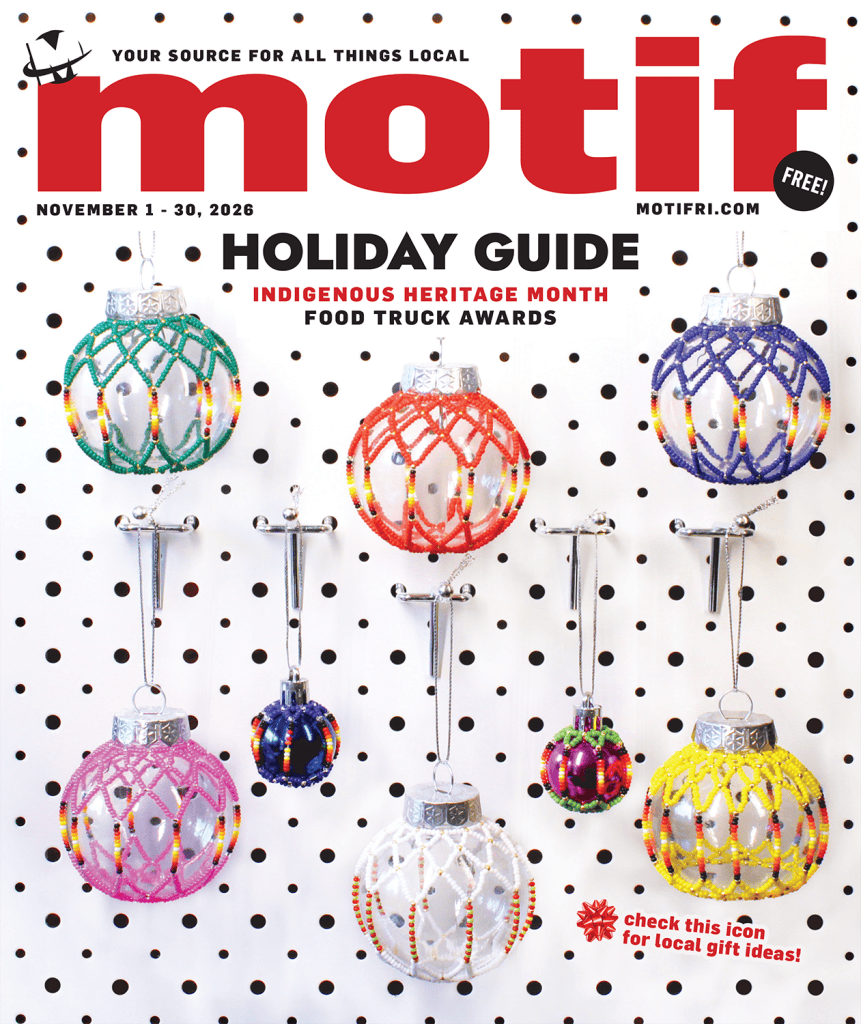
For cover artist Mishki Thompson of Hopkinton, love helped her conquer a disability and embark on a journey of learning and practicing the art of beadworking, and passing on her Indigenous traditions to the next generation, she relates.
A member of the Narragansett Tribe, Thompson was forced to go on disability in 2012 due to chronic back pain, and vasovagal syncope, which can cause a fainting episode brought on by a drop in blood pressure that reduces the flow of blood to the brain.
“It means that I can pass out anytime,” the beadworker explains, adding, “I can’t drive a car, and I can’t cook. Everything I do has to be done with caution, and there is always someone with me.”
She refused to let the disability define her.
“It could have caused depression. But I love being around people. I love smiling. I love laughter. I love being out and about,” she says. Instead of just sitting around the house and going stir-crazy, Thompson wanted to keep both her mind and her hands busy.
So she took up beadworking. She’d always found it interesting, having watched her grandfather do the craft while she was growing up in Charlestown, where she was born. And she has cousins who have beaded for years and shared their techniques.
“For me, it’s about the love of it,” she says.
Thompson started out by making hair bows. She came up with a name: Red Fern’s BOWtique. Mishki means red in the Narragansett language, and Fern is her middle name. And she liked the wordplay of BOWtique.
She went on to making jewelry. “My sister, Silvermoon, told me the basic way of how to do it, and where to get supplies,” she recalls. Then it was a matter of figuring it out for herself. Thompson makes beaded earrings, as well as beaded ornaments like the ones gracing the cover of Motif’s November issue.
The artist has taught beadworking to Indigenous students at Brown University. She’s also conducted beading classes for adults, with separate classes for children, at various public libraries, with the focus on appreciating Indigenous art instead of appropriating the Tribal community’s art by copying it.
Thompson also loom-beads, cross-stitches accessories, sews leather regalia and ribbon skirts, and makes moccasins.
Her Indigenous heritage is at the heart of everything about her.
“When I had kids, I saw the importance of carrying on our traditions,” she says. They’d go to powwows and other Tribal events, where Thompson would always buy some beadwork. These days, she’s on the seller’s side of the table. And there’s always a relative with her who knows the drill on what to do when she has a fainting episode.
Thompson’s beadwork is a way of helping to support her family, she explains. The artist has a soft spot for children, though, often giving gifts to them. “Watching their little faces light up when I give them a gift is the best form of payment for me,” she says.
She and her husband, Joseph, have two daughters, Aquene and Weeko, and a son, Nekoda. They also have a grandson, King. “And he is the king,” Thompson says with a laugh.
She’s made her grandson his first regalia, out of traditional deer hide. Thompson has also made full contemporary regalia for her younger daughter.
“It’s very important for me to put our culture in front of our kids,” she emphasizes. “We learn from our elders and from younger people. Actually, you can learn from everybody, and everybody has something to give.”
Family and community are important to her. “In supporting each other, we are helping our communities,” she explains. Thompson likes simplistic patterns, although she has done more elaborate pieces.
“Beading is medicine,” she concludes. “Crafting is my happy place. I challenge myself each day, either by doing a different type of beadwork, or learning another skill, as I share my art with others.”
–John Picinich
Thompson’s beadwork and jewelry can be seen @mishkii92.