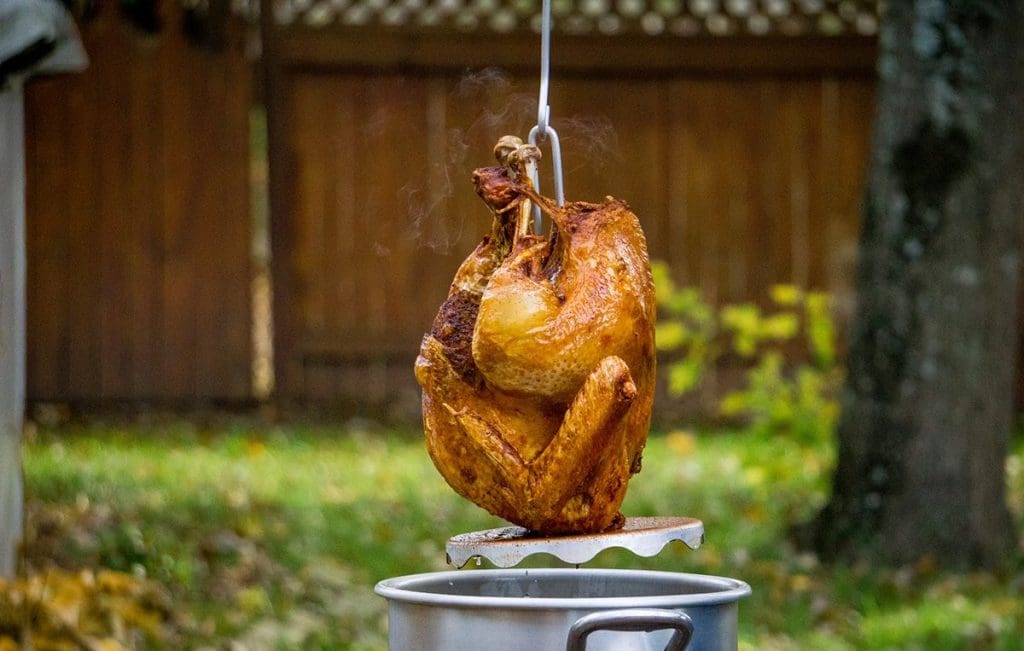
One of our favorite cooking traditions is deep-frying the turkey on Thanksgiving Day. We’ve been doing it safely for 15 years.
We bought a turkey fryer that came with a 30-quart cooking pot, a burner with a regulator and hose attachment, a vertical hook, a hanger, and a clip-on vertical temperature gauge.
A couple of weeks before the holiday, we order a fresh turkey of 12 to 13 lbs from the supermarket. You can also get one from a farm.
Here’s our three-day countdown to a scrumptious bird.
TUESDAY
Pick up the turkey in the morning. Take off the plastic covering and put the bird in the sink. Remove the giblets and neck.
Rinse out the bird thoroughly. Then, mount it on the vertical hook and put it in the pot. Fill the pot with water until the bird’s submerged. Then take out the turkey. The resulting water level shows how much oil will be needed. Mark that level on the outside of the pot.
Pour out the water, and dry the inside of the pot. Leave its cover off so it can air-dry during the next couple of days.
Take the turkey off the vertical hook. Using paper towels, dry the inside and outside, then place the bird on a pan. Put it in the fridge, and leave it uncovered overnight.
WEDNESDAY
Take out the turkey. Make sure it’s dry. Then, apply a dry rub to the entire bird.
We use Turkey Thyme, which our in-house rubmeister concocted by mixing whole thyme, ground bay leaves, ground sage, salt, and ground white pepper, among other ingredients. Sprinkle some of the rub inside the bird, too.
Put it back in the fridge, uncovered, for it to thoroughly dry overnight. Never stuff the bird, because it’s meant to cook simultaneously from the outside in and the inside out.
THANKSGIVING DAY
In the morning, take out the turkey, and let it come to room temperature. Put it back on the hook, and lay it down in an aluminum pan, with which it’ll be carried outside.
For safety, we set up the cast-iron burner stand on the driveway well away from the garage and house. Importantly, all deep-fryers come with detailed instructions on operation and safety. Read them. And make sure someone is outside with the deep-fryer at all times.
Attach the burner’s regulator and hose to a propane tank. The regulator controls the gas flow from the tank to the burner.
Place the fryer pot on the stand and fill it with oil to the outside line that was marked on Tuesday. We buy two 3-gallon containers of a high-smoke-point peanut oil blend. For us, it typically takes a bit more than four gallons to fill the pot to the desired level.
According to the USDA, most people with a peanut allergy can safely eat food cooked in highly refined peanut oil because the high heat strips away the peanut proteins that trigger allergic reactions. But consult a specialist if you have peanut allergies.
Insert a clip-on, long-stem deep-fry thermometer, which came with the fryer. Turn on the gas, use a clicker to ignite the flame on the burner. Heat the oil to 350 degrees Fahrenheit. We’ve found that it takes about 45 minutes to reach that temperature.
Once it hits 350, turn off the burner, put the hanger through the eye of the vertical hook, and slowly lower it into the hot oil. Don’t drop the turkey in because that’ll make the oil spill over the side and flame.
YouTube videos show what happens when a frozen turkey is put into a pot of boiling oil. There is an explosive eruption of hot oil and an immediate catastrophic fire. Which is why we use only a fresh turkey.
It should take about 40 minutes for the breast meat to reach 160 degrees. To make sure, pull up the turkey and take the temperature of the breast at its thickest part with an instant-read thermometer.
Once the breast registers 160 degrees, with the dark meat at 170 degrees, turn off the burner. Hook the hanger through the eye socket of the hook, and slowly lift it out of the pot. Place the turkey in a clean aluminum pan to bring inside.
Put the lid on the pot, detach the propane tank, and put the pot onto the ground.
Please note that rules about the disposal of used cooking oil vary from town to town. Go to your municipality’s website to find out its preferred method, which should be Friday’s chore.
Once inside, cover the turkey with aluminum foil and let it rest for 15 to 30 minutes, during which time the temperature of the meat will rise another 5 degrees.
The skin becomes a crisp and golden brown, with both the white and dark meat deliciously moist.
Carve, serve, and savor the taste of this delectable bird, with all the traditional fixings on the side.