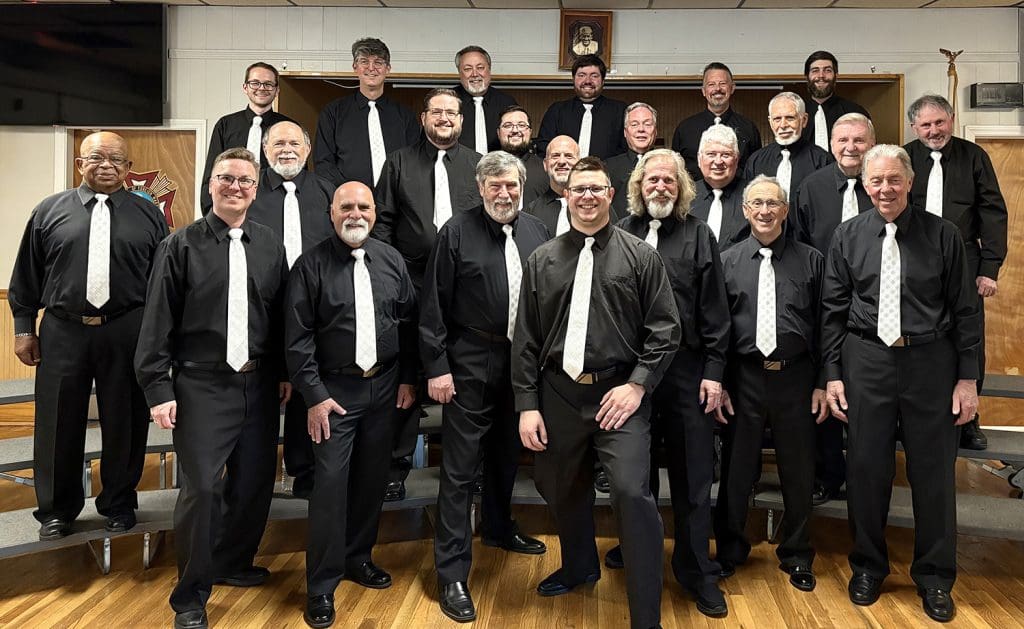
There is something undeniably joyful about being part of a group of people singing together.
For the Narragansett Bay Chorus, that joy has been part of the Rhode Island community for more than 75 years. Founded in 1949, the chorus grew out of a barbershop harmony tradition that began in 1938 and has evolved into a vibrant musical organization built on friendship, performance, and treasuring the opportunity to sing their hearts out.
I recently spoke with longtime member Michael Maino about the chorus, the history of barbershop harmony, and why, after all these years, people continue to come together to sing.
Dennise M. Kowalczyk: For someone who may not know about the Narragansett Bay Chorus, how would you describe it?
Michael Maino: The Narragansett Bay Chorus was founded in 1949 and has been going strong ever since. Its roots go back to 1938, when a group of men gathered in Tulsa, Oklahoma. They were looking for a fun night away from the political scene, the Depression and everything else going on at the time, so they got together and started singing. They ended up on the roof of a local hotel, thinking they were alone. A reporter walking down the street heard them singing, went upstairs to see what was happening, and wrote about it. That became the beginning of what eventually grew into the largest male singing organization in the world. In 1946, a chapter was started in New Bedford, Massachusetts. My father was involved, and when he moved to Rhode Island in 1949, he thought Providence needed a chapter. He and some friends started what became the Providence chapter of the Barbershop Harmony Society. Interestingly enough, 1949 was also the year I was born. So I’ve been involved with the Providence chapter — and now the Narragansett Bay Chorus — pretty much my entire life.
DMK: What makes the experience of hearing the chorus live so special?
MM: There’s something about live performance. You hear the different voices blending together, and there’s a camaraderie and friendship involved in creating those harmonies. Barbershop harmony is a melody singer with three harmony parts around it: tenor on top, bass on the bottom and baritone filling in between. When it’s done correctly, you can actually hear additional notes being created by the harmonies. We call that “ringing the chords.” Sometimes it can feel like you’re hearing six people instead of four. That’s part of what makes it exciting.
DMK: And that seems to be a big part of why people keep coming back.
MM: Absolutely. Once you’ve experienced it, there’s something very exciting about being in the middle of a good chord. We have members who have been involved for 30, 40 and even 50 years. For me, it’s been a lifelong experience. In fact, the night I was born, my father was singing on a show. When he learned I had arrived, he went to the hospital with four friends. They sang for the nurses and everyone else. That quartet was the Buffalo Bills, who later became famous and starred in The Music Man on Broadway and in the movies. So before I practically opened my eyes, I was hearing barbershop harmony.
DMK: The chorus has also had tremendous competitive success, including roughly 15 district chorus championships. How do you balance that pursuit of excellence with simply having fun?
MM: Having fun is the bottom line. That’s been my motto from the beginning. If you’re not having fun, there’s no reason to be doing it. We’re an amateur organization. The singers aren’t being paid, so it has to remain fun. We try to sing things that are fun — rhythm songs, Broadway show tunes, ballads, comedy and specialty numbers. We might add visuals or some comic relief. The goal is to enjoy what we’re doing.
DMK: That sense of community seems just as important as the music.
MM: It really is. People come from all different backgrounds. Everybody is there for the same reason — to have a good time and sing. I’ve made lifelong friendships through the chorus. My best friend in high school became the baritone in my quartet. I was the best man at his wedding, and he was the best man at mine. I even met my wife through singing. It’s part of life. It’s camaraderie. It’s a way to let the cares of the day go by.
DMK: What would you say to someone who says, “I’m not a singer. I could never do that”?
MM: I use a line from The Music Man: “Singing is only sustained talking.” If you can speak, you can sing. You don’t have to be a professional singer, and you don’t have to read music. In a chorus, there are other people singing the same part you’re singing, so you don’t have to be the star. You can just walk in, and we’ll help you learn. It’s a lot of fun.
DMK: Finally, what do you hope people take away from a Narragansett Bay Chorus performance — and what do you hope the next 75 years look like?
MM: At the end of the day, I hope we bring a smile to someone’s face or a tear to their eye. Both are good emotions. People will tell us that a song reminded them of their children, their childhood or something they heard on the radio years ago. If we close with “Sweet Caroline,” everybody is singing along. We hope the audience has fun. That’s our goal — to bring enjoyment to people. And I hope it continues for another 75 years. We have younger people involved in the chorus, including people in their 30s and even someone who just graduated high school. So we’re continuing to regenerate. There’s a lot of life left in the Narragansett Bay Chorus — and, hopefully, a lot more harmony to come.
To learn more about the Narragansett Bay Chorus, see www.singnbc.com. Follow Dennise on IG @TheAdventureBroad. To listen to the full conversation, visit motifri.com/on-the-rhode-with-the-adventure-broad.