There’s something wonderful about talking to film students because you can usually pinpoint the exact moment when movies stopped being simply entertainment and started becoming something much more meaningful. For Robert Blue IV, that moment arrived courtesy of giant alien robots.
As a kid, he sat down with his dad to watch Transformers. He was initially drawn in by the action, explosions, and larger-than-life story. But somewhere between the Autobots and Decepticons battling across the screen, a seed was planted — or more likely, a root of a career took hold. Looking back now, he can trace his path to filmmaking directly to that movie.
Of course, following a passion to become a filmmaker doesn’t happen in a blink of an eye and isn’t a very easy task. In my own journey, I started out as an accidental actor who also likes to tell a good story. Five years later, I directed my very first comedy short, Two Ladies and Their Parts.
For Blue, what started as a love of blockbuster movies gradually evolved into a fascination with how the films are actually made. Today, he watches movies using a filmmaker’s eye, paying attention to framing, lighting, editing, visual storytelling, and all the creative decisions audiences don’t pay attention to. Rather than taking the magic out of movies, studying filmmaking at Rhode Island College has only deepened his appreciation for the craft. He understands what is happening behind the scenes to bring that movie magic to life on the screen.
That combination of enthusiasm and analysis feels perfectly aligned with Rhode Island College’s Film Studies program, which blends film history, theory, and criticism with hands-on filmmaking experience. Students learn everything from screenwriting and directing to cinematography, editing, and visual storytelling while developing the collaborative skills required to bring projects to life. I have had the pleasure of working on a student’s thesis project as a volunteer actor and witnessed the deep level of commitment that the crew shared to help bring that film to life.
Samantha Conrady is another RIC Film Studies student. While in high school, a teacher encouraged her to take audio and visual production classes. Initially, the work centered around animations, skits, and storytelling exercises. Eventually, those projects expanded into live-action filmmaking, and something clicked right into place. She found a medium to take her own storytelling to a whole different level.
One of the key elements for Conrady’s success in filmmaking is collaboration – team work makes the dream work, as the expression goes. That became clear while discussing a short film created for a class. Serving as writer and director, she assembled a cast and crew that included both former high school theater friends and RIC classmates. The entire production was filmed in just two days. What stood out prominently to her wasn’t necessarily the final product. It was watching people who had never met before come together and instantly connect as a creative team.
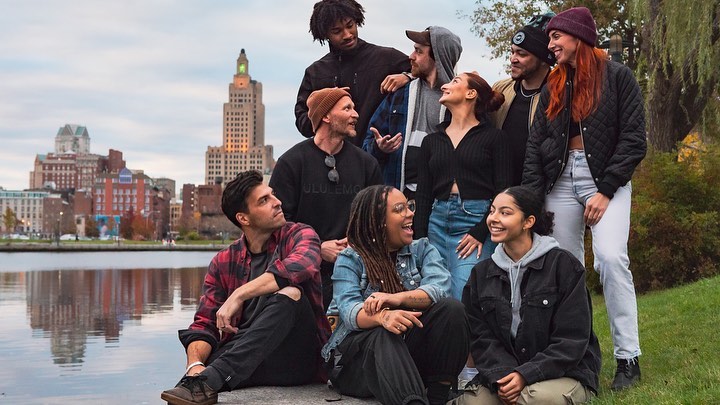
That kind of collaborative energy seems to be one of the strengths of RIC’s student film community. These two students describe it as a welcoming environment where students regularly volunteer on each other’s productions, share ideas, and help bring projects to life.
After graduating from RIC, both plan to continue building experience within the film industry, right here in RI, eventually moving into feature-length filmmaking where they can tell bigger stories. They see possibilities everywhere. Whether it’s Providence architecture, Newport waterfronts, or local special events, these students believe RI offers an incredible range of visual storytelling opportunities.
For now, the plan is straightforward: stay local, keep making films, continue learning, and build momentum one project at a time. Listening to them talk about movies, collaboration, storytelling, and Rhode Island’s creative potential, it became very clear that they know what they want as creatives.
This isn’t just a place where filmmakers come to shoot. It’s a place where filmmakers can learn, collaborate, experiment, build careers and tell stories that come from the people who actually live here.
If an aspiring filmmaker doesn’t want to go to college to learn the craft, there is another option in town: The Legacy Collective. It is a community-powered program helping creatives turn passion into income. The nonprofit was founded by Ian Travis Barnard in 2024.
For Louie Barroso, Legacy Collective RI’s Director of Admissions & Advancement, the organization grew out of years of working in commercial and nonprofit video production and recognizing what was missing in the local industry. There’s a lot of talent here but finding skilled creatives who reflected the state’s diversity was another story.
“We see a multi-cultural melting pot of creatives all over the Creative Capital,” Barroso explains, “But that’s not what the local filmmaking and video production industries look like.”
Legacy Collective was created, in part, to help close that gap and its philosophy is simple: Filmmaking is about more than cameras.
As Director of Operations Alex Terreault puts it, Legacy identified three major obstacles that can prevent emerging creatives from pursuing filmmaking — access to education, access to networks and clients, and access to equipment. That last one can be particularly challenging. Professional gear can cost hundreds or even thousands of dollars before a filmmaker has landed a single paying client. Legacy’s rental library gives members access to professional equipment while they build their skills, portfolios, and connections. The organization also provides education, mentorship, and opportunities to work on sets and develop professional relationships.
But perhaps the most important piece is community. Just ask Mae Zhang McCauley. A member of Legacy Collective’s sixth cohort in Fall 2025, McCauley arrived via a rather unconventional path. Storytelling had been a constant throughout her life, but it had taken many different forms.
She loved acting as a child and was making and editing her own YouTube videos by the time she was 12. In college, she studied literature and transcultural studies before moving into book publishing, where she worked as an editorial and publisher’s assistant. There, she spent countless hours reading manuscript submissions and developing an instinct for recognizing stories worth championing.
Then came acting and modeling. She began auditioning for commercials and eventually took a leap of faith into working full-time in that space. The more time she spent on film sets, the more curious she became about everything happening behind the camera. What would it be like, she wondered, to bring her own stories to life?
A friend who had participated in Legacy’s first cohort encouraged her to apply. Once there, she found exactly what she needed: time, space, equipment, mentors, and a community in which she could develop her voice as a filmmaker.
“Legacy put a camera in my hands,” she says, “built my confidence as an emerging woman of color filmmaker, and provided me with resources to just go and make the stories I wanted to tell.”
That kind of access matters. It matters because talent isn’t distributed according to who can afford a camera. Sometimes what’s missing is simply an opportunity.
Legacy’s model is built around creating those opportunities. Barroso and Terreault both emphasize that there is no single path into filmmaking. It is more accessible than you might think. Their alumni include people who entered the industry as a second career, freelancers who have built their own production businesses, and creatives who found their place behind the scenes as producers.
Terreault says he wants Legacy members to create whatever best represents them — a documentary, short film, music video, or something nobody has thought of yet. Barroso is particularly passionate about personal stories and the power of people telling stories from within their own communities.
McCauley is now putting what she learned into practice with her debut short film, HOT DANCING GRANNY, which she wrote, is directing and is acting in. The film follows three generations of Chinese women through one chaotic day as they dance their way through cycles of conflict and reconciliation. She has assembled a talented Asian American and women-led creative team, describing the collaborative process as something bigger than simply making a movie.
Legacy’s original three-year initiative was designed to address a need, create a ripple effect and eventually step back. But as the organization approached its final cohort, they realized the need wasn’t disappearing.
Beginning in 2027, Legacy plans to shift from three cohorts a year to one, with greater emphasis on supporting alumni through additional education, workshops, events, partnerships, equipment, studio access, and professional opportunities.
The goal isn’t simply to create filmmakers. It’s to create a community that keeps creating.
And five years from now, Terreault hopes RI will be living up to its Creative Capital potential in an even bigger way — with more opportunities for filmmakers, musicians, artists, and other creatives to build sustainable careers here. But between RIC classrooms, homegrown productions, Legacy Collective’s growing network, and filmmakers like me and McCauley who are refusing to keep their creative identities behind the scenes, the movement has already begun.
Learn more at RIC.edu, www.legacycollectiveri.com, and on IG: hotdancinggranny. Connect with Dennise @TheAdventureBroad on Instagram.