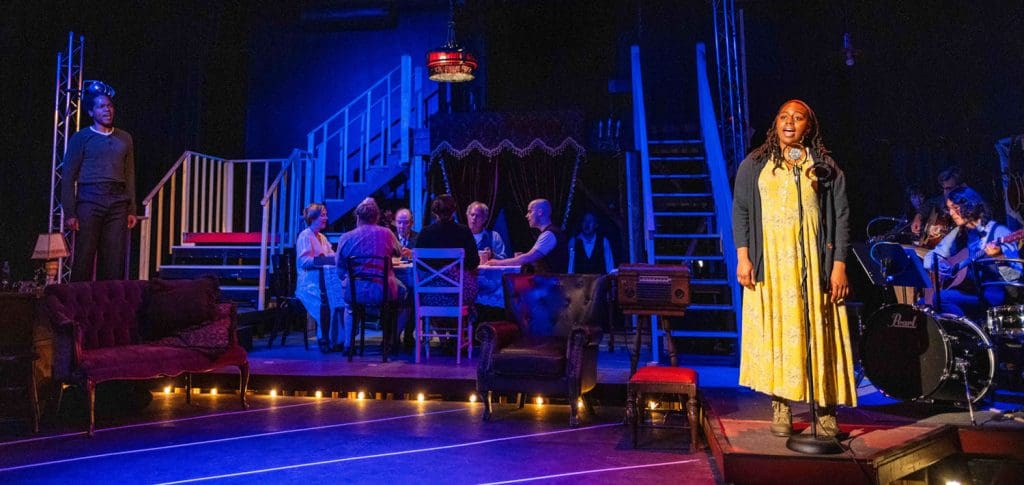
At Wilbury Theatre Group, Girl from the North Country settles in Depression-era Duluth, Minnesota, hauntingly restless and unexpectedly tender. It’s 1934. A group of wayward travelers’ gritty lives intersect in a rundown guesthouse filled with music, misery, life’s trials, and hope. Disparate transients gather here, each bearing the baggage of their own personal burdens. Financial woes loom, yet everyone emerges as fully realized individuals whose hopes and disappointments resonate. Duluth is Bob Dylan’s birthplace. Conor McPherson’s drama weaves together 20 legendary Dylan songs, reimagined to fit the characters, featuring Tony Award-winning orchestrations by Simon Hale and offering interpretations of these familiar tunes as never heard.
Directed with remarkable insight by WTG Artistic Director Josh Short, this production captures the tender humanity of McPherson’s celebrated musical, striking a chord thanks also to its ensemble and orchestra. Every character expresses a personal struggle through song, while clinging to survival through force of will. From the opening moments, the production establishes the spiritual exhaustion everyone is feeling.
“There’s something about a Bob Dylan song that resists being finished with,” says Short. “You think you know it, and then over time, with repeat listenings and new experiences, it shifts. A phrase lands differently, a line opens up in a direction you didn’t expect. I’ve been listening since high school, and every time I go back, I still get caught. Even so, I thought I knew these songs. Turns out you can spend a lifetime with a song and never really hear it until you watch someone sing it as a person on the edge of losing everything.”
Set design by Monica Shinn, paired with lighting and sound design by Andy Russ, achieves shadow-soaked lighting evoking a weathered boarding house that holds years of amassed memories. This visual design contributes significantly to the atmosphere, indicative of lives lived under constant pressure. There is a near-cinematic quality to several scene transitions as they dissolve into song and back again.
The cast navigates the material’s shifting tones with remarkable certainty, moving seamlessly between natural scenes and heightened musical expression. Even during the most heartbreaking moments — amid economic collapse, illness, prejudice, and disappointment — the players’ individual performances yearn for moments of grace.
Anne Scurria gives a heartbreaking performance as Elizabeth Laine, balancing fragility with flashes of brutal brevity, and startling lucidity with incomparable precision. Her interpretation of Dylan’s music feels personal, while scenes shared with Jim O’Brien’s weary, morally compromised Nick Laine, equally emotive, form the poignant backbone of their experience. O’Brien captures Nick’s desperation without seeking sympathy, breathing his exhaustion into the stale air.
Kimstelle Merisma brings extraordinary stillness and dignity to Marianne Laine. Surrounded by larger personalities and explosive musical moments, Merisma’s quietly restrained scenes speak the loudest. Carlin Fournier, as Gene Laine, offers a deeply humane performance capturing the character’s gruff exterior with vulnerability.
Among the supporting cast, Rodney Witherspoon II’s assertive Joe Scott introduces soulful intensity as a wrongly-jailed boxer, while Philip Iredale’s Reverend Marlowe is charismatic and unsettling, embodying hypocrisy’s false righteousness. Tanya Martin and Ricky Waugh as Mrs. and Mr. Burke provide memorable performances that ground the show with humor, grief and bitterness.
Some aspects of the play remain unresolved. McPherson’s unusually structured script often lacks clarity, deliberately leaving narrative threads hanging, character motivations elusive. The Laines had adopted a black baby girl circa 1910, which would’ve been quite taboo at the time, and although it allows more opportunity to address racism, it’s never explained why the couple did this. In present day, their daughter Marianne is five months pregnant, but who (or what!) the baby daddy is also remains a mystery throughout.
Some may find the ambiguity frustrating. Who exactly is this girl from the North Country anyway? She likely has more to do with Dylan’s personal life, as depicted in his 1963 song, rather than anything written into the 2017 play. Unlike with Joe Scott, who’s clearly represented by the song “Hurricane,” the music doesn’t always align with its intended character, feeling like a stretch in connection.
Under the musical direction of Milly Massey, connections are salvaged. A few of the musicians occasionally step up to the microphone as additional characters, with Dylan’s songs serving as a vehicle for collective melancholy. Classics including “All Along the Watchtower,” “Slow Train Coming,” “Like a Rolling Stone,” and “Forever Young” emerge transformed as mournful and raw, carrying the weight of the characters’ circumstances. These emotional confessions unfold as dreamlike meditations on survival, loneliness, and the fragile bonds connecting people during times of profound dilemmas with no foreseeable resolution.
This jukebox musical doesn’t offer catharsis. The music doesn’t rescue the characters as they struggle to be heard. The characters don’t escape poverty, regret, racism, physical and psychological ailments, or failed dreams. What the play does do is evoke our compassion within the tension. While Dylan fans may find it hard to make some song connections, the music does offer moments of revelation leading to unspoken emotional interludes the characters struggle to articulate. Wilbury’s production embraces those uncertainties, refusing assumed answers.
In the final moments, this emotionally resonant production laurels McPherson’s haunting vision and the enduring poetry of Dylan’s songs, conveying shared mourning, brittle hope, and that delicate balance between despair and resilience. It reminds us that human connection is possible even during the most dispiriting times. This is intimate, bruised, and emotionally charged theatre executed by artists fully invested in the humanity of the storyline, giving us a wonderfully acted performance steeped in mystery and melancholy.
Wilbury presents Girl from the North Country through June 21. For more information, visit thewilburygroup.org. Performance time is approximately 2 hours and 15 minutes including intermission, and contains the use of theatrical firearms with gunshots and stage combat.