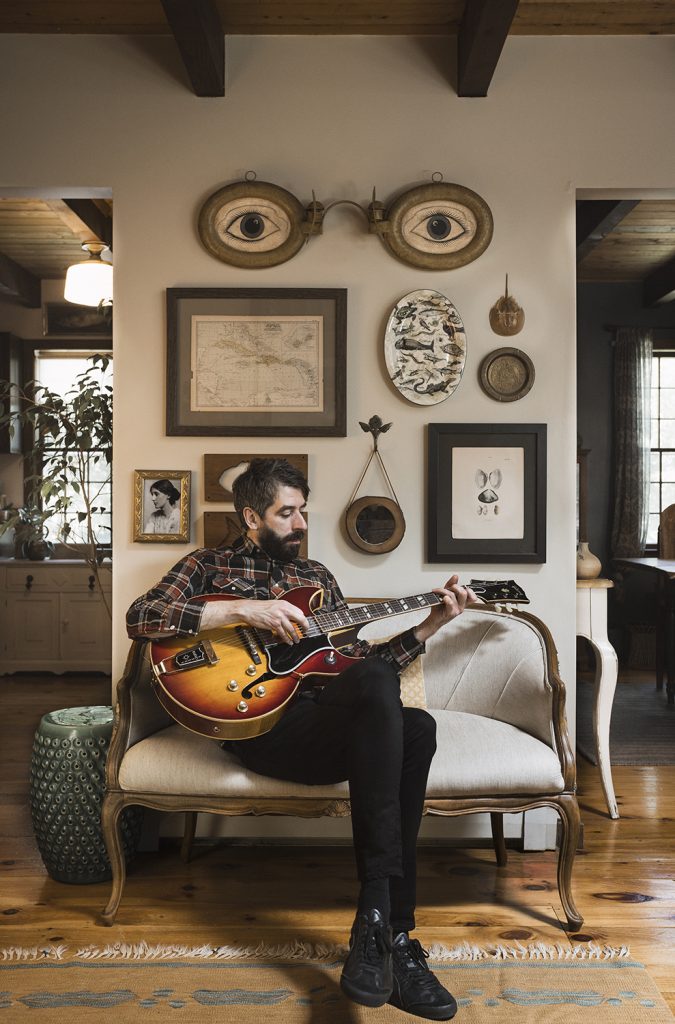
John Faraone: a man of many bands, many instruments, and one poetic voice. While John wouldn’t call himself a poet, I certainly believe that his lyrics are simply stanzas waiting to be printed. After working on his sophomore solo project The Waves for almost five years, he’s finally ready to release this new music and remind us all that if we allow for it, art can help us process feelings, express love, and experience joy.
Mayté Antelo-Ovando (Motif): As you think about this new record, what’s something you’d really like to share?
John Faraone: Overall, the whole thing is heavily inspired by the Virginia Woolf novel of the same name. I stole that from her. I started writing during the pandemic, probably in 2021. My first album came out in 2018, and then that interim — 2018 to 2021 – I wasn’t feeling musical. If I tried to do something, it just wouldn’t produce something I thought was worth it. People might call it writer’s block. But I started reading the novel around that time and it sparked that creative joy and the want to explore, even if the ideas weren’t very good, just exploring them anyway to get to the good part of it. So the entire album owes its life to that book.
MAO: This is why it’s so cool to talk to musicians about their creative process. I know of Virginia Woolf, but I don’t know that book, so it’s not something I would’ve understood without this conversation. You said this record is very inspired by the novel, and it also feels very personal. How personal is it?
JF: Yeah, it’s very personal, but not really in a very specific way. If I’m addressing somebody in a song, it could be any number of people, and all at the same time: people that I love, that I know, people that I was friends with that I’m no longer friends with, or people that we’ve lost over the pandemic. And so that novel, the structure of it follows these five people who are friends, from very young, all the way to the end. It tells the story through their inner monologues. There’s no real dialogue. It’s just their thoughts, as if they’re talking to themselves. It’s like a 300-page poem. It’s not really a standard structure, and it’s the prettiest thing I’ve ever read. I’ve probably read it seven times in a row, [partly] because it’s pretty heavy and hard to get through. You have to re-read it to pick up the parts that you missed the first time around. There’s just so much. It’s the gift that keeps on giving. It inspired the music. I wouldn’t say that I took lines from the book and turned them into song, but there were parts that I read where I thought, “Oh, this reminds me of that time,” and, “This thing happened that’s similar to this – let’s explore that idea.” There are definitely songs about specific people, and then there are songs that are about navigating all kinds of interpersonal relationships. Much of it was written during COVID, so there’s a lot of coming to terms with mortality and endings of things, and trying to make that okay and pretty — not sad and dark.
MAO: Yep, that sounds like you! “I’m going to talk about some heavy things, but I’m going to make it light, it’s going to sound ethereal.” I’ve actually heard you say that your music is “quiet.”
JF: Right, I have to tell sound guys, “Hey, just so you know, I sing really quiet. So if you can, turn me up in the monitors just so I can hear myself,” because I’m usually significantly lower volume than the people that I’m playing the show with.
MAO: Is it better for you then singing solo, rather than with a band?
JF: I’ve sung with a band maybe two or three times, and it’s something that I want to do more, but I just haven’t. It’s hard to get everybody’s schedules in the right place. And, I’m not good at winging it, not doing a lot of practicing. If I was going to have a band, I would want it to have a weekly rehearsal, so that we’re tight.
MAO: Coming back to the record itself, I feel like the pacing is just very you. It reminds me so much of your first record. But that’s my interpretation.
JF: When I first sent you the record I think your response was something like, “This is such a you record,” and I thought, “That’s the best compliment!”
MAO: What would you define as a “you” record?
JF: I would say universally introspective. My songwriting process isn’t really a process. I don’t think for any of the songs I’ve ever sat down to “write a song.” It’s not like, “I’ve got six songs for this record, I’ve to sit down and write another song.” It took 2021 to 25 – so four years, maybe even longer than that – almost five years. And I don’t want to ascribe anything, like spiritual or whatever to it, but I kind of just wait until something hits me, until I fall ass backwards into a song. Some sort of poetic force in the universe is like: “Here’s a cool line. Take this and run with it.” Or I’ll be sitting, playing guitar, and randomly come up with a weird little lick and think, “Oh, that’s pretty, voice memo that.” And then if I get a couple of lines that sound good, I’ll try to fill in the space between them with personal touches. I just go through my phone and find things on guitar that sound like they belong to those things. But it’s not the best way to do it; it’s not very productive or timely. But every time I’ve tried to do something, it’s not very good. So I’ll just wait until something happens and it just hits me — that’s when I’ll do it.
MAO: I think some of us, myself included, do well with deadlines. The pressure makes me do.
JF: And I can do that with non-creative things. When I was in grad school, I was turning stuff around super quick. I would actually wait till the last minute, then finish a project. But with this, every time I tried to do that, it didn’t work. There was a good friend of mine who was in a music marketing thing, very early on, before my first record. I just started playing out, and I was cobbling together songs to play live, and she said, “You have a voice, which is good.” Not singing, but like a creative voice. “And with people that are at an aspiring songwriting level, such as yourself, every word has to matter. There can’t be any fluff or cliches.” And it was eye-opening for me. I thought, of course every word has to matter! Why would I do it otherwise? So I went through my songs and I’m like, ”Well, this song sucks, and this song sucks.” I was writing songs just to write songs. I wasn’t trying to connect. And if the goal is to connect, then every single word has to matter. It has to matter to you, but it also has to have some sort of connection with a listener. There are people who say that in writing songs, you can’t write with a listener in mind. And I think you have to have that in mind that someone’s going to listen to it. But it’s really more, ”How will they connect with it? Where is the thread that you’re going to grab them with?”
MAO: You don’t want to rush the process, the honoring when something strikes you, and taking the time to notice that and write it down. There’s an intentionality behind it. This reminds me of something people may not know about you. You went to graduate school for English.
JF: Yeah, I went to URI, got a Master’s in English, with a focus on American literature. My thesis was on Toni Morrison and William Faulkner — deeper reads, a little bit of philosophy. I was talking about this to someone recently too, because we were talking about high school. I failed English every year of high school. I had to go to summer school for English, among other things.
MAO: Whoa!
JF: I mean, I failed math. But for all the years that I went to summer school, English was always one of the ones that was in there. So it’s odd that a) I even went to college, and b) that I decided to go for English.
MAO: Yeah! You mentioned the poetic mood striking, and listening to your music, I would say your songs feel like poetry to me. I feel like if we wrote down the lyrics to all of your songs, that is a book waiting to happen.
JF: Wow, that’s like the best compliment ever. It all stems from that conversation that I had all those years ago — every word has to matter, and you can say something 10 different ways. I would write out the feeling that I’m trying to convey. I’ll write down the way that I am processing it, but it’s just very matter-of-factly. “The sun is going down earlier, and I don’t like that.” And then take that apart and find ways to say the same thing, but prettier. I’m not trying to say that I’m like a poet, by any means. I try to find an interesting way to say something that’s maybe kind of normal.
MAO: Another common thread in your songs is talking about someone that you love while describing the waves, movement, and the passage of time. There’s a line in the song, “Nothing Left Behind,” where you sing, “Here I am getting older older older old… all the leaves are turning gold.” What does that mean to you?
JF: Yeah, there are lines from that song that I wrote, I don’t know, 10 years ago or something, maybe more than that. I was living on the west end of Providence, and the last verse says something about the street light and the color, the way that it is coming in through the window. It was that window in my apartment. That is just something that’s been kicking around, but I didn’t know what to do with it. And when this song came about, I was looking for something to tie those pieces together, and thinking about how long ago it was that that scene was happening in my life. I can remember looking out the window, but I’m thinking, “Man, that was like, 2009. I’m old now.” Old, old, old. There are parts of songs that are really old. And there are parts of songs that just came about because I was trying to fit those bits in. And then I learned something while doing it. Like, “Oh, wow. I learned something about myself today. I didn’t know I had that in me.”
MAO: As you said before, it’s the introspection and allowing yourself to reflect.
JF: It’s reflection that I normally recognize in myself, but that I wouldn’t necessarily put words to. It’s just a thing I’m carrying around that I know is there, but I’ve never acknowledged it in that way.
MAO: In an earlier conversation we had, you were questioning whether or not you making music was relevant, because you’re older, and what about newer generations. And I was thinking about that when I heard you sing, “I want to belong, but I’m always behind.” Reflecting on that, what helps you get past it? Because you could just not make a record, and yet, here you are.
JF: Yeah, that’s a good one. It’s been heavy on my mind for a long time. Definitely since having Henry, my son, who’s five. And trying to maintain a healthy relationship with art, because it’s incredibly important, especially when you’re younger. It should remain important your entire life; but if you have hitched a bit of your identity wagon onto it, it becomes different. You look at it in a different way, you have a different relationship with it, but that shouldn’t tarnish or poison it. It’s important to make things and to turn feelings — negative or sad feelings, or even happy feelings — to get that out of you in a way that is fulfilling and creative. And it doesn’t necessarily need to be music. It could be painting, writing. I find it in pool. I’m watching people in the leagues and, whether or not they know it, they have a voice in the way that they play. There’s a poetry to it. There’s people that shoot really pretty shots, and that’s their thing. They have a style. And then there’s other people that just don’t. I feel like encouraging my son to see value in music and or in being in communication with yourself. There’s a line in the sand where on one side is, “I enjoy playing guitar at my house, that is a thing I enjoy.” And then if you cross that line and step onto a stage and you’re like, “I’m going to dedicate a lot of my very little personal time to this thing. I think my first show I played, I was 31, so a little late. Usually people are doing that much earlier, in their teens and twenties, so I’m late to the party anyway. I did one open mic, and decided, “Well, this is what I want to do. I’m going to do this all the time now. I’m going to be in as many bands as I can.” And then 10 years goes by and you think, “All right, well, now what?” So you just keep doing it, and watching the crowds slowly get smaller and smaller. It’s a hard line to maintain and not recognize that there’s a shelf life. So, can I go back across the line to when I just enjoyed sitting and playing guitar on the couch now?
MAO: Going back to what you said about Henry: communicating to him that there is a benefit in expressing one’s feelings in any art form.
JF: Yeah. I’ll be going to a show. I’ll have my guitars, and he’ll say things like, “Oh, where are you going?” And I’ll say, “I have a show tonight.” And he’ll go, “Oh, cool. What are you gonna play? Who’s going to play with you?” You can see that he thinks it’s a cool thing, and keeping that relevant is important. There’s a childlike innocence in your mind that you have to have in order to allow yourself to make up a bunch of words and then go in front of, you know, people and sing them. Your adult brain is like, “Why would you do that? That’s so embarrassing!” I’ve had people that know me from other parts of my life, from work or family, who don’t really understand the whole music thing. They think, “Oh, so you’re, what, 40-something? And you go and you stay up all night at a club and play guitar, and that’s what you do? Okay.” And then they’ll come to show and say, “I mean, if that’s what makes you happy…” But you know, that’s your adult brain!
MAO: Yes! I mean, it’s a vulnerable thing when you’re up there. The last time I saw you at Myrtle and I said hi, you said, “I hate this. Why am I doing this to myself?”
JF: Yeah, I have horrible stage fright! I’ve been doing it for 10 years, and I’m still feeling the first-time level of fear.
MAO: And yet you overcome it. You overcome the gremlins in your brain that are saying, “Really, John?”
JF: Yeah, “Stop doing this!”
MAO: And you’re doing it anyway. Your son is mirroring back to you why you’re doing it.
JF: Yeah, and he’s picked up some instruments. He’s been playing drums, guitar, and there’s no wrong notes, there’s no wrong beats. He just goes at it! And I think, “Yeah that’s cool. Can I have some of that too? I need that. Give me some.”
MAO: Yes, I love it! He’s reminding you, saying, “Dad it’s okay!”
JF: Yeah, “Just mess around. It’s fun!”
MAO: I bet when people wonder out loud what you’re doing on stage, they’re probably thinking, “Damn, I wish I was doing the same and I’m not.”
JF: Yeah, it’s always a funny conversation, especially at family events and stuff. That cliche of, “Oh, so you’re still doing the music thing? And I say, “Ah…. am I? I don’t know.”
MAO: Well now your answer can be, “Fuck yeah. I’m releasing this record!” When is it coming out?
JF: Well, I released the first single, “A Ghost, A Feeling….” months ago and I’m going to be releasing another single as well. The official record release will probably be in the late spring. It’s only taken 6 years to do it (so we’ll just wait a little longer), and all I have to do is hit the button and it’s done. I have to be motivated and stop being like, “Oh I don’t know, blah, blah!”
MAO: I get it, it’s a vulnerable thing to release new music. It’s like being naked in front of people.
JF: It’s very much that, emotionally.
MAO: So I wanted to revisit something you said to me when you sent me the record for pre-listening. You said, “Best listen to at night, the daylight kills the vibe.” And then I wrote in notes, “What does that mean? Are you a vampire?”
JF: Yeah, that checks out. I feel like it’s hard to examine your feelings when it’s sunny out. Maybe that’s not everybody. Maybe that’s just me. I do my best introspective thinking usually at night. There’s nothing to do but sit with your stuff. If there’s something that is bubbling up, that’s the time to deal with it, not like, you know, one o’clock in the afternoon when you’ve gotta do stuff.
MAO: When you have to go be an adult.
JF: Exactly. Yeah, whatever time that is for people. For me, it’s probably later, because I’m a little bit of a psycho. But yeah, I get some of my best thinking done at night. I did a lot of the writing for this at night. It was weird recording them in the day. I recorded it at Big Nice, out in Lincoln, shout out to Brad for helping me navigate that and talking me off the ledge a million times. But it was weird, having written everything and thought about it mostly in the nighttime hours, especially when Henry was born. I didn’t have a lot of free time, so the free time that I had was when he was sleeping. And I would spend a lot of time playing guitar while he was sleeping in front of me. So to record it during the daytime, when it was light out was like, “Ugh!” (John looked like a vampire looking at sunlight at this point in our conversation).
MAO: See! My vampire imagery is right on.
JF: It’s totally right on. I feel like I tried to keep some of that nighttime vibe in it.
MAO: And there’s so much about love in it too. Even though there are heavy things, introspection about life, death, and time going by; I also feel like you’re anchored in loving someone.
JF: Totally. I mean, love is heavy and it contains all those things. It includes death. It includes missing what maybe you once had and no longer do. It includes coming to terms with the impermanence of it.It can present itself as scary and sad, but it actually can be really pretty if you apply it the right way.My therapist said that I never came to terms with mortality before. When Henry was born, all I thought about was, “Oh, my God, I’m gonna die someday. What the hell?” And she said, “Yeah, you just haven’t thought about it before. You know, you were doing whatever you wanted, and now you can’t.” Any relationship, any loves: family, friends, romantic. They contain all those things, including the fear of how deep it really goes. Those aren’t things that people necessarily want to think about. But why don’t we want to think about them? They’re built into it. So why are we trying to avoid it? Why don’t we, instead of being afraid of thinking about it, think about how the parts of it that are beautiful can maybe overshine the scary parts. And maybe it’s not as scary as we think it is, if we just talk through it and take the sentence apart.“I am scared of this thing.” All right, well, what’s a different way you can say that?
MAO: How can you reframe it?
JF: To tie it all back together.
MAO: It’s not always about something ending. It’s also about things beginning.
JF: By keeping things open-ended and more universal, I’m able to explore feelings, and my goal, anyway, is also for it to invoke that in a listener. There might be a line where someone thinks, “Oh, that sounds like a thing that happened to me one time.” And maybe it’s something that needs to be addressed, or they can find some sort of peace with it, or something.
MAO: Yes, the hopeless romantic in me picked out these lyrics from “A Ghost, a Feeling.” “Heaven must be to be seen by your eyes.” Feeling seen by someone you love, is, as you’ve said, universally connecting. As a listener, I hope that most people know how that feels, and if they don’t, I think it’s something that people long for.
JF: Yeah, and there’s beauty in both. There’s knowing what it’s like to have somebody look at you that way, and that it won’t be something that you can get back.
MAO: Hmm, it’s that moment, and it’s gonna end.
JF: There’s a friend that we have that is in a lot of those moments. You can see them places where they might not be, remembering those [fleeting] moments.
MAO: Anything else you want to say about your record before we end?
JF: I would have given up on it a bunch of times if Brad Krieger at Big Nice Studio didn’t help me in the ways that he did. The adult brain and the kid brain have a hard time getting along. And sometimes the adult brain wins. And it’s like, “This is silly. Don’t do that. Don’t go this deep with that. Just play a G chord and get it over with.” And Brad’s the best, he’s really talented. He’s got that kid mind, and he’ll see where I’m going and he’ll say, “You’ve got something here, and you’re either gonna do it too many times and make it worse, or not. Sometimes quicker is better, don’t hyper focus on things.” I’d say, “Hey, I think I want to do it again.” And he’d say, “No, we’re not going to do it again. You’re done. You did it.”
MAO: It doesn’t have to be perfect. What does that even mean when you’re describing your feelings in music?
JF: That’s the perspective that he provided, that I don’t have. It’s not a tool that I have, especially while it’s happening. I’d say, “Oh, I could have played this guitar note better?” and he’d say, “Oh, could you? Why does that matter?”
MAO: It makes me wonder, what is it about the kid brain that allows for it to just be? And then I think about children dancing. You don’t learn how to dance, it just happens.
JF: Yeah, and you’re shaking every limb like a lunatic. And then an adult says, “You look like a lunatic.” And the kid’s like, “I’m having an awesome time right now. I don’t know what a lunatic is. I don’t know how I’m acting like one, but all this feels good, and I want it to keep happening.” There’s value for me, on a personal level, in getting to reflect. There were times where I surprised myself with some things that I was carrying that I didn’t know I was. Being able to identify those things and give them a name. It’s a weird, magical, mystical thing, and you gotta nurture it. And it’s tough to continue that nurturing, but I’m gonna keep doing it.
All I can say is this record is absolutely worth the wait. Want to find out when John will release it into the ether? Follow him at @johnfaraone, on bandcamp at johnfaraone.bandcamp.com/track/a-ghost-a-feeling and go to his website: johnfaraone.com