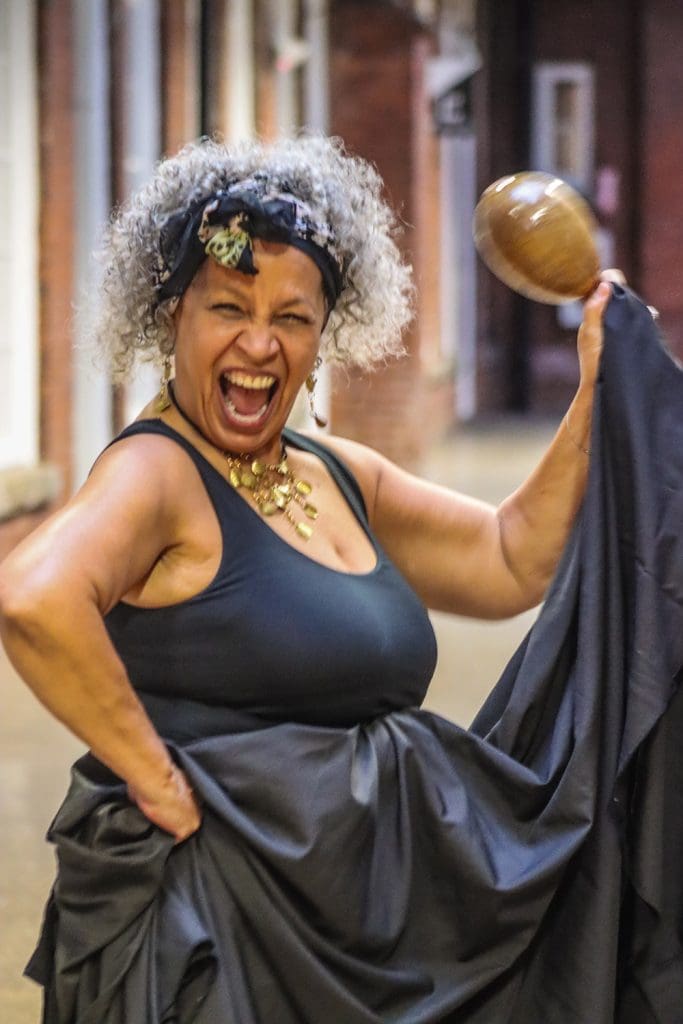
What can I say about Lydia Pérez? She is a local gem and a talented artist, fluent in Puerto Rico’s history. She is always ready to share its history and folklore with anyone who will listen. She can sing you a song, lead a drum circle, and even carve a saintly statue in the tradition of the Spanish religious invaders who brought the Dominicans and Franciscans to the island.
Lydia has a deep knowledge of the traditions of the island of Puerto Rico. For more than three decades, she has been a central figure in promoting and preserving Puerto Rican history, culture, and music here in RI. She is especially knowledgeable in the history of Bomba music and dance. Today, Bomba is a vibrant musical art form and a symbol of Caribbean Afro-Puerto Rican identity, as well as a vehicle for social justice and even protest. Think Bad Bunny!
The bookcases of the PRIAA, the Puerto Rican Institute for Arts and Advocacy, Inc., of which she is CEO, are loaded with awards and accolades from RI leaders: Governors, Senators, and other Representatives.
She has repeatedly given back to her community and to her students and apprentices of all ages. This attests to her willingness to share her encyclopedic knowledge with students from a variety of organizations, cities, and educational institutions. Especially dear to Lydia are the sweet letters from her students adorning the walls of the PRIAA. She has been honored by the communities of Woonsocket, Warwick, Central Falls, and Providence, as well as by African, Guatemalan, and other ethnic communities in RI, and by other artists for her impact on her students and community.
Lydia explains that one of her proudest moments was being asked by the Institute of Puerto Rican Culture (ICP) to represent the beauty of Puerto Rican culture at the 2019 National Assembly of State Arts Agencies (NASAA) conference, where she showcased Puerto Rican folklore. Another outstanding achievement was being selected by the National Endowment for the Arts, from among 4,000 organizations nationwide, as the only grant recipient in RI.
I asked this artist how she defines herself. She explained that, “I am of Caribbean heritage. I am from Puerto Rico, and I refuse to be boxed in by the stereotypes of the bourgeoisie, who wish to lump everyone together. I define myself as Puerto Rican, Boricua, and Hispanic American — a Spanish speaker.” She is also a Rhode Islander. She explained that although she is the keeper of Puerto Rican culture and music in RI, she has lived here longer than she has spent on the island of Puerto Rico. This is truly her home.
Yet, make no mistake, the main room at the PRIAA is her museum. It holds drums from Africa, Colombia, and Puerto Rico, as well as a variety of plena hand drums. In the center-back wall is a large portrait of Lydia dancing in a traditional white dress against a red background, by Chicago resident Reynaldo “Guaracibo” Rodríguez. It draws you into the room just as Lydia’s students are drawn to her and her drum circle.
At her Wednesday night workshops, her students learn to play the Barril de Bomba (Bomba Barrel) drums. These drums are traditionally made from recycled rum barrels and stretched goatskin. Along with the drums, Lydia plays the maracas, which supply a sharp, continuous pulse. She leads her circle with her hands, her smile, and her voice.
Her two beautiful daughters are part of the circle too. They shared that they have been playing since their childhood. One plays the drum with a pair of wooden cua sticks, keeping a steady beat for the drummers. The other daughter plays the barrel drum.
The circle is made up of younger women and one young man who come every week to learn more from this master. They are her apprentices.
Earlier in the week, Lydia explained that Bomba music reflects what is inherently Puerto Rican. It incorporates Taino influences such as maracas as well as characteristics from traditional European dances and African musical styles. This music was developed in the 17th century by enslaved Africans and their descendants, who worked on sugar plantations along the coastal Caribbean, most notably in Loiza and San Juan. It is the island’s oldest musical tradition.
The barrel drums are just like those used by an enslaved population to pass along information and communicate. One drummer in the circle explained to me that she came from Puerto Rico, recently joined the circle, and, under Lydia’s direction, is learning. She has found a “home” in the group.
Every Wednesday night, a drum circle meets to learn, practice, and sing. The room is alive with their rhythm, voices, and the beat of traditional Bomba music. Lydia leads the young drummers and plays the maracas. The cua keeps the steady beat, while the others on the barrel drums follow. Lydia guides her young apprentices who are there to learn about their Puerto Rican music. Her enthusiasm is infectious.
One young man in the circle explained that Lydia is a “gift” and a “drug” to her students. People are drawn to her knowledge, her energy, and her enthusiasm, as was I. On her cue, the circle switches from one rhythm to another.
“Sicá, Yubá, Holandé,” Lydia calls out. The circle follows.
Under her strong direction, the drummers sing and drum. It is mesmerizing and soothing all at once to listen to the rhythm and these songs that have existed and evolved from the coasts of Puerto Rico over hundreds of years.
This space in Pawtucket is her beautiful oasis and a museum where all are welcome to learn and enjoy. She is a vibrant and regal presence. Giving back is her lifeblood and neither a task nor a chore for Lydia. She shares it with all of us who are ready to learn.
Check out PRIAA at priaa-ri.org or visit in Hope Artiste Village at 1005 Main St, Pawtucket.
Next in this profile series: Jesus Andujar
Previous: Elvys Ruiz