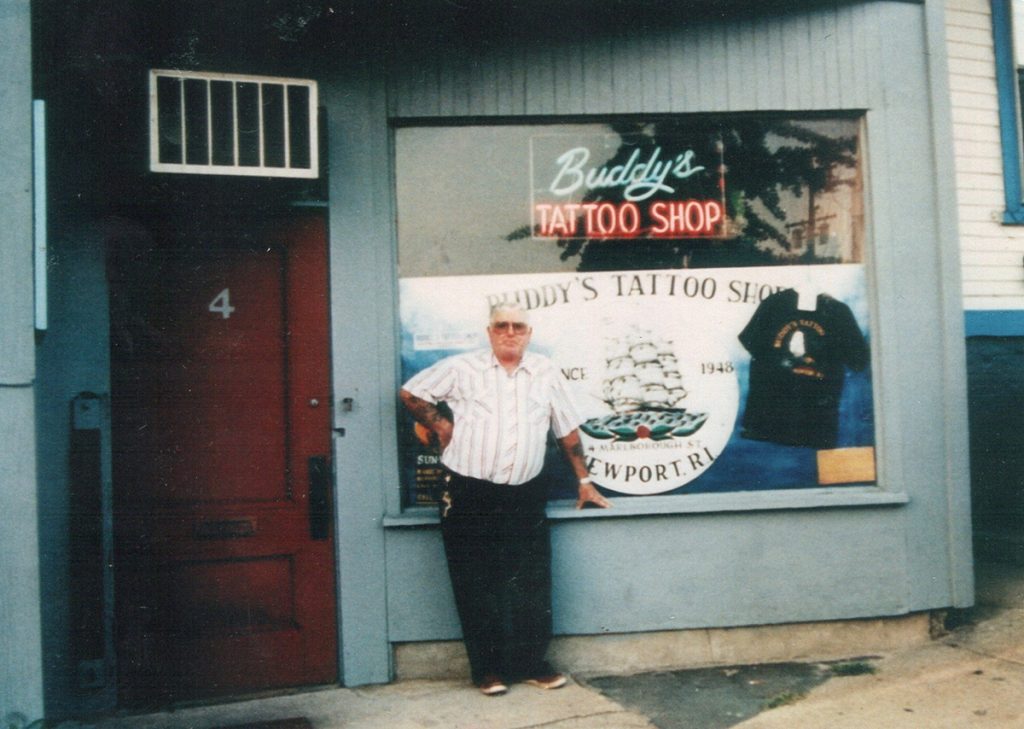
Once upon a time, if you wanted a tattoo, one of the things you could do was traipse to Newport from any of the four corners of the world and get yourself a tattoo drawn by a character named Carlton Mott, better known as Buddy. Tattoos were popularized at first by sailors who had them done in Polynesia and, eventually, the United States.
Way back in the day, most tattooers had some interesting carnival background. Old-timer Tex Rowe was known as a soldier, tattoo artist, animal handler, arcade owner, sideshow talker, and gun dealer. Buddy was a normal kid growing up in small-town Bristol, and artistic like his mother. He served in World War II on an army tank as the cannon operator. After the war, he joined the Navy Reserve. His thoughts were, if there was another war, he wasn’t going to sleep in the mud anymore.
Fred Day, a well-known artist, showed Buddy a few tricks of the trade early in his career. If you needed something, you made it, or tweaked it, and some of his ideas were genius. He typically created tattoos as all others did, using indelible ink pushed under the skin with handmade needles. He didn’t use a soldering iron. Instead, he used a jeweler’s pot and dipped them! He could make needles so fast, he and his daughter started a small needle-making business called “Making Points.”
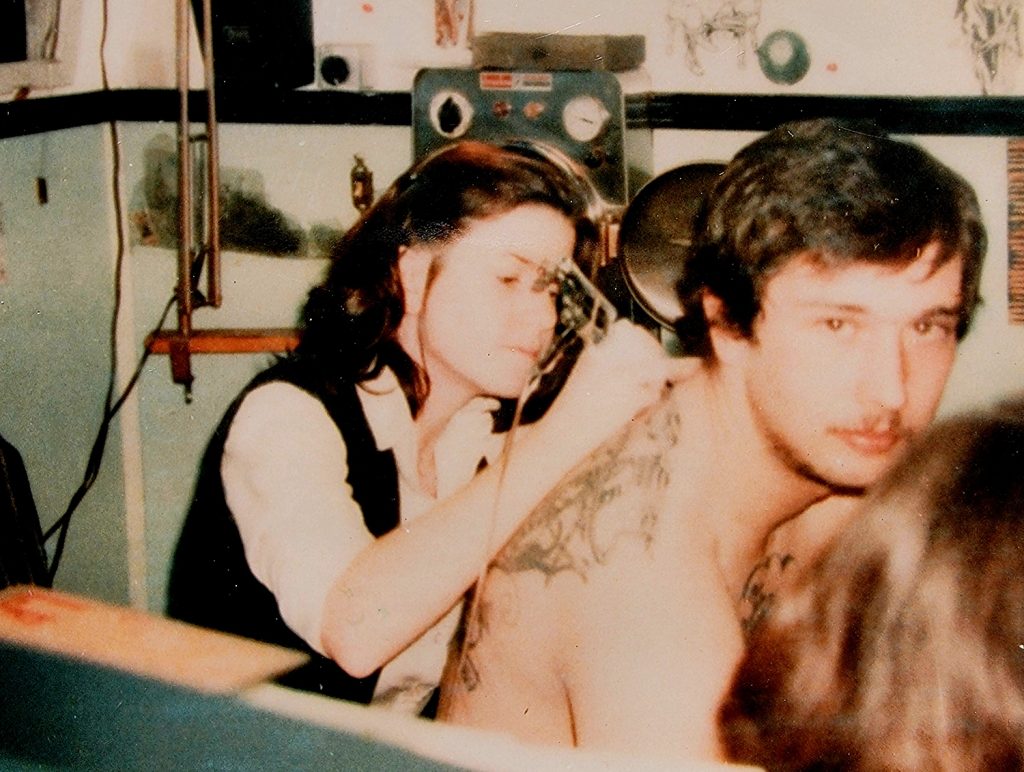
Buddy was proud of his work, and the first thing he said to his daughter in 1980, at the start of her apprenticeship, was, “Put it on like you’re wearing it.” The almost sacramental act was a pilgrimage in which die-hard “Buddy” fans traveled hours and untold miles for a brush with fame. One thing to recall is that permanent drawings on human skin were banned in the neighboring states of Massachusetts and Connecticut in the 1960s and reopened for business in roughly 1999. This “brush” was a pointy needle which drew blood and left a “lasting impression” somewhere on a customer’s roughly 22 square feet of skin.
But who were the real-life characters behind Buddy’s Tattoo Shop? Carlton and his daughters, Marilyn and Carolyn. (Yes, the names rhyme and they hate that). But the above-mentioned daughters were thrilled to become a part of the family business. The siblings said, “Working together was never dull.”
Buddy was happily married for 61 years to his wife, Madonna. She was a church organist and school music teacher. In her younger years, she would travel alone to state fairs as far away as upstate New York, towing her Hammond organ and playing for the live animal acts. I guess that starts to qualify them as “carnie folk,” but Madonna never got a tattoo or rode a motorcycle.
So, what did they actually do?
Draw on people. That’s what they did. And do it again. And again. Buddy estimated he did over 170,000 tattoos. Mostly everyone they knew eventually became part of the growing Mott canvas family.
“It’s a complex business, every night was different, every customer had a story, some good, some bad. We were very lucky and were never held up. Dad would work with a machete in plain sight behind him, and he had a rack of bullets to bite on. Buddy asked the bike clubs to not cause any trouble in Newport or he would throw them out. Thankfully, they didn’t,” said Marilyn, who worked with her dad for 30 years.
Buddy made a rotary tattoo machine in 1980 because he wanted something lightweight for his daughter’s small hands, and that would work the same every night. It took a couple of years to do, but finally it worked so well that he would kiss it goodnight before leaving the shop.
Her son Zachary was brought into an apprenticeship in the trade recently. Zack has now made it possible for Buddy’s machine to use the traditional-sized disposable needles and tubes.
The likes of Ed Hardy and artists from the 1970s took tattooing in a whole new direction. For example, Hardy’s style mixed American images with Asian-inspired designs. What was a custom carried out by the very few has now grown to an almost ubiquitous thing, finally accepted into the mainstream.
The Motts stayed clear of the kitschy images that sometimes accompanied tattoos. “We did not have live tigers in the shop or a tattooed pig living in the store window,” jokes Marilyn, unlike others who freaked out the Health Department.
The designs of this day and age are different than those developed by Buddy Mott. Some work has become psychedelic with color, fine lines, complex designs, and photo-realism. The ideas and possibilities are endless. Now, the industry claims that there are over 1.25 million tattoo artists worldwide and over 52 thousand in the US alone. (Buddy’s RI license was # 11.)
One item which may cause the tattoo business to skyrocket is Generation Z – most of them not yet 18 years old: Professionals say that the increase in tattoos within that age group is expected to explode when kids no longer need permission from an adult to indulge.
Buddy no longer practices his art form in this dimension. But in wrapping it up after nearly 59 years plying his trade, Buddy once divulged, “I’ve seen more skin than a public toilet seat.” Thanks, Buddy, we needed that.
Marilyn and Zachary are traveling to conventions and fairs to promote her book, Buddy’s Tattoo Shop. It’s all part of The Buddy Mott’s Traveling Tattoo Museum / Photo Booth, a recreation of Buddy’s workspace from the late 1970s.
August 14-16, 2026 will bring them back to the Providence Convention.