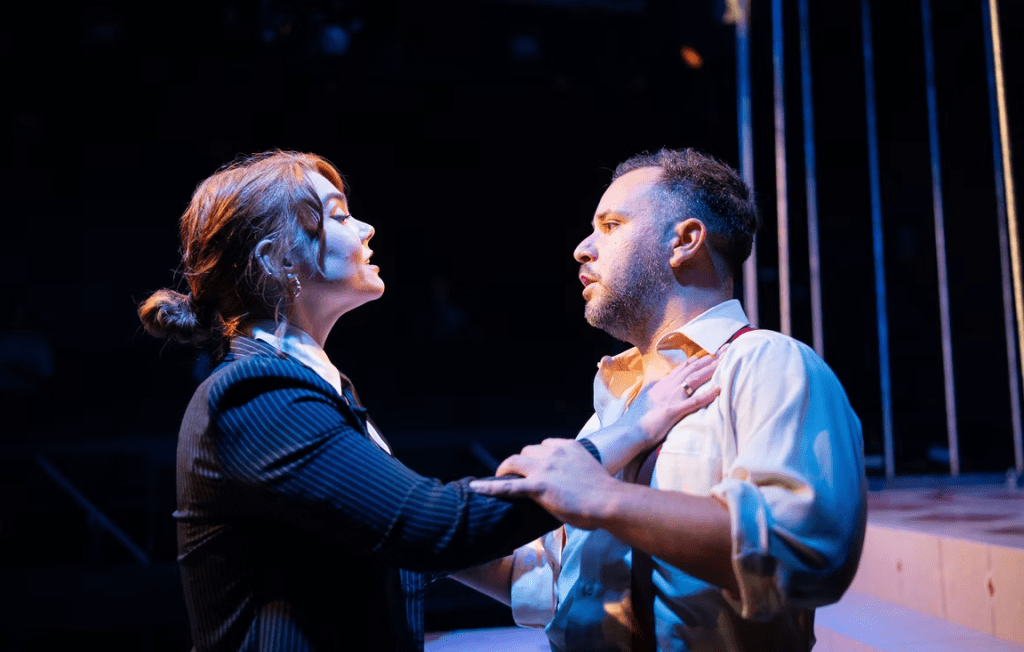
“Judge not, that ye be not judged” (Matthew 7:1). This is the core theme behind William Shakespeare’s darkest comedy, Measure for Measure, one of Shakespeare’s most exciting, underperformed and underappreciated plays, currently presented by Burbage Theatre Co. Although it’s often dismissed as a “problem play,” it contains some of the most compelling drama and bawdy comedy in the canon, complete with wit and tension typical of the bard’s brilliance at the height of his prowess. The title itself revolves around a complex balance between mercy and justice, moral hypocrisy and power in a city struggling to enforce its own laws.
Despite its darkness, the production is compulsively viewable, mostly due to the skillfully defined direction of Burbage’s artistic director Jeff Church’s stalwart pacing, embracing the play’s tonal instability. It doesn’t hurt that the cast’s performances are emotionally dangerous, and no one escapes untouched, including the audience. This staging addresses moral queasiness and sexual hypocrisy, as well as the shocking plasticity of power. Burbage has long maintained a reputation for making anything Shakespeare feel pressingly pertinent, and with Measure for Measure, they have accomplished this and more.
“It bridges the gap between tragedy and comedy in a way few of his plays attempt,” says Church. “It at times feels closer in spirit to Romeo and Juliet or the political intrigue of Julius Caesar than to the frothier delights of Much Ado About Nothing or Twelfth Night — serious, urgent, and deeply human, yet still replete with raucous laughter. It is a play about justice, power, mercy, and the dangerous distance between public virtue and private desire, and it could not feel more relevant to the world we are living in now.”
Church adds, “We are thrilled to have Alison Russo back to the Burbage stage as Isabella, and to welcome Trinity Rep Company-member Mauro Hantman as Angelo, and one of my favorite local professionals, Steven Liebhauser as Duke Vincentio. And these are only three of our cast of 14 exceptional artists — some Burbage veterans and some new faces that we are thrilled to welcome into the fold.”
Russo’s blisteringly intelligent Isabella, a novice nun trapped between institutional religion and misogyny, is faced with a profoundly personal proposition. She’s fiercely articulate and emotionally disciplined when men attempt ownership of her. Russo’s command of Shakespeare’s language is extraordinarily weaponized, landing with precise intent, as she avoids the traps of saintliness or fragility.
Liebhauser’s Duke covertly observes the chaos, orchestrating a series of deceptions to expose the corruption and test virtue, ultimately forcing the city to confront the uneasy balance between justice and compassion. The Duke is often played as a benevolent comic strategist, yet Liebhauser gives us a morally compromised interpretation akin to a political operative gathering leverage.
Hantman delivers Angelo as outwardly virtuous and genuinely unnerving, a man collapsing under the weight of repression. Tension can be cut with a knife when Angelo reveals his own hypocrisy, presenting Isabella with a sinister proposition. Rounding out the ensemble are Michaela Pendola, Andrew Stigler, Julia Curtin, Liam Roberts, Steph Rodger, Ben Pereira, Jordan Smith, Jack Clarke, Rosa Nguyen, and Andrew David Scanlon.
“The process has been great, and working with this cast and crew is a dream,” says Victor Machado, who portrays Claudio, a young man sentenced to death for a less-than-illicit affair, with gut-wrenching gusto. “What strikes me most about this play is that power is never really absent — it just changes hands and disguises. Claudio is the last person anyone expects to end up condemned. He’s well-born, well-liked, someone this society was built to protect, and yet Angelo weaponizes and twists the law to serve himself, while the Duke never truly surrenders control — he just wears a different costume to get what he wants. Isabel is the one character we watch move between agency and powerlessness, and even in that final moment, when she might expect freedom, she’s handed a marriage proposal instead of a choice. This play is a masterclass in showing how power often protects itself before anything else. Shakespeare isn’t giving us a morality tale, he’s giving us a mirror.”
Instead of period garb, the cast wears more modern clothing while staying true to Shakespearean verbiage. Lighting’s highs and lows move with the mood. Comic scenes are balanced against moments of genuine dread. Bawdy humor emerges from the desperation and spiritually rotting decay of the city, bypassing over-the-top facial mugging. Shakespeare’s comedies almost always end with a wedding, so the surprise ending is refreshingly unusual, giving the gals their choice!
The setting is unique in that the audience has a view from either side, while the centered stage itself is a set of stairs with a platform enabling the action to elevate as it escalates. Meanwhile, there’s lots of entertaining physical action happening at ground level.
“Together we are transforming the Wendy Overly Theatre with a configuration unlike anything audiences have seen at Burbage before,” says Church. “Remarkably, ours marks the first professional production of Measure for Measure in Rhode Island in more than three decades. It is long past time for this play to return to our stages. Don’t miss it!”
Burbage features Measure for Measure through June 7. For more information, visit burbagetheatre.org.