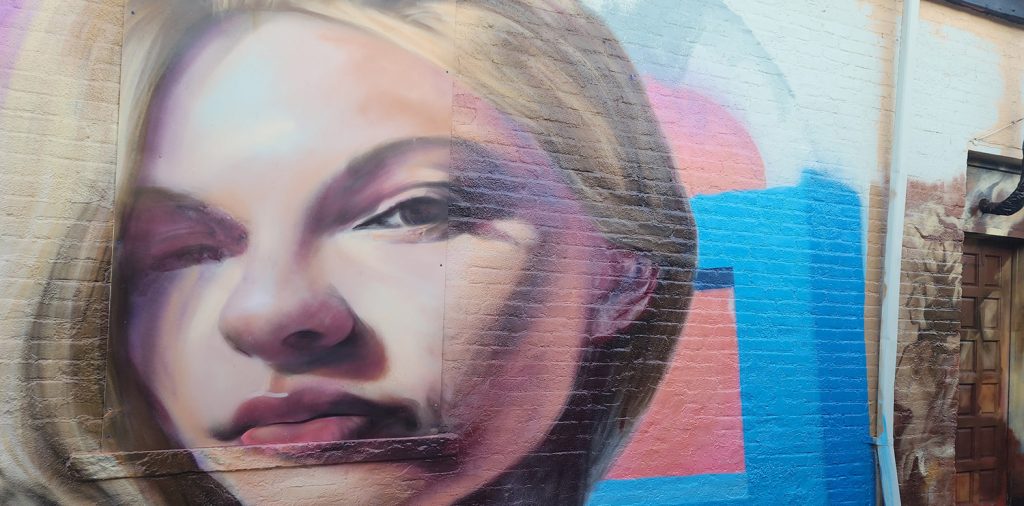
PVD-based artist Ian Gaudreau got a tip from a friend about a grant-sponsored mural project. Ten thousand dollars (the advertised amount) is a pretty good commission in the working artist world, so he looked into it. He discussed it with the sponsoring organization, who conveyed the tragic life-cut-short story of Iryna Zarutska. Gaudreau declined to name his contact, but conceded that she’d warned him there might be some controversy around the work.
According to Gaudreau, it was the parents of Zarutska that he had most in mind when planning the artwork. “Imagine having your daughter taken from you in such an unexpected way, and then having her appropriated by such deeply adversarial political causes in a controversy she wouldn’t have chosen to be involved with, so you can’t even mourn correctly without it coming across as a political statement. I wanted to show her original spirit breaking free of all the constraints everyone’s putting on her now.”
Gaudreau tracked down a willing wall for the project at the Dark Lady building on Snow St, in the center of PVD. As the mural’s shape and content started to come together, there was public outcry on every branch of social media.
The Dark Lady is a legendarily open-minded LGBTQ+ bar that frequently hosts drag and trans-friendly events. Regular customers in particular expressed outrage at the apparent endorsement of what has become conservative imagery.
PVD Mayor Smiley weighed in publicly with a powerful condemnation, calling the mural unnecessarily divisive and the project “misguided.”
“The murder of the individual depicted in this mural was a devastating tragedy, but the misguided, isolating intent of those funding murals like this across the country is divisive and does not represent Providence. I continue to encourage our community to support local artists whose work brings us closer together rather than further divides us,” the mayor’s office shared.
The controversy was heated and fast-moving; feeling that being involved in this political hacky-sack was anathema to their core values, the Dark Lady ownership called a halt to the project.
“We hear you, PVD,” they said in a short statement on social media. “After reflecting and learning, we have made the decision to discontinue this project and will move forward with removal as soon as possible. We remain committed to fostering unity, and care for all members of our community. We will continue to listen, learn and act with those values at the forefront.”
This decision also created a backlash, with a different collection of social media critics accusing the club of stifling free speech.
The mayor backpedaled rapidly, insisting he hadn’t tried to censor free speech, and hadn’t ordered the work stopped. He was just expressing his opinion.
“I might express my opinion, but we wouldn’t intervene,” he later said in an interview with WPRI12 News.
The half-finished mural remains, as of this writing.
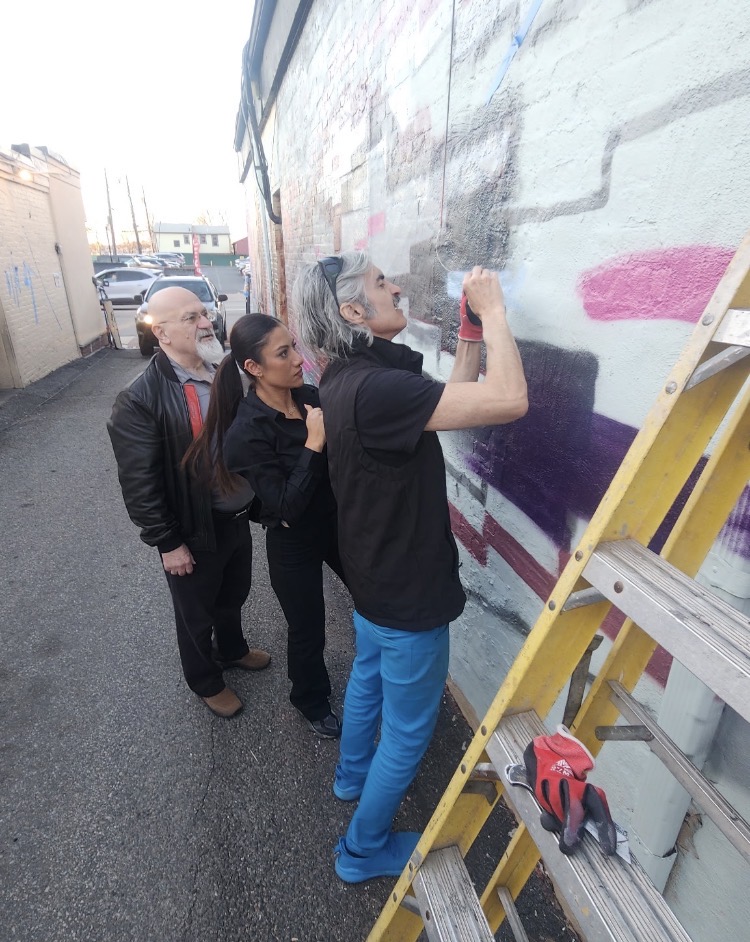
Seeking a new location to execute his vision, Gaudreau connected with the proprietors of Opa on Federal Hill, a family-owned and operated Lebanese/Mediterranean restaurant whose owners empathized with Zaruska’s plight, while asserting they were not interested in either side of the political debate. That mural will likely be completed by the time you read this.
Iryna Zarutska
If you hadn’t heard, Zarutska was a politically agnostic 23-year-old artist and Ukrainian immigrant putting herself through veterinary tech school by working at a pizza place. She was a random second-hand victim of mental illness, when she was stabbed to death on a subway by Decarlos Brown, a Black man and repeat offender who had been in and out of mental health facilities and prison for many years. Brown was recently found incapable of standing trial.
The National Mural Project
The tragedy gained political momentum when “hard on crime” advocates took it up as an example of a misfiring court system. The racial disparity fueled the controversy on each side. When Irish tech entrepreneur Eoghan McCabe began a project to put her image in public art, the motivations were called into question. When Elon Musk pledged a million dollars to support the project (a pittance to the trillionaire, but quite a donation in the world of public art), suspicions of motive exploded, and the scent of propaganda became overwhelming. So far, at least 17 murals have been painted across the country (rememberiryna.org).
The vitriol in PVD wasn’t directed at the late Zarutska or the artist so much as at Musk and his history of non-inclusive and MAGA politics. But all three are intrinsically bound together now.
While the Paint Was Drying
Gaudreau was invited to speak at an event, accepted without doing research, then withdrew when he realized it was a heavily-MAGA infused rally; but not before his likeness was added to posters all over the state.
Gaudreau was also invited to take part in a panel hosted by AS220 and moderated by The Avenue Concept, two of PVD’s most prominent arts organizations. The panel was tense, and several of the panelists, on different sides of the issue, had received death threats in the days leading up to the quickly-assembled panel. In a sad and terrifying way, that may have been the most unifying element of the conversation.
The audience included a who’s-who of PVD-based arts organization leaders, and seemed to be more divided than one might expect. While clearly not fans of Musk, an audience of artists will naturally have a special fondness for freedom of expression.
The discussion embraced this ambiguity, explored the vast gray area between expression and propaganda, and questioned what responsibilities public art has that differ from private artwork.
The moderators insisted that the panel was not about a specific artwork, but of course it was. They did a solid job of calming the audience elements that just wanted to shout, and of slowing the pace when the discussion veered personal, aggressive, or accusatory. AS220’s de-escalation practices were put to good use. Gaudreaux was ultimately overshadowed by more emphatic, practiced speakers and struggled to express himself clearly when given the mic – a marked contrast to one-on-one conversations with him.
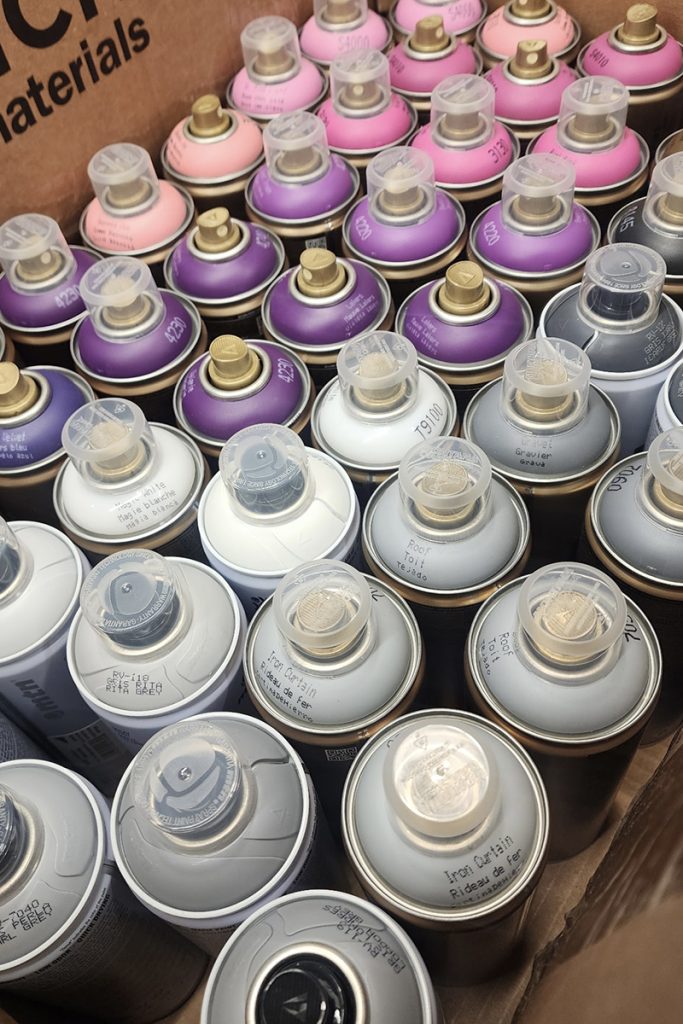
Within that sequence of events there are fascinating, divergent tangents of social policy to explore. It touches so many things – national politics, race politics, modern propaganda, propagandistic subversion, freedom of speech, artistic intent, the nature and responsibilities of public art, even the extreme cost of modern art supplies. Yet, as passionate as so much of the discourse around these murals has been, little of it seems to really be connected to the actual work. Many of the reactions are knee-jerk — on both extremes. They are reactions to the context of the project. Gaudreaux has expressed frustration publicly that the mural was judged and sentenced before he could finish “what I was trying to say.” Whether his stated intent would have come across in the finished piece is a mystery, but in his words, “When I look at the painting, I don’t see Elon. It’s not even relevant.”
At the recent panel, that statement drew boos from the crowd. The prevailing sentiment was that its context was, in fact, the most relevant consideration. What defines a piece of art? The intent of the funder? Of the artist? Or of what the audience interprets?
An informal poll of the audience after the event showed a broad range of opinions, and it didn’t seem like a lot of minds had changed based on the talk back. Reactions ranged from, “There’s so much other art you could have painted, why choose this project?” to “I wish he’d just say he did it for the money,” (Which is not something he said). Two prominent local artists in attendance, AS220 founder Bert Crenca and Mad Beast of Color Nick Paciorek, independently suggested the unfinished piece be left exactly as it is now. “I say leave it up as a testament to the power of art to inspire conversation,” said Paciorek. “Its unfinishedness also tells a story,” said Crenca, himself well known for not avoiding controversy.
This controversy isn’t over. The nearly-finished mural at Opa has already drawn anonymous overnight protest signage. The unfinished version at the Dark Lady awaits clarity, mostly on how its removal will be funded. And the artist is still searching for a replacement wall that can, and is willing to, host the 60’ high original concept. And the political divisiveness underlying the controversy – well, that shows no signs of receding. Not nationally. And not on our local walls.
Addendum: Umberto Crenca, quoted in this piece as suggesting the unfinished mural be left as is, subsequently posted on Facebook, “It was pointed out to me that the mural remaining in any form would make Dark Lady a target. What I was suggesting was conceptual but their concerns are real. Dark Lady should absolutely do whatever they need to do to insure the safety of their clientele.”