Some of the eeriest places in RI are ready for you to check out, if you dare.
As the first crisp, damp breaths of autumn begin to catch at the lungs and the trees begin to flare with bright bursts of color, I find Rhode Island to be more itself than the rest of the year. Maybe this is pure nostalgia, the result of childhood conditioning, heightened awareness during the excitement of a new school year and upcoming Halloween, but I think there is something truly special about October in the Ocean State. Ours is one of the oldest states in the country, and fall is a season of age, which makes the historic (and the mystic) seem close enough to touch.
Everyone loves a ghost story. There is a primal joy in allowing yourself to be just a little scared, but in RI spookiness is almost homey. There is a sacred thrill in knowing that you are wandering an area people have wandered long before you, and combined with the sheer natural beauty our state has to offer, RI in the fall is the perfect place to spend your time ghost hunting. So here are a few places to get you started – four spooky locations to explore and one cryptid story you may not have heard.
- Swan Point Cemetery
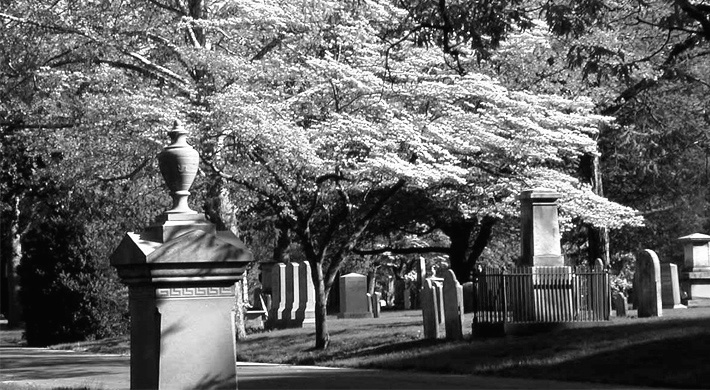
Located in Providence, Swan Point is the final resting place of famed horror writer HP Lovecraft himself. A man who lived his life in almost constant terror and who devoted so much of his mind to his own fear, Lovecraft seems like a prime ghost candidate, and his grave has been subject both to offerings and charms from horror fans, and some vandalism attempts.
However, his is not the only grave of interest in the stunning cemetery. Swan Point hosts many beautiful burial plots with fascinating imagery and iconography throughout. It was one of the first garden cemeteries in the country, established in 1846, and remains utterly beautiful to this day. If you enjoy a stroll around ornate tombstones and lovely trees, Swan Point is a wonderful place to visit.
- Slater Mill
Samuel Slater brought the Industrial Revolution to RI in 1793 with the opening of his cotton-spinning factory. Multiple mills were built as a boom of manufacturing spread along the Blackstone Valley. To this day, many brick buildings that were once used as housing for mill and factory workers are still in use as apartment buildings, and the Slater name remains on streets and landmarks that every Rhode Islander knows.
However, the Industrial Revolution was a time of great hardship for many workers, and just as in Great Britain and the rest of the States, Slater’s factories employed children for hazardous labor in narrow machinery spaces. Injuries and deaths followed.
Today, the Blackstone Valley National Park houses several of the old mill buildings. You can visit the historic site and even take a ghost tour. The ghosts of children are the most commonly sighted, but the buildings themselves offer their own rustic charm, and transport you back in time to this era of growth and tragedy.
- The Monastery and Nine Men’s Misery
The Cumberland Monastery sits upon a plot of roughly 481 acres and a site of significance during King Philip’s War. There is a stone monument on the premises marking the communal grave of nine British colonists who were taken prisoner, tortured, and killed after a bloody battle on the riverbank in 1676. The remains of the men were dug up by the monks who owned the land in 1928, then stored by the Rhode Island Historical Society until 1976, when they were reburied on the grounds, this time with a metal plaque commemorating them. A fire in 1950 caused the Monastery itself to be shut down, but these days the building has been rebuilt into the Cumberland Public Library.
Numerous supernatural and ghostly sightings have occurred in the area, both on the trails near the grave, and in the library, where it is said some of the monks’ spirits still reside. Whinnying horses and screams have been heard in the forest, and inside the library, staff have heard voices and slamming doors. With so much tragedy marking the land, ghosts may be plentiful.
As a location to visit, the Monastery is hard to beat. Historic and atmospheric, the trails are also long and beautiful, perfect for getting some exercise and fresh air. And once you have gotten your steps in, you can stop by the library and discover a stack of books to bring home with you; so it’s a definite win-win!
- The Witch Tree
In the middle of the intersection of Log Road and Mann School Road in Smithfield, there stands a tree encircled by a metal barrier. Currently, the tree is a pretty, slender sapling, but it was planted there to replace a much more rotten and beaten tree after it blew down. This was the Witch Tree, and its odd, dangerous placement in the middle of the street has led to a number of spooky tales, as well as quite a few car accidents.
Rumored to be the burial site of a witch, legend says that if you drive backwards around the tree three times, that witch will appear and chase you down. Late at night, she can be seen circling the tree herself on foot, muttering incantations. While I certainly don’t recommend summoning her, due to issues of car safety, if you happen to pass the Witch Tree, make sure to keep an eye out. This particular ghost witch seems to take pleasure in hunting automobiles, so drivers should be extra cautious on her stretch of the road.
- The Glocester Ghoul
One of the last people to be executed for piracy in the United States was Albert Hicks, of Foster. You may have heard of the treasure of Captain Kidd, which is rumored to be buried somewhere in the state. Albert Hicks, a man notably obsessed with acquiring great fortune, was desperate to find the treasure. In 1839, he and three other men decided to dig up a farm in Glocester belonging to the Paige Family. Under cover of darkness he went, for there had been rumors of Spanish doubloons found on the property.
There the men encountered what Hicks described as, “… A large animal with staring eyes as big as pewter bowls. The eyes looked like balls of fire. When it breathed as it went by, flames came out of its mouth and nostrils, scorching the brush in its path. It was as big as a cow with dark wings on each side like a bat’s. It had spiral horns like a ram’s, as big around as a stovepipe. Its feet were formed like a duck’s and measured a foot and a half across. The body was covered with scales as big as clamshells, which made a rattling noise as the beast moved along.” So terrifying did the men find the monster, that they fled the farm and never returned.
The creature, on the other hand, was spotted again many years later. One night in January, 1896, a man named Neil Hopkins was making his way home to Glocester from work, when he came across a creature he described thus: “It seemed to be all a-fire; it had a hot breath. There was a metallic sound, like the clanking of steel against steel. The beast didn’t seem to be strong in the wind, for it chased me only a short distance, and then plunged off into the woods. I could hear the dead branches and twigs crackling under the heavy tramp.”
Sightings of the creature have long since dwindled, but it is a fascinating mystery of yore to think about whenever you travel through the Glocester area.