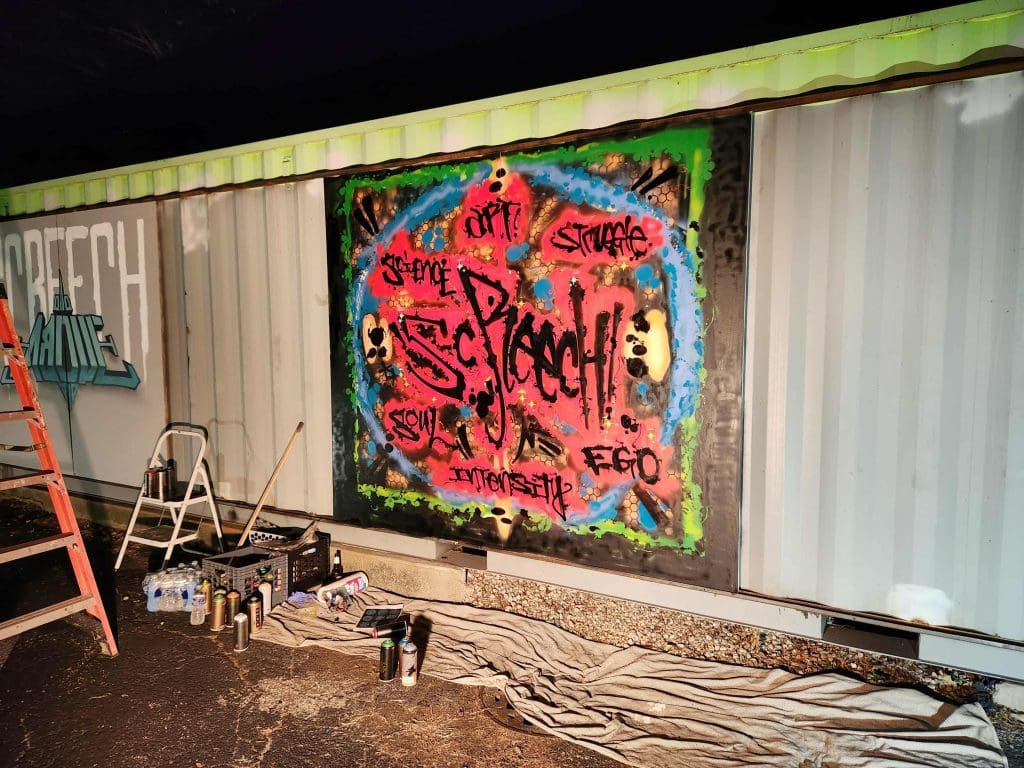
“Sounds like it’s highlighting the chaos in the world we are living in today.”
This was the reaction I got from my friend Nancy Teo when I sent her some of the photos I’d taken at Screech Sprays RI!, a live graffiti event held at Nick Paciorek’s Pitcher-Goff House in Pawtucket on August 28.
The remark was not surprising – Nancy lives in Singapore, where a graffiti artist can be fined $2K or sent to jail for up to 3 yrs for defacing public property. But she voiced a view that is pretty much shared by the population at large: Graffiti isn’t art, it’s just vandalism.
In part, it’s true. Graffiti artists are the cowboys of the art world and by the nature of their canvasses they tend to operate as outlaws. Providence Public Works classifies them as an urban fungus, sending out their Graffiti Squad to seek and destroy any creeping tendrils of expression, painting them over in dull, solid colors.
But illegal tagging is scarcely all there is to graffiti. The degree of skill in the design and execution of some of these murals is exhibition-worthy and major galleries and museums (notably the STRAAT in Amsterdam) now showcase spray-paint and street aesthetics. The common argument against graffiti is the lack of consent from the owner whose property was violated – but when that same painting is legally sanctioned, the argument fails.
It’s also difficult to call graffiti a crime when it covers an abandoned building that the city has let go to ruin.
The open accessibility of expression is what makes graffiti an Art of the People. It doesn’t ask for permission first or apologize afterwards. In the hands of a vengeful gang this can translate to violence, but in the hands of a dedicated artist, graffiti is not about highlighting chaos – it’s about finding a way to channel that chaos into art.
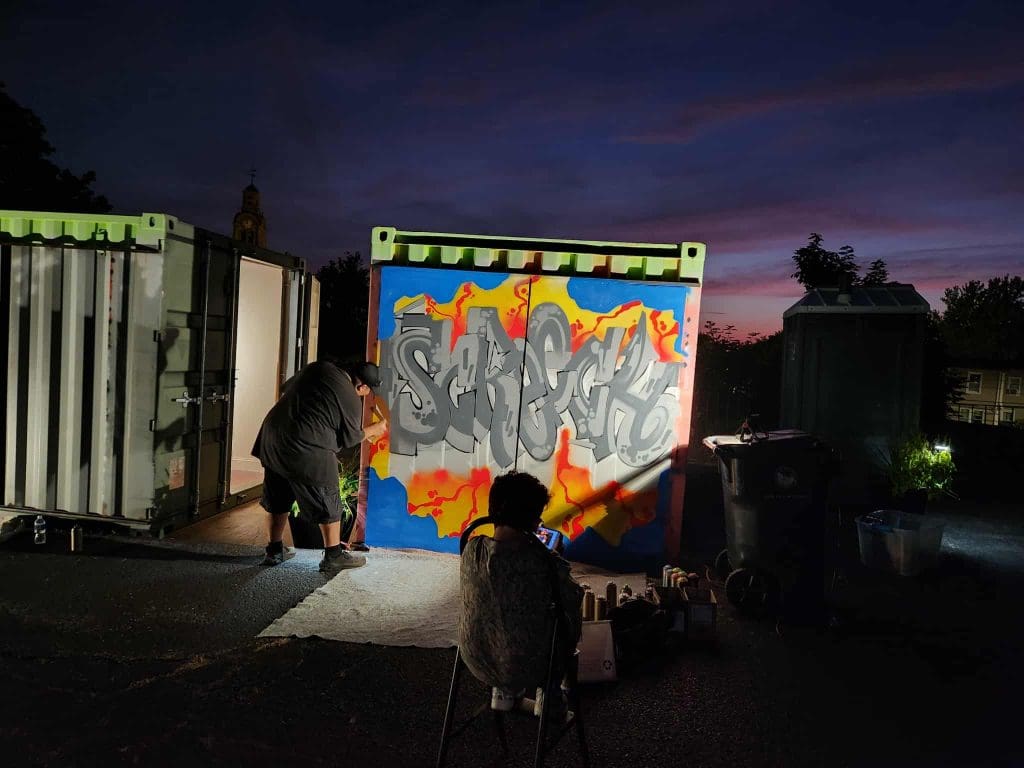
The sun was still above the trees when I first arrived at Screech Sprays RI and the art at each station was just a collection of lines and sketches. But by the time dusk settled into the trees, the colors on each wall were glowing in luminous pools cast by the skeletal clamp lights. In the last breath of sunset, the effect was eerie and magical.
The graffiti artists worked surrounded by spray cans, sketch books, and rags, stepping forward and back again in a lumbering dance with their art. Cloaked in black tee-shirts as they were, with baseball caps pulled low over their eyes, if I’d seen them in a dark alley at night I might have been afraid; but the illusion of menace melted away as soon as we began to talk.
All four had points in common. None of them were professional artists.They were working guys who got by making an honest living. They all came from economically challenging backgrounds, and they all said the same thing: If they had not gotten caught up in graffiti art, they would’ve probably gotten into serious trouble as kids growing up.
Oliver is a full-time Dad now. He stays at home and takes care of his sons. He brought his family to the event and while he painted, his wife and I chatted. Their two boys darted about laughing and teasing each other, while their mom showed me pictures of the costumes she’d made for them, and spoke about the affinity she had for colors. This was a family outing for them, a shared creative event.
Deluxe was born and raised in Providence. He’s been writing since he was 13 years old. He earns a paycheck every week, but graffiti and writing is what he Does. His writing moves from poetry, to verse songs, to rap. “It’s very therapeutic, a way to let out thoughts and emotions,” he told me. “Where would you be without art?” I asked. “Bored,” he said. “And in trouble?” I suggested. Deluxe laughed. “Well, I can also get into trouble with my art too.”
SAFE One is a security guard. “Art helps me escape from my everyday routine. I feel like I can be someone else when I’m painting,” he said. “It was a really accessible medium when I was a kid.” One elementary school in particular that he attended encouraged alternative art and inspired him to continue; a music teacher opened his eyes to the influence of jazz in hip-hop and art. Today, spray paint and lettering are his chosen tools of expression.
Axel works for Outreach, a non-profit in Boston. “We deal with the homeless community and work to find them housing.” Art has always been part of his life “It’s something I gravitate towards. It helps people to think outside the box and it helps to build community and bring us all together. It creates dialogues.” He looked down the row of artists, all focused intently on their walls, and smiled. “And all my friends are here.”
The artists that night created a community with their graffiti. It had been an evening of constant conversation, the crowd taking in the experience, taking in each other. As I walked the long driveway to my car, I looked back at the colorful festival of figures where voices still milled and lingered. There were no signs of chaos, no violation of property… just a spot of shared communion in the warm summer night.