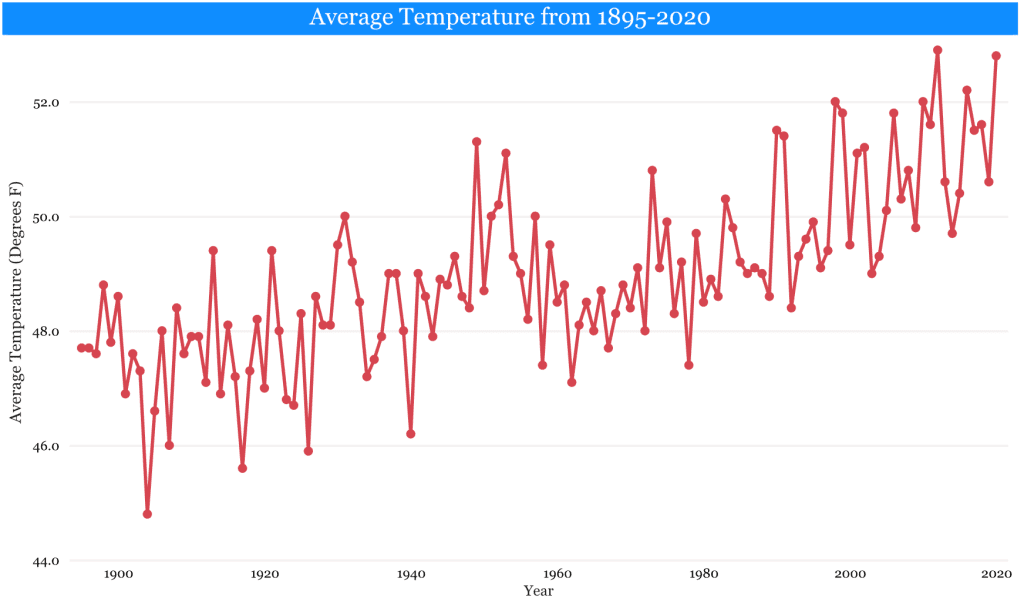
One of the clearest ways we are already contending with the effects of climate change is by feeling, well, warmer. Since the Industrial Revolution, average temperatures in RI have risen more than 3 degrees Fahrenheit. In fact, New England as a whole is the fastest-warming region in the US, in part because of our proximity to the Atlantic Ocean and Gulf Stream current. Heatwaves, or days where there are more than 3 consecutive days of temperatures over 90, are on the rise, with frequencies expected to triple by 2050. What does this mean for Rhode Islanders? How do we prioritize our collective safety?
As a child in the ’90s, I remember wilting over my desk, fan-spray bottle in hand to mist myself and others for some relief during the brutally warm and unproductive weeks before summer vacation. “Thousands of K-12 schools, many in states like Rhode Island that historically did not need air conditioning during the school year, now face rising temperatures that make teaching and learning increasingly difficult without modern HVAC systems,” says Matthew Kraft, Professor of Education & Economics and founder of SustainableED at Brown. Uncomfortable temperatures in schools are not only not conducive to learning, they are making our children and educators sick.
While humans have evolved to sweat as a way to cool ourselves off, on particularly humid days, sweating (and spray bottles) are less effective at regulating our core temperatures. Rising body temperatures can result in dehydration, cramps, heat exhaustion, and heat stress. In the worst cases, exposure to extreme heat can result in heat stroke, organ damage, and even death. Between the heat and poor air quality often associated with warm days, those living with chronic conditions like asthma, cardiovascular and kidney illnesses, and diabetes often experience exacerbated symptoms. Marissa Hauptman, co-director of the Pediatric Environmental Health Center in Boston, warns that people taking certain medications and drugs are extra sensitive to heat and should be especially mindful to drink plenty of water and avoid strenuous activities during heatwaves.
Air conditioning is the #1 protective factor against extreme heat – an especially important resource to relieve vulnerable populations like children, the elderly, chronically ill people, and those who work or live outdoors. Let’s face it, Rhode Islanders trying to maintain a comfortable temperature in their homes during summer months, like winter months, often results in prohibitively expensive utility bills, as we collectively suffer under Rhode Island Energy’s statewide monopoly. Sometimes, this means electricity can abruptly and dangerously get shut off on people struggling to beat the heat. The George Wiley Center, a Pawtucket-based nonprofit fighting for utility justice, among other social causes, “recognize[s] that utilities are a basic need and it is an injustice to terminate service to those who cannot pay unaffordable bills.” According to their website, households that receive a termination notice or experience a shut-off can call 401-728-5555 for support.
Thankfully, there are also public resources available to help us stay cool this summer:
Providence
All Community Libraries of Providence, plus Providence Public Library, operate as cooling centers during open hours, which vary. In true library fashion, local libraries help meet basic community needs, for free, as increasingly rare third spaces. Note: All libraries are closed on Sundays.
For those wishing to take a dip, rec center pools open to the public on June 1. Providence also offers a number of water parks at local parks and rec centers, which open on June 24. See a comprehensive list of all cooling centers, pools, and water parks in PVD outlined by PEMA, the Providence Emergency Management Agency, at providenceri.gov/pema/cooling-centers.
Greater Rhode Island
RI’s Emergency Management Agency has compiled a list of cooling centers by town. Broadly speaking, Rhode Islanders can often find refuge from the heat at libraries, community centers, public buildings like town halls, and senior centers. See their complete list at https://riema.ri.gov/resources/cooling-centers.
Related Resources
Heat and Medications Guidance for Clinicians, CDC
Massachusetts Extreme Heat Resource Guide
NOAA Climate at a Glance Statewide Time Series
Rhode Island Coalition to End Homelessness
Prevent and Treat Heat-related Illness, Massachusetts Department of Public Health Bureau of Climate and Environmental Health.