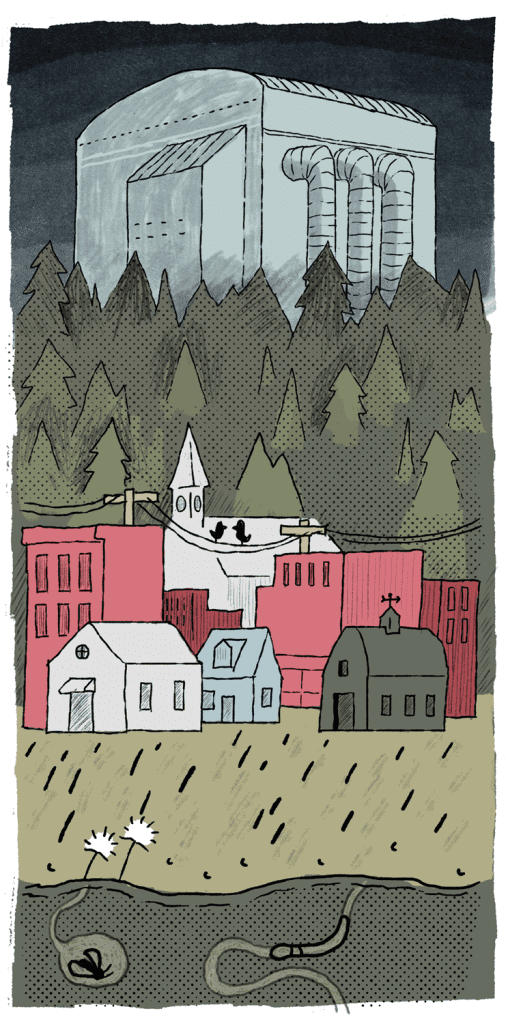
Smithfield, RI: A town known for its forests, trails, ponds, and well, wealth. An unlikely location for a potential AI-Data Center, one may think. Yet, this rural community, despite data center construction being illegal under current zoning laws, finds itself at the center of Rhode Island’s first major data center debate. Revity Energy’s desire to build one in the wooded area next to Bryant University has apparently been fermenting for several years. Although it had a lengthy runway, Revity’s proposal remains vague and speculative, offering general reassurances in lieu of hard facts and concrete promises. On Tuesday, May 5, Smithfield Town Hall was standing-room only as residents gathered to share their thoughts on the matter.
Of the six councilmembers present, three (Rachel Toppi, Michael Iannotti, and Angelica Bovis) had proactively proposed a moratorium, or ban, on AI Data Centers in the town of Smithfield, well before Revity’s proposal came to light. Their foresight, after seeing similar developments crop up around the country, has been pressured to slow, Toppi shared, as interests ensnare the moratorium’s process with the existential challenge to define what exactly qualifies as a data center.
For over two hours, community members testified, sharing their concerns and grievances. Elaine Polino, a longtime Smithfield resident donning an American flag trucker hat shared, “Wow – I gotta say one thing, I’ve never seen so many people from such diverse backgrounds, I can tell, such diverse political views, all standing up for the same thing,” and how refreshing it was to be reminded of that societal possibility. Another resident stated that they’d never seen the Smithfield community mobilize so quickly behind an issue, with neighbors talking in depth with one another, sharing resources, and urging one another to come out and voice their opinions. Residents’ broad and well-researched concerns included costs associated with personal and environmental health, quality of life for present and future generations, and the increased financial burdens / negative impacts on the local economy.
“The long-term health and environmental factors of AI data centers are largely unknown,” council member Rachel Toppi shared ominously. What the community does know, however, is that this construction would have a devastating effect on the local ecosystem, of which humans are a part. The hum from data centers running 24 hours a day has been compared to low lawnmower vibrations that never stop. These centers affect local residents’ mental and physical health by increasing blood pressure, cortisol levels, and insomnia while drastically reducing their ability to enjoy time both within and outside their own homes. Samantha Kane, a postdoctoral researcher at Brown, found that students at schools within a mile of AI data centers have lower math scores than peers further away, largely due to noise and air pollution. Rural communities dealing with data centers in the US have also seen negative impacts on livestock, with hens laying fewer eggs while other animals lose body mass under the duress. Local species like spring peepers, birds, and insects would undoubtedly be negatively affected by this proposed construction, further shrinking collapsing networks of biodiversity. Smithfield residents lamented how they were already experiencing climate change’s erratic weather, temperature extremes, and water crises. Essentially, adding an AI data center into the mix, which would exacerbate these issues, could not be more poorly timed.
As of yet, Revity’s proposal does not include a plan that considers the AI data center’s impact on Smithfield as a whole. Resident Matt Sharp highlighted how the wooded development site is home to the archeological ruins of Hanton City, a historic town dating back to the 1700’s. The land also includes several community trailheads which would no longer be accessible if the area were razed for construction. Olek Bogusz, a Smithfield high school graduate, confidently shared that he has been testifying “ever since” he came before the council with a mutual aid proposal for victims of Hurricane Helene in the fall of 2024. Currently a Bryant University student, Bogusz spoke on behalf of his peers, 3,000 of whom take classes each week at the school’s Fidelity building, right next to the proposed data center site. He worries that the droning vibrations would reduce students’ ability to focus. He also pointed out that, instead of abutting a forest, the controversial and unsightly building would lower prospective students’ interest in attending Bryant, in turn reducing the university’s positive economic force on Smithfield. Exorbitant water usage, a defining feature of data centers, would mean students and other neighbors would also have to contend with lower water pressure. He hopes to still go fishing with friends this summer in the town’s iconic ponds.
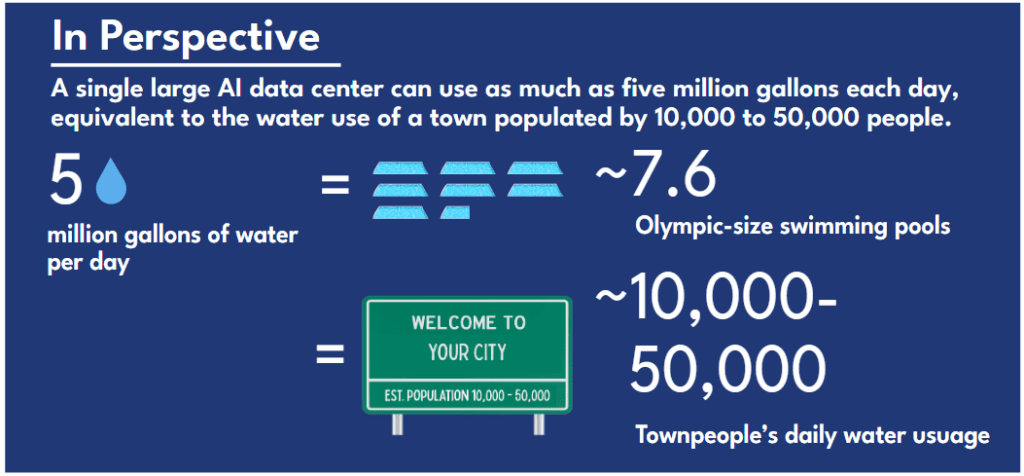
Imagine a warehouse of computers, humming up a heat island as it houses personal medical information disclosed to chatbots, bad art frankensteined from unpaid artists, and endless personal queries unanswered by brain cells, sidelined and atrophying on some growing, metaphorical sports bench. Randall Rose, a retired software engineer and member of Rhode Islanders for Personal Privacy (RIPP), disclosed that AI is already using most people’s personal information in ways we wouldn’t want, like training AI systems behind the scenes. Rose also shared that every new generation of hardware requires increased cooling, leading to increased toxic gases and chemical releases as facilities work to prevent themselves from bursting into flames.
While Revity’s proposal vaguely outlines that the center’s computers would be cooled by a closed-loop water system, the community raised unanimous doubts about whether that is at all possible, as AI use continues to expand. Inevitably, warm water contaminated with forever chemicals and heavy metals will both bleed into the local water table and evaporate into the air. Mary McConnell, a young, recent Rhode Island resident whose home is situated right next to Revity’s proposed site, is concerned that many of her peers aren’t yet thinking about AI and their data centers’ potential consequences, such as their impact on children’s development. She cited, for example, the case of chemical maker Dupont, who claimed they didn’t know the PFAs leaching into the surrounding environment would give people cancer and other terminal illnesses. While the vast majority of the town hall meeting’s speakers were locals, Kate Shapira from downstream Providence was also present to testify, noting that the source of the Woonasquatucket River watershed is in Smithfield, highlighting the reality that contamination knows no borders.
In addition to environmental and health costs, economically, Rhode Islanders already carry some of the heaviest burdens in terms of monthly utilities. Rising monthly bills would only increase with the presence of AI data centers, as the costs for their ballooning energy usage are paid by you, the average energy-grid consumer. How does this work? According to the NAACP, when data centers are built near residential communities, “Utilities pass a significant share of the associated costs of increased energy procurement and/or infrastructure upgrades on to residential rate payers (i.e. homeowners, renters), even as commercial and industrial rate payers continue to benefit from preferential agreements.” When the demand for energy cannot be supplied sufficiently by local means, rates increase for everybody. Although AI data centers are relatively new, they currently consume an astonishing 6% of the total energy use in the US.
Adding insult to injury, bills awaiting approval at the state level (House Bill H-7695 and Senate Bill S-2346 in the Rhode Island General Assembly) would offer data centers an up to 30-year tax break. Read RIPP’s testimony against the bill to give tax breaks to data centers here.
To date, there are no examples of AI data centers having a positive impact on property values or taxes. At the Smithfield Town Hall, residents posed questions like “Would you want to live near one?” and “Would you enjoy dining outdoors at a restaurant nearby?” Revity’s proposal claims that their AI data center would create ~50-80 permanent jobs, which residents dispute is overly optimistic. Given an anticipated loss of jobs from surrounding businesses and the overall job-replacing nature of AI, some speculate that the company would hire minimal physical employees, perhaps 10 people on site, while others would be hired remotely.
Paul Lafave, who spent 16 years living in Burrillville before returning to Smithfield, shared wisdom from his activism against the construction of a second power plant in that community. Residents of Burrillville strongly opposed Michael Polsky’s Invenergy project based on similar environmental concerns. As communities fight development, he warned that companies have a tendency to be dishonest and share “a lot of false promises” along the way. But Burrillville residents stood their ground, knowing the new construction would mean devastating consequences for their air, water, light, and sound. For the first time, Invenergy lost a battle to people’s political will.
In short, it is clear the people want a ban on AI data centers, by any definition of the term, not just in Smithfield, but in RI as a whole. Indeed, this issue is one faced by communities all over the US. Vernice Miller-Travis, an activist working to prevent a data center’s construction near her family’s home in Prince George’s County, Maryland, states: “We think of data centers as a localized issue, specific to a particular community, but their impact is everywhere — which means the responsibility to challenge their construction is on all of us, too.” She should know, as someone neighboring northern Virginia, “The AI data center capital of the world.” She reminds us that it is far easier to fight something before construction than retroactively – lest we end up like Ashburn, Virginia, a town home to a whopping 154 data centers.
Out west, a new data center was just approved in the desert of Utah. Its size? A record-breaking 62 square miles. What does this mean for our future?
One could argue that dangerous AI data centers do not belong in poorer communities, nor the global south, where they are emerging all over the map like a neo-colonial rash. Can we sustain and expand this “not in our backyard” energy in solidarity with humans and other living things and collectively reckon with how much abuse from AI industries we are willing to tolerate?
Earth is the only backyard we will ever know.
Call your senators.
Citations
Carini, Frank. (April 9, 2026). “Energy Intensive Data Center Proposed for Woods of Smithfield: Explosion of AI-supporting facilities requires proper planning.” Eco RI News. https://ecori.org/energy-intensive-data-center-proposed-for-woods-of-smithfield/
Castro, Alexander. (April 13, 2026), “As Smithfield moves to ban data centers, lawmakers debate how to define them.” Providence Business News via The Rhode Island Current. https://pbn.com/as-smithfield-moves-to-ban-data-centers-lawmakers-debate-how-to-define-them/
(July 11, 2025). “Chemical maker Dupont agrees to $27M settlement in polluted water in upstate New York.” Associated Press. https://apnews.com/article/dupont-water-contamination-settlement-new-york-hoosick-53a70887abbcaf686b545252de107600
(May 13, 2026). “Datacenters using 6% of electricity supply in UK and US, research says.” The Guardian. https://www.theguardian.com/technology/2026/may/13/datacentres-electricity-consumption-uk-us-ai
(May 13, 2026). “Irresponsible: Backlash as Utah approves data center twice the size of Manhattan.” The Guardian. https://www.theguardian.com/us-news/2026/may/13/utah-approves-datacenter-backlash
Moorehead, Jaquelyn. (April 2, 2026). “Smithfield puts the breaks on potential data center.” The Valley Breeze. https://www.valleybreeze.com/news/smithfield-puts-the-brakes-on-potential-data-center/article_cd279d3e-1bda-4e2e-b3ac-a716d776ab2f.html
(March, 2026). “The People’s Report: A Gap Analysis of Data Center Infrastructure in Prince George’s County, Maryland.” NAACP. https://naacp.org/resources/peoples-report-data-centers-prince-georges-county-md
Preston, Caroline. (May 10, 2026). “Data centers, air pollution, climate math: Lessons from a climate and education conference. The Hechinger Report. https://hechingerreport.org/data-centers-air-pollution-climate-math-lessons-from-a-climate-and-education-conference/
West, E.N. (Spring 2026). “The Data Center Down the Street and the Activist Next Door.” Peace & Riot. https://www.peaceandriot.org/the-data-center-down-the-street-and-the-activist-next-door
Other Resources
Missed the town hall? View it here.