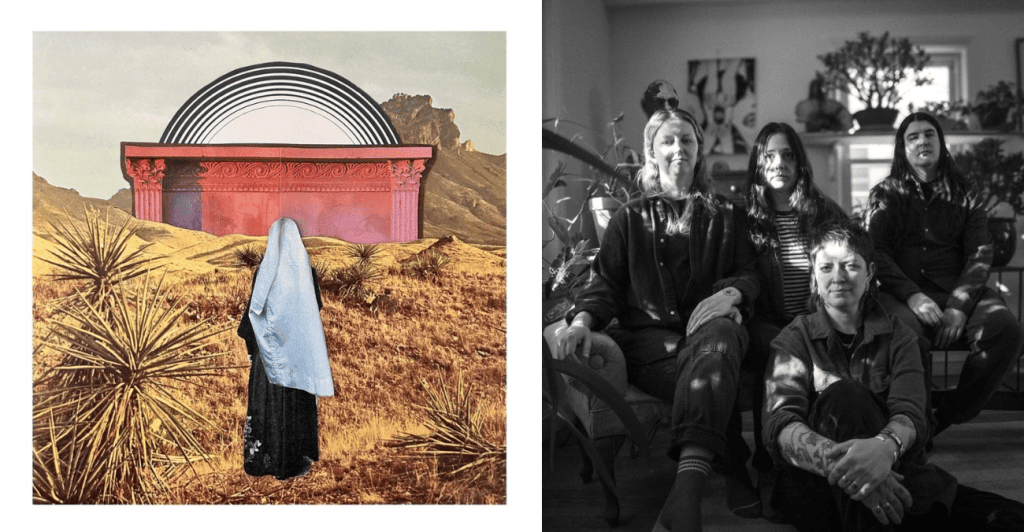
At a recent record-release concert in Providence, Rhode Island, MorganEve Swain teased a nearly full house that her band The Huntress and Holder of Hands was the “most fun grief band around.” This grief, and the process of grieving, has been a driving force behind Swain’s songwriting for more than a decade. As half of the longstanding Americana duo Brown Bird with her husband David Lamb, until his death from leukemia in 2014 at 35, Swain thrust the ache of her loss into The Huntress, whose 2017 debut Avalon begins a lyrical and musical narrative through agony underlaid by folk, metal, and blues influences. From the opening framing of her story “In the shadow of the hunted / We are everything but lost,” to the concluding plea, “What could I have done?” repeating within the embrace of a cello and upright bass. While Swain has since made music with Santa Cruz, California punked-up ragtimers The Devil Makes Three and contributed to other artists’ recordings—including viola on Tiger Saw’s Nightingales, bass on Silas J. Dirge’s Swan Songs, and violin and backing vocals on Lucero frontman Ben Nichols’s In the Heart of the Mountain—the grief that drove The Huntress has continued to deepen for almost a decade. With the Summer 2026 release of Babylon, the band’s sophomore album, Swain veers between beauty and doom in an evolving grief that ventures within and well beyond her own.
Seán Carlson: Congratulations on the new record. There’s more than a tinge of myth and religiosity woven into the titles and themes of both of your albums as The Huntress. How do you view the relationship between your debut Avalon and, nearly a decade later, this follow-up, Babylon?
MorganEve Swain: So the name of the band, The Huntress and Holder of Hands, and the name of the first record, Avalon, both came from lyrics that Dave [Lamb] wrote me—Dave being my late husband. The actual line he wrote was in a song called “Avalon,” and in the song he says, “You’re a huntress and a healer and a holder of hands, and your heart is the Avalon I seek for my end.” Mythologically, Avalon in the King Arthur myth is where Arthur goes to recover from his wounds, and Dave wrote the song while he was sick with leukemia. I think at that point he knew that the possibility was very real that he wasn’t going to overcome his diagnosis, even though we remained hopeful the whole time and his treatment seemed successful in all intents and purposes.
That line is, just, you know—well, I don’t need to explain it. The album Avalon came out of this very raw grief place, and it felt very clear to me that—believe what you will about what happens after you die or whatever—this was his message to me, a way of saying, look, you have to go and do this, this is what you’re doing, this is what you’re supposed to do, to keep making music.
Babylon is still related to Dave. He grew up in a very Christian household that taught him about Christianity in a way where during his younger years he often felt confused about why Christians were good and whether that meant if you weren’t Christian that you were not good. This was a concept that he grappled with for the rest of his life, and he devoted himself to reading about other religions and reading about other cultures. We were both rather obsessed with Joseph Campbell and listened to The Power of Myth (Vintage, 1991) a lot while we were on tour, about the mythologies of different people from places that have nothing to do with each other. It ties into this human thread. All of these stories are very similar, and Babylon was something that Dave was a little bit preoccupied with—the idea of Babylon as a mythology and as a metaphor.
Going into this album, it seemed appropriate to me—while everything that I write will always be autobiographical, because that’s just how I function—that while the new songs are still based in grief, they feel a lot bigger than my own story now. In the ten years between albums, one of the things that continues to happen and makes this worth doing for me is that people come up to me and tell me their own stories. I think my vulnerability and willingness to talk about grief makes other people feel safe to do that too, and it’s not just personal grief but also grief for what’s going on in the world, and certainly in our country, and the things that our country is doing to people who aren’t in our country. There is a universal grief, and the story of Babylon is a warning, biblically and mythologically, to not live materialistically, to not live for greed, and to not worship false idols, so Babylon seemed very appropriate given all that’s going on in our world.
SC: Especially compared with Avalon, your new album expands beyond the personal to consume societal grief as well. From the “steadfast heartbreak” stitched into your brooding opener, “Promethan,” to the closing mourn of “Thunderstorm,” you also implore questions like: “When the seas overflow and the oil dries up / Will therе be anyone to grant the pardon you’ll cravе?”
MS: It’s hard to say what I want to say without sounding like a hippie, but the more you’re out in the world, the more you meet other people and the more you see how similar we all are. You begin to see how we share the same story and how we all have the same pain, just for different reasons.
SC: Do the vulnerabilities within your songwriting change as they become part of a performance?
MS: There’s nothing like—there’s no better feeling for me than—playing a Huntress show and having people come up in tears afterwards. I’ll joke about it, like, oh, I’m so sorry that I made you cry, but also I’m really glad that I did, because that’s the connection we’re looking for.
There are many reasons why it can feel like we don’t have community. Blame the internet, blame AI, blame COVID, blame politics—but playing music proves that community is alive and well, and that we still really need it. I don’t know what The Huntress will be ultimately, but as long as that community is there and people respond to it, that feels like I’m doing something important.
SC: When it comes to your songwriting, do you tend to write your lyrics first and fit the music around them? Or do you have an initial idea for the sound, then find words that work within that?
MS: Often, at least recently, it starts with the guitar line, and that gives me the framework—the boundaries where words can fit in. If there aren’t any words to be said, then they won’t come. But in general my songwriting is very rhythm-based. I play guitar like a bass line, really. It’s very repetitive. I’m pretty limited in what I can do on a guitar, so I tend to just repeat the line over and over and over again. Except for when writing “Absence,” which was totally different.
SC: This is one of your most stripped-back songs on Babylon, and you wrote it in one take, up late, struggling, somehow both lost and found in the memories of your husband?
MS: A lot of times when I write, it’s very much all or nothing. I actually don’t spend a whole lot of time writing songs. They’re just either there or they’re not. “Absence” is by far one of my most vulnerable moments, because when I wrote that song I was still living in my old apartment where Dave and I lived. I moved out of that apartment in 2019, maybe 2020, so it’s an old song, and when I wrote that song, I was extremely drunk because at that point in my grief, that was kind of how I was dealing with it, which I don’t recommend, but that’s where I was.
I was in a very deep, dark place when I wrote that song, recording it into my computer in one go. What the guitar and the vocals do is exactly the same. I never changed anything. It’s just what I had to say in that moment. I remember being there so vividly, and I had no idea if that song would have its own life after that. I felt a little foolish bringing it to the band at all, but the band took what I wrote and made it into this much heavier thing, sonically speaking. Even though it came from this really painful split-wide-open place, to perform it live doesn’t feel as split-wide-open as I did when I wrote it because of the support of the band literally behind me.
If you know me and the story of The Huntress, you know exactly what I’m talking about in “Absence,” because it’s so blatant, but I think the feeling that I have is that I’m also giving voice to somebody else. It doesn’t have to always be my story. If that song is making you cry, it can’t possibly be just because you’re only feeling for me. It’s got to be something that you’re feeling that’s making that—it could be grief for your mother, grief for a child, grief for your dog, grief for anything at all. I don’t care what it is, as long as it makes you feel something. Tapping into that place doesn’t always feel as vulnerable as it maybe should. Performing gives a certain strength as well. I hate using the word “healing,” but I find it does give me a certain healing.
SC: You’re now a five piece, but still The Huntress seems inseparable from you as an individual.
MS: I love this band. I love the people in this band, and feel so lucky to have them. Avalon was very much my own project. I wrote everything. I wrote all the string parts, and then the band took over and made them better with Babylon. With the three main members — Christopher Sadlers, Emily Dix Thomas, and Liz Isenberg — I don’t have to say anything about where I want a song to go. I come with a guitar line and vocals, and they just get it. On bass, Chris really understands how big I want things to be, and I’m always amazed by what he comes up with. And sometimes when Emily sings—when she and I are singing together—sometimes I can’t even tell whose voice is whose. It’s such an incredible feeling to be like, oh, here you’re my other half.
SC: At your recent record release show in Providence, there was a moment almost reminiscent of Trio Bulgarka when you and Emily and Liz all built on each other vocally, one after another after another. But your set, and Babylon as a whole, also has this persistent heaviness throughout it.
MS: I’ve always wanted The Huntress to be heavy—always, always, always.
Part of this is finding the language, finding the communication with my bandmates to make that happen. But even with Brown Bird, I wanted it heavier, and you can hear that if you listen back to the evolution of us getting there. Our last recording together, Axis Mundi (2015), would have been a lot heavier if we’d been able to do it properly in the studio, but I remember finding a notebook of Dave’s that had our mixing notes on all of all of the songs that we were working on. Like every single song said “make it heavier.” That’s just what we wanted to do. On Avalon, I think we were getting there, but we hadn’t been a band that long when we made the record.
I think playing live is really where that evolution comes out. My guitar playing got hopefully slightly better, as a band we have been able to communicate better. But I don’t know how to communicate to a drummer what I want or what I don’t want, and that has been a challenge for me, and for us as a band. We’ve had a few different drummers, all of whom are people I absolutely love, and now we’re playing with Matt Slobogan, who used to play drums for the Low Cards in Providence. Just spending time together as a band and spending time in a van together, you begin to hear what we’re listening to together, too. I love Mastodon, I love Sleep, and I love Earth. I love All Them Witches. I love Secret Chiefs 3. You hear that heaviness on Babylon.
SC: Your recordings as The Huntress have been self-released. How do you refine your raw sound?
MS: We recorded again with the producer and engineer Seth Manchester at Machines With Magnets in Pawtucket. I’ve been lucky to work with Seth since 2008. We did most of the Brown Bird records with him, and Seth is one of those people whom I no longer really need to tell him anything. He knows me. He knows exactly what I’m going for. He knew with Brown Bird, too. And he’s really, really good at both engineering and producing, all in one. He’ll be like, “do that take over again, that’s not what you meant” or “go take a swig of whiskey and sing that again.” He just knows, and he will push me until I get it. It’s basically completely in his hands.
SC: How would you want someone who’s encountering you for the first time to listen to you?
MS: As important as my story is to what I do, I would love for Babylon to stand alone without that knowledge. I hope that a perfect stranger could listen to it and feel something, regardless of my personal story. On the other hand, I also hope that it piques their interest enough to want to learn the history and go backwards and find Brown Bird through it., I think listening backwards to the whole catalog would actually be really interesting, to go from Babylon to Avalon to Axis Mundi, you know, and actually do it that way. Fits of Reason (2013), Salt for Salt (2011), The Devil Dancing (2009) and hear that evolution the other direction, to get a sense of that journey.
SC: The imagery in your lyrics reminds me of this Lucille Clifton poem, “oh antic God,” grieving her mother decades after losing her: “I can barely recall her song / the scent of her hands / though her wild hair scratches my dreams.” How has other art affected how you work with your own grief?
MS: A number of books have been really helpful. The Light of the World by Elizabeth Alexander is so close to my story as she writes about losing her husband. The Long Goodbye by Megan O’Rourke is about losing her mother. During the pandemic I went back to school and got my MFA in creative nonfiction at Vermont College of Fine Arts and wrote a draft of a memoir. I’m trying to figure that out right now, but reading other people’s stories keeps me feeling like what I’m doing is valid and worthy, knowing that there’s a place for all of these stories of grief.
In the Clifton poem you mention, I love the fact that her grief is 30 years old and she’s still feeling it. So many people tend to approach grieving—and bad feelings of any sort—like a thing that needs to be fixed. It’s not. It’s a really difficult thing to communicate to somebody if they haven’t experienced something themselves yet. I’ll speak from experience as a 41-year-old who lost her husband when she was 28 that it can make dating really hard. If you haven’t experienced this yet, you’re often threatened by my grief. That’s a thing that comes up rather often, and just having other people’s stories out there and having my own story out there helps make that okay.
SC: Your songwriting seems like something you just do. What was it like to enter a MFA program?
MS: Enlightening and humbling. I had no intention to go back to school in the first place, and I started to write my own memoir, really as a way of processing my grief. I had gotten as far as I could get with it, and I reached out to a former professor from when I was an undergrad and asked for advice. She read it and was like, “go get your MFA.” I applied, and I really wasn’t expecting it to be what it was. But it gave me a kind of permission to work on this story, and it also made the story change from what I thought it was meant to be. It began with me trying to get down my story with my husband, and instead it became my love story with music itself.
SC: So much of this story in music seems to be anchored in place, and that place is Providence. What was it like for you to cross state lines from Rhode Island back to Connecticut?
MS: Providence will always be my city. When I first moved to Providence, I was 18. I went to college in Western Massachusetts and basically lived in Providence the whole time, which I also wouldn’t recommend in retrospect. With Providence, it feels like I did all of my growing up there. From 18 to 28 was all in Providence. Dave and I lived a short drive away in Warren, Rhode Island for most of our life together, but to me that’s still Providence. It’s the same scene.
Leaving Rhode Island was not exactly by choice. I had started dating somebody right before the pandemic, and he lives in Connecticut, close to where I grew up. I grew up in Newtown, and I had no interest in moving back. I liked him and wanted to date him, but I did not want to return to live in Connecticut. And basically on his 36th birthday, which also happens to be the age Dave was when he died, he suffered a seizure, and it quickly became clear that he had a brain tumor. That pretty much expedited our relationship into an all or nothing situation, so I left with him.
I hung onto my apartment in Providence for a long time, but I moved down to Connecticut to be with him and to get through that together. Essentially, the relationship didn’t last, but it felt very, very important at the time that I be there with him. This parallel, going through all of this again. It almost felt like I had met him at this time for a reason, and that I needed to be there with him.
So while I was there in Connecticut, I reached out to the music school where I went when I was a little kid. One of my at-home jobs is that I fix violins, so I contacted them in case they needed any violins fixed and it turned out that the same people are still running the school. It was really great to reconnect, and they asked if I had any interest in being a teacher because they had a teacher who was leaving. It’s a long short story, but I fell in love with all of their kids. I’m still teaching, and when I left that relationship I wanted to stay close enough to be able to keep those students because I care for them as if they were my own children. But I also wanted to be close enough to Providence to be able to come back, so I found a place that’s somewhat equidistant. I still consider The Huntress to be a Providence band, even though I’m not there now. When we played our record release at the Uptown Theater, it one-hundred percent felt like coming home.
SC: And tell me, how do you go about fixing a broken violin?
MS: I have an advantage in fixing violins, because I have always had one. I was three years old when I started playing, and I can pick up a violin and tell pretty quickly, oh, it’s just an open seam or, oh, the setup is wrong and it just needs this or that. I love working on instruments. Violins are not supposed to be mass-produced things that come from factories. They were never meant to. As a teacher, I try to tell the parents of my students, do not buy a violin off of Amazon. Just don’t do it. It’s not real. It’s literally not real. It’s just a toy. Really, don’t do it.
Every week I go to the dump here in town, and maybe once every couple months the guys at the dump will have found a violin that somebody else threw away. They hang on to it for me, and they’re like, “I don’t know if this is anything, but can you work on it?” And I’m like, “Always.” I can always work on something, and it’s so much more worthwhile to work on something old. Just because it’s broken, or there’s something that seems irreversible, it’s not. You know, with the right attention, the right care, we can still reverse the damage. Most damage is never irreversible.
Listen to Babylon, the latest album from The Huntress and Holder of Hands, online at: https://thehuntressmusic.bandcamp.com/album/babylon