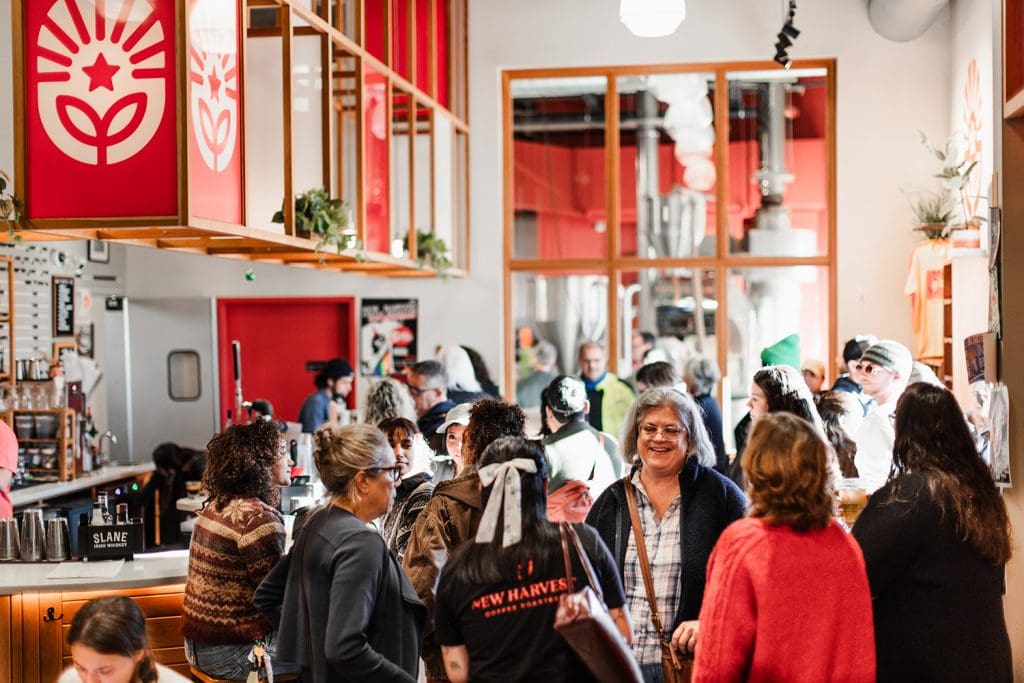
From one former industrial site to another, New Harvest Coffee Roasters has expanded from humble beginnings in Rumford (East Providence) to become a cornerstone for coffee in RI. Today, the business employs more than 20 employees, serves roughly 130 wholesale accounts, and includes a roastery and cafe at 10 Sims Ave. in Providence. In the lead-up to a 25th anniversary party held on October 18, 2026, Motif’s Sean Carlson sipped a cappuccino while interviewing co-founder Rik Kleinfeldt on the past, present, and future of New Harvest.
Sean Carlson (Motif): You and Paula Anderson co-founded New Harvest just over 25 years ago. Can you bring us back to those early days? How did you get the business off the ground?
Rik Kleinfeldt: I’m from Ohio and moved to Providence in 1989 to study history at Brown for graduate school. I found that my teaching assistantship wasn’t enough to make ends meet, so I got a job at the Coffee Exchange on Wickenden Street. I eventually earned my master’s degree, and I wasn’t sure what to do next. Coffee Exchange needed a manager, so I took the job and was a manager and roaster there for almost 10 years — basically all through the ’90s. Providence changed enormously in that time span. The reason I started New Harvest is because I was in the process of starting a family with my wife Paula — New Harvest’s co-founder — and needed to take the next step in my life. I saw an opportunity for wholesale specialty coffee because there really wasn’t anyone doing it locally, or even regionally. I had learned everything I knew at that point from the Coffee Exchange and wanted to apply those experiences to supply bakeries, cafes, and restaurants. That was the inspiration behind New Harvest. Our original location was in Rumford, at the Phillipsdale Landing, which is an old mill complex right on the Seekonk River. We had sort of a glorified garage, just me and one or two other people for those first few years. We were focused primarily on our roasting and wholesale. We have some of those same customers today.
SC: Could you share the trajectory of New Harvest from Rumford to Pawtucket to Providence?
RK: At Phillipsdale Landing, most of the tenants were enormous, like Capco Steel, and we were just this tiny little business. The landlord was a friend of a friend, so we were able to pay month-to-month. He thought it was cool that we were doing this in his industrial complex. We had a very informal arrangement, but when there were grand plans to convert Phillipsdale into condominiums, we had to leave. But the condos never came to pass because in 2008 the economy collapsed. Hope Artiste Village in Pawtucket was a great next step. Farm Fresh Rhode Island started doing its wintertime market in the building as well, so that became our first retail experience. Up until then, we had been exclusively online sales and wholesale. But at Hope Artiste Village, individual customers could come stop in to buy beans. We served drinks, but it was casual. We opened our first standalone retail location in The Arcade in Providence in 2013.
SC: What were your aspirations and expectations in shifting from primarily a wholesale model?
RK: We had long looked for a retail spot. I never had the ambition to open a bunch of cafes, but I felt like we should have one cafe, if only to promote all the other things that we do — not just our wholesale, but also our training program. Having a cafe of our own gives us an opportunity to showcase that a little bit. Our rationale at the time for going into The Arcade was that everyone felt that something was going to happen with the Superman Building. When our lease came up in 2020, we were in the middle of the pandemic. Downtown Providence just was completely hollow, so it made no sense at all for us to keep it open at that point.
SC: But your present-day cafe and roastery opened around the same time at 10 Sims Ave.
RK: With the farmer’s market coming over here, we signed a contract on our current space in 2020, before Covid. Going forward with the project was quite a risk, not knowing what would happen in the pandemic, but it turned out pretty well. This is actually our busiest year ever.
SC: You must have shock absorbers for risk by now. How have you changed along the way?
RK: I’ve made most of our mistakes, and I’m sure I’ll make some more. But the key thing that I’ve learned over 25 years is to focus on what we’re good at. I think that’s a helpful lesson for any small business. We work with a lot of new businesses, restaurants, and cafes. It’s common to see mission creep — people trying to do too much. I was definitely in that camp, trying to do too many things for too many people. Our coffee isn’t for everybody, but I’d double down on the wholesale program that we have, our focus on local businesses and universities, and our emphasis on quality, sustainability, and transparency in our relationships with coffee growers.
SC: Those mistakes you’ve made — what are some of your favorite mistakes over 25 years?
RK: Well, we bought a cafe and bakery in Boston: Ula Cafe in Jamaica Plain. They had been a wholesale customer of ours for many years, and my vision was that we would eventually turn it into a New Harvest cafe. But I think the distance in Boston is just a much different animal than in Providence and RI. I love Providence. I love being here. I love working with people here. Boston was just not a good fit for me. So that was a great example of getting away from our focus. I think every mistake I’ve ever made has involved losing focus on what we’re good at.
SC: What does this focus mean when coffee and consumer expectations have evolved so much?
RK: Staying approachable has been a through line for us from the very beginning— not being too precious about what we’re doing. We respect what our partners at origin do on coffee farms and with their coffee processing. We honor that hard work, but not to the extent that we want to exclude people. We want to meet people where they are, and bring them along for the journey rather than trying to hit them over the head about their taste, or ours, in coffee.
SC: I once met one of your employees from the Hope Artiste Village days, outside a warehouse in Warsaw, Poland of all places. His band was on tour, and he mentioned how accommodative New Harvest tended to be when it came to allowing for artistic and creative commitments.
RK: Our cafe here in the Valley neighborhood is a great illustration of this. I think it’s really fantastic for us, culturally, artistically, creatively. I’ve seen a lot of our staff over the years having varied interests — a lot of artists, a lot of musicians. As you said, I think we’ve been known for a long time as trying to be really accommodating for touring musicians. I’ve always been in that orbit in Providence, at least since I’ve lived here. That’s an important part of what we do, giving our people the time and space they need to pursue other interests outside of coffee.
SC: Let’s return to Providence. As you were starting up in Rumford, Fort Thunder was still open just down the street from where you are now. You’ve seen any number of venues and restaurants and cafes come and go. Students too, the city’s rotational lifeblood. You’ve stayed all this while.
RK: I mean, things have changed a lot. Shortly after I got here we were back in the second Buddy Cianci era. Providence was a very different city from what it is now. I feel like it has become a lot more inclusive over the years. I see that in our clientele. I see it in the businesses we support and the cafes and restaurants that are opening up. There’s just a lot more diversity, which I think is awesome. It really speaks to Providence as a great place to live, and a great place to own a business. One of the frustrations I have is that Rhode Islanders can be very critical of Providence, or of RI in general. I’m still a newcomer, even though I’ve been here for almost 40 years now. I think Providence is a great city. I think RI is a great state. Of course, everywhere has its challenges and its problems, but I feel that we’ve come a long way.
SC: Do you see the chapters of your business in terms of each location, or as something else?
RK: For me, I put the chapters around each of the four times we’ve lost our biggest customer over the past 25 years. Blue State Coffee and Fuel America, for example, were major wholesale customers of ours, but they both decided to start roasting their own coffee. Those challenging moments, I think, at each stage forced us together as a team to figure out how to move forward. We certainly don’t want to lose a customer, but when we have in the past, we always learn from it. I’d say the key to failure is to learn. If you dwell on the hard part of failing, you’re missing the message.
SC: But fuel prices, climate change, international trade, inflation — you face a lot of pressures.
RK: Tariffs hit us last year. Thankfully, we did get refunded not long ago, but tariffs were an enormous challenge because coffee prices were already at an all-time high. I wasn’t really sure how we were going to navigate them in the long term. Those tariffs are gone, at least for now, but the broader picture is that coffee prices are going to continue to go up because the demand keeps increasing and the supply is pretty stagnant. There really aren’t opportunities to create new coffee producing areas. You see some new coffee production in places like China, which didn’t have significant coffee yields before. I see it as a positive that the coffee industry, especially specialty coffee, is growing enormously, which very few industries can say. That’s true locally, nationally, and worldwide. The downside is that there’s only so much coffee being grown, so coffee prices are continuing to be a challenge. I remember when I got started, one thing I heard frequently was, “well, you know, I can get a coffee at Cumberland Farms for 50 cents, or 99 cents, or at whatever deal they’re offering at any given time.” I don’t hear that so much anymore.
SC: And getting back to New Harvest’s coffee. What are you especially excited about right now?
RK: My favorite coffee of ours right now is one from Burundi, which we’ve had for a few years. But we’re in the process of developing a new supplier relationship in Guatemala, which dovetails with the beneficiary of our 25th anniversary party: the Guatemalan Center of New England. We’ve always bought a lot of coffee from Guatemala, and we have a wonderful Guatemalan community in and around Providence, so it’s especially nice to be able to connect those together. We’ll be going back there in February or March, so that’s something we’ll all be excited about.
SC: When you travel to meet the growers of the coffee you roast and sell, is it you? A team?
RK: We try to send all of our production staff out into the field. More often than not these days, it’s not me. Since the Guatemalan relationship is new, I’ll go on this trip. Pretty much everyone who works in our roastery has visited a coffee farm, and that’s an important priority for me.
SC: Looking back, any other highlights or moments along the way that stand out as highlights?
RK: For several years, we hosted a coffee conference here in Providence: the Mid-Atlantic / Northeast Coffee Conference. MANE was probably one of the premier independent coffee events in the country while it lasted. We held the final one in 2016 at what was then the Biltmore. From time to time, I revisit this memory as a high point, and look back on the photos. Hundreds of people filled the ballroom, and that’s one particularly fond memory I’d like to go back to.
SC: And a quarter century in, how are you thinking about the next 25 years?
RK: Well, I’m 60 now, so I’m not sure I’m going to make it to all 25 — at least not working, or hopefully not. We don’t have grand plans to expand. I’d prefer to remain focused on the business that we have now, making it a little better every day. I’m happy with where we are. Obviously, I want to keep growing so I can continue to support our staff — you know, continue to give them raises— but no quantum leaps. You have to grow because that’s the nature of business. The alternative is shrinking. I’d prefer smart growth that plays to our strengths, not getting out over our skis. I just want to build in an incremental fashion for the next 10 years or so, and then see where we are. Like I said at the beginning, I’d like to keep staying focused on what we do well.