Orville Becker looked again at his map of Lincoln Woods State Park. He’d hiked through the natural rock formations of Druid Circle, stopping to gaze at the Pedestal and Split Rock boulders, before continuing toward Quinsicket Pond, which lay to the northwest, where he planned to break for a late lunch.
Odd name, Druid Circle, he thought. It was bestowed by a local historian, according to one account, who’d said this ancient rocky site deserved an equally ancient name. And being Anglo, the historian delved into the pages of European history for a name, ignoring the Indigenous people’s stonescapes and stories, Becker speculated.
But back to the hike. Where the hell was he?
By now, he should have come to the hiking trail that led to the pond. Rather than walk on the unnamed spur road that curved to the west to get to the trail, he had instead struck straight through the rugged forest on an unblazed dirt footpath to hook up with that trail.
It offered more of a hiking challenge.
“I can be an Earl Shaffer,” he had said aloud as he set off, referring to the World War II veteran who’d become the first person to hike the entire Appalachian Trail in a single journey.
He smiled at the absurdity of his exaggeration as he walked northward along the footpath. The trees were getting closer and closer, he noticed. In no time, the path had narrowed to the width of his shoulders. And every dozen feet or so he had to go sideways like a crab to squeeze between a couple of encroaching trees.
Becker forged ahead, stuffing a handful of trail mix into his mouth. He washed it down with water from his canteen.
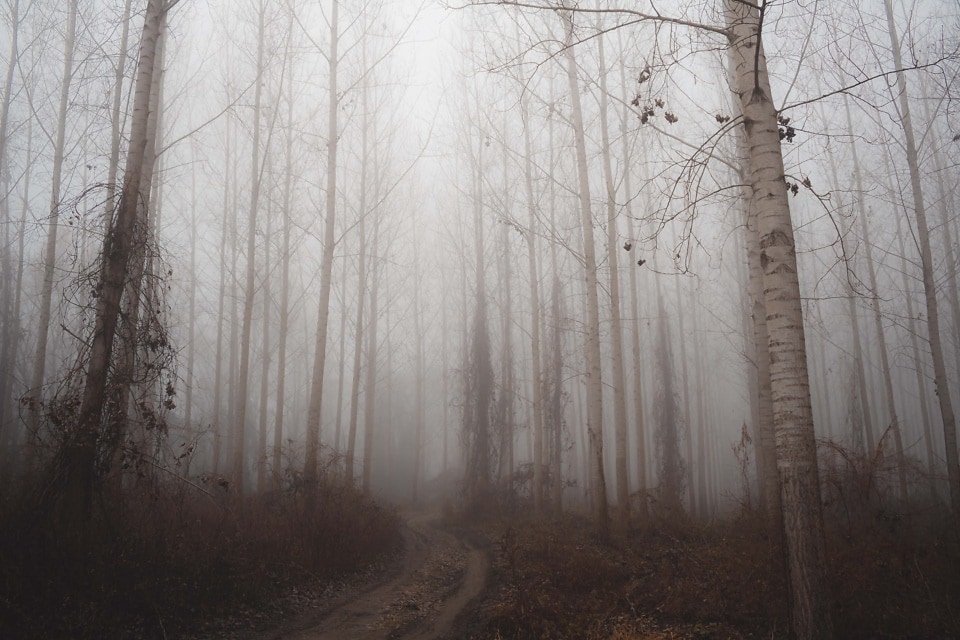
A thick mist descended. In the embrace of the sticky gray swirl, sweat beaded his forehead and forearms. He wiped his face with a handkerchief, then came to an abrupt stop. He looked down, and realized he’d gone off the dirt path.
Becker retraced his steps to the south. But after going thirty or so paces, he couldn’t find the footpath he’d been on. He stopped, folded the map, and tucked it into a pocket.
He decided to use dead reckoning to get to Quinsicket Pond. He turned around, and set out, heading northwest. That should get him to the pond, which was shaped like a pudgy pointing finger.
While he trudged along, he got the funny feeling that he was getting no closer to the pond. It was as if for every twenty steps he advanced, the pond retreated by twenty steps.
As he unscrewed the cap of his canteen, Becker stumbled over a thick tree root. Water slushed out onto his chest as he fell forward onto his hands and knees. He let out a soft “Damn,” then scrambled to his feet. The mist dissipated.
With a start, he realized that he was now standing in a small clearing. His heart thumped his chest when he saw, not twenty feet away, the weirdest sight: large engines suspended above the ground, held by thick waxy vines.
There were four of them. He rushed forward to get a closer look. Airplane engines. On each one was a framed black-and-white photo of a warplane, with its name in white marker: Hellcat, Corsair, Dauntless, and Avenger. All World War II vintage.
And behind them, in a crescent-shaped formation, were a dozen two-blade wooden propellers stuck into the ground like gravestones. Each sported washed out lettering.
Who had put them here? And to what purpose?
It was then that he noticed the rainbow above him. Only there were no bright colors in it. Rather, it ran the gamut from silver to slate to charcoal gray. It was not natural. Disquiet gnawed his insides.
The mist closed around him again, this time totally blotting out the sun. And it breathed down his neck, like a predator. He wanted to run away, but he couldn’t move a muscle. The mist had become solid, pinned him upright, and ushered his statue-like body to the crescent.
The ground near his feet collapsed into the shape of a grave, and a wooden propeller stabbed into the dirt. It had his name on it.