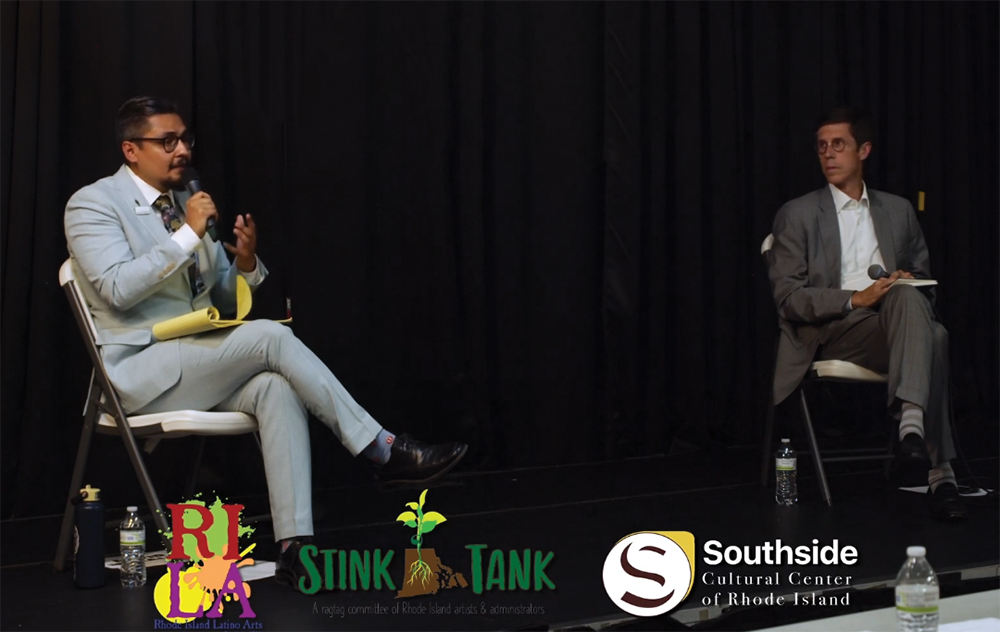
On August 12, Motif cohosted a forum on the Arts in Providence featuring Democratic Primary Mayoral candidates Brett Smiley and David Morales.
In Providence, the real election typically happens in the primary. The winner will go on to face David Tenet (R) and Allen Waters (I) in the general election, but Providence is a determinedly Democratic city, and so the winner of the September 9 contest will be a hands-down favorite in the general election.
The event was supported by the Southside Cultural Center, where the forum took place, and was a collaboration with Southside, a new arts advocacy project named Stink Tank, and RI Latino Arts. The panel of moderators was made up of AS220 and Stink Tank founder Umberto Crenca, Little State Big Voices podcasters Tracey Solomon-White and Shahidah Ali, and Motif publisher Mike Ryan. The proceedings were called to order by Ron Crosson II, vice chair of the Southside Cultural Center.
The audience more than filled the space and included too many arts organization leaders to name, as well as advocates for each candidate who kept up a healthy cheering section.
Full videos of the forum are available on Motif’s YouTube page. The event went smoothly and the candidates were civil and engaging. There was no shortage of subtle jabs, but the conversation was diplomatic and enlightening. Here’s a summary and some highlights – we had to cut a lot out to fit this space, so for a deeper dive, check out the videos!
Surprisingly – or perhaps not so, since both seasoned politicians understood their audience – the two candidates agreed far more than they differed on issues surrounding the arts and their importance to the culture and vibrancy of the city of Providence. Each eloquently expressed the idea that the local arts culture is an essential element that makes Providence distinctive and different from other cities our size.
Bert Crenca kicked off the proceeding asking, “What role do you think the arts played in the Providence Renaissance?” When councilman Morales responded with a general statement about the importance of the arts to the city, Crenca interrupted: “Excuse me, the question is very specific. I really would like to hear about your perception of the role of the arts in the Providence Renaissance. How did we get here and what was the role of the arts specifically? We’ll have other questions later.” And that specificity set the tone for the evening, where each candidate mostly gave grounded examples of artistic support they would leverage if elected.
Morales focused on how that now historic period 30 years ago was activating spaces, supporting artists by “Beautifying community without having to necessarily correlate with gentrification.”
Smiley went further back in time: “To look at the Providence Renaissance, really we need to go back to the ’70s and ’80s when this city was empty mills, abandoned buildings and really a situation of serious economic decline. And our artists and creative communities were the ones that held on and that turned something that was not just deteriorating, but in rubble, into something beautiful and created this foundation for today. So whether it’s legally or less legally occupying spaces and turning them into creative maker spaces, and the creatives in our economy that fought for these spaces, that kept it economically vibrant and that filled the void when downtown hollowed out, when we were in a period of disinvestment.”
Smiley returned to his history in terms of arts support over the last four years. Morales regularly returned to his tagline of “A Providence for All,” in this case representing issues of affordable art spaces and living spaces, and equitable disbursement of opportunities across neighborhoods.
Both candidates intend to introduce more arts programs and afterschool support for the arts into the school system as it returns to municipal control.
Throughout the debate Smiley conveyed confidence in his current programs and that they would be bolstered going forward. Morales focused more on educational opportunities and bringing artists into the school system, and on a deliberate plan for residency programs designed to support individual artists and integrate them more into everyday life, education, and placemaking dispersed around the city.
Smiley talked about the success cultural festivals have had in the City, including PVDFest (The Candidates differed openly about the timing of PVDFest. Morales preferred the summer for its weather and hospitality, and Smiley preferred September to stay clear of other events on the city schedule, but both would continue the fest).
Morales would copy Boston’s model of small stipends for groups throwing neighborhood events, while Smiley asserted the positive impact of supporting bigger festivals. Both expressed support for integrating the arts into other municipal activities. “We can’t call ourselves the Creative Capital with a straight face if it is not infused in all of our activities. And so the city’s Department of Arts Culture Tourism plays a central role in that,” argued Smiley, while Morales stated that the arts could be better integrated, especially on a grassroots level, and more multicultural and multilingual, citing examples like Auntie’s House, which specializes in mobile after-school programs which can literally roll up on any given geography in the city.
Throughout, Morales emphasized affordable work space, planning to leverage some of the many vacant commercial spaces in the city with a plan to convert some to affordable work spaces for artists.
Smiley, responding more directly to the disappearance of federal funds, mentioned the importance of advocating to restore those funds and “swap out the President,” conceding that the city will never be able to replace the possible federal dollars for causes like the arts. In the meantime, he cited his work with the Providence Tourism Council to fund projects, and mentioned taking the 1% of public project budgets mandated for the arts, and how that has been applied toward cultural infrastructure because, “It’s not just enough these days, particularly in the context of these cuts, to commission another mural; that’s of no benefit to the arts community here when cultural institutions are going under. And so now we’ve been able to use that existing funding for a broader range of activities to help folks stay afloat. In this year’s budget, I proposed and was able to pass a cultural festivals fund, which gives us grant making dollars to support those entities, which are not just good for the community, but also then create opportunities for makers and vendors and restaurateurs.”
Funding – or the current scarcity thereof – was a consistent theme for the evening. When pushed on where the funds for their arts programs would come from, and how that would be defended in the face of other pressing fiscal concerns like housing, healthcare, and education.
Smiley talked about finding funding where it was moving to; for example, arts organizations making use of workforce training funds to bolster projects that train artists for careers in the arts, learning by producing art. He also pointed to programs like the cultural festivals fund that are locked into the city’s budget for next year.
The specific example of the recent buyout by the city of the WaterFire building was explored in some detail. Both candidates support the multiplier effect that applies to funds spent on the arts (numerous studies have found that each dollar spent on the arts works its way back into the economy with a higher multiplier than most other investments in industry and commerce). WaterFire has a tremendous ripple effect on the downtown businesses and brings a lot of commerce into the state, as well as making residents proud to live here.
The city purchased the WaterFire Arts building, acquiring an asset and securing an element of sustainability for the project, instead of straight-out funding the events more fully as they happen. Smiley used it as an example of outside-the-box art support problem solving. Morales pointed out that an expectation plan should have been written out to prevent uprooting The Wilbury Group, which saw the rent for its sublet space at WaterFire instantly go up significantly. That unintentional side-effect he called, “Just wrong,” but he agreed with the innovative problem solving and felt that paradigm should be taken further.
When asked how artistic expenses would be justified, Morales said, “We defend our investments in the arts by simply justifying and defending public joy. Our neighbors deserve to be able to have access to public art that one can enjoy through the institutions that help make it possible.” He mentioned focusing on grassroots organizations, like the Steel Yard, which indirectly helps fund art and artists by providing a space, resources, and training they can use to create and in turn enhance the quality of life of city residents. He also indicated that with large endeavors, like repairing stormwater facilities, there was financial room to make an artistic difference with funds that are essentially rounding errors around the big expenses. Stormwater run off projects served as an example – they involve construction, but could include beautification too. “There is a realm of possibility for us to be able to pursue these more ambitious ideas for the creative capital to remain creative as opposed to limited thinking and just dealing with the status quo,” he said.
Morales also promised, if elected, to take the night life economy.more seriously. He contended that most clubs and music venues try to stay as far off the city’s radar as they can, and he’d like to see them approaching the city and asking for help with the business challenges they’re facing.
There was a brief but surprising discussion of an arts district – an idea that’s bounced around in civic conversations over the years – an idea to change zoning or take over some housing and make it accessible primarily to arts businesses or for artist housing, akin to the AS220 model. Both candidates seemed to consider that a viable concept worth consideration, although neither could weigh in specifically. There would be a lot of zoning and financing and map-drawing considerations before any proposal could be shaped, although Mr. Crenca argued that those communities were founding themselves anyway to some extent, mentioning the Valley St area and Atlantic Mills as examples.
Finally, as the evening wrapped up, an audience member asked: “How can we help advocate for these policies and make more of them a reality?” “I think the people in this room are already doing it,” Mr. Smiley said.
Motif – and the partners in this event like Stink Tank, Southside Cultural Center, RI Latino Arts – are eager to keep these kinds of discussions going and we’re very open to suggestions and feedback on topics we should try to address in the future. The community feedback made clear that there is demand for more discussion on some of these topics. Of course, it’s easier to get people’s attention in an election year, but if you have forum topic suggestions, let us know!