Category: Nationally relevant

Articles relevant beyond the local area

  • Pfizer COVID-19 vaccine fully approved by US FDA: RI hopes will boost take-up rate

    Pfizer COVID-19 vaccine fully approved by US FDA: RI hopes will boost take-up rate

    The US Food and Drug Administration (FDA) today approved full licensure for the two-dose Pfizer-BioNTech COVID-19 vaccine that was given Emergency Use Authorization (EUA) on December 11, 2020, for recipients age 16 and older. It will now be known under the trade name “Comirnaty” (pronounced koe-mir’-na-tee). The identical vaccine will continue to be available under EUA issued May 10, 2021, for recipients ages 12 to 15 and under subsequent EUA as a third dose for immuno-compromised recipients.

    About 92 million people in the US have been administered the Pfizer vaccine under EUA. Full approval is expected to persuade some who have been hesitant to get an “experimental” vaccine. Full approval may also smooth legal obstacles to COVID-19 vaccine mandates by public and private employers and schools, where existing vaccines (such as for measles, mumps, and rubella) are already mandated.

    In a statement, the FDA said approval was based upon clinical trial data from both before and after the EUA, including one for effectiveness with 40,000 participants and one for safety with 44,000 participants, in each case half receiving the vaccine and half receiving a placebo. The vaccine was found 91% effective in preventing sickness from COVID-19. About 12,000 vaccine recipients were monitored for adverse events for at least six months.

    “The FDA’s approval of this vaccine is a milestone as we continue to battle the COVID-19 pandemic. While this and other vaccines have met the FDA’s rigorous, scientific standards for emergency use authorization, as the first FDA-approved COVID-19 vaccine, the public can be very confident that this vaccine meets the high standards for safety, effectiveness and manufacturing quality the FDA requires of an approved product,” said Acting FDA Commissioner Janet Woodcock, M.D. “While millions of people have already safely received COVID-19 vaccines, we recognize that for some, the FDA approval of a vaccine may now instill additional confidence to get vaccinated. Today’s milestone puts us one step closer to altering the course of this pandemic in the U.S.”

    “Our scientific and medical experts conducted an incredibly thorough and thoughtful evaluation of this vaccine. We evaluated scientific data and information included in hundreds of thousands of pages, conducted our own analyses of Comirnaty’s safety and effectiveness, and performed a detailed assessment of the manufacturing processes, including inspections of the manufacturing facilities,” said Peter Marks, M.D., Ph.D., director of FDA’s Center for Biologics Evaluation and Research. “We have not lost sight that the COVID-19 public health crisis continues in the U.S. and that the public is counting on safe and effective vaccines. The public and medical community can be confident that although we approved this vaccine expeditiously, it was fully in keeping with our existing high standards for vaccines in the U.S.”

    In Rhode Island, free vaccination sites can be found on the state government web site vaccinateri.org for the general public, as well as more than 100 back-to-school clinics in communities listed at back2schoolri.com.

    RI Gov. Dan McKee said in a statement, “To anyone who was on the fence, the science is crystal clear. These vaccines are safe, and they are very effective at keeping people healthy. It is time. It is time to protect yourself. It is time to protect your family. It is time to get vaccinated. We have vaccination opportunities available in communities across Rhode Island. If you have not gotten your shot, get vaccinated today.”

    “The FDA did an extremely thorough review of this vaccine and reaffirmed that it absolutely was safe,” said RI Director of Health Nicole Alexander-Scott, MD, MPH, in a statement. “It is undeniable that the COVID-19 vaccines save lives. If you are eligible, get vaccinated today to protect you and your family. It’s easier than it has ever been before.”

  • TS Henri: RI spared worst effects as storm passes

    TS Henri: RI spared worst effects as storm passes

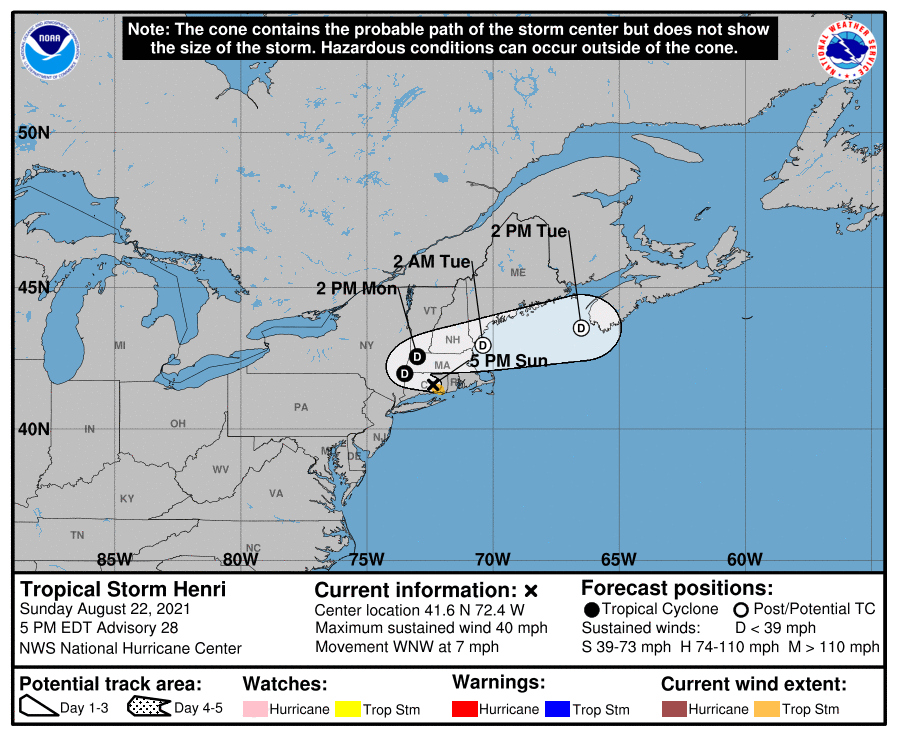
    As of 5pm EDT Sun, Aug 22, 2021 in RI: All watches and warnings have been discontinued.

    TS Henri spared RI its worst effects: Rain has already ended over most of the state and winds should subside by 7pm. The storm is barely hanging onto tropical storm status with maximum sustained winds 40MPH, and likely will be downgraded to tropical depression later tonight.

    The main effects in RI have been electrical outages.

    Tropical Storm Henri: Probability of tropical storm force winds for five-day period beginning Sun, Aug 22, 2021, 2pm EDT.
    Tropical Storm Henri: Probability “cone” of track of storm center for five-day period beginning Sun, Aug 22, 2021, 5pm EDT.

    A second wave of rain is possible tomorrow 6pm to 11pm, but nowhere near tropical storm conditions.

  • Record Breaking Heat on Sayles: Children pepper-sprayed, arrested by police recorded making bigoted comments

    Record Breaking Heat on Sayles: Children pepper-sprayed, arrested by police recorded making bigoted comments

    Competing narratives emerged from dueling press conferences about an incident in the streets of South Providence on June 29. By 6pm, scorching temperatures had cooled only slightly from the afternoon high of 97 degrees, breaking a record that had stood since 1934. On Sayles Street between Searle and Cahill streets, two blocks west of Eddy Street, people had opened a fire hydrant so children could cool off in the water. Two families in neighboring houses at 260 and 264, separated by a few dozen feet of grassy yard, were part of this impromptu street party.

    Map showing 260 and 264 Sayles St, Providence, where a June 29, 2021, melee occurred. (Source: Michael Bilow, via OpenStreetMap)

    The residents of 260 Sayles St held a press conference July 1, alleging that police overreacted to 14 year olds having an argument, with the police themselves escalating a situation over the course of several hours that resulted in children as young as 1 year old being exposed to pepper spray, beaten to point of injury, and detained in total darkness inside police vans without air conditioning. Witnesses said they counted 18 police cars, two vans used to detain and transport arrestees, and fire and rescue apparatus.

    The City of Providence held a press conference July 2, where Mayor Jorge Elorza, Public Safety Commissioner Steven Pare and Police Chief Hugh Clements portrayed the police response as professional, although the matter is still under investigation. According to Clements, police responded initially to a noise complaint but had to return, eventually leading to a major incident where at least one officer activated their personal “officer needs assistance” alarm, directing every available police officer to the scene, at least 35 officers in this case.

    On July 1, the city publicly released an hour-long video taken from the body-worn camera of one of the responding officers. That video recorded comments from some of the police officers talking among themselves, making unprofessional comments that betrayed racist and anti-LGBTQ prejudice. At one point, an officer is heard saying, “We’re out here all summer with these two houses. They hate each other. It’s the Spanish against the Blacks.” The same officer then describes one of the people as a “shemale,” a derogatory slur to describe someone with male genitalia trying to appear female, saying, “I told you, that’s the one I wanted to go [be arrested] the most, the one in the black there that has the man haircut that they said, ‘Oh, it’s a girl,” and I said, ‘She ain’t a girl.’” Later on, he says, “I don’t wanna hear it. All animals.” Remarks are captured of officers criticizing the fire department for being slow to respond and criticizing the police dispatcher as an “idiot” and “moron.” At one point, an officer challenges a 14 year old, “You wanna fuckin’ fight me, kid?” A few minutes before the end of that video recording, the officers say they hope they “don’t look bad,” but by then it is way too late.

    Two additional body cam videos were released by the city on July 2, with a promise that they are working to redact private information so that the estimated 25 body cam videos can be released as soon as possible.

    At the city’s press conference, Providence Mayor Jorge Elorza acknowledged at least the public relations problem resulting from the body cam video. “I’ve reviewed some of the tapes myself, and I’ve seen what’s out there publicly, and I’m reviewing the video that we released yesterday. Now what I saw are two things. On the one hand, we see officers that arrived, who act professionally and de-escalate the situation. But you also see several instances of officers who use inappropriate language, did not de-escalate the situation, and certainly did not reflect the police department that we strive to be.” Elorza promised, “We will do is we’ll do a full investigation. And any officer or anyone on the scene, who acted inappropriate, who acted unprofessional, or did not comply with our stated goal of de-escalating situations is going to be held accountable.”

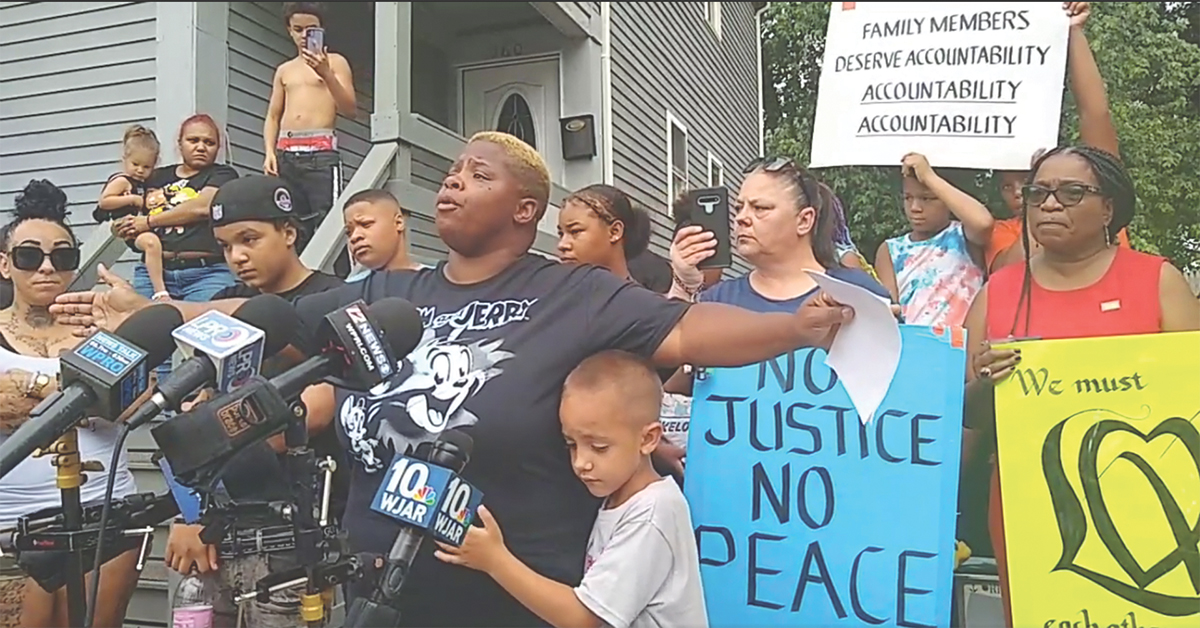
    Taffii Moore, who said she is the resident of 260 Sayles St and was the principal speaker at the Thursday press conference, said that police arrived at the scene with an unnecessarily confrontational attitude, saying they lined up in the street facing the house “like ‘we will get ready for war.’” She said, “When they attacked us, they attacked our children, they attacked everybody that was in this home. If you were recording, they attacked. They pepper sprayed. My son is who is 14 years old, Rashad, was protecting his cousin, Juan, from being beat by the police. They then pulled out their baton: beat him; five, six police officers at a time beat him. I have my neighbors in houses saying, ‘You know, why are you beating them? Why are you beating them?’ You know, trying. They pepper sprayed with my grandkids sitting on the porch.”

    The back of a 14 year-old showing injuries from what his family described as a beating by Providence Police on Sayles St, June 29, 2021. (Source: Provided by the family of the photo subject)

    According to the police report, people on the street began fighting with each other, and when police tried to arrest them, the crowd began fighting with the police trying to prevent the arrests, and “the crowd followed and attempted to interfere with Ptlm. Benros, who deployed [pepper spray] as a defensive measure. Lt. Barros then ordered the crowd to back up as they continued their threatening behaving and ignored commands as he issued a short burst of pepper spray to create distance for the officers who were wrestling on the ground in a vulnerable position. It was at this time that several police officers had to use their department issued pepper spray, due to the large size of the crowd, as well as the crowd becoming threatening towards police.” The use of pepper spray “to create distance” as described in the police report, effectively dispersing it into a wide area without any specific threatening target, is questionable at best, especially in the presence of so many children.

    Moore continued, “We sat right here on our property and bothered nobody. They came up in this yard. They dragged one of the young ladies out of the yard, not hitting nobody, not having no weapons, slammed her against the paddy wagon, threw her on the paddy wagon. They had their knees in my daughter’s face, beating and punching her, yelling at her that she was a man, as we were telling her she’s not a man, she’s a woman. They still didn’t care. They still beat on her. They beat on my son who was ill. Beat him with batons on his back.… My 1-year-old grandson was sprayed, my 5-year-old granddaughter was pepper sprayed, and they were looking right at her pepper-spraying. Didn’t even care that there was children.”

    Moore’s daughter Zyrray, age 21, was the only adult among the five arrestees; she was charged with assaulting a police officer. She appears to have been the person referred to on the body cam video by a police officer as a “shemale.” At the press conference, she recounted her experience of being detained in a police van with no light and no air, despite the oppressive heat, as her juvenile family members were put in the van with her. “It was a pretty crazy situation. Just us trying to be protective of our young ones and my family…. [The police are] taught for crowd control and they’re… ready to be aggressive and just trying to pretty much arrest everybody down to the kids.… I had got punched in the face by several officers. I’m trying to explain to them like, ‘You guys. I’m not resisting arrest. There’s no reason for you guys to have your feet in my neck, on top of me, stuff like that.’ They put me inside the van. And as I’m inside the van, I still hear everything going on outside, I can’t see. There was no lights, there’s no air. And then I hear them putting my cousin and my other cousin in the van. And they’re just crying, they can’t see… and me being the oldest I’m trying to keep them calm, trying to sing music, do something, because of everything they’ve been through and we’ve been through, it’s a lot.”

    Zyrray said she was pleading for air. “We’re yelling, we’re screaming… just open the door. You don’t even gotta turn on the AC, it’s hot, just open the door. You wouldn’t leave a dog in the friggin’ car for 20 minutes. We’re getting arrested. It has been there for over an hour, yelling and screaming, just ‘Open the door, open the door’… You can see on the videos, one of the officers is sitting in the back of the van as we’re banging on it. He was laughing [with other police officers] and talking to each other and just conversing like we’re not in the back of that van with our eyes burning, they want to give us no medical attention..”

    At the city press conference, Pare conceded that the police vans have no air conditioning in the back, but denied that anyone was confined in them for longer than 30 minutes and said that no one was denied medical attention.

    The Moore family has received death threats as a result of their press conference, Motif was told, and there are websites blogging about the incident using numerous racial slurs and providing personal identifying information about the adults involved.

    Clements said that police responded 42 times over the past 18 months to these addresses on Sayles Street. Motif asked both Pare and Clements whether this might itself have been indicative of a failure of policing, inducing a kind of frustration and fatigue that was ultimately going to blow up in some kind of incident as finally happened.

    We asked Pare, “If the police are called to the scene 42 times over the course of 18 months, is there any city service that could be provided, other than law enforcement, to try to deal with that?” Pare answered, “Without examining each and every call to that address, it’s hard for me to say. They weren’t calling the police because they needed food or shelter, they were calling because there was a public safety issue, and we respond when people call for the police on a public safety issue.” We followed up, “The city has a big effort to deal with gang violence, to try to intervene in a preventative way. Is there something the city could have done other than what has been done?” Pare answered, “I don’t know of any other service that we could have plugged in to prevent the repeated calls. I think a part of this is a feud in the neighborhood among neighbors, that we get called because there’s feuding, there’s loud music, there’s allegations of assault and those kinds of things.” We continued, “If you had gangs feuding you have a process for that, you have people for that.” Pare said, “Right, and this isn’t gang related.”

    We asked Clements the same question, “Is there anything other than a police response that the city had available on social services to respond to that situation?” Clements answered, “That’s a very good question. Had clinicians or street workers been on the scene could we have had a different outcome? I don’t know, but I don’t think so. This was pretty tense, these two families were very agitated with each other, and they really wanted to get to each other. So to answer your question, I think at the end of the day it’s a police response.” We asked, “The city has an effective program and has for years: If this was a feud between gangs, which I understand it wasn’t, there are resources you have to deal with that. But in a feud between families, it seems you’ve got nothing.” Clements answered, “Correct. I don’t believe there was a constant family feud going on – but were that the case, there was certainly opportunity to use some form of mediation between the families, or maybe the police introduce that model and then step out. So, yes, that’s a possibility.”

    At the Sayles Street press conference, a neighbor from across the street who identified herself only by her first name, “Linda,” provided an eyewitness account that raised an intriguing possibility the police may have made a classic tactical error that in military situations almost always leads to disaster. “The sergeant who was getting in front of my garage yelled to his police officers, ‘Get him.’ And six police officers ran after, ran in the yard. And all of the mothers were like, ‘Please, my son, don’t bother my son, he’s just a teenager.’ And so the police couldn’t get to him. So the sergeant ran to the back, came around the back side here, and pushed everybody out into the street. And he actually pushed everyone into the other police. So the police were acting like they were being attacked, but it was actually the sergeant who invaded everyone’s personal space and pushed them into the street. And when [the boy] got pushed into the street, he was the target. And so four policemen came after him.” (It should be noted that Linda may be in error about the “sergeant” because she said she knew he was of higher rank because he was wearing a white shirt, but in Providence that would indicate a lieutenant or above.)

    What may have happened was that the police failed to coordinate properly, so one phalanx of police moved toward the children from the street while another phalanx of police went around the house and moved toward the children from the opposite direction. That could have led each police phalanx to assume the children were charging them, although each police phalanx was pushing the children toward the other phalanx, which each phalanx interpreted as hostile action. That’s a classic military disaster that usually results in death by friendly fire. No shots were fired by anyone, but it would explain the strange near-panic the police seemed to exhibit.

    Video:
    Press conference, July 1, with Sayles Street residents: facebook.com/motifri/videos/1147054699105481/
    Press conference, July 2, with City of Providence: facebook.com/motifri/videos/163628802488366/
    Police body-worn cameras: providenceri.gov/police/ppd-video-release-62921/

  • Slam on the Brakes: Food trucks at RI state parks abruptly canceled

    Slam on the Brakes: Food trucks at RI state parks abruptly canceled

    This story has been updated; scroll to bottom of text.

    The sudden cancellation by RI state government of the remaining six of eight food truck events scheduled for 2021 in Colt and Goddard State Parks comes amidst a serious conflict of views as to what happened at the two events that were actually held.

    Eric Weiner at the 2016 Motif Food Truck Awards

    According to Eric Weiner of FoodTrucksIn.com/PVD Food Truck Events, the coordinator for these events and many others involving independent food trucks, RI Parks and Recreation notified him on May 28 that the then-seven remaining events would be canceled.

    “They last Friday asked if we were available for a quick Zoom call, and during that Zoom call they told us that they had been having internal conversations and that, after talking to the park managers, they had made a decision to call in the clause in our agreement that they could cancel events that they didn’t have enough staff to handle the events, and that’s what they were doing,” Weiner told Motif. “Obviously, we panicked immediately because this was Friday of the holiday weekend, and we reminded them that our next event was scheduled in just five days… and that it was too many people relying on an event five days away to cancel it with such short notice. They got back to us and said that we could actually do this event this past Wednesday, but all events after that would need to be canceled.”

    Only events at those two state parks are canceled. Weiner said, “I want to make sure it’s really clear to people that all of our other series of events in cities and towns, and city parks, are unaffected.” Roger Williams Park, which hosts Weiner’s flagship Friday events at the Carousel Village, is owned by the City of Providence rather than the state, and events there are continuing as scheduled.

    Michael Healey, chief public affairs officer at the RI Department of Environmental Management that oversees Parks and Recreation, said in a statement to Motif that “DEM has received a number of positive comments from Rhode Islanders who enjoyed the first events, held May 19 and June 2, at Colt State Park. At the same time, however, there was a parking problem when more than 1,500 people in 600 cars overwhelmed the 197 parking spots. DEM needed to pull Parks and Recreation staff from other needs in the region to manage the event safely. Also, existing restrooms were not adequate for both event attendees and other park patrons.”

    Weiner directly contested these claims, saying, “We think that over the three-hour event, on Wednesday night, we parked about 350 cars, and probably 2 to 3 people per car.” Asked by Motif to respond to Healey’s statement specifically, Weiner said, “I took pictures of the parking areas every 45 minutes and, at the peak of the event at 6:15 and 7:00pm, there were parking lots that were 100% empty. The event ended by 8:00pm, and by 7:15pm all the park rangers had left the area because they were not needed. If there were 600 cars over the course of the three hours, they were not there the entire time and never filled up the parking lots.” Weiner said, “I have pictures showing that neither overflow parking lot was used at all.” Weiner also told Motif, “We were monitoring the restrooms, and the restrooms on the far side of the park were not impacted by our event at all, and it was never a line to use the restrooms at the ones closest to the event space.”

    Healey said in the statement to Motif that DEM canceled the food truck events scheduled for the state parks in July because “more Rhode Islanders visit state parks and beaches in July than any other month,” but was open to considering such events in August and September when the parks would be less busy and there would be time to plan to bring in portable toilets and take other needed measures. Healey said DEM has been unable to hire enough seasonal employees, with only 391 of 503 positions currently filled. “DEM will continue to work in good faith to help food truck operators increase their business while, at the same time, ensuring that the tens of thousands of Rhode Islanders who view state parks as their ‘backyard’ have public places to go to that are clean, quiet, and inviting,” Healey said.

    Weiner estimated the economic impact as substantial, not only for the 12 to 15 food trucks and their workers at each Wednesday event, but also for his own staff and local musicians he hires. “For trucks that are grinding it out throughout the week to have a place where they can go on a Wednesday night to generate revenue is not something that’s easily replaced. We’re very strategic about adding Wednesday and Thursday night events because that’s the money that helps trucks be profitable, in addition to the revenues that they generate from the weekend.” At the Wednesday events that last 3 to 4 hours, “On average, the trucks serve about 30 customers per hour,” Weiner said. “On an average night, an average truck would like to make $600 to $800 in revenue… There’s no doubt when people come to our events, that when they’re coming and they’re going, they stop at other retailers or other businesses in the town, so for people that are coming into Colt State Park, there’s 800 people coming to that event over the course of the night on Wednesday night, that’s also 800 people driving through Bristol and Warren, and then maybe coming back and renting a camp site at Colt State Park. We had a number of people tell us it was their first time ever at Colt State Park… The direct and the indirect impacts are really things that should be thought about in general.”

    Per contract, the event coordinator reimburses the state for extra costs incurred. “The original plan was that they told us that we needed two park rangers. Now that is seeming to increase to 4 to 6 plus an environmental police officer. We’re not necessarily opposed to paying a fair share for the event to go on, but it doesn’t seem like this is just about the cost of the event. It seems like there may be other issues,” Weiner said. “We’re paying for rangers to help with parking. We’re paying a dump fee to take all the trash to a Dumpster. We’re paying for state services to be able to use the parks for the event.”

    When the second event on June 2 was allowed to take place, Weiner said, “Our hope was that the event Wednesday would go completely smoothly and that they would reconsider that decision. The event did go smoothly. We monitored the parking; the parking lot never filled up. There was no trash left behind. There were no incidents with behavior. People on our Facebook event pages actually went out of the way to say what a great time they had. But still, that did not change any of the decision to tell us that we could not continue on with either the events at Colt State Park or the events at Goddard Park, which are supposed to start next Wednesday [June 9].”

    Weiner said that he is still talking with DEM. “Our hope is that something develops quickly with DEM to figure out a way to let us do this at a part of Goddard Park where we can support the event. Goddard Park’s a huge park, there is a great waterfront area, there’s plenty of parking by the Goddard beach. We’re hoping that someone in DEM or in state government will find a way to let this event happen. If not, we are going to be spending our weekend and our Monday looking for an alternate place, any place, hopefully nearby in that area where we can do the event instead. But we are really not in a position where we can afford to cancel this event: too many people are looking forward to the event and relying on the revenue. So our goal is to have an event somewhere Wednesday night, and what that looks like yet we really just don’t know.”

    Over the next few days, efforts continue; however, time will be very short, Weiner acknowledged. “We’re ready and we have a plan. If they give us the go-ahead, we have been prepared and ready to produce an event at Goddard Park on Wednesday night… We just need the voice of the public to be heard: It’s been almost completely on our side of saying that we were able to do this during the pandemic. They’ve been events that people are appreciating and enjoying, and there’s no downside. It’s not impacting anyone negatively. We’re hoping that they’re going to come back around relatively soon so that we can be a go on Goddard instead of finding just a parking lot somewhere in a town that allows us to come in.”

    UPDATE: RI DEM agreed to allow the June 9 event to be held as originally scheduled at Goddard Park. On June 18, spokesman Michael Healey told Motif in response to an inquiry, “We had a successful food truck event with a good turnout at Goddard State Park last week. We hope the PVD Food Truck operators did a good bit of business. DEM is optimistic that the two events initially planned for July will go ahead. The exact dates may or may not change and there still are contingencies and final details to be worked out. We will be reaching out to the vendor very shortly to discuss.”

    Food truck event at Colt State Park: at 6:18pm, June 2. (Photo: Eric Weiner)
    Food truck event at Colt State Park: at 7:00pm, June 2. (Photo: Eric Weiner)
    Food truck event at Colt State Park: parking lot at 5:37pm, June 2. (Photo: Eric Weiner)
    Food truck event at Colt State Park: parking lot at 6:19pm, June 2. (Photo: Eric Weiner)
    Food truck event at Colt State Park: parking lot at 7:02pm, June 2. (Photo: Eric Weiner)
    Food truck event at Colt State Park: parking area at 7:00pm, June 2. (Photo: Eric Weiner)
    Food truck event at Colt State Park: parking area at 6:36pm, June 2. (Photo: Eric Weiner)
    Food truck event at Colt State Park: parking area at 7:05pm, June 2. (Photo: Eric Weiner)
    Food truck event at Colt State Park: parking area at 7:06pm, June 2. (Photo: Eric Weiner)
    Food truck event at Colt State Park: parking area at 7:11pm, June 2. (Photo: Eric Weiner)
    Food truck event at Colt State Park: parking area at 7:26pm, June 2. (Photo: Eric Weiner)

  • US Supreme Court rules 9-0 Cranston wrong in warrantless gun seizure

    US Supreme Court rules 9-0 Cranston wrong in warrantless gun seizure

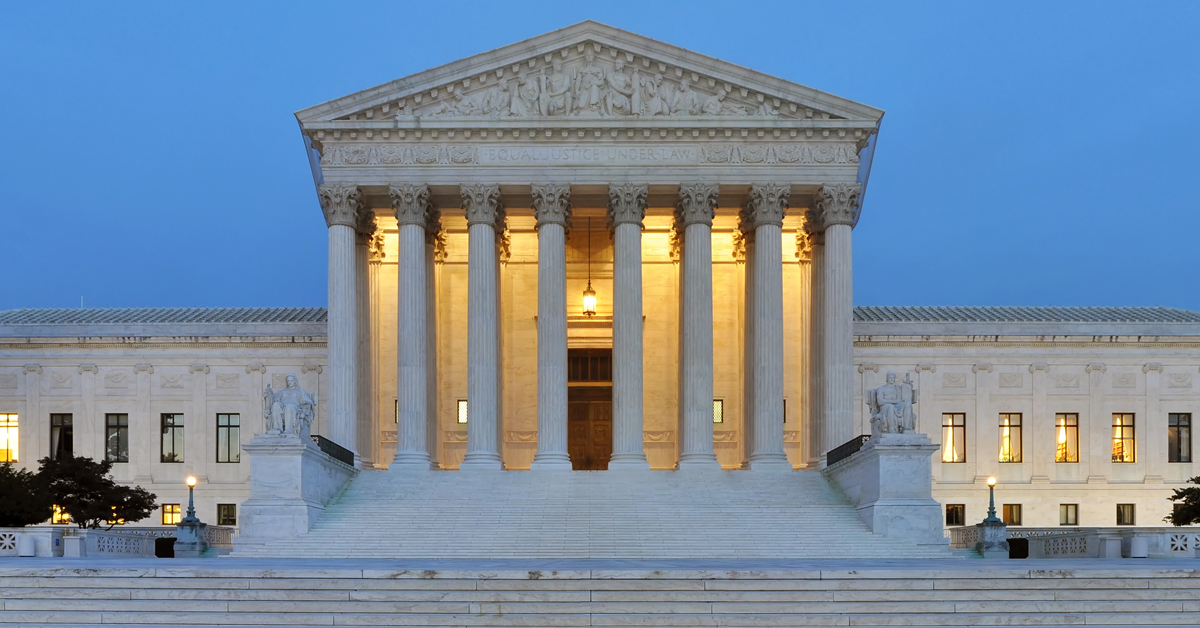
    The Cranston Police were wrong to seize guns without a warrant from a possibly suicidal man’s home after he had already been transported to a hospital for psychological evaluation, the United States Supreme Court ruled this morning, unanimously, in a 9-0 vote. The case is Caniglia v. Strom (20-157).

    On August 20, 2015, Edward Caniglia argued with his wife Kim in their home in Cranston. He got a handgun from the bedroom, put it on the table, and told her something like “shoot me now and get it over with.” It was not loaded, but she said she didn’t know that at the time. He went out for a ride while she returned the gun to the bedroom and hid its ammunition. When he got back the argument resumed, so she packed a bag and spent the night at a hotel. The next morning she was unable to reach him by telephone, so she was worried he had killed himself and called the police to ask them to accompany her back to the house to check the well-being of her husband, worried what she might find. She met with Ptlm. John Mastrati and explained the situation.

    It turned out that her husband seemed fine, denying he was suicidal and saying the events of the prior night were simply him being dramatic. By this time, three other officers had arrived, Sgt. Brandon Barth, Ptlm. Wayne Russell, and Ptlm. Austin Smith. As the ranking officer, Barth determined that Mr. Caniglia posed an imminent danger to himself or others, and determined that he needed to be psychologically evaluated at a hospital. Barth decided to seize the firearms, getting telephone approval from his superior Cpt. Russell C. Henry, Jr.

    Thomas W. Lyons III

    In an interview with Motif, Caniglia’s attorney Thomas Lyons, of Strauss, Factor, Laing, and Lyons, said that his client felt he had no option to refuse the evaluation. “They came to the house, they spoke with him. He said he was fine. They said they didn’t believe him. They wanted him to go to the hospital for the psychological evaluation. He agreed to that, because it was also represented to him that they would not seize his handguns if he went to the hospital for the psychological evaluation and checked out okay. He went to the hospital. While he was still at the hospital, the police were still at his house, told his wife that he had agreed to the seizure of the handguns, and she showed them where they were. And they seized them,” Lyons said. “Our argument was that he did not voluntarily consent, he only agreed based on the representation the police made to him that if he went to the hospital, got checked out, was okay, they would not seize his firearms. And then when he agreed to that under duress, they nonetheless seized his firearms.”

    Mrs. Caniglia had not wanted the police to intervene to the extent they did, Lyons said. “His wife actually testified that all she wanted the police to do when she contacted them was just accompany her to the house to make sure Ed was okay, and if Ed was fine, that’s all, she’d be fine, too. That was it. She just wanted someone to make what they call a ‘wellness call’ with her to make sure he was okay. And what happened was entirely unexpected to her.”

    Without explanation or reason, Lyons said, the police refused to return the guns for over three months until they were sued in federal court, claiming a court order was required for the return of the guns. “That was one issue on which we did prevail before Judge McConnell at the federal district court: He held that the police requiring Mr. Caniglia to go to court to get a court order to get back his guns was a violation of his procedural due process rights,” Lyons said.

    The key issue in the case was whether police could bypass the usual requirement for a warrant under the “community caretaking” exception to the constitutional Fourth Amendment protections against search and seizure. For the Court, Justice Clarence Thomas wrote, “Decades ago [in Cady v. Dombrowski (1973)], this Court held that a warrantless search of an impounded vehicle for an unsecured firearm did not violate the Fourth Amendment. In reaching this conclusion, the Court observed that police officers who patrol the ‘public highways’ are often called to discharge noncriminal ‘community caretaking functions,’ such as responding to disabled vehicles or investigating accidents. The question today is whether Cady’s acknowledgment of these ‘caretaking’ duties creates a standalone doctrine that justifies warrantless searches and seizures in the home. It does not.”

    Thomas’ opinion for the Court was unusually short, only four pages. For Thomas, the principle was simple: a house is not a car, so a search and seizure requires a warrant.

    We asked Lyons why didn’t the Cranston Police just get a warrant? Mr. Caniglia was either at the hospital, or at least on his way to the hospital, with no access to his guns in his house. Lyons said it had been stipulated that there were no “exigent circumstances” requiring action so quickly that there would have been no time to obtain a warrant. Lyons said that “part of the argument that we raised was he was actually gone. He was gone like almost all day at the hospital as it turned out, waiting to see someone. So yes, they had plenty of time to get a warrant, certainly for the seizure of the guns. And for that matter, our position that we argued was they get plenty of time to get a warrant or a court order for his seizure [of Mr. Caniglia himself] because there were four police officers standing on his back deck talking with him, and he was just chatting with them and drinking his coffee. Our position was that it would not have been all that difficult for one of the four officers to leave the scene to make a phone call or otherwise get a warrant since it’s not very far in Rhode Island to a judge or a magistrate.”

    A concurring opinion by Chief Justice John Roberts, joined by Justice Stephen Breyer, was even shorter, a single paragraph noting that prior cases allowed police officers to enter homes without warrants when there was a “need to assist persons who are seriously injured or threatened with such injury” or “an objectively reasonable basis for believing that medical assistance was needed, or persons were in danger.” At oral argument on March 24, Roberts asked whether the community was relevant to deciding what was appropriate for the police to do in checking on an elderly neighbor without a warrant, humorously referencing decades-old television shows: “Could it be that, you know, somebody like Andy of Mayberry is all right because people expect him to, you know, keep track of things, but, you know, Kojak isn’t?”

    Justice Samuel Alito in a five-page concurrence – one page longer than the official opinion by Thomas – takes great pains to emphasize what the Court did not decide in the instant case. “The Court holds — and I entirely agree — that there is no special Fourth Amendment rule for a broad category of cases involving ‘community caretaking.’ As I understand the term, it describes the many police tasks that go beyond criminal law enforcement. These tasks vary widely, and there is no clear limit on how far they might extend in the future. The category potentially includes any non-law-enforcement work that a community chooses to assign, and because of the breadth of activities that may be described as community caretaking, we should not assume that the Fourth Amendment’s command of reasonableness applies in the same way to everything that might be viewed as falling into this broad category.”

    Alito noted that it was not only the guns that were seized but the person transported to the hospital. “Assuming that petitioner did not voluntarily consent to go with the officers for a psychological assessment, he was seized and thus subjected to a serious deprivation of liberty. But was this warrantless seizure ‘reasonable’? We have addressed the standards required by due process for involuntary commitment to a mental treatment facility… but we have not addressed Fourth Amendment restrictions on seizures like the one that we must assume occurred here, i.e., a short-term seizure conducted for the purpose of ascertaining whether a person presents an imminent risk of suicide. Every State has laws allowing emergency seizures for psychiatric treatment, observation, or stabilization, but these laws vary in many respects, including the categories of persons who may request the emergency action, the reasons that can justify the action, the necessity of a judicial proceeding, and the nature of the proceeding. Mentioning these laws only in passing, petitioner asked us to render a decision that could call features of these laws into question. The Court appropriately refrains from doing so.”

    Alito continued, “This case also implicates another body of law that petitioner glossed over: the so-called ‘red flag’ laws that some States are now enacting. These laws enable the police to seize guns pursuant to a court order to prevent their use for suicide or the infliction of harm on innocent persons… They typically specify the standard that must be met and the procedures that must be followed before firearms may be seized. Provisions of red flag laws may be challenged under the Fourth Amendment, and those cases may come before us. Our decision today does not address those issues.”

    Lyons said, “While this doesn’t rule that red flag laws per se are unconstitutional, I think there is still the open question as to whether any particular red flag law may or may not be unconstitutional, and if it was based on a reasoning like community caretaking and it did not require, for example, some sort of previously issued court order or warrant, then it may be in some trouble.” Asked about the implication to the red flag law in RI specifically (“Red Flags: Taking Guns from the Mentally Ill”, by Michael Bilow, Mar 14, 2018), Lyons said, “I know one of the concerns that was out there was whether or not you had to get a court order in advance for the seizure, and the statute as presently written does require that as well as a follow-up proceeding at which the defendant is entitled to be present to object. In terms of the vagueness of the proceeding, of the statute, I think that there may still be questions about that, but to the extent to which it’s vague, that may depend on the particular circumstances of a particular case. So it’s a little hard to make a general statement about that.” The RI red flag law was not enacted until several years after the incident that gave rise to the Caniglia case.

    Justice Brett Kavanaugh also wrote his own five-page concurrence, saying that while he agreed with the Court that there is no “community caretaking” exception to the Fourth Amendment, the “exigent circumstances” exception would usually apply when police are trying to determine whether someone is injured or needs assistance. As noted, however, it had been agreed by the parties that there were no exigent circumstances in this particular case.

    Asked how it felt to be on the winning side of a unanimous Supreme Court decision, “Well, I would say we are immensely gratified – and by ‘we,’ I would include our client – that the court ruled in his favor unanimously. It feels great,” Lyons said. “Now, the case isn’t over though, because there still may be issues to address on what they call remand, that is to say, when the case goes back down again [to the lower courts], but it means that we’re still alive, still in the hunt, so to speak.”

    Originally the suit was brought not only against the City of Cranston, but against the individual police officers and police chief Col. Michael J. Winquist under the Civil Rights Act, and the case was dismissed against the police officers on grounds of “qualified immunity” that holds police officers cannot be held responsible for violating civil rights unless those rights have been clearly established by prior court cases. “Our position would be is that the defendants stipulated that exigent circumstances did not apply here. However, one issue, at least that remains, is so-called qualified immunity, and the district court had held, first, that our client’s constitutional rights were not violated, but even if they were violated then qualified immunity would apply. The First Circuit Court of Appeals did not address that issue on appeal, and so, conceivably, the defendants may, for example, argue that they’re still entitled to qualified immunity,” Lyons said. “I think we have some pretty good arguments on that. It is certainly clear that the City of Cranston as the municipal entity cannot claim the benefit of qualified immunity. I think that’s pluperfectly clear, and that was even something that the First Circuit, at least at oral argument, seemed to agree with, so, at least in that respect, I think we’re in fairly good shape. The issue of whether the individual officers can get qualified immunity may be something that gets argued further.”

    Marc DeSisto, attorney for the City of Cranston, and Col. Michael J. Winquist, police chief at the time of the incident and still currently, did not respond to inquiries by press time.

  • News Analysis — Washington Park shooting is not a gun problem

    News Analysis — Washington Park shooting is not a gun problem

    As has been widely reported, the worst mass shooting in Providence history occurred last night in the Washington Park neighborhood. At a press conference this morning on Allens Avenue near the scene of the shooting, Public Safety Commissioner Steven Pare provided the details on what he described as an “active criminal investigation.”

    Providence Public Safety Commissioner Steven Pare at May 14, 2021, press conference on Washington Park shooting.

    “What we do know, and we’ll be identifying those victims later today, there were eight people that were shot. The ninth person was injured by something other than a bullet. We had nine people that were treated. We believe all will recover. There were two that were critical and we believe there’s one that remains in serious condition, but all are expected to recover. Some have been released from the hospital,” Pare said. “We have not brought any criminal charges thus far. We know who all the nine victims are, obviously. We are attempting to identify others that we know that were here. We know there was an exchange of gunfire between one group that had three, possibly five, firearms that drove up in front of 87 Carolina [Avenue], and opened fire on at least three, if not five, individuals that were in and around the porch area. There was a return gunfire by at least two that were in or around 87 Carolina, and as a result there were eight injuries from gunfire.” Pare said all of those injured were between 19 and 25 years old.

    Both Mayor Jorge Elorza and Pare identified the primary problem as guns, and there was a sharp break between them and several other speakers at the press conference, including state Sen. Tiara Mack and state Reps. Jose Batista and Grace Dias, who instead said that the main problem is the reasons why people want to shoot each other. The legislators, while acknowledging gun crime as a symptom, pointed to the root causes that drive young adults into social and economic despair.

    Providence Mayor Jorge Elorza at May 14, 2021, press conference on Washington Park shooting.

    Elorza focused on gun control. “What happened last night is very clear. There are too many guns and there are too many young people in our community ready to use them. We have to address this issue from both of those angles. We’ve been saying for a long time that we need to stop the flow of guns, illegal or otherwise, onto our streets. I was here last night about a half hour after the incident occurred. I was here a while talking with all of the police officers and almost to a tee, every single officer would tell me the same thing. They would shake their heads and tell me if there are too many guns out there. They told me that even not that long ago – five, six years ago – incidents like this would not happen because there may be a drive-by: maybe one person has a gun, maybe somebody has a revolver who’ll let off a few shots. What happened yesterday, is just something altogether different. Yesterday, there were five, six, maybe even more guns involved, each one of them semi-automatic, and in a matter of seconds we have dozens and dozens and dozens of rounds that are let off in a hail of gunfire. We as a society can’t allow this to happen and we have it in our power to make sure it doesn’t happen. We have called and we will continue to call for comprehensive and also common-sense gun control, to stop the flow of these guns onto our streets.”

    Elorza is factually wrong about guns and appears to be confusing “semi-automatic” with “automatic.” I’ve addressed this common misunderstanding in great detail before (“Opinion Guns — The Facts, the History, the Philosophy”, by Michael Bilow, Feb 28, 2018) where I explained, “By federal law, fully automatic weapons have been heavily restricted from civilian use since 1934 and almost totally prohibited since 1986. ‘Semi-automatic’ simply means that, each time the trigger is pulled, one round is fired and the next round is chambered ready for firing: it is the conventional mechanism used in the vast majority of both rifles and handguns since the late 1800s. Nearly all guns in practical use today are semi-automatic.” Whatever “hail of gunfire” occurred was because there were a bunch of people firing from the car and then others firing back from the house, not because any of those guns were especially powerful or exotic.

    Pare, avoiding the factual errors committed by his boss, made essentially the same flawed argument. “We have seen most recently, the number of guns and the number of shootings in the city go up pretty drastically. Typically, we’ll have shots fired with one or two or five shell casings. Now we’re finding that it’s typical for people to be shooting at one another or at homes with 20 and 30 shell casings that’s left behind, meaning there were 20 to 30 shots fired in that incident. We do everything to prevent this from happening.” While Pare did not explicitly say the shooting was gang-related, his language clearly left that impression: “These victims from last evening range from 19 years old to 25. These are young adults that are resorting to violence because of feuds on the street. And I’ll echo that there are too many guns that are accessible to too many young adults, and they resort to getting guns and firing at people. Sometimes innocent people get injured, and that needs to stop.”

    If Elorza and Pare try to address this as a gun problem, they are doomed to fail. The absolute last people gun control could ever disarm are gang members already enmeshed in criminal activity. Anyone inclined to commit a drive-by shooting is unlikely to comply with restrictive gun laws. It’s also a reasonable inference that the people in the house, if they did in fact return fire, had guns because they felt threatened and therefore needed them for protection, a conclusion borne out by their being attacked in a drive-by shooting. Many of these young adults fully expect not to live long enough to see their 30th birthdays.

    RI Sen. Tiara Mack at May 14, 2021, press conference on Washington Park shooting.

    Putting the term “violence” in a broader social context, State Sen. Tiara Mack said, “This is a community and we have to recognize that there is also systemic violence, and not just the violence that we talk about that these young people engage in, these children 19 to 25 years old engage in, the violence of a system does not provide our young people, our families, with access to affordable housing, access to clean air, access to drinkable water. These are the systemic violences that this community faces every single day that we fight at the State House, at the city level, for a community to have all of the resources that they need. We are fighting against not just the violence of the streets, but violence of a system that tells us that our communities don’t deserve a living wage, violence of a community that does not afford the opportunities for economic advancement. We cannot just push the blame onto these young people who are a product of a system that has not allowed them to flourish.”

    Mack cited the pandemic relief programs at the federal level, which will send money to local governments, as a “once-in-a-lifetime opportunity, with billions of dollars being put into our system to make sure that we have housing, clean air, renewable energy, quality schools in our communities. Right now, Providence public schools are in receivership. We have not seen our young people afforded the opportunities for educational advancement and an opportunity for jobs after they graduate from our schools. These are the problems that our young people face, and it comes out in the violence that we see right here on the street. We should not keep blaming our young people, or too many guns on the street.”

    RI Rep. Jose Batista at May 14, 2021, press conference on Washington Park shooting.

    State Rep. Jose Batista spoke in more personal terms. “I have yet to make any sort of statement on this issue just because of how complicated it is. And to me it’s particularly complicated because the one phrase that continues to come to my mind, as I think about the senseless violence that took place just here last night, is ‘There, but for the grace of God, go I.’ I’ve spent my entire life in this community. I may be an elected official now, but even prior to that life, I’m a graduate of the public schools: Roger Williams Middle School, Classical High School. I have friends who are in jail sentences, and in some cases even worse. And rather than repeat so many of the important points that have been made today about policy and politics, the one thing that I think I’m uniquely qualified to talk about is the experience of young people in this community.”

    Batista said he was particularly disturbed by “the disregard for life that took place here last night. And I don’t think it matters what political stripe we come from, or what skin color we are, but I think we can all agree that leadership begins with us. And if we want young people, particularly young people in this community, to value their lives, to value lives of each other, then we need to value their lives. We need to affirmatively, aggressively, passionately say their lives matter. It does not get any more simple than that.”

    For Batista, he said the issue hits home in more ways than one. “Sadly, my house is four streets that way and this could have been a lot worse. It was indiscriminate. At its core, it was a plea for help. It was a plea for help. I wanted to think about those public schools and what it’s like to actually be in those classrooms, and what it’s like to maybe not feel like you have any options, like you don’t have a future. And I’m telling you, I have been that young person. Today, perhaps I might be celebrated because I have a law degree or because I’m an elected official but when I was 13-14 years old, I promise you, I was not very different from the young people involved in that violence last night. And at every turn, and every thought, I’m going to be thinking about that. I’m not going to be using judgment or lecturing or pontificating. I’m going to think about what was it like for me in my life, when perhaps I didn’t have much value for life either and begin from that point. And if we do that, we can begin to address what happened here last night. The violence may seem random, it may seem like it just happened now, but last night’s violence is the product of decades-long worth of failed policy that Senator Mack did such an excellent job talking about.”

    Elorza and Pare would do well to listen to the people from the neighborhoods, such as Mack and Batista, and stop mischaracterizing a problem of social and economic despair as a gun problem: it’s not a gun problem, and it cannot be solved by misguided efforts at gun control. Elorza betrayed the inherent failure of his approach when he said, “we need to stop the flow of guns, illegal or otherwise, onto our streets” (emphasis added) – because he can only stop the legal guns and will never be able to stop the illegal guns wielded by criminals.

  • J&J vaccine use to resume next week, CDC committee recommends

    J&J vaccine use to resume next week, CDC committee recommends

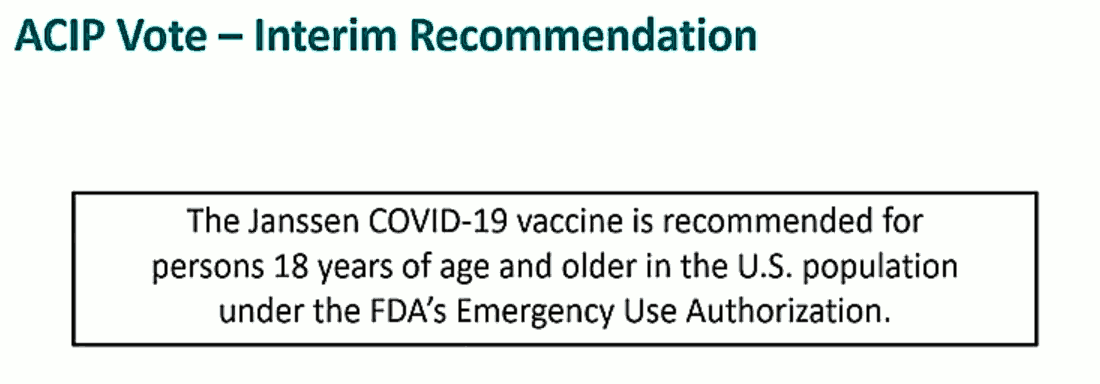
    Janssen vaccine policy adopted by Advisory Committee on Immunization Practices of the US CDC, April 23, 2021

    Use of the Janssen (also known as Johnson & Johnson) COVID-19 vaccine should resume next week after a “pause” begun on April 13. At the end of a six-hour meeting today, the Advisory Committee on Immunization Practices (ACIP) of the US Centers for Disease Control and Prevention (CDC) voted, 10-4-1, to recommend resumption of the use of the Janssen vaccine with no specific restriction by age or sex. By Tuesday, the CDC director is expected to decide whether to accept the recommendation, ordinarily a formality, and if so it will be published by the agency as formal guidance for public health systems throughout the nation.

    The pause was in response to six cases of an unusual blood clotting condition accompanied by a drop in blood platelet count, all in women ages 18 to 49, an incidence below one-in-a-million out of nearly seven million doses. (See “Don’t panic! J&J vaccine pause and rare blood clots: One-in-a-million risk”, by Michael Bilow, Apr 14, 2021.) During the pause the total of identified cases increased to 15, of which three were fatal.

    Asked for comment by Motif, the RI Department of Health (RIDOH) responded this evening, “RIDOH is aware that the Advisory Committee on Immunization Practices (ACIP) has made a recommendation about continued use of the Johnson & Johnson (Janssen) vaccine. We will review all of the information and data and will make a decision next week. RIDOH is storing roughly 5,000 doses of Johnson & Johnson vaccine, as we were instructed to do. We would not expect to get another shipment of Johnson & Johnson vaccine for another two to three weeks. We do not expect this to have any impact on Rhode Island’s COVID-19 vaccination efforts because the state’s weekly allocation of Pfizer and Moderna vaccines has been increasing.”

    The ACIP quickly dispensed with other options on the table, including stopping use of the Janssen vaccine entirely. The ACIP concluded that restricting the vaccine to men would be unwise, both in terms of practical constraints on how to do that at points of dispensing (PODs) and because the tiny number of cases made it impossible to quantify the risk to men as opposed to women.

    Eventually the ACIP reached a consensus that individuals should be given the choice whether to accept the Janssen vaccine, subject to informed consent about its known risk, in consultation with their healthcare provider, and therefore decided against restricting use to age 50 and older. In the end, members of the committee differed only as to whether their recommendation should explicitly mention that women younger than 50 may want to consider choosing an alternative vaccine, but there were concerns this would be misinterpreted and no such proviso was appended.

    The ACIP made clear that there was an understanding patients who receive the Janssen vaccine in the future would be given explicit warning using language approved by the US Food and Drug Administration (FDA) listing the symptoms of the rare blood clot reaction, detailing what to watch for and what do.

    Janssen vaccine warning by FDA to patients, exhibited at CDC ACIP meeting, Apr 23, 2021.
    Janssen vaccine warning by FDA to clinicians, exhibited at CDC ACIP meeting, Apr 23, 2021.

    Because the Janssen vaccine is the only one authorized by the FDA for use in the US that needs a single dose and can be stored in ordinary refrigerators rather than deep freezers, it is valuable for providers dispensing small numbers of doses, especially in rural areas, and for reaching populations for whom it would be difficult to arrange a second dose, such as the home-bound, the homeless, migrants, transients and the incarcerated. As a result, the CDC internally concluded that the loss of use of the Janssen vaccine could result in more deaths due to the virus than cases of the rare blood clotting reaction, as well as tens of times more intensive care unit (ICU) unit admissions and hundreds of times more hospitalizations.

    The ACIP meeting included a half-hour of public comments, limited to three minutes each, chosen by lottery from applicants in advance. A significant number of the commenters appeared to be anti-vaccine conspiracy theorists, and the members of the ACPI made no response beyond the moderator thanking them for their comments.

  • Don’t panic! J&J vaccine pause and rare blood clots: One-in-a-million risk

    Don’t panic! J&J vaccine pause and rare blood clots: One-in-a-million risk

    The national pause isn’t cause for panic

    In “pausing” use of the Janssen vaccine, one of only three COVID-19 vaccines currently authorized for use in the US, RI is following national guidance from the federal Food and Drug Administration (FDA) and Centers for Disease Control and Prevention (CDC), the RI Department of Health (DoH) said in an early morning statement on Tuesday, April 13. The Janssen vaccine is also known as the Johnson and Johnson vaccine after the parent company.

    The national pause results from cases of an unusual combination of blood clots and decreased platelet counts seen in six women, age 18 to 48, with onset 6 to 13 days after vaccine injection, three senior federal government doctors explained in a telephone conference call with press later Tuesday morning. One of the women died, apparently because she was given the standard treatment for blood clots, an anticoagulant or blood thinner, which in this unusual situation is likely to make the patient worse, they said, and one major reason for the pause is to get information out to the healthcare community how to treat this unusual condition if encountered; that is, blood thinners such as heparin or even aspirin, should not be given.

    Nicole Alexander-Scott, RI Department of Health director, at press briefing on Janssen vaccine pause, Apr 13, 2021.

    In a Tuesday afternoon press briefing, Nicole Alexander-Scott, director of RI DoH, said that 31,500 doses of Janssen had been administered in the state prior to the pause, which RI COVID-19 czar Tom McCarthy said represented about 5% of the total. Alexander-Scott emphasized that the adverse reaction is extremely rare and that it had been detected quickly. “It’s important to be able to relay to Rhode Islanders that the robust monitoring system that we have talked about from the beginning is demonstrating its full effect here in our ability to do this with access to data among millions of individuals who have been vaccinated. Because, again, this is a result of six cases out of 6.85 million doses nationally that have been administered.”

    Alexander-Scott distinguished the mild flu-like symptoms that often occur in the first few days after vaccination from the more severe symptoms of the rare blood clotting problem that can occur at least six days and up to three weeks after vaccination, with a median onset of nine days. “It’s a combination of the clotting, the low platelets, and the symptoms that patients would watch for: of severe headache, abdominal pain, leg pain or shortness of breath,” she said. “It’s also important to note that the symptoms that I’ve mentioned as a part of this presentation are very different from the mild flu-like symptoms that people experience within a few days after receiving vaccine… Usually the the mild flu-like symptoms that can occur are within that very short window, those few days right after vaccination.

    “We would not want to have everyone who’s had Johnson and Johnson just rushing to their provider to be evaluated because of how rare this seems to be. However, we do want to ensure that both patients and providers are informed and equipped with the information of what to monitor for,” said Alexander-Scott, cautioning against public alarm especially among those recently receiving the Janssen vaccine.

    Anyone already given the Janssen vaccine, Alexander-Scott said, should not panic. “If you were vaccinated with the Johnson and Johnson vaccine more than a month ago, that’s before March 13, your risk is extremely low for having any sort of complications or challenges… The time frame of six days to 13 days after vaccination makes it such that if you are significantly past that, more than a month ago, of getting vaccinated, your risk is extremely low. If you have been vaccinated with Johnson and Johnson vaccine in the last three weeks, your risk is also very low, given that overall data point, one for every million vaccinated.”

    Both Alexander-Scott and McCarthy agreed that the pause would have little practical effect in RI. In response to a question from Motif whether even the temporary loss of the only authorized single-dose vaccine would make it harder to vaccinate people for whom getting them to the second dose might be challenging, especially those in lower socio-economic strata, in hard-hit communities, prisoners, home-bound individuals and the homeless, “We anticipate and certainly look forward to this pause being brief so that it has minimal impact on how valuable Johnson and Johnson is for being able to provide some of the protections in, across the board, the individuals that have had very allergic reactions to vaccines in the past and just want one [dose] or those who are home-bound or hospitalized, or otherwise. We are anticipating that, in the long term, we’ll be able to continue with the appropriate safety mechanisms in place, but, if that were to not be the case, we would be prepared to adjust as we needed to and as we were planning to prior to Johnson and Johnson being available, working with our partners and determining ways that would allow us to ensure that would help ensure that people are able to return to get their second dose,” Alexander-Scott said. “Whether it’s Johnson and Johnson, Moderna or Pfizer, we will make it work.”

    Tom McCarthy, RI COVID-19 czar, at press briefing on Janssen vaccine pause, Apr 13, 2021.

    McCarthy said, “As we’ve shared over the last few weeks, the amount of Johnson and Johnson vaccine coming into Rhode Island has decreased significantly. Two weeks ago we received 16,000 doses, last week that number decreased to about 6,000, and this week we’re only receiving 2,000 doses of Johnson and Johnson. Now those 2,000 doses are in addition to 1,400 of the Johnson and Johnson vaccine that we’ve carried over from last week for a total of 3,400 doses that are currently in the state.” Most of the patients scheduled for the Janssen vaccine would be switched to one of the others at the same time and place, McCarthy said, with the exception of about 300 appointments at three local pharmacies or clinics without the cold storage and other facilities needed for the other vaccines, naming the Rhode Island Free Clinic, Green Line Pharmacy, and White Cross Pharmacy; those patients were being contacted individually. He said he had no concern about waste of vaccine as a result of the pause: “No, none at all. The team has done a fantastic job. Our waste is well below even one-tenth of a percent at this point.”

    Janet Woodcock, acting FDA commissioner, said on the morning call that she expected the pause to be brief. “The time frame will depend obviously, on what we learn in the next few days. However, we expect it to be a matter of days for this pause.”

    Although only six individual cases have been reported in the US out of nearly 7 million doses administered of the Janssen vaccine, fewer than one per million, US regulators are recommending the national pause because the unusual adverse reaction essentially never occurs naturally and appears to be similar to an adverse reaction to the AstraZeneca-Oxford (AZ-O) vaccine observed in 222 cases out of 34 million dose administrations as of April 4, a rate of about one per 100,000 recipients; the AZ-O vaccine is not yet authorized for use in the US, but as of March 22 European regulators had conducted reviews of 86 of the cases, of which 18 were fatal.

    “The combination here, that’s the real thing that is so notable here,” said Peter Marks, the director of the FDA Center for Biologics Evaluation and Research, on the call. “Those two things [blood clots and low platelet counts] can occur. It’s their occurrence together that makes a pattern, and that pattern is very, very similar to what was seen in Europe with another vaccine. So I think we have to take the time to make sure we understand this complication, and we address it properly.” He emphasized that it was critical to avoid the use of blood thinners in treating the unusual adverse reaction: “Together, the CDC and the FDA are reviewing data involving six reports of a rare type of blood clot called cerebral venous sinus thrombosis, or CVST, in combination with low levels of platelets in the blood, called thrombocytopenia… Treatment of this specific type of blood clot is different from typical treatments for other types of blood clots, which usually involve an anticoagulant called heparin. With cerebral venous sinus thrombosis, heparin may be dangerous and alternative treatments need to be given, preferably under the guidance of physicians experienced in the treatment of blood clots.”

    In fact, before the emergence of what is coming to be called “vaccine-induced immune thrombotic thrombocytopenia” or “VITT,” almost all previously observed cases of the same unusual combination of blood clotting and low platelet count was caused by heparin, a rare autoimmune syndrome known as “heparin-induced thrombocytopenia” or “HIT.”

    Alexander-Scott was even more emphatic about the need for the pause to allow reaching out to patient-facing health care providers: “One of the elements that is different about the thrombosis that has been identified in these six cases is, clinically, we would usually treat thrombosis with the medication referred to as heparin. Being able to pause with just the six that we have to get the message out to all providers that this presentation is leading to not using heparin as a treatment option. Being able to get that message to providers has been a critical element of this and warranted the pause so that we could make that clear, because that is a definitive shift from how we would usually treat such a condition identified.”

    None of the worldwide cases occurred in anyone age 50 or older, and many countries have resumed use of the AZ-O vaccine with an age floor between 50 and 60 depending upon the country, based upon an assessment of risks versus benefits, taking into consideration that older people are more vulnerable to hospitalization and death from COVID-19 as well as apparently less susceptible to the particular adverse reaction.

    The CDC will convene its Advisory Committee on Immunization Practices (ACIP), an independent panel of outside experts, on Wednesday, April 14, said Anne Schuchat, principal deputy director of the CDC, on the morning call, and they could choose to recommend age or other restrictions for the Janssen vaccine as other countries have done for the AZ-O vaccine. The meeting will be broadcast live on the web – ustream.tv/channel/VWBXKBR8af4 – 1:30-4:30pm ET. [UPDATE: After running long by an hour, at 5:30pm the ACIP reached a consensus that there was insufficient data to vote on any recommendation, and so decided to allow the pause to continue until they could schedule another meeting to be held in 7 to 10 days, hoping that clearer quantitative evidence of risks would develop.]

    “We are committed to an expeditious review of the available information and to an aggressive outreach to clinicians so that they know how to diagnose, treat and report. One of the things that the ACIP deliberation will do is review the data on the cases and the context of risks, benefits and possible subsets of the population that may be in a different category. So I think our intent is, in the days ahead, to provide an update regularly and that the pause provides us time for deliberation and assuring appropriate diagnosis and treatment,” she said.

    The Janssen and AZ-O vaccines use similar delivery vectors to produce immune response in the body, although using different carrier adenoviruses. The Pfizer-BioNTech and Moderna vaccines, the only remaining COVID-19 vaccines currently authorized for use in the US, both use a messenger RNA (mRNA) delivery vector and not an adenovirus. Marks said that the adverse reaction was strongly likely to be induced by vaccine rather than coincidence, given its near-zero occurrence naturally. “It’s plainly obvious to us already that what we’re seeing with the Janssen vaccines looks very similar to what was being seen with the AstraZeneca vaccines. The AstraZeneca is a chimpanzee adenoviral-vectored vaccine. The Janssen is a human adenoviral-vectored vaccine. So I think we can’t make some broad statement yet. But obviously, they are from the same general class of viral vectors.”

    There are hypotheses about the cause of the unusual adverse reaction but little is known with confidence. Marks said, “We don’t have a definitive cause, but the probable cause that we believe may be involved here that we can speculate is a similar mechanism that may be going on with the other adenoviral-vectored vaccine [AZ-O] is that this is an immune response that occurs very, very rarely after some people receive the vaccine, and that immune response leads to activation of the platelets and these extremely rare blood clots.” Woodcock agreed, “The person being vaccinated makes an immune response potentially that actually involves their own platelets or other parts of the coagulation system, and can cause this problem. And that’s the sort of leading theory or hypothesis about what’s going on here.”

    “Just to remind clinicians and the public that 121 million people have been vaccinated with at least one dose of one of the three vaccines, and the vast majority of the doses were of the other two products, the Pfizer and Moderna products. With our intensive safety monitoring, we have not detected this type of syndrome with the low platelets among the other vaccines” authorized in the US, Schuchat said.

    Despite all of the US cases so far occurring in women of child-bearing age, Marks said, the vaccine-induced adverse reaction is unlikely to be associated with that, because the type of blood clots sometimes seen as side effects from oral contraceptives are substantially different in both loci and absence of correlation with low platelet count. “It’s not clear that there’s any association with the oral contraceptive pill, birth control, in the individuals who had these blood clots,” Marks said, pointing out that generalizing from only six cases was impossible. “Additionally, I think it’s too early to make any speculation on how many cases will come out.”

    Schuchat agreed with Marks, “We’re working right now from a small number, from the six events that have been reported here in the US, and so while we’re seeing them in women under 50, I think we are going to need to take some time and have our Advisory Committee on Immunization Practices take additional time to review. My understanding is that there weren’t predisposing conditions for these events in at least some of those individuals.” Asked to clarify, she said, “What I tried to say is there were not [predisposing conditions] in all of them. So not to say that there may have been in some, but I think my main point is that review of six is difficult to make generalizations from. We’re going to have our expert committee take a careful look, and we’re, of course, trying to assure that providers will report suspect episodes so that they can be further investigated, because the numbers are quite small, small enough that it’s hard to generalize, but large enough that we wanted to take the action with the pause.”

    In response to a question from Motif whether the Janssen pause could increase vaccine hesitancy, even if fears were irrational and unfounded given the one-in-a-million risk, and what effect that might have in RI on his previously stated goal of reaching 70% of everybody eligible to be vaccinated by May 15 and 70% of the entire population by June 5, especially because in order to reach 70% of the entire population of the state we have to reach about 84-85% vaccine take-up in those eligible to be vaccinated, McCarthy said, “Absolutely, and that’s something that’s top of mind for me. It’s ambitious but it’s absolutely achievable, and why I am confident in it is that among those groups of Rhode Islanders that are currently eligible, we have seen uptake rates around that mid-80th percentile. So I think it’s absolutely doable and achievable, but the important thing is we all have a part to play, whether it be getting vaccinated, having conversations with your loved ones, your neighbors, folks in the community, to make sure that people are educated, they have the facts, I find that there’s a tremendous amount. It’s something we’ve seen throughout the pandemic, just based on how dynamic it is and how quickly things change. There is a lot of information out there, making sure we get the right information, the facts to build that confidence, is going to be important. Again, before even this consideration, we knew that it was going to have to take a deliberate intentional community effort to achieve those goals. I don’t think that has changed. I do think though this gives us an opportunity to focus some of our conversations even more about some of the specific safety and impacts of the different vaccines.”

  • Pulp Made Modern: Rhode Island author Robert Isenberg’s supernatural adventure tales modernize the genre

    Pulp Made Modern: Rhode Island author Robert Isenberg’s supernatural adventure tales modernize the genre

    Author Robert Isenberg

    Robert Isenberg fell in love with Pittsburgh.

    During a 16-year period of living there, and in the years following, Isenberg became a jack-of-all-trades, working as a journalist, a playwright, an actor and a videographer. His dream had always been, he said, to write the next Great American Novel. But somewhere along the way, a new dream took root.

    His master’s degree from University of Pittsburgh gave him a reading list of Great American Novels, of “serious” fiction, and of difficult stories. As he was pursuing his creative endeavors in his spare time and working on his degree, he began to think about writing something fun.

    “I loved the idea of writing something for fun… [something with a] pulp-fiction atmosphere,” Isenberg says. And, perhaps most importantly, he wanted to “do it my way.”

    Enter Elizabeth Crowne.

    The backdrop of her stories, compiled in multiple formats under the title, “The Adventures of Elizabeth Crowne,” is the city he loved so much. The world she lives in is pulpy, filled with adventure. And its writer is happy to keep building stories around her.

    The first Elizabeth Crowne story, “The Woman in the Sky,” came out in 2016. Since then, Isenberg has been working on this serialized project, creating an audio series that covers about two arcs per year. 

    Physical copies of the stories are also in print.

    His latest endeavor, an audiobook titled “The Mysterious Tongue of Dr. Vermillion,” compiles five of these stories into hours of listening. In it, Elizabeth Crowne, a paranormal detective with a sharp wit and quick tongue, leads listeners through supernatural mysteries, against the background of a fictionalized 1920s Pittsburgh.

    These stories indulge the author’s love for classic adventure stories, embracing the hallmarks of the genre, including sidekicks, traveling and a quick-witted, snarky heroine. 

    But Isenberg explains that his writing style places a high importance on grounding the story in the personal and the real. 

    “[Elizabeth is] a female paranormal detective in the 1920s — how can that be personal?” Isenberg laughs. The answer, he explains, is to build the story around likeable characters who are dynamic and have realistic weaknesses. 

    “Ultimately, it’s not going to be up to me if she’s authentic,” Isenberg says. 

    But he says that his listeners, when they explain their enjoyment of the series, tell him that what they like the most is his centerpiece creation: Elizabeth. 

    “Every character is a composite of [real] encounters,” Isenberg says. He explains that he worked to create a diverse cast that felt real to him, and acknowledged the historical nature of the story. 

    The characters may fit a cliche, he explains, but his style is to take these character archetypes and give them something completely unexpected. This, he says, grounds the character, makes them feel more real in the subversion of what is expected. 

    And though embracing cliche is a part of the appeal for Isenberg in the stories he’s worked on for the last few years, his goal is to subvert some of the more problematic elements that classic pulp adventure stories have long been known for. 

    As an example, he says, in her travels, Elizabeth investigates in Egypt — a setting that Isenberg says he tried to write from a less colonial perspective than a traditional adventure story might take.

    “[This is] such a trope, such a cliche… How can I do this differently?” he says of his writing process.

    He explains that the genre allows for so much room to explore and play with characters, traits, stories. This is an exciting world for Isenberg to play in, and he plans to continue working on stories about Elizabeth and her supernatural adventures. 

    “The Mysterious Tongue of Dr. Vermillion” is available on Spotify, iTunes, Stitcher and Audible. Copies of the physical book are also available on Amazon and Books In Print — which means any indie bookstore can order them.

  • The Ghost Light: A year in the theater

    The Ghost Light: A year in the theater

    “Do you think theater will survive?”

    Believe it or not, I started getting asked this question long before the pandemic struck. I would be asked to come in and do a Q&A at a college or attend a talkback for a play I’d written, and more often than not, somebody would ask some version of this question.

    Sometimes it would be phrased as “What’s the biggest challenge theater faces right now?” or “How do you get young people interested in theater?” but if you listened closely, it all boiled down to the idea that theater was in trouble.

    Why?

    How much time do you have?

    Suffice to say, by the time theaters were shut down a year ago, I was already starting to wonder, “Could this be it? Are we finally done?”

    As much time as we’ve spent over the last year hearing people bemoan the loss of human contact and socialization, the fact is, we had built up an entire (albeit mostly humorous) infrastructure of commentary on how much people did not like going out. Netflix and other streaming services had put a large dent in the entertainment industry and that, combined with a culture obsessed with working people to death, seemed destined to transform us all into those gelatinous cartoon humans from Wall-E glued to a screen and permanently immobile.

    When staying home became a public necessity, and when that stay extended far past the two weeks we initially anticipated, I thought the war was lost.

    We were now embracing isolationism — not trying to ward it off.

    People were more engaged with streaming content than ever. Nobody was leaving their house. And surely we would all get used to this, right? And once we did, there’d be no going back. We would have fully transformed into the at-home society.

    Do you know that horrible parenting story about the kid who got caught smoking so his parents made him smoke a whole pack? The idea being that once he was done, he’d never want another cigarette again?

    By the time, we were a few months into lockdown, I began to suspect that everyone was ready to quit smoking.

    People I’d never seen show an interest in theater before were messaging me to ask when I thought we’d be able to open up again, because they wanted to come see a play.

    Friends were streaming online theater only to post that while it was a nice substitute, they desperately wanted to be in a room with actors and other audience members again when it was safe.

    Speaking from experience, I was in the midst of a theater burnout. I wasn’t sure what my relationship to theater was or if I wanted to continue on with it for much longer. I joked that if I was married to theater, then theater was sleeping in the guest room.

    Well, wouldn’t you know, theater moved out on me, and now I call it everyday and beg it to come back, promising that I’ve seen the error of my ways.

    I know a lot of people in the same boat.

    While nobody would have wished for these circumstances, the fact is, absence is a powerful stimulant for gratitude, and all this time away from making something with someone face-to-face has made me preemptively grateful for when I can have that back.

    It’s not just theater either.

    I find myself having wonderful dreams about simple activities like eating without a mask in a crowded restaurant or going out dancing.

    Truthfully, I am a terrible dancer and avoid it at all costs, but that was back when things like “worrying about how I look dancing” seemed reasonable. Anything self-conscious now seems wildly unreasonable. Life is simply too short.

    If my expectation that theater was going to pause entirely and let the void it left do all the work for it, I was mistaken.

    After some trial and error, it was inspiring to see actors and directors and playwrights and artists of all kinds making an effort to do something. It was a heartening reminder that we don’t create to win trophies or garner attention or show off.

    Okay, I mean, yes, we do it for all those reasons, but–

    We also do it, because we come from a long line of revered and respected people known as storytellers, who understood that when things are at their worst, people will look to art.

    To comfort them.

    To keep them engaged.

    To remind them that there’s a bigger world out there even as we were all sheltering in our homes.

    Artists were connecting from all over the world for readings and digital productions and discussions about what they do and how they can do it better.

    Legendary performers were suddenly available to do things like give free master classes everywhere from Instagram to their living rooms.

    Huge leaps were made in discovering how we can make theater more accessible.

    Important conversations were started about equity and representation.

    We learned that we have so much work to do that might never have been initiated, let alone completed, if we weren’t forced to stop and reflect.

    There were so many problems that were getting worse, not better, and while I desperately wish it didn’t take a tragedy of this magnitude to bring about change, change rarely happens any other way.

    What I am most struck by is the feeling that I am never going to have to hear the question “Do you think theater will survive?” again.

    It had become a frequent echo throughout this year, but I noticed, over the past few weeks, that echo lessening.

    Because we are moving away from “Will we?” and toward “We are.”

    We are surviving this.

    And not because we always have. Not because theater is old. Lots of old institutions crumble. Rome was not a spring chicken when it eroded and eventually collapsed.

    We survive because it has suddenly become abundantly clear that we are needed in a way that no other thing can satisfy or fulfill.

    And if we can survive this, what can’t we survive?

    At a time when every forum and public square is filled with people shouting over each other, theater tells you that you have to sit in a room and listen to somebody else speak.

    As I was listening to the ongoing argument all year about what responsibility we have to our communities versus ourselves, I realized that everything I know about existing within a community, I’ve learned from doing and watching theater.

    It’s not just the group of artists who gather together to put on a show. Yes, that is its own community. Beyond that, though, it’s the basic assembling of people in a room who have all agreed to spend an hour or two devoted to nothing more than the telling and enjoying of a story for reasons that are specific to them.

    It is a tradition in theater to leave a ghost light always on in a space that would otherwise be dark. There’s a history behind it that I won’t bore you with, but the symbol of the ghost light is one that is inextricably linked to the performing arts, and it is one of resiliency.

    You leave the light on because you know you won’t have to leave it on forever.

    It’s been one year since rehearsals and productions and gallery openings and dance recitals and concerts were all brought to a halt. Many of those projects and experiences will not be returning, but as artists, we know that nothing we do lasts for very long and so much of what we’d like to do or see never comes to fruition.

    But we do it anyway.

    We spend time and money building sets we’ll one day have to strike. We write novels that will sit somewhere in our computers until we’re brave enough to show them to someone. We teach 30 people a dance, then decide we don’t like it, and teach them a different one.

    We make something where there used to be nothing, and when we’re done, we make something else.

    And in between, you leave a light on.

    Because you know, one day, you’ll be back.